Fostering: the ultimate form of community activism

22/12/2011, 08:52:44 AM

by Peter Watt

I wrote recently about other forms of community activism that we, as a political party, should be celebrating. Well can I recommend one in particular to you all: fostering.

Christmas is a time for families and a time for children. It’s a time for celebrating the nurturing, loving and secure environment of home. But of course that is the ideal and we all fall short of that from time to time. And for all sorts of reasons, some children from some families are unable to live at home with their parents. Instead, for a short period, or longer, they live with a foster family. Each and every day in this country there are about 59,000 children and young people living with 45,000 foster families.

The numbers of places available have always been tight, but are getting worse. This week saw fostering network raise the alarm about the looming shortfall in foster carers. Their research indicates that there needs to be a further 8750 families who foster across the UK over the next 12 months to avoid a potential crisis.

(more…)

Facebook Twitter Digg Delicious StumbleUpon

Cumbria was always New and Blue Labour

21/12/2011, 04:04:15 PM

by Jonathan Todd

No less an authority than Lord Mandelson has declared New Labour dead. Dan Hodges has called time on blue Labour. But the revisionist principles driving New Labour long predate it and will surely outlast it. They stretch back to Eduard Bernstein via Tony Crosland and are timeless. As Lord Mandelson certainly knows, they cannot die. And the quest for belonging in a globalised age that underpins blue Labour shows no signs of losing its resonance as we continue to live through globalisation’s biggest economic crisis since the 1930s.

If the revisionist principles of New Labour are un-dead and blue Labour retains significance, perhaps Labour’s future, as both David Miliband and James Purnell have postulated, lies in some fusion of New and Blue Labour.

Labour’s future, in other words, is Cumbrian.

New Labour made Labour’s peace with business; reconciling Labour’s values of social justice with a pro-business attitude at ease with globalisation. Little could be more open for business than a national park which welcomes around 12 million visitors annually, the largest concentration of nuclear expertise in Europe and a vital production facility for BAE Systems, the third-largest defence manufacturer in the world. If New Labour means being pro-business, then New Labour is Cumbrian.

(more…)

Facebook Twitter Digg Delicious StumbleUpon

The Olympics: ten times the disaster of the Dome

20/12/2011, 11:38:23 AM

by Kevin Meagher

I don’t often find myself in agreement with Diane Abbott, but I have cut out her piece from the Independent about the olympic games and pinned it above my desk, so I can read it over and over again while weeping tears of joy.

God bless the woman. She hit the nail on the head, articulating what I have been murmuring to myself for the past couple of years: the 2012 Olympic Games is a dreadful, expensive pile of tosh. Diane didn’t quite put it like that; she is a London MP after all and it takes more bravery for her to diss the games than it does for a chippy northerner like me; but it was a good effort on her part – worthy of a podium spot.

Diane rightly bemoans the “missed opportunity” of not employing more local people in building the games’ infrastructure, saying the Olympic Delivery Authority (ODA) was “never serious”  about giving opportunities to local people, which may indeed have been a smart move to help avert this summer’s London riots.

Instead the jobs created by the ODA have gone mainly to outsiders, with workers being bussed-in from all across Europe. (more…)

Facebook Twitter Digg Delicious StumbleUpon

Cameron lets his cynicism show, again.

19/12/2011, 02:58:00 PM

by John Woodcock

Alastair Campbell’s  notorious “golden rule” on political sackings – that once someone had been subject to a press onslaught for ten days or so they had to go – may well have been apocryphal.

That no-one seems quite sure when he said it or exactly how many days the siege of government had to last before the hapless cabinet member was tossed over the castle ramparts suggests as much.

But Alastair’s rule has passed into Westminster folklore because it accurately encapsulates a wider phenomenon: namely, the power of media pressure in deciding who should be allowed to keep their job in the face of controversy, and who should not.

That sustained pressure has undoubtedly claimed political scalps which, once the storm of controversy has subsided, people realise ought to have remained on their owner’s head.

So on one level, it was shrewd of David Cameron to send out a message on becoming prime minister that he did not recognise the rule and would not be abiding by it. It was the obvious thing for a new premier to do – any signal to the contrary would be an incentive for the press pack to sustain its attack beyond the merits of a story in the knowledge that journalists were guaranteed to get a result if they held out for long enough.

(more…)

Facebook Twitter Digg Delicious StumbleUpon

Sunday review on Monday: “Out of the ashes: Britain after the riots” by David Lammy

19/12/2011, 07:30:19 AM

by Anthony Painter

There is a new moralist movement in British politics. It binds red Tory and blue Labour and even Ed Miliband and David Cameron from time to time. The latter was at it this weekend in his “Christian country” lecture. This new moralism emphasises traditional values, family, responsibility, community, right and wrong, security, good and bad. A judeo-christian thread runs through it. David Lammy’s Out of the Ashes: Britain after the riots is, in part, a significant centre-left expression of this new moralism.

The definitive argument of the new moralism is that Britain has faced two liberal revolutions in the last fifty years: social liberalism in the 1960s and economic liberalism in the 1980s. Both were disastrous and explain why our society faces its current travails. It’s why people are rioting.

This “two revolutions” marker is there in red Toryism, blue Labourism, and it’s in Out of the Ashes:

“The problem is that we can never have enough. The revolutions that shaped modern Britain – the social liberalism of the 1960s and the economic liberalism of the 1980s – have schooled us to think of ourselves as individuals living lives free from each other”.

(more…)

Facebook Twitter Digg Delicious StumbleUpon

The Feltham Fig Leaf

16/12/2011, 07:47:25 AM

by Atul Hatwal

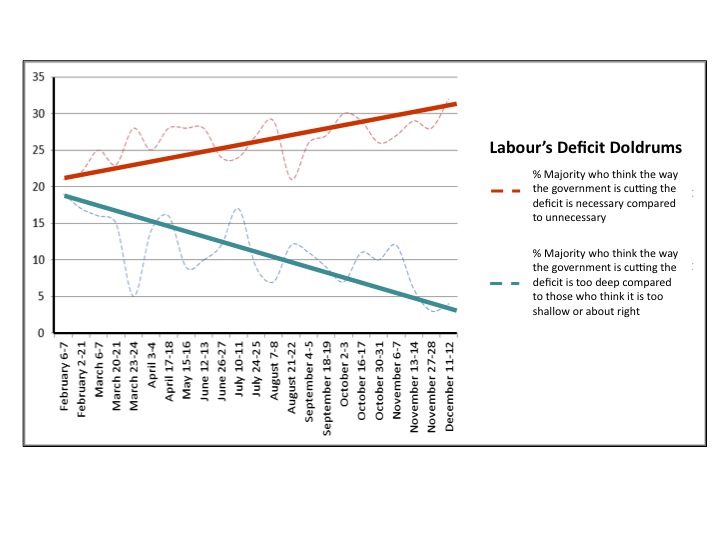
It looks like 2011 is ending for Labour as it began, with a solid victory in a by-election. At the start of the year it was Oldham East and Saddleworth, and last night it was Feltham and Heston.

But although both Oldham and Feltham were strong performances for Labour, the similarities are superficial. The intervening months have fundamentally changed the context.

At the start of the year, the economic argument remained unresolved. Would the public back the Tories’ cuts when they saw them implemented? Or could Labour provide a more persuasive alternative.

Victory in Oldham in January bought the leadership some time to focus the party’s economic policy and make the case to the public.

Since then, Labour has set out its alternative, developing a distinct critique of the coalition and a very different economic prescription.

Eleven months on from Oldham, the choice has been made.

The graph above based on YouGov poll results shows just how badly Labour has lost the argument on the central economic issue – the deficit.

(more…)

Facebook Twitter Digg Delicious StumbleUpon

Hope lies with the (eastern) proles

15/12/2011, 07:59:14 AM

by Jonathan Todd

In the summer between the Arab Spring and the European Autumn, my wife and I were naturally delighted about the birth of our first child, Stanley, which helped push the world’s population over 7 billion.

It is autumn in Europe because, notwithstanding the UK’s estrangement under David Cameron, the comparisons between the euro and the titanic continue to hold water. And they will continue to unless the euro is fundamentally reformed.

Cameron has swallowed the City of London’s line on a financial transactions tax. This tax would not be the end of the universe. Indeed, it could contribute towards a rebalancing of the UK economy. However, the move towards this tax seems driven by a determination to punish “Anglo-Saxon capitalism” for the euro’s failings, rather than correct the structural flaws within the currency union, which remain largely in place.

In spite of the persistence of repression in Egypt, Syria and elsewhere, spring continues in the Arab world, as democratic flowerings have begun that seem to have an irresistible force. These flowerings were never going to be quick and painless, but the drawn-out process of moving from the left to the right of Ian Bremmer’s J Curve.

Stanley is named after his great-grandfather, who remains as optimistic about America as he did when he emigrated there from Poland over 70 years ago. Hope carried him across the Atlantic. Now hope moves eastwards. Hope powered the Arab Spring, the protests in Russia and the rise of the BRICs. In the decade since the term BRIC was invented these countries have contributed seven UKs (2001 vintage) to the global economy.

(more…)

Facebook Twitter Digg Delicious StumbleUpon

Cameron is the people’s Euro hero

14/12/2011, 10:12:07 AM

by Peter Watt

Recent events have shown that a majority of voters are not generally pro-EU. Or at least they are agnostic at best and not averse to giving the Euro the middle-finger, if given a chance or encouraged. The Times carried a poll on Monday that showed:

“57% of people thought that David Cameron was right to use the veto, with 14% disagreeing and 29% don’t know. 53% also agreed that the use of the veto showed that Cameron is willing to stand up for Britain”.

But as a party we seem to be in denial about this. We seem to think that because we believe that our membership of the EU is a good thing, that everyone, apart from a few rabid right wingers, agrees. After all it is such a reasonable and obviously good thing that countries get on and cooperate, rather than disagree and fight. It can surely only be goggle-eyed euro headbangers that could possibly disagree?  And anyway, no one really cares about Europe. As an issue, it really only worries Tory leaders who need to keep an eye out for friends wielding daggers. Or so the complacent Labour orthodoxy goes.

(more…)

Facebook Twitter Digg Delicious StumbleUpon

The coalition is on life-support

13/12/2011, 10:12:36 AM

by Rob Marchant

“Mummy, what is that man for”? This exquisite, though probably apocryphal, comment from a small child has been variously said to be about many politicians over the years, including Herbert Asquith. But Asquith’s successor a century later, Nick Clegg, may suddenly be finding that a real and painful question, as he reflects on the wreckage of last week’s European summit.

But first, what happened: Cameron vetoed a treaty amendment on European integration, leaving the remaining countries no alternative but to set up a separate group which would implement the deal outside the EU. It was technically a veto, but only technically: it stopped nothing. The sticking point was said to be the financial transaction tax (FTT), an oddly unfair idea that a group of countries with relatively small financial sectors could jointly gang up to tax the one country which has an unseasonably large one, and which would certainly have damaged British interests. In that sense he was right to veto. Since the FTT is unfeasible without Britain, it was very likely a deliberate ploy by Sarkozy, as Ben Brogan suggests, to insist on this point which he knew Cameron could not accept, thus removing the “difficult” Cameron from the scene and clearing the way for an EU which might just have a chance of agreeing what it needed to agree.

However, this does not mean a triumph for Cameron – far from it. It is, as former Downing Street chief of staff, Jonathan Powell, told John Rentoul, “the worst foreign policy disaster in my adult lifetime”. But not because of the FTT. It is a disaster because it should never have come to this. Sarkozy took this action precisely because he knew Cameron was hamstrung and would never co-operate. Rather than the EU limping around with a British club foot, Sarkozy ruthlessly opted for amputation. But Sarkozy is no fool: he must have seen the attractions of a deal, but didn’t see it as possible.

(more…)

Facebook Twitter Digg Delicious StumbleUpon

Don’t let the Tories hide their economic debacle behind their euro farrago

12/12/2011, 09:28:00 AM

by John Woodcock

The European summit may end up being bad for Britain, but it has had at least one notable up-side for David Cameron aside from getting him back on Bill Cash’s Christmas list.

The drama of the summit has filled a space in the domestic media that would otherwise still be occupied by scale of the problems Britain faces after the failure of the Tories’ reckless economic gamble.

So let the pages of Labour Uncut, at least, return to the fray over the consequences for Britain of the Tories choking off the recovery too early, despite Ed Balls’ warnings. They are terrible and ought to dent the Tories’ reputation for economic credibility for many years to come.

There has been lasting focus on these pages on the excellent pamphlet that marked the birth of In the black Labour. But, in the brief window of interest before attention was diverted by the euro, most observers failed to probe and discount the crude Tory line that sentiments of the pamphlet were outside, and in opposition to, the party mainstream.

In fact, as, to their credit, its authors have tried to point out, the pamphlet is simply picking up what both Eds set out in their speeches to Labour’s annual conference on the fundamental importance of re-staking our claim as the party of economic responsibility.

What they said then stands us in good stead to recapture the public debate now on how to deal with the fall out of the failure of the Cameron-Osborne plan.

First, rebalancing the economy. Our opponents continue to mischaracterise and under-estimate the importance of what Ed M said in Liverpool. Far from being a flight of fancy, his words were driven by Labour’s basic recognition of the need for an era of increased responsibility to build sounder economic foundations after the global recession. At a time when we continue to reel from the crash, and when so many families worry that that their ability to make ends meet is hampered by things beyond their control – from the turmoil of the eurozone countries to the collapse of the banks – there has rarely been a more pressing need to re-examine how governments can encourage greater longer term success and stable prosperity. It is up to us to make that vision add up to a convincing programme that we can present to voters.

And critically, our opponents have under-estimated what both have said on the need for fiscal discipline to get the country back on track. Ed M said back in September that he would deal with the country’s deficit if the Tories fail to do so in this parliament. Given the mess that the Tories are making of returning the country to growth, that pledge to the British people could prove to be the most important we make. Similarly critical to delivering it will be Ed B’s commitment to new fiscal rules – independently monitored by the office of budget responsibility – to get the country back to balance and national debt on a downward path.

We should give way to no-one on the key battleground of economic responsibility. The framework that Ed and Ed have set gives us chance to win. We need to get out and make that case.

John Woodcock is Labour MP for Barrow and Furness and a shadow transport minister.

Facebook Twitter Digg Delicious StumbleUpon