




Sunday review: Ancient Greek by Oliver Emanuel

11/12/2011, 11:17:14 AM

by Conrad Landin

What if, in spite of what we’re constantly told about violence and vandalism on demonstrations, such action usually does have a political basis?

Is there such a thing, as David Cameron described the events of August, as “criminality, pure and simple”? As Suzanne Moore argued on Wednesday, if the PM was right about the riots, why then, and not before or after?

I would never defend the rioters and the destruction faced by predominantly-working-class communities. But can we look each other in the eyes and truly say that such events are apolitical?

In last week’s Radio 4 play Ancient Greek, this is the charge levelled at sixth-form student Alex King by his geography teacher Mr Ibrahim. Illegible graffiti have appeared; painted in corridors and etched into the deputy head’s car. And the culprit is the studious Alex, about to take up a place to study classics at Cambridge. (more…)

Facebook Twitter Digg Delicious StumbleUpon

Labour needs to be an honest friend to the forces

09/12/2011, 11:38:44 AM

by Atul Hatwal

At the start of autumn, Uncut revealed that morale amongst the armed forces had plummeted, the first decline since the annual surveys began in 2007.

The obvious reason is the government’s bungled strategic security and defence review (SSDR). But as deep as the cuts to defence budgets are, and as badly as they have been managed by the MoD, the SSDR alone does not sufficiently explain the depth of the collapse in morale. There’s a missing element.

Context.

While in opposition the Tories turned a slogan, “backing our troops”, into the entirety of their party’s policy. General Dannat’s love-in with David Cameron was symptomatic of a military establishment that felt the Tories endorsed their world view and would act as a political arm of the defence chiefs of staff. (more…)

Facebook Twitter Digg Delicious StumbleUpon

Volunteers make the world go round: we must thank them

08/12/2011, 09:23:36 AM

by Peter Watt

Everyone loves an activist. Political parties simply couldn’t operate without them. Those with shared values and purpose, who dedicate themselves to furthering the success of their party by spending hours fundraising, leafleting, stuffing and knocking on doors. My personal pet hate over the years has always been street stalls – I hate them. But elections couldn’t be won without them, as the machinery of delivery would quite simply grind to a halt.

But there are other forms of activism that are not overtly political, but that nevertheless are also values lead and also worthy of merit. The chair of the community group, the scout or guide leader and those that run sports clubs on a Saturday morning. What about magistrates, hospital visitors or those who spend time cleaning out canals. Or samaritans, trustees or school volunteers. All examples of people who give up their unpaid time to be active in the pursuit of something that is for the good of others.

Just think about it. Could you really be a parent, or work or volunteer at something else, and still be active enough in the Labour party to get noticed? Possibly; but it would be pretty difficult and you almost certainly wouldn’t see very much of your family. (more…)

Facebook Twitter Digg Delicious StumbleUpon

Socialism is the language of priorities

07/12/2011, 10:06:30 AM

by Jonathan Todd

I had no idea that policy network was going to publish “into the black Labour” at the end of last week. Its stress upon fiscal credibility, however, chimed with one of the themes of my piece for Labour Uncut earlier last week. My other theme was the economic incompetence of the government, which Cormac Hollingworth argues was not shown in “into the black Labour” and needs to be demonstrated for Labour to return to government.

I see no contradiction between demonstrating both the government’s economic incompetence and Labour’s fiscal credibility. In fact, the whole point of my piece last week was that both are essential. There is every chance that the government’s incompetence will come to be more widely accepted by a frustrated public. However, we delude ourselves if we presume that this will be enough to return us to government. We will not win by default. We need to make a positive case for Labour that includes lessons learnt from the last general election.

“Into the black Labour” is right to see fiscal credibility as central to this positive case. To make this case, Labour needs to follow through on the policy changes that increased fiscal credibility requires and to repeatedly stress these changes in the way we present ourselves.

We need to change and be seen to have changed, such that by being this change we personify the answers to Britain’s problems. And Britain faces no bigger problem than finding the resources to pay for public services. Yet, as “into the black Labour” recognises, “it is precisely the vagueness of Labour’s position over its short to medium term plans for the deficit that confirms the voters’ worst suspicions about the party’s lack of commitment to addressing the fiscal crisis”.

(more…)

Facebook Twitter Digg Delicious StumbleUpon

When does a social democratic party stop being social democratic?

06/12/2011, 08:22:55 AM

by Kevin Meagher

“There is nothing right-wing about fiscal conservatism”, begins “In the black Labour: why fiscal conservatism and social justice go hand-in-hand“. The policy network’s much talked about pamphlet argues that to rebuild its reputation for economic competence, Labour has to learn to love big brother in the shape of embracing fiscal rectitude.

It is a hard-headed but reductive prognosis for a centre-left party. It seems a bit like having a car without any petrol. You can point it in the direction you want to travel in, but you have no means of ever getting there. So what, ultimately, is the point of the car?

That is, in essence, the dilemma this argument, elegantly and persuasively made by the authors (including our own Anthony Painter), presents Labour with. When does a party – a democratic socialist one (in the words of “new” clause four) – stop being the very thing it professes to be? How elastic are our principles, our thinking, and, most importantly, the trust of the people who vote for us if we embark on a self-denying ordinance on public spending? (more…)

Facebook Twitter Digg Delicious StumbleUpon

Heading for a generation of Neets in the North East

05/12/2011, 02:17:44 PM

by Roberta Blackman-Woods

Last week the chancellor delivered his autumn statement which offered very little to stimulate growth and create employment opportunities for areas of high youth unemployment. Last month figures revealed that youth unemployment has for the first time topped one million in this country and in the North East the situation is extremely troubling.

The government scrapped Labour’s future jobs fund which created over 100,000 jobs for young people. Youth unemployment is now reaching crisis levels, having shot up by 77% this year alone. There are now fewer people moving from benefits into work than at any time since 1998 which the chancellor’s statement fails to address at all.

Whoever the government tries to blame, the fact is Britain’s economic recovery was choked off a year ago and unemployment started rising again well before the recent eurozone crisis. We know this because unemployment rates are time lagged.

(more…)

Facebook Twitter Digg Delicious StumbleUpon

Sunday review: The autumn financial statement and “In the black Labour” by Graeme Cooke, Adam Lent, Anthony Painter and Hopi Sen

04/12/2011, 02:20:54 PM

by Anthony Painter

There’s no hiding place. The autumn financial statement outlined in full the dire economic situation that this country will face for much of this decade. Squeezed living standards, high borrowing, cuts in public services and the shrinking of the welfare state, ongoing uncertainty, and high unemployment will define the 2010s: the austerity decade. What’s worse is that all of the risks are on the downside.

George Osborne has made the situation worse – unnecessarily so. Cutting short term programmes and investments such as the future jobs fund and building schools for the future which don’t add to the structural deficit was myopic. Once his model of economic recovery – driven by exports and private sector investment – was faltering early this year he should have intervened. He didn’t and that has made things worse. We are all paying a price as a consequence.

The choreographed dance so far this parliament has been for the Tory-Lib Dem government to blame the last Labour government for all our economic ills. And for Labour to blame the government austerity. The reality is far more complex. The government bears some, but by no means all, of the blame: a strong stance on fiscal consolidation has reduced the risk of government debt in the eyes of investors; world oil prices and food prices that have increased by 30% in a year have also been a drag on growth; eurozone crisis is starting to be a drag on confidence and demand; but an early and inflexible fiscal consolidation, especially the VAT increase, has made matters worse.

(more…)

Facebook Twitter Digg Delicious StumbleUpon

November Shadow Cabinet League

02/12/2011, 09:06:45 AM

by Atul Hatwal

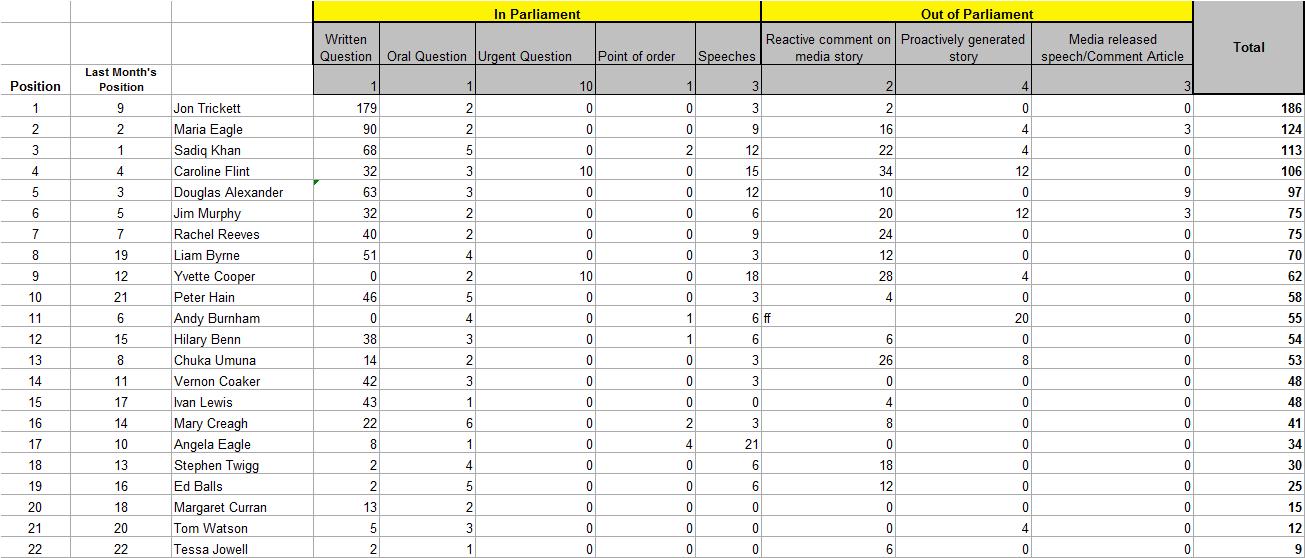
Have they put something in the tea at shadow cabinet meetings?

Because they seem to be a team transformed – in work ethic at least.

Despite doubts about Labour’s strategic positioning on the big issues, Ed Miliband’s new shadow secretaries of state have set about their task with a vigour not seen for months.

The days when Jim Murphy and Douglas Alexander gazed down on their colleagues from a distant summit appear to be past. Instead there is a genuine competition across the top ten with any and all capable of mounting a challenge for top spot.

(more…)

Facebook Twitter Digg Delicious StumbleUpon

Abuse of vulnerable adults should be criminalised

01/12/2011, 08:00:30 AM

by Peter Watt

“Where, after all, do universal human rights begin? In small places, close to home… Unless these rights have meaning there, they have little meaning anywhere”.

So said Eleanor Roosevelt at the united nations in New York on 27 March 1958. It is a powerful message and one that is used to open an important report from the equalities and human rights commission (EHRC) “Close to home, an inquiry into older people and human rights in home care”. The report was launched last week. It followed a year long inquiry looking at the protection and promotion of human rights of older people in England who require or receive home-based care.

What is so so depressing is that once again a report comes out that details a litany of abusive behaviour towards vulnerable older people. In this case the abuse is taking place in people’s own homes when they are in receipt of home-based care. The report says that around half of those giving evidence to the inquiry were satisfied or happy with the care that they or a relative received. Great; but that leaves the other half where there was plenty of evidence of:

(more…)

Facebook Twitter Digg Delicious StumbleUpon

Government pubs report fails to stand up for the little guy

30/11/2011, 02:07:29 PM

by Toby Perkins

Pubs are businesses at the heart of their communities; so it is a cause for great concern that pubs are now shutting at the alarming rate of 25 a week, and the government is failing to live up to its promises to take action to support this great British institution.

The pub sector is also an area which starkly illustrates the difference between the active, intelligent government working in partnership with business which Labour stands for, and the ‘government getting out of the way’ approach, favoured by Osborne, Cable et al.

The business, innovation and skills select committee has investigated in detail the relationship between the pub companies (or PubCos) – the branded chains of pubs which account for the majority of pubs in the UK – and their tenants. It has produced three reports on the subject over the past three years.

Most significantly, they found an unfair relationship between the huge companies which dominate the market and the small business owners who run individual pubs, alongside restrictive practices preventing smaller breweries from accessing huge swathes of the trade.

This week, after months of dither and delay, the government finally responded to the long-standing call for a fairer relationship between pubs and their owners. Sadly, it is a case of too little too late, and comes up short of the action needed.

The previous Labour government gave the industry a year to reform itself, putting in place a voluntary code, and made it clear that a statutory code would be put in place if the industry did not get its act together.

(more…)

Facebook Twitter Digg Delicious StumbleUpon