




Good home offered to custard pie throwing entryists

13/09/2011, 09:08:25 AM

by Dan Hodges

Recall the name of  the leader of the Militant Tendancy? Me neither.

We remember Derek Hatton, of course. All sharp suits and scouse wit. But he wasn’t the leader. Hell, he wasn’t even leader of Liverpool council.

That’s the thing about political entryists. They’re sneaky like that. They don’t hold formal positions, or hold elected office. Wear name badges and carry business cards; “Hi, I’m Derek, I’m here to infiltrate you and divert you from the path of moderate democratic socialism. Please enjoy the canapés”.

In fact, many of them don’t even think of themselves as entryists at all. They’re just honest to goodness “new members”.  A bit of fresh blood and innovative thinking for a battered and beleaguered movement.

I’m a bit of an entryist myself. A “Blairite” or a “Thatcherite”; apparently they’re interchangeable. I know this because people tell me so every time I write something outrageous, like suggesting we should try and get more seats at the next election than the Tory party. (more…)

Facebook Twitter Digg Delicious StumbleUpon

Banking Commission: Only Labour can save capitalism

12/09/2011, 09:18:07 AM

by Jonathan Todd

When the global financial crisis struck, as John Kay recently noted:

“The political left offered no diagnosis or new ideas, and it gained no electoral advantage. Instead, across Europe, the parties that had waited a century for capitalism to collapse under its own contradictions congratulated themselves that such collapse had been averted by the injection of incredible amounts – trillions of dollars – of taxpayer funds into the banking system”.

Gordon Brown and Alistair Darling were right to bring us back from the brink. The left’s failure is the dearth of explanation as to how we came to be in this position or prescription as to where we go next. The explanation is a precondition of the prescription. If you can’t say how the crisis came about, then you can’t say how repetition should be averted.

The left’s explanations have tended to be personalised (e.g. “greedy bankers”), in spite of the left’s historic mission being to identify and correct structural explanations. We don’t think people are born wretched (even “Fred the shed”); we think that injustice and circumstance makes them so. The left’s explanation, therefore, shouldn’t be the banker’s greed but the structures that create and sustain this greed.

The left, for the most part, was no more analysing these structures than anyone else in 2008. Such analysis would have revealed a paradox: what we thought was high capitalism was anything but. Well functioning markets wouldn’t have allowed the banker to be so greedy. Effective competition would have restrained wages to merit-based levels.

(more…)

Facebook Twitter Digg Delicious StumbleUpon

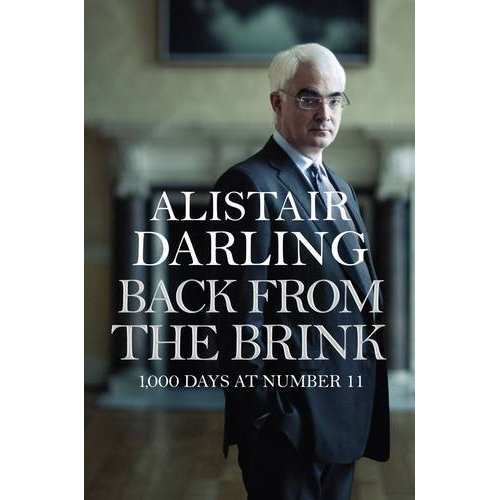
Sunday review: Back from the brink, by Alistair Darling

11/09/2011, 11:16:44 AM

by Anthony Painter

Like the Kennedy assassination, new camera angles on the decline and fall of Labour in office will be discovered for many years to come. What’s more, each new piece of undisclosed footage will end with the same dreadful, bloody result. So why do we do it to ourselves? We just can’t help it.

The latest offering from a senior Labour figure, the ‘never knowingly over-optimistic’, Alistair Darling’s Back from the

"A wise voice of reason"

brink has the same literary merit as the others in the genre: structure and style are put in the service of proving a point. But like the chick lit, executive biography or self-help genres (the political memoir may be a subset of this latter category- for the author) it is not full-throttle, florid prose that is the attraction. The author gets to have their say, settle a few scores and we get to vicariously sit in the room while momentous decisions are made.

Perhaps only Chris Mullin’s diaries would be worth recommending to a non-Westminster obsessed friend amongst the New Labour memoirs. For the rest, twenty minutes in the company of exclusive in the Sunday Times would be enough. None of this is particular to Darling; it should be clear by now that this is not my favourite genre. If it’s your taste then Back from the Brink is no better or worse than most of the others.

The Alistair Darling who emerges from these pages is decent, honourable, intelligent, courageous, and resolute. He’s rather like Alistair Darling in fact: very likeable and engaging. When events have subsequently proved him right, he makes his point and then moves on. There is no great crescendo of self-justification. But there’s no real mea culpa either. We simply see things- most of which we knew already- from his perspective. Kennedy gets shot and dies. (more…)

Facebook Twitter Digg Delicious StumbleUpon

Fox’s cuts bite as new figures reveal plunging troop morale

09/09/2011, 07:00:28 AM

by Atul Hatwal

As the findings of the Baha Moussa inquiry cast a shadow over the British army, new figures sneaked out by the MoD in the last week lay bare the slump in morale across the armed forces in the past year.

44% of personnel reported low morale in their service – army, navy, royal air force (RAF) or royal marines – according to the 2011 forces survey, a rise of 11% since 2010.

It reverses a five year trend of improving morale in the forces since the survey began in 2007.

The figures were slipped out by the government last Thursday, via the office of national statistics website. Unlike previous surveys, the ministry of defence did not issue a press release or give any indication the survey was being released. (more…)

Facebook Twitter Digg Delicious StumbleUpon

Remind me why we hate elected police commissioners

08/09/2011, 02:00:59 PM

by Kevin Meagher

Ed Miliband was right in the Commons yesterday: spending £25 million postponing elections for the 41 proposed police and crime commissioners is a waste of money that could instead pay the wage bill (presumably before overtime) of 2000 coppers.

Cameron should be ashamed of himself. And he was doing so well: police commissioners are one of the few things he has got right. He should have stuck to his guns and held the elections next May, as planned. Unfortunately he has caved-in to Lib Dem backwoodsmen in the Lords who have pushed for the polling day to be postponed back to November 2012 to “depoliticise” the issue.

Whenever police commissioners arrive, the resource-intensive, low performance culture of British policing will at long last get a democratic makeover. They will be a shot in the arm for accountability in a key frontline public service and a finger in the eye for complacent chief constables. The public’s priorities might, for once, get a look in.

The only snag is that Labour opposes elected police commissioners. Why? Nobody knows why. But oppose them we do. On grounds, it seems, of cost and because they will politicise policing (whatever that is supposed to mean). (more…)

Facebook Twitter Digg Delicious StumbleUpon

The Tories still have the best tunes

08/09/2011, 07:00:07 AM

by Peter Watt

Back to school this week; families are struggling and life is hard. Kitting out one child is expensive, and we have more than one. Shoes £30 – £40, skirts £15 each and you need several, white shirts £6 each and at least two school sweat shirts at £15 per pop. Then there’s the PE kit. And pressure to buy a new school bag and pencil case. So not much change from £150 there then. More than one and the price goes up. And of course, all of this comes at the end of a long summer, with the inevitable costs of entertaining the kids with or without the cost of the annual holiday.

Over the last few years fuel price rises mean that it costs at least £70 per week to fill the car, parking charges have been raised and the gas and electric just keep going up. You try and cut down on usage, you get your cavity walls filled, your “units used” drops; but the bill still rises. Your weekly shop costs more and you seem to be getting less. Train and bus fares are higher this year as well and they’ll probably go up again next year. So there really is no slack in the budget to pay for the back to school purchases – credit card it is then. Assuming there’s still some credit left. And there’s a pretty good chance that over the next few weeks there will be a series of letters from the school asking for money for trips, photographs and commemorative school tea-towels.

What is worse, is that many are also worried about their job. So they are working longer hours in order to impress the boss just in case. And maybe there is a second job just to help make ends meet.  There’s not much, if anything, left at the end of the month. The TV is full of news of more economic woes to come. It just doesn’t seem fair. (more…)

Facebook Twitter Digg Delicious StumbleUpon

A statue of Peter Hain?

07/09/2011, 10:02:59 AM

by Dan Hodges

Can’t we just build Peter Hain a statue? Whack up a giant bronze monument to him slap bang in the centre of Neath and be done with it.

Refounding Labour started life as a good old fashioned vanity project. Peter’s reward for services rendered to Ed Miliband during the Labour leadership campaign. No more, no less.

Fair enough. Such baubles are handed out regularly. Part of the currency of politics.

But then things started to get out of hand. First the process, which was supposedly being driven by Labour party members, was outsourced to private contractors. Then some strange rumors began to circulate about what was emerging behind the closed doors of this open and inclusive consultation.

Non party members were to be given some say in superficial areas of the party’s activity. Like deciding its leader and its policies. At the same time, the role of the trade unions was going to be diluted.  The collegiate nature of this part of the  conversation was underlined by the “insider” who told the papers, “the union leaders are playing hard ball but they need to wake up”.

Members of the PLP were informed that plans for an elected party chair had been dumped. Calls for the refounding Labour submissions to be published were, in keeping with the transparency of the exercise, repeatedly rebuffed. It emerged that party conference was going to be ordered to either endorse the recommendations in their entirety, or reject them.

Then on Monday, via that traditional form of internal communication  – a leak to the Guardian – Labour members learned how they’re planning to transform their own movement. According to the report, the  party’s traditional aim, “to maintain elected office”, is now deemed outdated. Instead Clause 1 of the constitution will be re-written to “explicitly put the principles of community organising at its heart”.  An army of 2,000 “community organisers are to be recruited before the next election, and movement for change affiliated as a socialist society. At the heart of all this is the radical idea of “making formal [the Labour party’s desire] to be attractive to a far greater range of people”.

(more…)

Facebook Twitter Digg Delicious StumbleUpon

Ten years on from 9/11: Why can’t the west believe in itself?

06/09/2011, 09:06:13 AM

by Jonathan Todd

As the national transitional council’s (NCT) grip on Libya tightened, I wondered: What do the Muammar Gaddafi loyalists in their last redoubts want? Having refused the NCT’s generous reconciliation offer, do the Gaddafi loyalists really think that they can recover the whole of their country? As this is implausible, it must be that they remain loyal enough to their barbaric, ego-maniac, delusional leader that they’d rather die in his name than accept Libya’s new reality.

Belief held so absolutely has become alien to most westerners and, thus, inherently terrifying. Willingness to fight to the death is beyond the ken of people unwilling to fight for much besides the TV remote. That’s why it wasn’t just Tony Blair and George W Bush who were mortified by Al-Qaeda. We all were. These ingenuous people would go to any lengths, including sacrificing themselves, to destroy us. What wasn’t to be afraid of?

Well, much less than it seemed. We thought Al-Qaeda’s appalling idea could attract ever more active backers. We suspected that many people, possibly millions, absolutely believed things utterly out of kilter with what we believe fundamentally. And they believed these things with the passion of newlyweds, while the passion of western citizens for the defining values of their states is that of the long married. Not non-existent, but not obviously burning.

While the passionate beliefs of Gaddafi loyalists now bemuse western eyes as much as the passionate beliefs of Al-Qaeda have done, these passionate beliefs are very different, of course. Gaddafi comes from a tradition that starts with Gamal Nasser and hopefully ends with Bashar al-Assad. Upon these strong men Arab states were personalised. Gaddafi was Libya and Libya was Gaddafi. And that just seemed the way things were.

(more…)

Facebook Twitter Digg Delicious StumbleUpon

Give us a Barnett formula for the North to match the Marshall plan we have for the South

05/09/2011, 09:09:24 AM

by Kevin Meagher

“Power, wealth and opportunity” should be “in the hands of the many, not the few” intones Clause Four (Section Four) of the Labour party constitution. An admirable sentiment and one that we could usefully start by applying to our unbalanced and dysfunctional national economy.

No, this isn’t a moan about the iniquities of the Barnett formula, which was revealed last week to shower a fifth more public spending on Scotland than England.

For those of us living north of the Wash, our beef is not with our Caledonian neighbours, but our Southern English brethren. Yes, the problem is our old friend the North/ South divide; that drag anchor that mars all efforts to deliver the wise words emblazoned on the back of our membership cards.

You can see why, when the unemployment rate in the South East is now half that of the North East. The TUC estimates that there are 158,000 fewer jobs now than there were on the eve of the recession in December 2007. During that time, the North West and Yorkshire and Humber regions have lost 60,000 jobs apiece. London, on the other hand, has actually seen 122,000 more jobs created.

Meanwhile the Chartered Institute of Personnel and Development’s latest quarterly labour market outlook found a stark differential in business confidence, with employers in the South expecting to increase staffing levels over the next three months, while those in the North predict further job cuts.

The government’s response to this glaring asymmetry? The department of business has just confirmed that it has only managed to green-light one out of fifty approved bids to its new regional growth fund, the scheme designed to bolster the private sector in those regions most reliant on the public sector (and therefore most exposed to cuts). Yet even if all its projects were up and running, this £1.4bn pot amounts to just a third of what Labour’s regional development agencies were spending.

(more…)

Facebook Twitter Digg Delicious StumbleUpon

Blue Labour goes global

02/09/2011, 10:18:06 AM

by Jonathan Todd

Blue Labour seems less in fashion than previously. It was never the answer to every challenge facing Labour. But it does have contributions to make to Labour’s renewal. Whatever it is, blue Labour seems defiantly rooted in our country and the traditions which have shaped and continue to comfort and inspire its people. Global and jet-set it isn’t.

It feels odd, therefore, to see the core motivations of a creed as unabashedly Anglo-Saxon as Britpop reflected back in the protests convulsing India and Israel. These protests, like blue Labour, are, fundamentally, about rejecting contemporary materialism for the perceived morality and communality of exalted past eras: the dignity of Gandhi’s India; the solidarity of the Israeli kibbutz; and the warm embrace of the Labour party before the middle class dilettantes stole it from the working class. It’s easy to be cynical. There were, of course, no golden ages. But it’s what blue Labour and the protests say about the present that is most interesting.

Tobias Buck recently observed in the Financial Times that 250,000 Israelis have taken to the streets calling for social reform. He described them as ranging “from students to pensioners, and Holocaust survivors to taxi drivers” and as “perhaps the most serious challenge yet to the government of Benjamin Netanyahu”. He went on: “Many Israelis, regardless of their wealth and social status, say they still long for a return to the years when the country was less materialistic and more egalitarian. Even in cosmopolitan Tel Aviv, the ideals of the kibbutz live on”.

(more…)

Facebook Twitter Digg Delicious StumbleUpon