




More members alone won’t pay the bills

04/08/2011, 08:00:11 AM

by Peter Watt

I feel the need to return to a favourite topic of mine – the funding of the Labour party. Why? Well because this week has seen two developments. First, the publication of the party accounts for the year ending December 2010. And second, the announcement that Charles Allen, former ITV chief executive, has been asked by Ed Miliband to lead a commercial and management review of the party.

Taking the accounts first. At face value the accounts are a mixed bag. On the one hand, they show just how fragile the party’s finances are with a balance sheet showing a deficit of almost £7.5 million.  For the financially illiterate, that means we owe a lot more than we have. The reason that we are still solvent is that we are able to meet these obligations as they become due by making sure that we have enough cash year-on-year.

On the other hand there is clearly real improvement in the overall year-on-year position. Sound financial management, some purchasing of property and a sensible strategy of rescheduling debt has ensured healthy surpluses in the last few years. Ray Collins, Roy Kennedy and the Victoria street team should take huge credit for ensuring that the balance sheet improved from a deficit of over £27 million in 2005, in the aftermath of that year’s general election, to the 2010 position.

One contractual consequence of the debt rescheduling, is that the party has to pay off at least £2 million of debt every year. This enforced discipline lead to a policy of “if we don’t have it we can’t spend it” at the 2010 election. The result was, incredibly, that in an election year we reduced party debt. At this rate, the party will have a balanced balance sheet in the next couple of years. (more…)

Facebook Twitter Digg Delicious StumbleUpon

USA: checks and balances in the age of chaos

03/08/2011, 09:47:33 AM

by Jonathan Todd

“I don’t want to talk to anyone about anything right now,” she exploded. With tears in her eyes, she retreated to a back room.

This was how the Democratic congresswoman Barbara Jordan, an eloquent contributor to the committee that voted to impeach President Nixon, reacted to a request for comment immediately after the vote. This request came from Michael Sandel, later a distinguished philosopher, then a newspaper intern.

Sandel recalled this encounter when the House began impeachment proceedings against President Clinton in 1998. While Barbara Jordan’s explosion demonstrated that even Democrats opposed to Nixon recognised the magnitude of impeachment, partisan passions against Clinton overrode any such recognition on the part of many Republicans 24 years later. 13 years hence, and the trends evidenced by the contrasting attitudes of Democrats to Nixon and Republicans to Clinton have hardly dissipated.

Many Republicans today would throw a tea party on the White House lawn, rather than discretely sob, if president Obama were impeached. This is in spite of the fact that impeachment should only properly occur when the constitutional system is seriously threatened. No matter that such a threat is inherently a matter of national tribulation; glee could be expected from those who seem consumed only by tribalism. The “Nazi Socialist Communist Muslim” would have got his comeuppance. (more…)

Facebook Twitter Digg Delicious StumbleUpon

Can Labour’s Cooler King make it over the wire?

02/08/2011, 12:43:18 PM

by Dan Hodges

Every Christmas evening my family and I would settle down for the same ritual. Excitement, mixed with anticipation, blended with hope.

Could this, we wondered, be the year Steve  McQueen finally makes it over the wire?

In the days before satellite television lured us out of our cosy viewing habits with “Ice Road Truckers” and “Extreme Animal Attacks 2”, the film the Great Escape was a festive staple. Cruel Gestapo hoods. A brutal execution of heroic allied officers. The perfect accompaniment to the season of peace and goodwill.

Though it was on every year, familiarity did not breed contempt. Instead it produced intrigue. Would James Garner check the fuel gauge before shepherding Donald Pleasence on his doomed flight to safety? Might Gordon Jackson hold his tongue when the suspicious German ticket collector wishes him “good luck”?

But most tantalising of all, what fate would befall Captain Virgil Hilts, ‘The Cooler King’, McQueen’s perpetually incarcerated US fighter pilot?  Every year he would gun his stolen BMW motorbike towards the snow capped mountains of neutral Switzerland. And every year his heroic bid for freedom would fall agonisingly short.

For the first year of his leadership Ed Miliband has been the Labour party’s Cooler King. Trapped by an inconclusive mandate, imprisoned by his own insecurity, held hostage by a party unable to come to terms with electoral defeat and the reality and demands of opposition.

No longer. Labour’s leader has awoken to find the cell door ajar, the guard towers deserted and the searchlights extinguished. Suddenly he sees the prospect of making his own great escape. (more…)

Facebook Twitter Digg Delicious StumbleUpon

Murdoch – sympathy for the devil?

02/08/2011, 09:05:22 AM

by Kevin Meagher

Ever since that bright Friday morning on 10 April 1992 I have maintained a blood oath. As I woke following Labour’s fourth consecutive general election defeat – robbed by Rupert Murdoch’s tabloid snipers at The Sun – who picked off our leaders and traduced our policies with heartless precision – I swore revenge.

So, in the spirit of “think global, act local”, I have never bought a copy of The Sun from that day to this. As an occupational hazard I read it from time to time, as I do The Times, but my conscience is clear; I never shelled out cash for either paper.

Rupert Murdoch is deprived of my few shillings in protest at his malign impact on our public life. The only flaw in my otherwise spotless moral universe is purchasing The Sunday Times. I have not worked out a way around that one yet (well it is the Sunday papers, after all).

But there’s no Sky TV in the Meagher household. Even though, following BSkyB’s acquisition, I now miss out on the oeuvre of cult US cable station HBO, I will not budge. My nineteen year boycott of (nearly) all things related to the Dirty Digger remains resolute.

I am not alone. For many on the left Murdoch is a member of the pantheon of the detested; up there with Thatcher, Tebbit and Powell. The late Dennis Potter even called the cancer that was killing him “Rupert” as a reminder of the man he despised for his coarsening effect on British popular culture.

But does there come a point when there is no more hate left to give? Over these past few weeks I have come to realise that my spleen is all vented out. I am content, rather, to win on points. The octogenarian Rupert Murdoch will now go to his maker under the cloud of an investigation of one kind or another.

He will be lucky to fend off investors who are tired of his antics and the way he runs his business like a personal fief; or US authorities who take a dim view of companies bribing public officials in whatever jurisdiction. The end game for Rupert Murdoch seems nigh.

(more…)

Facebook Twitter Digg Delicious StumbleUpon

The weasel the government sneaked through during the phone-hacking frenzy

01/08/2011, 10:02:12 AM

by Michael Dugher

It’s fair to say that local government finance is not something that sets hearts racing.  The complexity – or incomprehensibility – of the subject turns off even the most ardent policy wonk.  In fact, some of you reading this article are already thinking about abandoning doing so, with a view to logging on later when hopefully Dan Hodges has written something more interesting.  So when Eric Pickles made a statement in Parliament about local government business rate retention during the height of the phone-hacking frenzy, it was not surprising that the majority of the media gave it little attention.  However, despite the lack of interest, these proposed changes that have slipped under the radar are extremely important and could be the government’s most damaging reforms to date.

At the moment, local businesses pay rates to the council, which are then pooled nationally before being redistributed to less affluent local authorities using a complex formula.  This system generated over £19bn last year and is used to pay for crucial public services like the police and fire brigade.  The government wants to change this.  From 2013, it wants to “re-localise” business rates, meaning that councils will get to keep the money they receive from local businesses within their patch.

The government says this is all about “localism”.  Eric Pickles claims that enabling councils to retain what they gather from businesses within their area will incentivise them to foster a more competitive business climate.  The idea is that councils will try that much harder because they will be the ones that reap the rewards.  Pickles has gone as far as saying that it will empower poorer councils to stop having to use their annual “begging bowl” in Whitehall.

(more…)

Facebook Twitter Digg Delicious StumbleUpon

Sunday Review

31/07/2011, 01:30:31 PM

Revivial: the struggle for survival inside the Obama White House by Richard Wolffe – reviewed by Anthony Painter

The American constitution is a wonderful construct for a nation of reasonable men and women. The problem is that the political representatives who currently populate the nation’s capital are not, in the main, reasonable people. There is an exception to this- the president. But how can you lead as a reasonable man in a political system stacked with checks and balances which allow unreasonable people to obstruct reasonable endeavour?

The answer as Present Obama has discovered since new intake entered Congress in 2011- with Republican control of the House of Representatives- is with enormous difficulty. It is like attempting to lead while restrained in manacles. And despite extreme restraint it is the president who will be called to account for the political madness that is now engulfing Washington as the battle over raising the debt ceiling reaches its insane climax.

Birmingham born Richard Wolffe’s Revival: the struggle for survival inside the Obama White House is the second book about this presidency from the de facto official biographer of the Obama White House. Renegade: the making of a president was the first in a series in which there will surely be more to follow. At the centre of the latest book is a discussion about the revivalist (idealist) instincts of the president versus the survivalist (pragmatic) instincts. I’m not sure that it is much of a spoiler to say that Obama ends up as both. Survival is necessary but not sufficient in the making a great president.

Familiar personalities drift into the story during the early months of 2010 which is the period on which the book concentrates. Those who remain from the campaign such as David Axelrod or return such as David Plouffe tend to embody the president’s revivalist trait while the survivalists tend to be Washington insiders such as Rahm Emmanuel. The president’s first chief of staff gets a bit of a rough ride. One of his colleagues says of Emmanuel: “It’s all tactics and no strategy. That’s something the president feels very strongly he’s missing. How do I get from here to where I want to go?” We are never quite told where that destination is. (more…)

Facebook Twitter Digg Delicious StumbleUpon

Does Labour have the courage to stand up for the workers?

29/07/2011, 02:20:27 PM

by Tom Harris

Every elected Labour official has the same experience: hard-working constituents regale us with tales of how they receive no help from the state, whereas the plights of others, usually described as “immigrants” and almost always “unemployed” and “benefit claimants” receive the most attention.

The problem for my party is that such grievances have a dangerous amount of validity.

One parliamentary colleague describes how his father, having worked all his adult life, raised a family in their council house and never failed to pay his rent on time, was philosophical about the fact that his modest request for a new home, closer to relatives, would remain at the bottom of the priorities list. Why? Because he had worked all his adult life and never failed to pay his rent on time.

The government’s various panic-stricken maneuverings over council house tenures reveals that the multi-millionaire, privately educated members of the Cabinet (and I use none of those descriptions in a pejorative sense) are finding it just as hard to get a grip on this aspiration thing as many members of my own party.

The Tories and their Lib Dem partners seem to see council housing as a sign of failure, almost a punishment for not having worked hard enough at school. Their “solution” to the housing shortage is to force those living in such estates to bugger off as soon as they find a job and start to enjoy the fruits of their labour. In a sea of inept initiatives from this government, this is probably the most bonkers of them all: reserve council estates exclusively for those who can’t or won’t work, and remove all the successful, aspirational tenants, often against their will.

Where does that leave young people living in such estates? Where are the role models that teach them that hard work is rewarding? I’ll tell you where: nowhere near you, mate! (more…)

Facebook Twitter Digg Delicious StumbleUpon

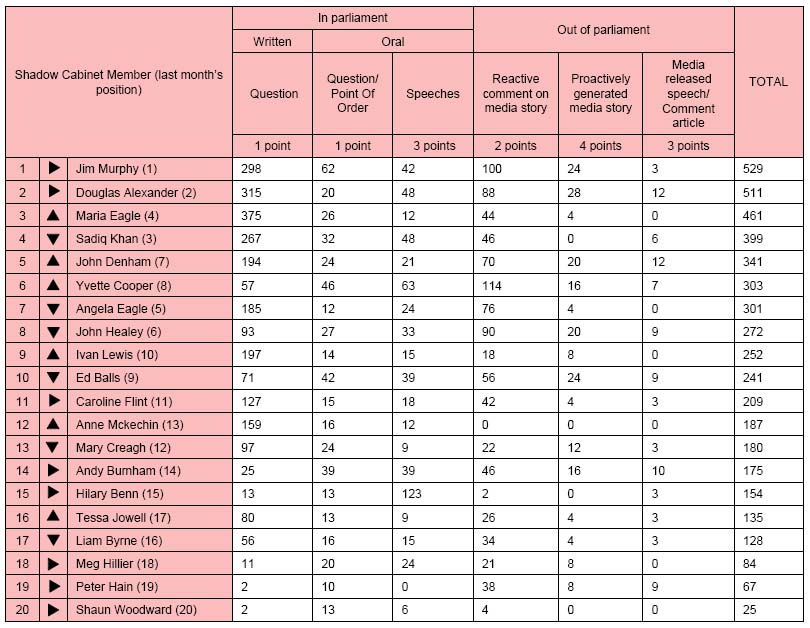
Shadow cabinet league: End of season awards special

29/07/2011, 07:00:58 AM

by Atul Hatwal

School’s out for summer and after a roller-coaster July its time to look back on performances over the past parliamentary year.

And as is traditional at the end of the season it’s time for some prizes.

Uncut is proud to be awarding prizes in four categories – 2010/11 league champion, top media performer, top House performer and most improved all round performer.

In keeping with Uncut’s Corinthian traditions, it’s not the monetary value of the prize that counts, but the popular recognition.

Handy, since this being a blog, these are virtual prizes and not worth a penny.

(more…)

Facebook Twitter Digg Delicious StumbleUpon

There is not a single place in the British isles that is more purely English than Lord’s cricket ground

28/07/2011, 12:00:21 PM

by Dan Hodges

On Monday I failed the cricket test. I fought it. Tried to wrap myself in a warm cloak of English patriotism, but I couldn’t. Sachin Tendulkar tore it from shoulders.

We are constantly lectured that we must make a stark choice. Cold, multicultural separatism. Or dull and oppressive social conformity.

But no one told the 28,000 people who crammed into Lord’s to watch the climax of the hundredth test match between England and India. Just getting into the ground produced a sense of elation. We 28,000 were the fortunate few. Outside, the queues that had begun forming at 2.00 am snaked for almost a mile. To be part of a cricket match. A supposedly dying pastime, a sport naïvely out of touch with the tensions and demands of modern society.

Some queued for their share of history; the Little Master’s last jog down the pavilion steps. Some in the hope of witnessing England reclaim ascendancy of the game they introduced  to the world, then relinquished. Others to see India, now the best team on the planet, turn back the would-be usurpers.

But it didn’t really matter. No passports were required. No one here would be asked to pledge allegiance to faith, or flag.

There is not a single place in the British isles that is more purely English than Lord’s cricket ground. In fact it is not a place, but an ethos. Fair play. Grace under pressure. Healthy competition. Individual  excellence. Collective brilliance. Those politicians who seek to define Englishness would do well to put down their speeches about “British jobs for British workers” and “muscular liberalism” and take a quiet stroll through the Long Room.

Not that Lords has always been welcoming. Far from being a level playing field, the pitch slopes alarmingly from left to right. The members who sit on the old pavilion, and have finally deigned to admit women to their ranks, have been known to obscure the ball as it leaves the bowlers hand, making it difficult for a new or inexperienced  batsman to defend himself.

(more…)

Facebook Twitter Digg Delicious StumbleUpon

Refounding labour: reinventing the wheel

28/07/2011, 07:00:13 AM

by Peter Watt

So the refounding Labour consultation is done. According to the Labour party website there were:

•    3,255 individual submissions
•    20,354 hits on refounding Labour websites
•    66 regional events across the country led by our national and region offices
•    184 party submissions
•    36 submissions from groups or affiliates

It seemed a well-run process with much enthusiasm from many members and some great leadership being shown by some of the more active members of the NEC. There has been a strong sense that the party needed change and there was plenty of energy shown by hundreds of members determined to play their part in delivering it. So far so good.

And then last week saw the publication of “refounding Labour to win” the summary report of all of the submissions. There was a brief bit of “excitement”, as some people seemed worried that a document was published so soon after the close of the consultation. This was a clear indication to some of the new generation that not every submission could have been properly reviewed. A rat was smelt and, in order to check if indeed an injustice had been perpetrated, some demanded that Ed Miliband publish all of the submissions. In a dramatic moment (not) during the one of the twitter “ask Ed” sessions, Ed conceded and agreed to publish. (more…)

Facebook Twitter Digg Delicious StumbleUpon