



Hope, help and community

12/08/2011, 01:30:03 PM

by Stella Creasy

Fear is a powerful motivation for action. As I stood on Sunday night with other terrified and angry residents and watched looters turn up and trash Walthamstow I wanted it just to stop. This was our home. Our shops. Our people frightened. Nothing justifies this and ever will.

Since then I have worked with police, outreach workers, residents and the council to try to restore order and calm to our streets– to sweep up the glass, separate internet fact from fiction, account for the welfare of people and try to assess the damage. To channel this fear into something positive. To draw strength from a commitment to the capacity of collective endeavour to restore and replenish rather than demolish and destroy. Because to do otherwise is to give up hope.

Those who label these events indicative of a sickness in the areas where they happened get short shrift in Walthamstow. Only a strong community could put together a pop up canteen for all those helping to keep our community safe. Springing up overnight, with hundreds of volunteers we are providing cakes, tea, hot food and friends for our police and outreach workers. That tells you what we are capable of – not the broken glass outside our local bank.

Following the weekend, young people have played cat and mouse with the authorities in Walthamstow. They are setting fires, taunting officers, frightening residents and damaging local businesses. My community, like many others in the UK, is now dealing the fact that the looters have unravelled the boundaries of socially acceptable behaviour.

Changing this isn’t about shutting down twitter, or handwringing about liberal elites. It is about restoring those boundaries and showing those testing them there are consequences to their behaviour.  That’s why speedy justice and strong sentences are important as a means to illustrate to those rioting and looting- and those who help them- that it isn’t worth it.

It is also about our increased police presence. Our Borough Commander Steve Wisbey and his team have had less sleep than anyone, working round the clock. Only when the calm has held for several days will the emotion of this time dissipate- and so too the rumours driving the tweets, bbms and texts which are fuelling disorder and fear.

Yet it is too easy to see this as solely about criminal acts and mindless thugs. On Sunday night there were agitators who instigated events, exploiting tension and technology to organise criminal activity in a way not seen before. But a strategy that only deals with these people is one which only sees half the story. (more…)

Facebook Twitter Digg Delicious StumbleUpon

Memo from Croydon to Westminster

12/08/2011, 11:08:21 AM

by Atul Hatwal

Walking down, past Reeves Corner in Croydon on Thursday evening, one thing was crystal clear.

The government doesn’t get it.

Cameron’s proposals in the parliamentary statement didn’t come near addressing the reality of what has happened.

And while Labour did slightly better, particularly on police numbers, the response didn’t give a clear sense of an alternative.

When David Cameron talks of a sick section of society and the need for a moral fightback, he sounds like an opposition politician.

‘Broken Britain’ was a decent routine two years ago, but he’s in power now. Government’s job in this situation is to identify what failed and fix it – not opine impotently on social morality.

Instead, the prime minister’s parliamentary statement gave us some irrelevant commentary, a pointless inquiry on gang culture and a re-heat of existing plans.

There’s nothing new in the police being able to force people to remove facemasks or in social landlords evicting tenants found guilty of looting. Councils across the country are already pushing ahead on this front.

Ed Miliband was cautious in his response. He asked pertinent questions, but didn’t frame a narrative for how Labour would make a difference. The net result is a political vacuum from our leaders.

It shouldn’t be this difficult. All our leaders need do is to listen to their constituents. (more…)

Facebook Twitter Digg Delicious StumbleUpon

Cameron must rethink police cuts

11/08/2011, 02:14:05 PM

by Matt Cavanagh

Two weeks ago, I highlighted the embarrassing gulf between David Cameron’s pre-election promise that cuts would not affect the front line, and the reality of the planned police cuts, as set out in the recent report by Her Majesty’s Inspectorate of Constabulary.

There is undoubtedly scope for efficiency savings in the police, but as HMIC set out, with 81% of police funding going on staff costs, and another 10% going on areas like transport and premises, cuts of 20% were always going to cut deep into police numbers. HMIC’s report is the most systematic and rigorous attempt so far, to estimate not just the likely effect on total police numbers – a cut of 16,000 by 2015, ironically the exact number the Met have deployed on London’s streets in recent nights – but also the likely effect on the front line for different forces around the country.

This is relevant to Cameron’s defence of the policing cuts today, when he was confronted in the Commons by former Home Secretary Jack Straw. To justify his assertion that the cuts will not affect the front line, or visible patrolling, Cameron chose to discuss his own local force, Thames Valley. This choice was either ignorant, or disingenuous. A glance at the graph on page 22 of the HMIC report shows the difference in the scale of the challenge faced by Thames Valley Police, in trying to protect the front line from spending cuts, compared to those forces who have been dealing with the riots, including the West Midlands, Greater Manchester, and Merseyside. Thames Valley Police would have to reduce their non-front-line officers by just under 50%, in order to avoid cutting into the front line. That is challenging, but arguably possible. By contrast, the West Midlands, Greater Manchester, and Merseyside forces would have to cut their non-front-line officers by 100%. Even those who hold the simplistic view that almost all ‘back office’ jobs are unnecessary would have to admit that to cut at this level without affecting front line police numbers is simply impossible.

As public concern about crime and policing soars, the government seems to be trapped in defending two increasingly indefensible claims: first, that the cuts won’t reduce front line police numbers, and second, that anyway police numbers don’t affect crime. This position was already starting to look naïve or complacent before the riots, especially with the signs that the long downward trend in crime may be on the turn. Now it looks reckless and hopelessly out of touch, as even Conservative MPs and ‘ministerial sources’ admit.

It has been amusing, if also a bit depressing, to watch Tory cheerleaders like Tim Montgomerie suggest that the way out of this problem is for Theresa May to introduce a new target for how much time police officers actually spend doing visible work. In fact, May inherited such a target from Labour. Admittedly, it was applied only to Neighbourhood Policing Teams, but she could have chosen to extend it; instead, in those heady days of last summer when ministers were falling over themselves to mock Labour’s ‘top-down targets’, she scrapped it.

Even more ridiculous is the spectacle of Conservative MPs and Conservative-leaning think-tankers trying to use the riots to back up the case for elected police commissioners – just like they did with the scandal over the Met’s links to News International – without realising that the Met is precisely the one police force which is already very close to the elected commissioner model.

These rather desperate moves are not surprising, since other than elected commissioners, and some useful development of Labour’s introduction of online crime maps, the government doesn’t really have any crime policies – and yet they need to talk about something other than police cuts. But these moves aren’t working. As John McTernan noted this morning, Cameron’s reluctance to break off his holiday to grip the riots ignored the “basic political law, that if you’re going to have to do something, you should do it of your own free will, rather than being forced to.” He needs to realise that rethinking the police cuts falls in the same category.

Matt Cavanagh was a special adviser on crime and justice under the last Labour government.

Facebook Twitter Digg Delicious StumbleUpon

People are rioting and politicians are revolting

11/08/2011, 08:00:46 AM

by Peter Watt

Politics has never had such a bad name. Well, that is one of those slight exaggerations that help to colour opinionated blog posts like this one. But there is surely no doubt that politics and politicians are pretty unpopular at the moment. A succession of scandals, and a sense that they are in it for themselves, has meant that most people look on politicians with disdain. The ongoing hacking furore has just added to a sense that those inside of the elite bubble don’t live in the same space as the rest of the country. This isn’t just a UK problem, but that hardly matters to those who live here and are disdainful of UK politicians.

A large part of the problem is that people just don’t think that politicians get their lives. That the language used, and the solutions offered, just don’t resonate with their own experiences. For instance, for years people have felt that some young people have been out of control. Not many, certainly nothing like a majority, but some. No one seems to be in charge of them and they don’t seem to listen to anyone or respect or fear authority. They put their feet upon the seats of trains and tell the guard to “fuck off” if they are asked to move them, with no apparent sense of embarrassment. They mouth off at anyone who looks at them in the wrong way and are never at school, college or work. Normal deterrents, like parental sanction, fear of arrest, fines, public shame or worse, don’t seem to work.

Over the years, politicians’ responses have included more education, boot camp style discipline, national service, more youth clubs or more benefits. Most people knew that there were elements of a solution in all of these, that some would benefit from each. But they also knew that it wouldn’t help those who were really out of control, because the problem for them was something else. It was a problem with parenting or rather the lack of parenting.

Politicians from the right would demand tough love, and those from the left more understanding. But people out there knew that the real problem was that for some family life was not providing the support, discipline and example that we all need to become responsible adults. In fact, for some family life was providing exactly the opposite. It was nurturing irresponsibility and lessons in how to operate outside of the mainstream. (more…)

Facebook Twitter Digg Delicious StumbleUpon

Obama and Merkel can still make history, not be its victims

10/08/2011, 08:00:04 AM

by Jonathan Todd

People make their own history, as Karl Marx knew and Angela Merkel and Barack Obama cannot deny, but under circumstances existing already, given and transmitted from the past. Over hundreds of years America has evolved to a fiercely divided, uncompromising polis wedded to a system demanding compromise. Over decades Europe has achieved monetary union. Thousands of years of history hang over its fiscal consummation, which is required to avoid collapse and further calamity. The tradition of all dead generations weighs like a nightmare on the brains of the living.
One of the ironies of Marx is that communism was supposedly inevitable, but his tombstone declares that the point is to change the world, not interpret it. What’s to change if history’s terminus is already determined? What was the point of agitating publications like the Communist Manifesto if we were all, in spite of ourselves, destined for communism?

Such publications imply that Marx himself may not have seen communism as quite the iron certainty that rigid interpretations of his writing suggest. But one of the divisions between Marxism and much of the rest of the left concerns the extent to which we are prisoners of history. Parties such Labour predicate themselves on an assumption that the institutions of advanced capitalist democracies can be moulded to serve socially just ends. Ed Miliband’s father, of course, like other Marxists, thought this naive.

Recent economic events seem to vindicate Ralph Miliband. Political leadership seems oxymoronic when our nominal leaders appear only witnesses to events that they can barely fathom, let alone command. (In the non-economic sphere, our Tuscan prime minister is similarly bemused by the revenge of the lumpenproletariat). Nothing has happened to undermine James Carville’s famous wish to come back as the bond market and intimidate everybody. It’s these markets that are in the box seat and our political leaders that are cowered.

What they demand are credible plans from governments to repay their creditors. This isn’t unreasonable. I expect you’d want to see credible repayment plans before you leant non-trivial amounts of money. The governments of the third and fourth largest economies in the eurozone, Italy and Spain, seem increasingly unable to produce such plans. The downgrade of the USA, though unjustified, speaks to a similar lack of confidence in America’s ability to manage its debts.

While events seem to lead towards the largest country in the world that still professes to be communist, China, being an ever more dominant geo-political force, the Marxists should not be too triumphant. The markets are, of course, as powerful as James Carville’s wildest dream and Ralph Miliband’s bleakest nightmare. But they do not remain beyond the capacity of political leaders to have them becalmed. That is if political leaders do what it says on their tin; lead.
This doesn’t mean interpreting opinion polls as immovable. Germany, for example, could swing behind the full steps required to save the euro if Merkel articulated them well enough. It means seeing your electorate as intelligent beings capable of being won over by the force of your argument and your actions. Merkel and Obama can still do this. But only if they stop being intimidated not only by the bond markets but also by opinion polls, their political opponents and their own inevitable failure to hold in their minds every relevant fact and figure. (more…)

Facebook Twitter Digg Delicious StumbleUpon

Not today

09/08/2011, 10:00:04 AM

by Dan Hodges

Not today. Please, just not today. Laurie Penny, I think you are a beautiful and gifted writer. But don’t tell me violence cannot be mindless. Or that it is all about catharsis. Not today.

Sunny Hundal, your real and passionate desire to break politics free from its straight jacket of committees and speeches and selection meetings does you credit. But please, don’t circulate any more time lapse photography of people’s homes burning and tell me it’s “brilliant” or that it’s “art’. Not today.

Owen Jones, the working class need a voice, and you are an articulate spokesman. But please, no more hand wringing about the dangers of an “authoritarian backlash” against those who tried to loot and burn our city to the ground. Not today.

Ken Livingstone, you were once a great and radical figure. But no one needs to hear your cheap politicking about your statesmanlike dash from the Olympic awards ceremony. Or your back of the envelope theories about how 14 and 15 year old rioters trashed JD sports because they are not able to provide for their wives and children. Not today.

Boris Johnson, I’d actually liked to have heard something from you. But instead I had to put up with your spokesman Kit Milhouse explaining why it was fit and proper for the Mayor of the world’s greatest capital city to watch from afar as his charge exploded in an orgy of destruction. We’ll no doubt hear the same excuses trotted out often this election year. If we must. But not today.

Theresa May, I understand being the only senior member of the government, (Nick Clegg hardly counts in these circumstances), is tough. But I don’t want to hear any more rubbish about “policing with consent” when that consent has been brutally withdrawn by a small but violent minority. And I’d park the protestations that cutting thousands of police officers won’t have had any operational impact. For today.

David Cameron, I don’t actually blame you for taking a much needed break in Tuscany. And it was nice you made friends with your waitress. But as you sit savouring the taste of your Tuscan Dream please, do one thing for me. For all of us. Don’t tell us we’re all in this together. We are, of course. But we don’t need to hear it from you. Not today.

There is lot we do need to hear.  And lots that needs to be said. About the dislocation of inner-city youth. About the link between crime and poverty. About race and resentment. About lack of employment and educational opportunities. The widening gap between the rich and poor. The politics and the sociology and the criminology. All deserve, indeed require, an airing.

We must debate, and examine, and interrogate. We must argue and enquire and report. We must ask ourselves what sort of society we really want to be, and take a deep look within our own communities, and souls.

We must do all of these things. Just not today.

Dan Hodges is contributing editor of Labour Uncut.

Facebook Twitter Digg Delicious StumbleUpon

Party reform: In the hands of the many, not the few

08/08/2011, 10:11:16 AM

by Rob Marchant

So, we are having a debate about the role of unions in the Party. Perhaps Ed, as my Uncut colleague Peter Watt suggests, is on a hiding to nothing: he is paddling against a strong current of realpolitik that dictates that this cannot change, at least whilst the party is taking ninety per cent of its donations from unions.

But, this aside, perhaps we should examine something more important: rather than whether Ed will win, we should look at whether or not Ed is right.

Firstly let’s frame the debate: every time we try to have a debate about the right level of involvement for unions in party decision-making, the familiar refrain comes out from all corners of the labour movement: “man the barricades, someone is trying to break the link!” The siren goes up, we all rush to the defence of the link, the devilish intruders are repulsed, and the debate stops again.

But breaking the link is essentially a straw man: no serious, contemporary party figure is suggesting that we should do such a thing. Most of us are members of, and support, unions, even if we don’t always agree with everything they do. And how would we survive, let alone campaign? It is natural that, in part-funding the party and being linked to its decision-making mechanisms, unions should have a say.

However, the more nuanced debate that needs to be had is: how much of a say? Because, on the other hand, the current system does beg the question of whether or not it is right that three leaders, whose interests are naturally sometimes directly aligned with those of the party, and sometimes not, control a very sizeable block vote.

So, are we comfortable with that? Because perhaps we shouldn’t be, and it’s quite possible that the upcoming, wholly independent study into party funding may not be, either. Why? (more…)

Facebook Twitter Digg Delicious StumbleUpon

Life, love and loyalty: in defence of nepotism

06/08/2011, 11:00:13 AM

by Michael Merrick

Relationships are a good thing. Even disciples of Hobbes and Rousseau will admit as much. The social sphere is, by its very nature, social. That is, it depends on relationships. And the more vibrant and diverse the relationships, the more vibrant and diverse the social sphere.

The more positive and virtuous those relationships, the more positive and virtuous the social sphere. This means that any resurrection of the social sphere as a safe and positive place of interaction (which includes economic interaction) must in some sense build upon an appraisal of the relationships we share with one another.

Nepotism is an important part of this drama.

Yet whenever the issue is discussed, particularly by those who place themselves on the left of the political spectrum, we are given naught but murky tales of powerful upper-class types jealously seeking to protect their social and professional circles from penetration by working-class oiks, often by treacherously bestowing opportunity and privilege solely upon their unworthy and less than capable nice-but-dim nephews and nieces.

Understandably enough we consider this an injustice. We shout loudly, we hold our banners and hone our slogans, we turn the pursuit into one of universal social justice for the working classes and wrench up the rhetoric against these evil nepotistic enemies of the people.

And in so doing, we get it entirely wrong. We get our accounts of human relationships wrong, we get our account of society wrong, and we get our account of nepotism itself wrong. We deny what is good and to be cherished in human relationships, in preference of a cold atomism only possible within a sanitised concept of the social sphere.

For nepotism is the natural by-product of healthy relationships. It is the urge and instinct toward fraternity. It is the outward manifestation of solidarity, the mortar that binds society together as a complex construction of personal and social relationships.  It is the external expression of love and loyalty, the social and filial fulfilment of duty and responsibility.  It spreads opportunity horizontally and vertically and it strengthens bonds of friendship, family and community.

Camaraderie spreads through it, comradeship flourishes within it, solidarity courses through its veins. (more…)

Facebook Twitter Digg Delicious StumbleUpon

The shadcab mini-makeover – It’s not just the party’s policies that are getting refreshed

05/08/2011, 08:00:40 AM

by Atul Hatwal

Step back Gok Wan. Take a break Trinny and Susannah. Competition is on the way.

Although the identity of the new makeover maestro remains secret, what we do know is that they work with the Labour party and they are operating at the highest levels.

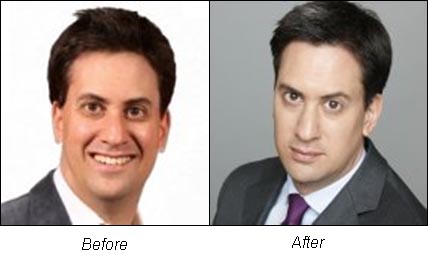
A few weeks ago the news section of the Labour Party website got a facelift. But it wasn’t just the site that changed its look. At the same time, a small number of the file photos of Labour’s top team were also miraculously transformed.

Amongst the lucky few, the leader of the Labour Party went through a metamorphosis.

Before the change, Ed Miliband’s manic grin and staring eyes were reminiscent of a crazed teddy bear. The composition of the picture and the stark white background made it look like something from a school year book:

“Ed Miliband, student most likely to join the U.S. postal service”

What a difference a simple snap makes.

In the new picture the grin is gone, the colours are more sobre and the little dab of white in his hair is in shot to lend gravitas. And then there’s the expression. He’s looking the viewer knowingly in eye, measured and focused. It’s an expression that’s strangely familiar.

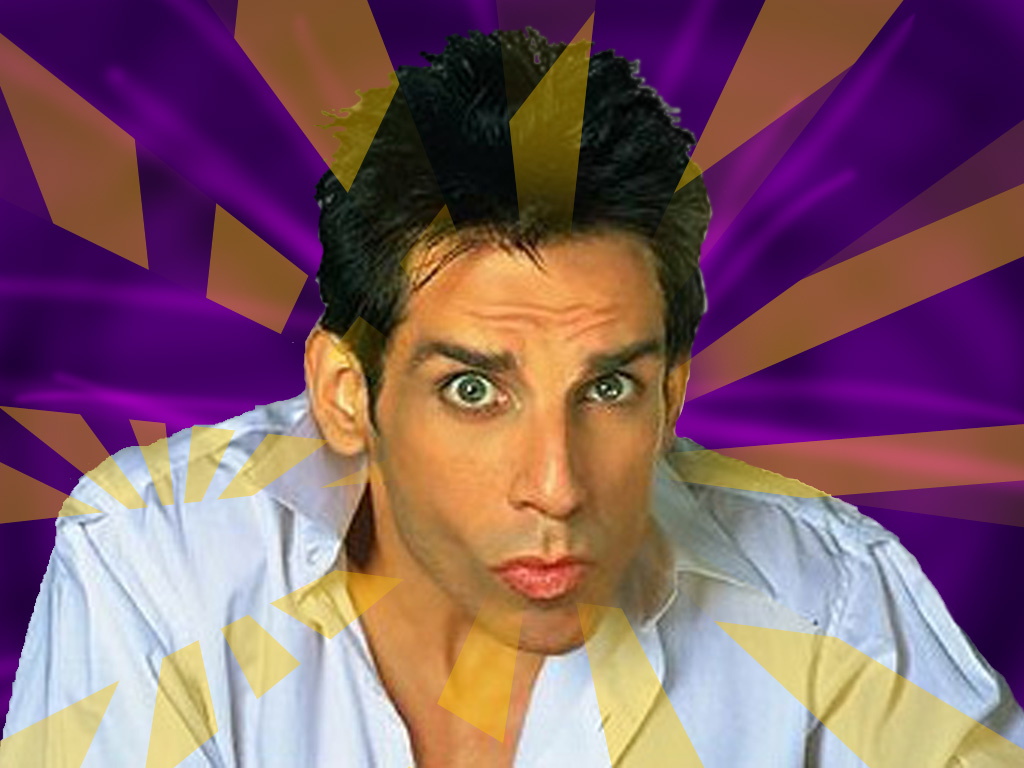
Ah yes – Blue Steel. (more…)

Facebook Twitter Digg Delicious StumbleUpon

Will the right face its 1989 moment?

04/08/2011, 02:00:36 PM

by James Watkins

1989 was a bombshell for many people on the left. Any hopes that a communist utopia would flourish went up in a puff of smoke when the peoples of eastern Europe turned against their governments.

In Britain, the impact of 1989 was profound. The Communist party went into freefall, various factions split into further factions, Marxism Today went off the shelves and a further spur was given to the changes in the Labour party.

So why has there not been a “1989 moment” for the right? For in 2008, the confidence in laissez-faire markets should have gone up in a puff of smoke when the markets failed – and the only thing that held economies together was the intervention of the nation states.

The 2008 moment went against everything that Friedman, Hayek and other free market thinkers had been advocating. This was clear, conclusive evidence that rolling back the state and giving free rein to markets does not lead to a natural equilibrium in the economy. Former US federal reserve chairman, Alan Greenspan, said he was “surprised” by this. One former Tory Parliamentary candidate told me at the time that if free markets led to the collapse of all the banks and the mess that this would lead to, then so be it. This was the confused and muddled state the right was in back in 2008. (more…)

Facebook Twitter Digg Delicious StumbleUpon