


A snap election is no longer unthinkable – but it won’t happen

26/04/2011, 03:10:58 PM

by Sunder Katwala

An election this year is no longer unthinkable, writes Guardian columnist Jackie Ashley. ConservativeHome’s Tim Montgomerie, influential champion of the Tory netroots, advises Cameron to prepare his troops. Perhaps the prime minister’s most unlikely adviser, Tom Watson, was ahead of the game.

Except that it won’t happen. (Just as economists have successfully predicted six of the last three recessions, commentators and bloggers promoting snap elections should have to declare their previous kite-flying efforts).

The most prominent objection so far is the difficulty of Mr Coalition Cameron engineering the destruction of his own government without the public seeing that he has acted in entirely bad faith. This would be Paxman’s dream “why should anybody believe a word you say” election, so brazenly have both governing parties done things which they promised not to. The prime minister who legislates for fixed term Parliaments and then runs to the country would put the seal on the most cynical interpretations of the new politics.

Perhaps a breakdown of collective responsibility and backbench rumblings will create gridlock, unless the LibDems do not simply pipe down again after May 5th. The LibDem grassroots are mobilising to seek to fillet the NHS Bill that their MPs voted for at second reading. But most Conservatives, while grumbling about the excessive influence of their junior partners, would be secretly relieved if a cosmetic pause comes closer to a full stop on reforms which the public finds incomprehensible. ‘Save Andrew Lansley’  is probably not a battle cry to win an electoral mandate.

But there is a better objection still. David Cameron hasn’t got the votes.

The Liberal Democrats certainly don’t want to face the voters anytime soon. They could lose their role in government and more than half of their MPs, probably including all of their women.

All the prime minister making that threat would have to lose is Downing Street and his political career.

The blindspot of much of the political class lies in consistently over-estimating David Cameron. He certainly looks the part as PM. He performs the public role with grace. But his record as party leader is as much about failure as success. His own side put him into TV debates to ‘seal the deal’ in 2010. He didn’t. But the assumption that he would was shared by his opponents, helping to explain why Labour didn’t prepare properly for the hung Parliament, and the LibDems made the pledge to students which would have served them well had the Tories won a small majority.

Yet everybody is doing the same thing again.

It has become a staple assumption that, had Cameron formed a minority government, he would then have swept to victory at the time of his choosing. If it was a sure thing, why didn’t it happen – and why was there so little Tory pressure to attempt it? It was because the risk was too great.
Historically, when the parties have gone back and asked the voters the same question after a hung Parliament, they have been given the same answer as the first time around. Had Cameron tried it, I have suggested before that David Miliband might now be Prime Minister.

A Tory election campaign this year would be rather less plausible than last Autumn. Ultimately, they would fall back on running against Gordon Brown and the government’s inheritance from Labour. Since that didn’t work well enough for the Tories to win when Gordon Brown was the alternative candidate, there is little reason to think the voters would find it more plausible now.

It is true that Labour is still rebuilding. If Ed Miliband’s party is more popular than Labour was at the last election – as, with 2 million LibDem voters having switched to Labour, it undoubtedly is – it is difficult to see how Cameron’s gamble could pay off.

If it didn’t come off, he’s Ted Heath, and surely on the way out. (more…)

Facebook Twitter Digg Delicious StumbleUpon

The Tories have got tax right: they’ve just got marriage wrong

26/04/2011, 07:00:13 AM

by Peter Watt

My youngest sister just got married in South Africa. About 30 of our large family went for a holiday of a lifetime to celebrate the big event. We had an incredible time and it made me think once again about the importance and influence of our family. We provide each other with friendship, informal social care, safety, emotional support, counselling, nurturing, parenting and parenting advice, financial support and of course a sense of belonging. Of course, we aren’t alone in this. The family has to be one of the most important influences on everyone’s life.

It is for this reason that “supporting families” is something that all political parties claim as central to their social policy. At the last election, the Tories emphasised their flagship policy of recognising marriage in the tax system.

Rightly, Labour argued that this was not only simplistic but also discriminated against families that do not include a married couple. But we lost the election. And the budget saw the Tories take their first small steps in implementing their approach. There is no doubt that over the coming years they will continue to use the tax system to aggressively demonstrate their intent.

(more…)

Facebook Twitter Digg Delicious StumbleUpon

What America really thinks of William and Kate

25/04/2011, 03:30:54 PM

by Jonathan Todd

Baltimore

“I know America to be a forward thinking country because otherwise why would you have let that retard and cowboy fella be president for eight years? We were very impressed. We thought it was nice of you to let him have a go, because, in England, he wouldn’t be trusted with a pair of scissors”.

With such jokes, Russell Brand, as host of the MTV awards, initiated what is becoming an Anglo-American tradition: the cheeky Brit at a major American award ceremony. Ricky Gervais followed up at the Golden Globes this year. These comedians aren’t short of lines ripping George W Bush, but what assurance can we have that the British head of state can be trusted with a pair of scissors? Or even know what scissors are?

We can, of course, have no such guarantee. Birth right determines our head of state, irrespective of their abilities with scissors or other qualities. In contrast, the commander-in-chief is subject to the most gruelling of recruitment procedures. This fundamental difference between our monarchy and their republic convinces me that no matter what wise cracks Brand may make and how many William and Kate themed souvenirs American tourists may buy, ultimately, Americans are laughing at us. The idea of Donald Trump being president is preposterous, but selecting our head of state by birth is infinitely more so. (more…)

Facebook Twitter Digg Delicious StumbleUpon

Three kinds of leader in the age of the insurgent

25/04/2011, 12:00:58 PM

by Kevin Meagher

Like bad luck, musketeers and Neopolitan ice cream, our political leaders come in threes. Consolidators, new brooms and insurgents; a trio of broad headings that sums up the different approaches to party leadership -Tory, Labour and Liberal alike.

First, we have consolidators. They are elected to lead divided parties, offering a familiar, reassuring presence, often at a moment of peril and self-doubt. They provide a small “c” conservative choice for parties turning in from the world. Michael Foot, Iain Duncan-Smith and Ming Campbell fall into this category. Their election is often a mark of intellectual defensiveness for their party, sometimes at the fag end of a period in office. Douglas-Home, Callaghan, and Gordon Brown also fit this bill.

Consolidators are kept on a short leash by their party; sometimes only too willingly. Their guiding belief is “hold what we have”, which really means that the party believes it is right, regardless of what the electorate has decided. Although never leader, this is Tony Benn quipping that Labour’s disastrous 1983 election result was “eight and a half million votes for socialism”. (more…)

Facebook Twitter Digg Delicious StumbleUpon

The Sunday Review: the interim report of the independent commission on banking

24/04/2011, 01:00:13 PM

by Anthony Painter

There is nothing more British than an establishment fudge. And as establishment fudges go, the interim report of the independent commission on banking (ICB) is an absolute belter. It lays out the case for a fundamental reassessment of the UK’s financial sector, but proposes nothing like that. It is like a flood risk report saying that only a twenty foot high concrete wall will protect a town from flooding but then actually only recommends the installation of sandbags. And given that George Osborne is in compromising mood, it will be watered down further. Get ready for the flood.

Don’t worry, the UK might get lucky. Maybe there won’t be a flood at all. We didn’t think floods happened – or we forgot. Then one did. But still, they are rare right? Well, The ICB doesn’t seem to think so:

“There is an inherent uncertainty about the nature of the next financial crisis”.

So we are not dealing with “ifs” here; we are dealing with “when”. This staggering statement, buried in section 4.173 comes after a long section on the need to protect the competitiveness of the UK financial sector. It provides jobs and £50 billion of tax revenues, after all (though £10 billion or so are from the retail operation, which presumably isn’t going to be off-shored any time soon). That is not insignificant. As we have discovered, that is not a cost and risk free income. In fact, it is highly risky and costly.

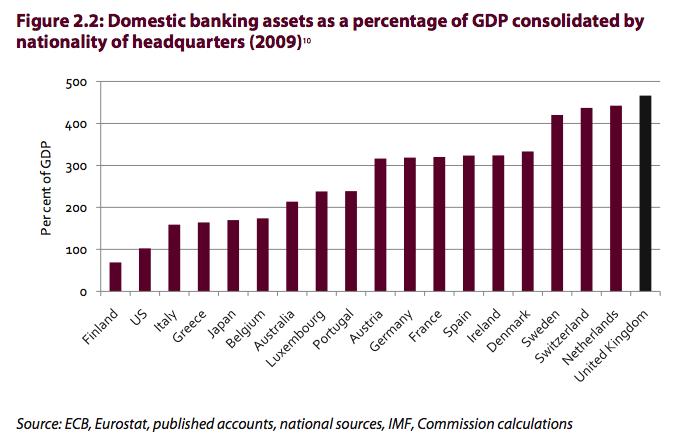
This graph helpfully provided on p.22 of the report tells us why:

In financial terms, the UK is more flood-exposed than any other nation. It may not feel this way given the massive output loss, fiscal disaster, and unemployment, but the UK was “lucky” this time. For Ireland, it was far worse:

“Had the asset quality of UK banks turned out to be as bad as that in Ireland, the hit to the UK’s fiscal position would have been significantly worse than it was”.

Oh, those Irish with their junk investments. How silly of them. Only it’s not quite like that. Financial crises don’t generally occur because people are buying junk. They occur because people are buying high quality assets that turn out to be junk. If people are buying junk then investors notice. If it’s AAA grade prime then they are relaxed. The global financial crisis occurred in no small part because AAA assets turned out to be useful only for composting.

At enormous cost, it’s all been quarantined, sanitised and disposed of now right? Perhaps. But there’s still lots of other risks that may be underpriced. An obvious example is the sovereign debt that banks hold. What happens if governments start to default on their debt just as owners of subprime mortgages started to default on their repayments?

Calamity is what happens. If Greece, Portugal, Spain, or Ireland were to default then suddenly the bonds held by German, Dutch, British banks et al are turned from prime to subprime in an instant. Mark Blyth on Crooked Timber has war gamed the shock that would be sent through the European economy. Fantasy? No actually, it’s a completely plausible scenario. The eurozone crumbles but, worse than that, the fiscal hit will be tremendous. What on earth will the Royal Bank of Scotland’s balance sheet look like if that happens and how will we keep a flow of credit to the real economy?

According to the ICB report, there are four functions of a banking system:

• providing payments systems;

• providing deposit-taking facilities and a store-of-value system;

• lending to households, businesses and governments; and

• helping households and businesses to manage their risks and financial needs

over time.

Its measures only aim to safeguard two of them: keeping the payments system going and providing deposit-taking facilities. In the event of another flood, it means that lives will be saved which is clearly a good thing. However, the damage and economic cost to the unprotected town will be enormous. If the flood is a eurozone flood, then governments will need to fiscally intervene once again if credit and lending are to be maintained (and we do have a £141billion deficit to finance as well a businesses and mortgages to finance). The question is – again one posed by the ICB – at what point does “too big to fail” become “too big to save”?

The harsh reality is that we have a financial system that would be too big to save if the flood were big enough. It is a bigger weight on our shoulders than that any on other country’s. We have broad shoulders, but they can’t take unlimited pressure.

And this is the real issue with the ICB interim report. It lays out the evidence that UK may face a financial catastrophe even greater than was experienced in 2008. And then it defaults to the traditional defence of the UK financial sector’s competitive position as an unarguable good. It has been criticised for not doing enough to promote further competition (and our banking sector is monocultured and uncompetitive), or to separate casino from utility banking. In a sense, these criticisms – though fair – miss the point also.

The UK economy and UK taxpayers may not be able to sustain the risk of a financial sector this large at all – even with better regulation. Actually, “competitiveness” may be economically calamitous. So the ICB should have been more honest with us. It should have said:

“We are recommending a 20-foot high concrete wall. This is expensive and it will cause much pain but that is our honest assessment of what it will take to protect us from the flood. It is not unreasonable if we do want to protect ourselves from what could be an adverse event that we see in the not too distant future. This needs a bigger debate than the one we are having. It is about the whole way we run our economy and requires real long-term vision, explanation, and courage. This is a choice but we don’t feel it is a choice that should be brushed under the carpet because of vocal interests or political compromise. We have experienced a calamity but it may only have been a warning. Next time we may not be able to cope at all”.

It didn’t say that. It said, it’s bad but let’s not overact. For that reason, the report is a failure. Meanwhile, Bank of England figures show lending to small and medium sized businesses falling again and the cost of finance increasing. And consumers are starting to borrow to consume more once more.

Here we go again. And did I mention the flood risk?

Anthony Painter is an author and economist.

Facebook Twitter Digg Delicious StumbleUpon

In Australia AV doesn’t live up to the rhetoric of the ‘No’ or ‘Yes’ campaigns

22/04/2011, 12:00:07 PM

by Andy Bagnall

I’ve just returned from a five-month stint down under – advising the Australian Labor Party (ALP) on the New South Wales state elections – to a pile of post several inches high. Among the bank statements and the pizza adverts was a leaflet from each of the campaigns for the AV referendum. A hand-delivered, two-colour flyer from the YES campaign and a full-colour glossy, posted direct mail from the NO campaign – perhaps reflecting the differing financial resources of the two sides.

Although I’ve followed the AV debate from afar, I read the two flyers with interest, only to be disappointed by the simplistic level of the debate and the exaggerated claims of both sides.

As far as the YES camp is concerned, I can categorically assure them from my New South Wales experience that optional AV will not make MPs work harder. It will not end safe seats or jobs for life, and it most certainly won’t stop MPs becoming embroiled in scandals.

If that were the case someone forgot to give the memo to the two dozen New South Wales MPs  who, during the last parliamentary cycle, were tainted by accusations of domestic violence; marital infidelity; sex for planning consents; child molestation; or having their hands in the till. Sadly, all of these were Labor MPs and the charge sheet explains, at least in part, the scale of the Labor government’s defeat in NSW.

The most colourful scandal was the then police minister being accused of dancing in his underpants at a post-budget party simulating a sex act with a fellow MP while saying to her daughter “look, I’m t***y-f*****g your mother.” This has been strenuously denied by all concerned. No-one’s been sued but the Minister still resigned. No, my friends, not even the awesome power of an AV electoral system can stop that level of error of judgement even if it could stop an MP fiddling their expenses.

Similarly, to the NO camp, AV will not mean the rise of extremist parties in and of itself. Nor will it mean that some people’s votes are counted twice – everyone’s vote is counted the same number of times no matter how many rounds of counting. Nor will it lead to more broken promises. This last one made me laugh out loud. (more…)

Facebook Twitter Digg Delicious StumbleUpon

The real Labour lie on immigration

22/04/2011, 08:00:36 AM

by Atul Hatwal

David Cameron’s speech on immigration last week sparked a predictably incoherent response from Labour.

The official line was to not have a line on what Cameron was talking about. Nor was it to have a line on Vince Cable’s response.

Instead, Labour just talked about there being a government split. While several elephants trampled around Labour’s room. Did the party agree with Cameron? Or Cable? Did it want to defend its record?

Questions, questions.

No answers were immediately forthcoming, but some clues on leadership thinking, beyond abject terror at the use of the ‘I’ word, have begun to seep out in the past week.

Up popped Maurice Glasman in the pages of Progress, Labour’s very own pearly king, or at least Lord. He had lots to say about Labour’s “lie” on the levels of immigration, the impact on traditional working class folk and the need to “reconnect” with members of the English Defence League.

Gor blimey guvnor.

Then Ed Miliband chipped in to Nick Robinson. Citing the mythical conversation with the average punter, so beloved of politicians reaching for some authenticity, he said:

“I think we clearly underestimated the number of people coming from Poland…People say to me, look I’m worried about the pressure on my wages of people coming into the country, I’m worried about what it does to housing supply”.

Looking beyond it being unlikely anyone really said that to him, given no-one outside of a think tank actually talks like that, Miliband’s words marked the complete triumph of a new narrative for Labour on immigration. He might have skirted around the topic during the leadership election, but this was the first time he had articulated the narrative as leader of the Labour party.

While the right wail about identity, security and look suspiciously at the Pakistani migrants and their children; Labour has gone down the Duffy road with an invading army of eastern Europeans pushing hard pressed Brits out of jobs.

Increased labour supply at the lower income end of the labour market, driving down wages, increasing unemployment and increasing pressure on public services is the more salon-friendly version of this thesis.

But here’s the problem. Regardless of the way it’s expressed, it’s wrong. Not morally or ethically, but factually. (more…)

Facebook Twitter Digg Delicious StumbleUpon

This government’s back-of-the-envelope approach to national security must change

21/04/2011, 04:05:03 PM

by Matt Cavanagh

Con Coughlin’s article in today’s Telegraph will make uncomfortable reading for those Conservatives (and News International journalists) who like to pretend that Cameron’s national security council (NSC) is a genuinely radical reform based on a serious attempt to learn the lessons of the last decade. Coughlin writes:

“To judge by the NSC’s increasingly inchoate response to the challenge presented by Gaddafi’s regime, it seems to me that all it has achieved so far is the replacement of Blair’s much-derided “sofa government” with a new, back-of-the-envelope approach.”

argued in November that Cameron had persistently over-sold his reforms to our national security machinery, which really amounted to “a tinkering and re-badging exercise”. In the first couple of weeks of the Libyan crisis, the continuing lack of strategy, coherence, and grip was obvious.

The narrative changed when Cameron was able to take the credit for British diplomatic efforts to secure UNSCR 1973, and for being one of the first leaders to call for military intervention. The changed narrative didn’t change the facts – that Cameron’s call for intervention was more a response to immediate domestic pressure than part of a real strategy, and that UNSCR 1973 itself didn’t seem to be part of a real strategy – but it did push these inconvenient facts into the background. At that stage, what mattered was that Cameron seemed to be winning the international argument.

Now what matters is who is winning on the ground. The curiously timed joint letter by Sarkozy, Cameron and Obama, insisting that Gaddafi must go, hasn’t made that outcome any more likely compared to the various possible outcomes which leave him in place – the potential collapse of the revolution outlined by Anthony Loyd in this month’s Prospect, or a protracted stalemate, or a messy negotiated settlement. The letter has, however, increased the extent to which the West’s reputation, as well as Libyans’ future, is on the line.

It might therefore be time to look again, not just at the implications of the Libyan crisis for our defence and foreign policy – reopening or updating the strategic defence and security review (SDSR) – but also at the implications for our national security machinery. It needs real reform, rather than tinkering and re-badging, if we are to increase the chances of our foreign and security policy being driven by strategy rather than emerging out of the interaction between media coverage, domestic politics, and bureaucratic dysfunction.

Matt Cavanagh was a special adviser on defence in the ministry of defence, treasury, and Downing Street from 2005 to 2010.

Facebook Twitter Digg Delicious StumbleUpon

Labour needs to stop being the bossing and interfering party

21/04/2011, 08:39:28 AM

by Peter Watt

Last week’s decision to end the so called bin-taxes was clever politics by the government.  And as there hasn’t been an awful lot of clever politics recently by the government, I thought that it was significant. What was particularly clever was that the weekend “announcement” was actually an announcement that the ending of bin taxes would be announced in about a month’s time.

But the government knows that the local elections and AV referendum (whatever the result) are going to be pretty challenging for them. They know that there is not a lot that they can do to alter that. So they have decided to keep reminding people of what they think the public see as Labour weakness. So they might lose the battle in the next month, but they will keep sowing the seeds of an election victory in 2015. These reminders obviously include playing the blame game on the deficit and attacking Labour’s economic competence. But it also involves something else. Something more personally emotional for many voters. A perceived tendency by the last Labour government to overly interfere in people’s lives. (more…)

Facebook Twitter Digg Delicious StumbleUpon

The show goes on: bring back Prezza

20/04/2011, 03:30:23 PM

by Kevin Meagher

John Prescott was supposed to have gone to seed with the passing of the Blair era. His future lay in regaling well-heeled passengers on cruise liners about his forty years in Parliament. But the old sea dog keeps coming back into port. So much so that his retirement from the frontline is barely discernable.

Labour’s Emeritus Deputy Leader has been busy. He led the Go Fourth campaign to get Labour ready for last year’s general election. He has become an unlikely star of Twitter, supplying a constant stream of characteristically pithy opinions. In fact, he has transcended politics altogether and entered popular culture.

He had a cameo role playing himself in the BBC comedy Gavin and Stacey. Then he popped up presenting a documentary about class with wife Pauline. Now he’s sending himself up in that advert for a price comparison website (which he says helps fund his office in the House of Lords).

And when he’s not busy leading the charge against AV, he’s rattling cages about the phone-hacking scandal; jousting on Channel Four’s zeitgeist-y 10 O’clock Show the other week with former News of the World hack Paul McMullen.

Some retirement. But there’s not much effort involved. Prescott’s secret is that the words coming out of his mouth are the same as the thoughts in his head. That nanosecond between brain messages forming into words is detectable to the electorate. They know that politicians apply a filter before saying anything. They sense they are not being told the unvarnished truth. That’s why all MPs are bunched together in the public’s mind as conniving charlatans. (more…)

Facebook Twitter Digg Delicious StumbleUpon