




Labour must use the next five years to modernise

13/05/2015, 05:52:13 PM

by Callum Anderson

Labour’s defeat has undoubtedly kicked off the most significant period of soul-searching within the party for a generation.

The general election saw a clear and total rejection of ‘Prime Minister Miliband’ and a Labour government led by him. Indeed, the defeat was so clear that we have lost our would-be chancellor and foreign secretary.

But whilst the finger pointing and blame loading is, in some ways, the nature direction of a party that has suffered losses across all three parts of Great Britain, it is essential that rather than this, we, as a party, dust ourselves off and begin to consider how we modernise and rebuild for the years that lie immediately ahead.

The first step will be to truly come to terms with not only with the election defeat itself (particularly why swing voters ended up siding with the Conservatives), but, actually, with the entire period of 2008-2015.

By far the largest error of this time was allow the macroeconomic argument to be led and defined by the Conservatives (and, partly, by the Liberal Democrats). This ultimately resulted fixing the whole concept of ‘Labour spending too much’ as the public’s mainstream view, which reared its head in the final Leader’s Question Time on 30 April.

Thus, the most pressing and overwhelming challenge facing the next Labour leader and shadow chancellor will be in devising a compelling economic narrative of progressive fiscal responsibility, whilst resolutely holding on to our core principles of self-improvement, fairness and equality of opportunity.

Equally, the Labour mainstream must also face the reality that it has fallen entirely out of sync with voters north of the border, which has resulted in the SNP being the standard bearers of Scottish voters. With Cameron likely to further stir up English nationalism that will lead to more of the Scotland vs the rest that we saw too much of in the last Parliament, Labour must be the vehicle of fair and sensible constitutional change.

(more…)

Facebook Twitter Digg Delicious StumbleUpon

Will Labour survive a drawn-out leadership contest?

13/05/2015, 10:22:55 AM

by Kevin Meagher

The inside of the Labour party is beginning to feel like a tense family funeral, just before the point when everyone starts drinking.

There’s a lot of unreconciled psychological baggage as we await the National Executive Committee’s decision about whether it will institute a short leadership process, or stretch it out to the September party conference, or, indeed, beyond.

The problem is that years’ worth of sleights, rivalries, anguish, antagonisms and things that have been left unsaid have all built up. If invited to have a drawn-out discussion about why the party lost, it is inevitable that this will lead to family members’ pulling each other’s hair out as they send Granddad’s ashes flying.

In its soul, Labour is a party of deep divisions (personal and social as well as in terms of emphasis and priority). When a colleague remarked that Herbert Morrison was “his own worst enemy” Ernest Bevin famously snarled, “not while I’m alive he ain’t.” The decade-long drama between Blair and Brown (“the TB, GBs”) was merely symptomatic of this same psychosis.

These tensions are usually capped by the affected manners and superficial pleasantries of the party’s generals. Everyone is nice to each other’s face. Get behind that carapace, however, and it’s a different story.

During a Labour leadership contest, it is not enough for candidates to put themselves forward and explain what they would do, they also need to define themselves against their opponents.

So while your candidacy may represent The Last Hope, the only possible choice of any sentient adult; your opponents are, in contrast, sell-outs, lickspittles, lightweights, too associated with the past, too untested, too naïve, too unpopular, too Blairite, or not Blairite enough, et cetera, ad infinitum.

(more…)

Facebook Twitter Digg Delicious StumbleUpon

Whatever the question, Andy Burnham is not the answer

12/05/2015, 09:00:08 AM

by David Talbot

In the end, Ed Miliband was just a better-dressed Michael Foot. An apocalyptic result in 2010 was turned into a near-existential one five years later. The coming post mortem must be detailed and clinical. A complete overhaul of the party, of its policies, ethos, outlook and thereby electoral appeal is now a necessity. There can be no nostalgia, ingratitude, mistrust, and even downright bitterness, which, sadly, has already been witnessed, of the electorate and the verdict it delivered last Thursday. The Labour party is, as my Uncut colleague Atul Hatwal has already noted, the sole signatory of its own downfall. Only it can pick itself up and offer itself to the nation anew come 2020.

The scale of the defeat must now be fully absorbed, understood and then acted upon. It is obvious to note given the scale of the defeat, but this was a process almost entirely lacking in the leadership election of 2010. The wrong conclusion was reached. The party had chosen to be comforted rather than challenged, and we witnessed its sorry aftermath on Friday morning. The electoral landscape as it now currently is, with Labour 99 seats behind the Conservatives, means that being out of office for twenty years is a very real possibility. The importance of whom the party chooses next as its leader is now central and vital to its fortunes.

Leadership contenders will be positioning themselves in the coming weeks, with Andy Burnham an early front-runner. But for the very reason that he is the epitome of a Labour figure who would rather pander to the party’s base then reach out to the nation, he must not succeed. Merely repeating “the NHS” is not – as we have just painfully witnessed – a successful election strategy. Burnham was at the heart of this. Candle-lit vigils, people’s marches, nonagenarians deployed at party conference – Burnham descended into the politics of demagoguery over the NHS. All wistful, nostalgia nonsense that fired up our base but was ultimately ignored by the electorate.

(more…)

Facebook Twitter Digg Delicious StumbleUpon

Reasons to be cheerful, 1, 2, 3…

11/05/2015, 07:00:37 PM

by Kevin Meagher

Of course, it would be pretty difficult to pen a piece entitled: ’10 reasons it’s not as bad as it seems for Labour,’ but as the dust settles on last Thursday’s calamitous result, there is cause for optimism – cautious optimism – that the task of rebuilding Labour’s position is not as hopeless as many assume.

  1. Policy isn’t a mess

First off, the party’s positioning in terms of its policy offer is actually pretty good. The manifesto was not “the longest suicide note in history” as 1983’s version was famously described. Sure, there’s work to do in dialling-down some of the rhetoric that has made it so easy to characterise the party as anti-business, but Jon Cruddas, Miliband’s policy supremo, must have had an eye on the long term because there is a lot here to salvage (apart from that wretched headstone).

By way of illustration, there was no real moment during the campaign where a Labour policy unravelled under scrutiny, or different shadow ministers found themselves saying different things. That’s what commonly used to happen in the 1980s.

And for those pointing out that, electorally, Labour is now 100 seats behind the Tories, just as it was in 1987, consider that, back then, the party was committed to unilateral nuclear disarmament. Ed Miliband was promising to renew Trident. There is no massive internecine struggle in prospect in order to get policy in the right place.

  1. SNP and UKIP insurgencies will fade

Nicola Sturgeon and the unresigned Nigel Farage, now have it all to prove. Both parties haven’t so much evolved as exploded out of the test tube.

Both have benefitted from charismatic leaders exploiting their (relative) outsiderness and a (temporary) decline in the fortunes of the mainstream parties.

(more…)

Facebook Twitter Digg Delicious StumbleUpon

If Labour doesn’t kill old ideologies, they will kill it

11/05/2015, 02:10:13 PM

by John Clarke

We’re at that moment when Wile E Coyote has just missed the Road Runner again, run off the cliff and is now standing on thin air.

Labour seems happy when it’s flapping around on thin air. We’re good at it.

Old Labour, soft left Labour and New Labour have all failed and will fail again.

A Labour leader peddling any these old approaches will lose in 2020.

As things stand, to get a working majority in 2020 the best route is to win over 110 seats directly from the Tories in England.

Does anyone have any sense that Labour is capable of doing this? As it stands, I’m not so sure.

The Labour party has contributed to creating a politics that leaves people on the outside. That uses language that people don’t like or understand. That values systems over people’s lived experience, stunts over reality, simplistic messages rather than real engagement.

It’s a politics divorced from the lives of people.

We are completely unable to speak to people’s concerns about immigration. We are completely mistrusted on welfare reform. We’re not seen as being able to create a strong economy that works for everyone. No one knows what we stand for.

To top it all off we can’t speak to England. Those wondering why Labour are doing so badly in England may want to ponder a point made by Lord Glasman last year. It’s not that England dislikes Labour. It’s that England thinks Labour dislikes them.

(more…)

Facebook Twitter Digg Delicious StumbleUpon

Let’s face it – Thursday night was painful

11/05/2015, 08:28:06 AM

by Joe Anderson

In the last few weeks we have seen some of the strengths of our movement.  Hundreds of activists in every seat across the country – full of the energy and passion of our people fighting for our values.

But their efforts unfortunately weren’t enough to convince the electorate to overlook our weaknesses over the last few years; confused communications and policies which never offered hope against the onslaught of Tory cuts.  Our people and the institutions they depend on were suffering and we weren’t sure whether a Labour Government would save us.

We need to work out what the next five years will mean for us. And we should get it right.  This new Tory government will challenge us on a number of fronts. Our narrative on devolution (local and national), benefits and welfare, the need for economic growth which gives people security and countless other policy areas has all been tested.  It doesn’t seem like it now, but we will look back on some of these and be proven right. On others we are clearly out of step with the country.

We need to take our time and ask the right questions.  Do we really understand how the country (all four of them) feels about what Labour has to offer?  Are we offering the right things to both cities and rural areas?  Do we really understand how the wider city regions and counties feel about what we want to offer?

Scotland is a case in point. The SNP haven’t locked us out of government – we lost the keys years ago when the mistakes were made. And despite fumbling around in the dark, we still haven’t found them again.

We have to face the reality that we have a lot of thinking to do.  And we must do it together as one party.

Anyone who blames “new labour” or “compass” or any other grouping, is damaging the party.

We need to come together and forge a new cohesive force for the country, before deciding which person we invite to lead us.  We need voices from every part of the country to be included, not just those from the Westminster Bubble. We need to work out a policy direction which will give hope to every single part of our country.  And we need to take our time doing it.

We have five years.  Let’s get it right.

Joe Anderson is mayor of Liverpool

Facebook Twitter Digg Delicious StumbleUpon

We don’t see it, but our arrogance stops us from listening

10/05/2015, 03:45:36 PM

As Labour considers what went wrong last Thursday, and leadership contenders jockey for position, we’re re-posting a piece from December 2010 by former general secretary Peter Watt. Four and a half years on, almost word for word, it’s as relevant today as it was then – Atul Hatwal (ed)

by Peter Watt

Understanding this year’s defeat is, as we all know, central to bouncing back electorally. A lot has been written about the need to listen and the need to reconnect to voters. And the launch of the policy consultations in Gillingham last weekend was an attempt to listen and learn the lessons of defeat.

But there is an arrogance at the heart of our politics that is going to make it difficult to really understand why we lost. It is an arrogance that says that we alone own morality and that we alone want the best for people. It says that our instincts and our motives alone are pure.  It’s an arrogance that belittles others’ fears and concerns as “isms” whilst raising ours as righteous. We then mistakenly define ourselves as being distinctive from our opponents because we are morally superior rather than because we have different diagnoses and solutions. It is lazy, wrong and politically dangerous.

If you think that I am being harsh, just think about what we say about our opponents. We assume that they are all in it for themselves, that they are indifferent to the suffering of others. In fact, that they are quite happy to induce more suffering if it suits their malign ends. What we don’t think is that they may want the same things as us, but just have a different approach. Instead, we cast high-minded aspersions on their morality and humanity. (more…)

Facebook Twitter Digg Delicious StumbleUpon

The Labour party is responsible for this defeat. It’s our fault. Nobody else’s

10/05/2015, 10:57:47 AM

by Atul Hatwal

Labour lost the election for the same reason that parties always lose elections – mistrust on the economy and leadership.

Defeat turned to utter disaster though following a grossly inept campaign.

As parliament was dissolved at the end of March, for the start of the short campaign, it was clear that Labour was going to lose. Just as it was clear at the start of the year and has been so for a number of years.

For the entirety of the past five years, Ed Miliband and Ed Balls trailed David Cameron and George Osborne in terms of who the public trusted to best manage the economy. At the start of April the deficit was 25%.

Econ lead

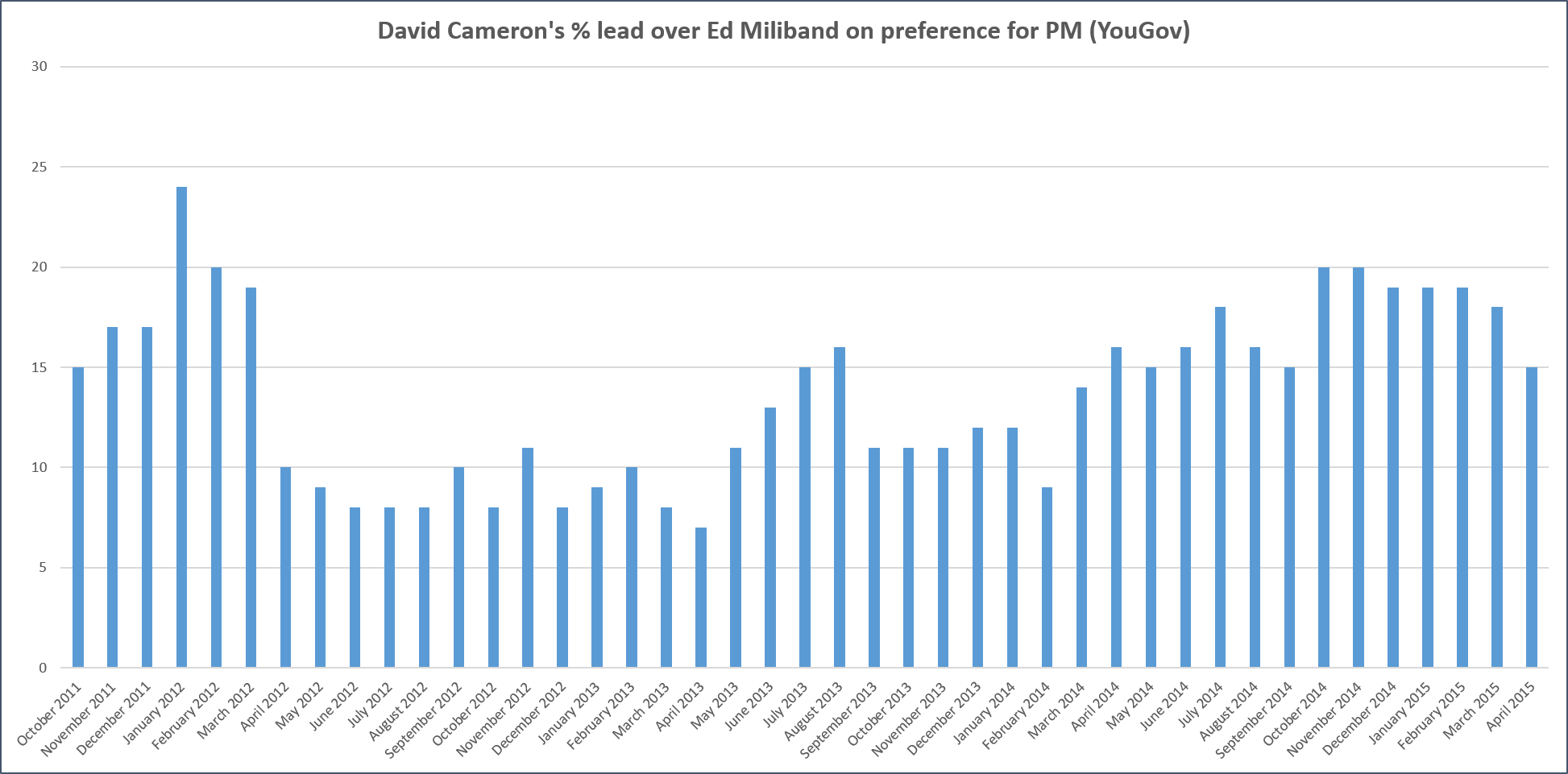
And for the entirety of the past five years, Ed Miliband also trailed David Cameron on the public’s preference for prime minister. In April, the average deficit was 15%.

PM lead

Two numbers. 25% and 15%. These are the reasons that Labour was going to lose to the Tories, no matter what type of campaign the party ran.

These are also the reasons that Labour was always going to lose to the SNP in Scotland.

The SNP pitch was only possible because Labour was evidently weak and Nicola Sturgeon could portray her party as the best route to stopping the Tories.

If Labour had been comfortably ahead in England and held the confidence of Scottish voters on the economy and leadership, this would not have been possible.

In the cacophony of polls, statistics and data journalism, this is the signal. All else is noise.

(more…)

Facebook Twitter Digg Delicious StumbleUpon

Labour used to know how to win elections. We need to re-learn. Fast.

09/05/2015, 04:01:27 PM

by Ian Moss

We, who came into the Labour party in the late 80s and early 90s thought we had built an invincible election fighting machine – after laying the foundations to get Labour back in contention and become an electoral force again the New Labour project embraced the changes in society and was the only party that looked in touch with modern Britain.

In reality, when we look back in 2020 the last 41 years of our endeavours will have seen only 13 years of Labour government. Labour is back into its natural state – as a party of opposition. The only virtue to make of letting the Miliband leaderships run its course to the election is to say that the left had another go, and again it failed. We have tried this plan enough in my lifetime now and it needs to stop.

Cameron has now got the opportunity to be PM for as many years as leader as Blair was, although I suspect he will happily retire after 2 or 3 years. Think about that. Blair, the all-conquering, was PM for 10 years. Cameron could do the same, happily, given this election result.

But he won’t find it easy. The majority is thin and his party will only stay becalmed for a while before its inevitable tensions start showing – over Europe and social liberalism – and he’s not a man noted for knuckling down to the hard business of government or has the soft skills of wooing back benchers. His style of party management means he could be in for a rough ride.

Labour has the power in opposition given this result, to make life difficult for the government, but only if it joins forces with exactly the political groupings that the public were frightened it would. If Labour spends the next 5 years voting down measures in alliance with the Greens and SNP it should prepare itself for a long time in opposition.

The Labour party should not see the way out of this result as building a coalition of Green voters, left wing Liberal Democrats and various fringe campaign groups. The only connection to the non-metropolitan world they have is as they drive through it on camping holidays. Labour does not need to appeal to the drivers of motor-homes; it needs to appeal to the car mechanics that fix them.

The Labour party core vote is urban and liberal. It also needs to be suburban and blue collar. People who run small businesses, work in trades and, yes, drive white vans. Empathy with their issues was notably absent from the team around Miliband which was full of the types of people who spent their Saturdays in Fabian Conferences. Real people don’t spend their weekends in seminars. Labour need to appeal to aspirational and entrepreneurial voters.

(more…)

Facebook Twitter Digg Delicious StumbleUpon

Answers to the questions of general election week 2015

09/05/2015, 12:28:51 PM

by Jonathan Todd

I asked five questions about this week at its start. Now we are at its end, we have our answers. And few of them are pretty. But amidst the rubble of Labour’s defeat, shards of opportunity protrude.

Will a “Sheffield rally moment” happen?

There was an eve of poll rally in Leeds but it generated few headlines. Rather than the Sheffield rally of 1992, we had humbling moments akin to Michael Portillo’s defeat in 1997. Douglas Alexander, Ed Balls and Jim Murphy were all symbolic and significant defeats for Labour. As were Danny Alexander, Vince Cable and Simon Hughes for the Liberal Democrats.

The churn in big names was high. The Parliamentary Labour Party has been shorn of major intellects and players. The Parliamentary Liberal Democrat Party even more so. Much changed eras dawn in both parties.

Can the Tories make it to 290 MPs?

The Tories cleared that threshold by a massive 41 seats. We erroneously thought that the Tories might fall short and that we’d be in for weeks of haggling over the government’s composition.

The 4 per cent swing to the Tories in the key seat of Nuneaton at about 2.30am brought the nightmare scenario of the BBC exit poll a decisive step closer to reality. The Tories did not just beat Labour in seats, like Nuneaton, that they were defending against us.

They prevented Labour PPCs from becoming or returning as MPs in a number of seats that had been held by Labour: Julie Hilling (Bolton West); Andy Sawford (Corby); Chris Williamson (Derby North); Martin Caton (Gower); Ed Balls (Morley and Outwood); Alison Seabeck (Plymouth Moor View); Rowenna Davis (Southampton Itchen); David Wright (Telford); and Chris Ruane (Vale of Clywd).

Conservative Amanda Solloway was so stunned to win Derby North that she hadn’t prepared a speech. “It was a bit of a surprise,” conceded Johnny Mercer, the new MP for Plymouth Moor View. Lucy Allan, who overturned David Wright’s majority, had been, “told Telford was totally unwinnable”.

“They couldn’t use NationBuilder,” Davis recently said of her Conservative opponents in Southampton Itchen. “They haven’t got the people to co-ordinate. And in an election where people don’t trust the media but do trust their neighbours, that’s a problem.” Somehow, however, the Conservatives did communicate more successfully than Labour in that seat.

(more…)

Facebook Twitter Digg Delicious StumbleUpon