




INSIDE: Advantage Alexander in Labour’s campaign team reshuffle

04/07/2014, 08:02:33 AM

Three new faces join Labour’s campaign team as deputies to Labour’s chair of campaign strategy, Douglas Alexander: Gloria de Piero, Toby Perkins and Jon Ashworth to improve broadcast coverage, field operations and work with candidates. Cue warm fraternal regards from all and sundry on Twitter, nothing to see here, all just run of the mill announcements.

Except of course, they aren’t.

The essential background is that Michael Dugher – responsible for campaign communications – and Douglas Alexander, are not on speaking terms. We know because of this. Quite possibly the most extraordinary example of red on red briefing since the low point of the TB-GBs a decade ago.

The overlapping nature of their briefs was always likely to cause friction, a function of Ed Miliband’s reluctance to pick a single campaign boss. Now, the Alexander-Dugher antipathy has become so entrenched that even by Labour’s dysfunctional standards (see recent comments by J Cruddas about unreconciled camps), something had to be done.

Rather than fix the original mistake and unambiguously choose a single campaign lead, Ed Miliband has opted for a fudge.

The primary role of the new appointments is to form a human shield between Alexander and Dugher.

In the original campaign structure, Dugher and Alexander had an executive function: their role was to discuss the recommendations from the staff team and make decisions. But in a world where the two aren’t talking, and the leader refuses to choose between them, a buffer was needed.

Enter the new deputies.

It’s notable that on the Tory side of the fence, there is no comparable proliferation of MPs in campaign roles. They have a single official at the helm, Lynton Crosby, who is accountable to Cameron and Osborne and that’s it. Everyone else does as they are told.

Read the rest of this entry »

Facebook Twitter Digg Delicious StumbleUpon

UNCUT: Labour must take the lead on extending competition in the banking sector

02/07/2014, 07:23:59 PM

by Callum Anderson

With a little under a year until the 2015 general election, Labour is marginally ahead of the Conservatives in most polls, yet Ed Miliband continues to trail the prime minister on the issue of leadership and the two Eds still lag behind the prime minister and the chancellor on who people trust to run the economy and, in particular, who will best secure the public finances.

Indeed, as is agreed by most people, it is the economy, and how the two main parties intend on developing it over the next five years, that will dominate the political discourse over the next twelve months.

Now, whilst the public finances are quite reasonably the fundamental dividing lines between Labour and the coalition government, it is essential that other issues surrounding the cost of living crisis are also not ignored: rising energy prices, the shortage of affordable housing, to name just a few examples.

But there is another strand of this debate that is sometimes overlooked: the provision of basic financial products –a bank account, access to fair and affordable credit –that are, quite simply vital to everyone across the country if they are to participate fully in the UK economy.

The Community Investment Coalition (CIC) this month launched its Community Banking Charter states these basic financial products that every adult, household and business in the UK should have access to the following:

  • A basic transactional bank account;
  • A savings scheme;
  • Credit;
  • Physical access to branch banking facilities;
  • Insurance; and
  • Independent money management advice.

Everyone, regardless of party affiliation, will agree that these six elements are not excessive. Without access to these basic products, millions are been prevented them from participating fully in the economy. Add this grim reality to the coalition government’s calamitous rolling out of Universal Credit, and you have a situation where it is extremely difficult for people to escape poverty.

Read the rest of this entry »

Facebook Twitter Digg Delicious StumbleUpon

UNCUT: Continuity Miliband: Why it’s likely Ed Miliband will fight on if Labour lose next year

02/07/2014, 10:54:17 AM

by Rob Marchant

It’s a rollercoaster ride, this one. On the one hand, we continue to have a recovering economy, a relentlessly-downward-trending poll lead and pretty horrific personal polling for the Labour leader. The head of the policy review says “interesting ideas and remedies are not going to emerge through Labour’s policy review”. A well-meant piece on LabourList tries to argue “Why Miliband still matters”. Senior party figures, sensing a possible future leadership contest, are clearly on manoeuvres. The impression of disarray in Labour ranks is hard to avoid.

On the other, we have Michael Ashcroft’s analysis which shows that, surprisingly, Labour is still ahead in the marginals, where it counts. Incumbent parties do not generally increase their vote-share, either (although neither have we had a coalition for 70 years, so who knows).

Wiser heads realise that this is because the election really is still too close to call, ten months out. We can but set out the possible scenarios, without any real idea which will prevail. Whatever the result, the one thing we can say with a reasonable probability is that no-one is going to get a landslide. And this one thing that we can say, the relative closeness of it all, brings its own consequences.

So, those scenarios.

One: Labour has won a majority. Theoretically possible and should always be the public aim but, at this point, surely more prayer than probability.

Two: Labour in minority government or coalition. Whilst not an ideal situation, it is possible to conceive a government that could go the full five years. And it’s better than being in opposition. Risk: “Hollande syndrome”. Government perceived as weak, we promise a bunch of things that we can’t deliver and end up out of government, quite probably for a long time. Note that this syndrome might also happen in scenario one, but the parliamentary arithmetic here makes it worse.

Three: Labour has lost, Miliband resigns. We explored that in another Uncut piece here. It’s not pretty: whether or not the Unite-PCS merger goes ahead, or Len McCluskey carries out his threat to disaffiliate from Labour, a much messier transition than 2010 seems certain and a battle for the heart and soul of the Labour Party quite a real possibility. All in the context of a not-yet-bedded-down set of rule changes over who gets to vote for the new leader. Not for the faint-hearted.

Four: Labour has lost, Miliband looks to stay on. This is a scenario which has been the subject of much speculation over recent days. While we must take the Daily Mail’s stirring on this with a pinch of salt, and it is easy to view such things as the feverish imaginings of over-ambitious colleagues with their eyes on the prize, Uncut’s intelligence indicates that it is, on the contrary, a real possibility.

Now think about why.

Read the rest of this entry »

Facebook Twitter Digg Delicious StumbleUpon

UNCUT: Brownian big numbers don’t persuade anyone, so why does Labour keep announcing them

01/07/2014, 12:59:44 PM

by Atul Hatwal

Today, the disconnect between Labour’s approach to political communications and the general public was on full display.

To accompany the launch of the Adonis Growth Review, the topline of Labour’s story was that it would devolve up to £30bn of central government funding to new regional partnerships of local authorities.

The model of regional co-operation that Labour is advocating has had demonstrable results in Greater Manchester, where 7 North West local authorities are working well together. The incentive of greater devolution of funds from central government would surely prompt other areas to follow Greater Manchester’s lead.

As a policy, there is much to recommend today’s announcement. Which is why the way it has been packaged for the media is so depressing.

Gordon Brown was notorious for bludgeoning audiences with lists of gargantuan numbers to demonstrate his commitment to Schools-n-Hospitals. Notorious because, while these types of big numbers have a certain resonance within the Westminster bubble, they are positively off-putting for most voters.

I’m currently conducting a series of focus groups for the day job, looking at how people understand political messages. The topic we’re looking at specifically is immigration, but the findings are applicable to most political issues.

When confronted with a statistic, particularly a Brownian big number, there is typically a two stage response: “I don’t understand your number,” swiftly followed by, “I don’t trust your number.”

Dealing with the first response is comparatively straight-forward. It’s all about context.

Abstract statistics mean very little to voters. Cash numbers in the billions or percentage growth rates lack any practical resonance with peoples’ lives.  They tend to simply fade into the white noise of politicos’ stat chat.

Read the rest of this entry »

Facebook Twitter Digg Delicious StumbleUpon

UNCUT: Miliband’s bridge building with business should be applauded

01/07/2014, 08:15:02 AM

by Jonathan Todd

The case for augmenting Labour’s cost of living campaigning is almost as old as this campaigning. The advantages accruing to Labour from this campaigning are challenged by those that accumulate to the Conservatives from the more general economic improvement. This improvement encourages optimism among businesses, which some feel Labour threatens.

Labour needs to reassure these businesses and the voters who work for them that Labour poses no such threat. That, as Pat McFadden and Alan Milburn have both put it, Labour is as concerned with generating wealth as with distributing it. It is, as Chuka Umunna is quoted in a recent FT article headlined ‘Labour seeks to reposition as pro-business party’, a fairly academic decision how you can cut the pie more fairly if you haven’t increased the size of the pie first.

That Umunna is clearly right, while business fears that this is not understood by Labour, makes the repositioning heralded by the FT welcome. We are now in what The Sunday Times described as “a week long campaign to mend fences with business leaders”. No matter what big policy announcements this week may bring, Labour should not expect that they alone will secure business support.

Fifty small press releases matter more than a big policy announcement, as the ex party adviser Steve Van Riel recently observed. If Labour wants better relations with business, and I’m pleased that we do, we shouldn’t think that these can be cemented in a week, no matter how big our policy announcements. Such relations require diligent cultivation over the long-term. Which the activities of this week should be a staging post on.

It is to be hoped that Ed Miliband and his shadow cabinet are up for this. Because there will be those in our party who will implore them not to be. Similar protestations, as Uncut has noted, have blunted moves to the centre on welfare. Concerted efforts to win business support would be another move to the centre, which is valuable enough that Miliband should be prepared to endure internal criticisms.

Read the rest of this entry »

Facebook Twitter Digg Delicious StumbleUpon

UNCUT: Reshuffles hardly ever make a difference. But that won’t stop the speculation

30/06/2014, 06:09:38 PM

by David Butler

David Cameron and Ed Miliband are preparing to shuffle their packs and make their final cut of this Parliament; for one, this will be the last reshuffle they preside over. Ministers and their shadows buzz around nervously awaiting the phone call that will determine the next few years of their political career. For a few, membership of the cabinet (or shadow cabinet) awaits. For others, the comfy leather of the commons backbenches is their destination. However, as much as fun discussing reshuffles can be, the act itself will be mostly irrelevant to either party’s prospects next year.

There is a media tendency to overhype the impact of reshuffles. In Miliband’s most recent shadow cabinet reshuffle was argued to be a cull of the Blairites. In fact, it was more of a replacement of Blairites associated with the Ancein Regime rather than Blairites per se. The 2012 government reshuffle was said to be a ‘rise of the right’ moment but has made little discernible effect on the overall direction of the government, aside from possibly the work done by Chris Grayling as justice secretary and Owen Paterson as environment secretary. Another discrepancy between media discussion and political reality is the perception that reshuffles are a political masterplans, executed with supreme efficiency; in fact, it is often the case that they are chaotic and messy. For example in 2012, the failure of Cameron to convince Iain Duncan Smith to move from the DWP to the MoJ caused a chaotic last minute rethink of the reshuffle and damaged relations between Number 10 and IDS.

The presence of a northern woman in the cabinet will not be the silver bullet to the issue of Tory unpopularity with urban voters and women, just as Sajid Javid’s appointment has not made the Tories more appealing to ethnic minorities. Without addressing the deeper roots of the problems – culture, policy, perception and history – that prevent the Tories from winning over said voters, such an appointment will have only the most marginal of impacts.

For Labour too, a few fresh faces, perhaps a promotion for Gloria de Piero or Dan Jarvis, won’t get over our problems of the lack of trust on the economy and Ed’s poor personal ratings. These are problems arising from strategy, communication and Ed himself. People don’t believe we will make the changes we have pledged and are sceptical that we can manage the economy and public finances well.

Read the rest of this entry »

Facebook Twitter Digg Delicious StumbleUpon

UNCUT: Hyperbole is becoming a bad habit for our political class

30/06/2014, 07:29:35 AM

by Kevin Meagher

If the Scottish referendum on independence is ‘lost’ in September it may be a tad late to reflect that apocalyptic warnings of Caledonia dystopia didn’t exactly help win the case.

Claims in February that Scotland wouldn’t be able to keep the pound – a “masterstroke” concocted by the three main Westminster parties’ frontbenches – were silly enough, leaving the electorate unmoved while playing into the SNP’s hands, showing-up the Westminster elite up as a cosy club.

Last week, however, the ‘hyper’ was well and truly put into ‘hyperbole’ when Ed Miliband floated the idea of border checkpoints if Scots opt for independence. The supplementary question are obvious enough.

Will these checkpoints come with watch towers and Alsatians? Will we see miles of unfurled razorwire stretched across the countryside, just like in The Great Escape?

Hell, why not just rebuild Hadrian’s Wall.

Why can’t we treat the Scots as rational adults?

“Sorry you’re thinking of going. We’ll miss you. There’s nothing at all wrong in embracing your nationhood, but there are a few serious practical downsides. We’ll respect your wishes, but, out of friendship, we want to discuss these and try to persuade you to stay.”

Surely that’s better than threatening them with Checkpoint Charlie?

Alas, too many Westminster politicians, schooled in that ghastly student union habit of painting debates into tiny corners in order to make broader points, think this is how you shape public opinion.

Read the rest of this entry »

Facebook Twitter Digg Delicious StumbleUpon

UNCUT: Khan’s reaction to new lags’ bedtime is tone deaf

28/06/2014, 02:41:35 PM

by Kevin Meagher

As campaign slogans go: “Soft on criminals, soft on the bedtime of criminals” is hardly a winner.

But it nevertheless appears to be Labour party policy after Shadow Justice Secretary Sadiq Khan today described the government’s bid to introduce a new 10.30pm “lights out” policy in young offender institutions as a “gimmick”.

Justice Secretary, Chris Grayling, believes the move will help inmates (“most of whom have had chaotic and troubled lives”) by setting clearer boundaries and instilling some much-needed self-discipline.

According to today’s Independent, prison governors have been told to enforce the new policy from August. After 10.30, watching television – or reading under the covers – will be strictly banned and staff patrols will enforce the measure, including removing privileges from anyone breaking the new rules.

At the same time, however, Grayling also proposes to “more than double” the hours of education and training that under-18s in custody receive each week.

Khan’s – and Labour’s – response?

“Routine is crucial for those with chaotic lives, but to think that turning the lights off at the same time in every youth prison is all that’s needed to turn them all into law-abiding citizens is a joke,” he said.

“This looks like a gimmick to cover the cracks caused by Grayling’s cuts.”

“A joke?” Really? “A gimmick?” Was this response off-the-cuff? And who was Khan aiming it at?

Why did he not say something more balanced like: “Setting boundaries for young offenders is sensible and helps provide structure and encourage self-discipline; however Chris Grayling’s cuts to prison budgets means there are concerns about staffing these new arrangements.”

Read the rest of this entry »

Facebook Twitter Digg Delicious StumbleUpon

INSIDE: “290 seats and Ed stays”

27/06/2014, 03:32:37 PM

Much rumour and speculation in recent days on the aftermath of a potential Labour defeat next year. The Guardian splashed last Saturday with an anonymous frontbencher demanding Ed Miliband’s resignation if Labour loses the next election. The Mail followed up earlier this week with “friends” of the Labour leader talking up his chances of “doing a Kinnock” and fighting on in the event of a loss.

To party members these types of stories often seem to erupt into the news without warning.  But in reality they represent the cresting waves above currents that are surging below the surface.

Uncut has now spoken to four parliamentary sources that have highlighted a specific operation by team Miliband to reset expectations in the PLP. Rather than an outright victory, or even being the largest party, this endeavour is focused on setting a new benchmark: the minimum number of seats Ed Miliband needs to stay on as leader.

The magic number currently being touted is 290, a gain of 32 on Labour’s current voting strength.

290 seats for Labour would almost certainly mean the Tories were the largest party with the Lib Dems in the high 20s to low 30s. Labour would be facing another five years in opposition.

The leadership operation has involved senior parliamentarians, political advisers and friendly journalists, all giving a similar narrative on why Ed should stay. Common phrases include, “two term journey,” “changing the terms of the debate,” and “Labour needs to stay unified.”

In the event of Labour securing 290 seats, the leader’s pitch would offer the prospect of a return to office if Labour could stay unified under Miliband and make another 30 or so gains at the next election. He would have a track record on making this type of progress and the fear of a divisive leadership election would be used to discourage rival candidates supporters declaring publicly.

This is the context for the recent press stories. They haven’t just happened randomly. They are the reaction to a concerted lobbying campaign by the leader’s team that prepares the ground for defeat and the internal battle to come. Expect more over the coming weeks and months.

Facebook Twitter Digg Delicious StumbleUpon

UNCUT: How Labour is losing the battle for media relevance

26/06/2014, 07:00:08 AM

by Atul Hatwal

Last week Ed Miliband, gave a major policy speech at the IPPR. One of the biggest of his leadership. The Labour party mounted a significant press operation around it: there was the mandatory trail to the Guardian the previous night, lots of morning chatter on Twitter among Milibelievers about what a big deal this all was with shadow ministers deployed to comment immediately following the speech.

But within two hours of Ed Miliband finishing his Q&A, the story was elsewhere. Rather than discuss the deeper policy or electoral ramifications of the intervention, the media’s attention was captivated by something else entirely: owls.

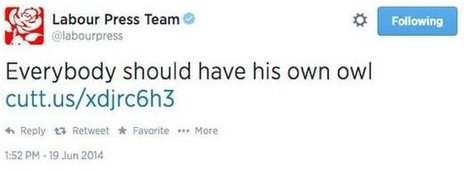
The Labour party’s twitter account was hacked with this tweet going out.

Owl Tweet

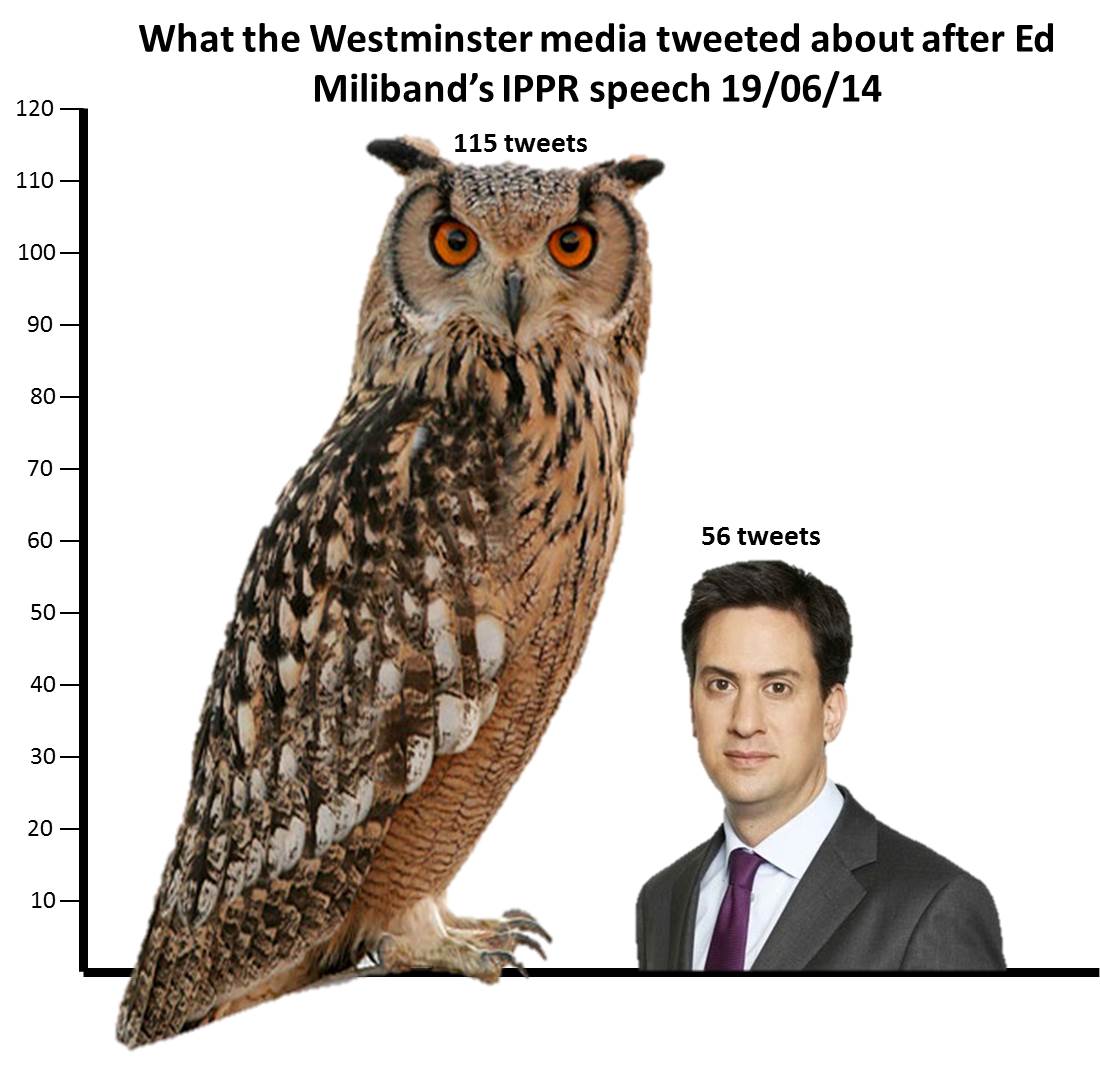
The rest is history. An analysis completed for Uncut by Twitter analytics experts, of tweets by the Westminster media (lobby, press gallery, columnists, political reporters and bloggers) illustrates the extent to which this one rogue tweet overshadowed the big Miliband speech.

From the point Ed Miliband stopped talking, to the end of the day, there were over double the number of media tweets about owls compared to Ed Miliband’s IPPR speech.

Owls vs Ed

By the early evening, loyalist MPs were having to use the owls meme to crowbar Ed Miliband’s speech back into the Westminster conversation.

Read the rest of this entry »

Facebook Twitter Digg Delicious StumbleUpon