




UNCUT: Shadow Cabinet League: Reshuffle special

25/06/2014, 11:29:54 AM

by Alan Smithee

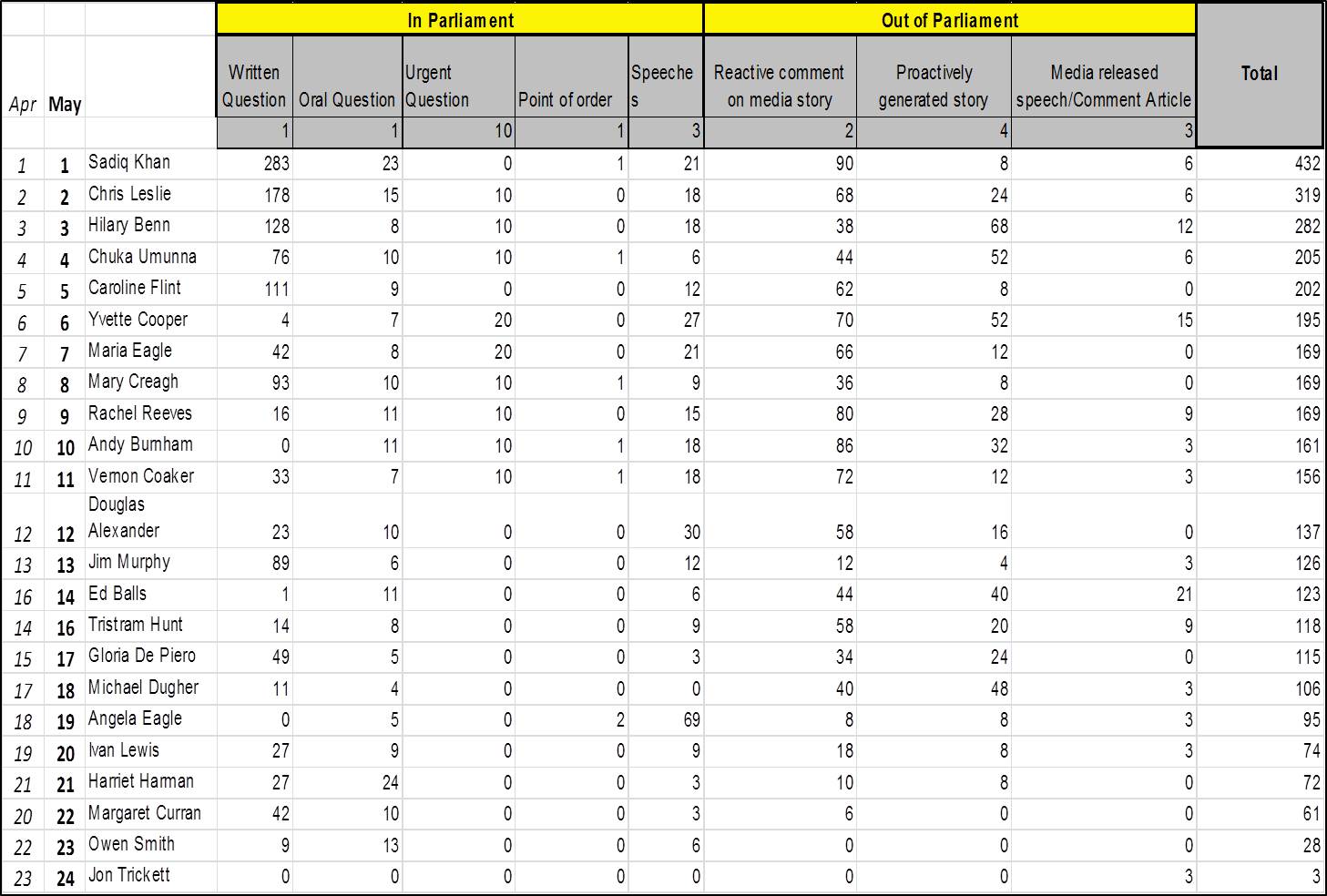
We are entering reshuffle season. Parliament is full of Labour MPs hoping Ed Miliband won’t put the black spot on them. For some shadow cabinet members, this is the end of the line. For others, they will cling on, their hopes of high office not yet dashed. At Uncut, we are nothing but loyal servants to Dear Leader, so our table may give him a few ideas as to who should be bumped off.

The recess and elections meant that May saw relatively low levels of parliamentary activity.  Sadiq Khan continued his good work. The relative success of the London results has boosted his chances of getting mayoralty nomination (even if his spectacularly poor Express article showed a lack of judgement). Chris Leslie had a busy media month, attempting to combat the Government’s narrative over the recovery and setting out how Labour would build long-termism into the economy. Hilary Benn and his team continue their strong media attacks on the DCLG, exposing the incompetence of Pickles.

Over at Progress conference, Chuka Umunna put in a smooth performance in his Q&A session with Jacqui Smith. This capped off a successful month where he rang rings around the Government over the Pfizer/AstraZeneca issue and bested the BBC’s notoriously tricky interviewer Andrew Neil.
Shad Cab May 2014 JPEG

Just behind Chuka, Caroline Flint and his potential leadership rival Yvette Cooper had contrasting months. Flint and her team had a slow month (aside from the mandatory campaigning). By contrast, Cooper made some good interventions, proactively generating stories over Labour’s policies towards the assets of criminals and exposing the government’s poor record on waiting times for victims of crime. In the media, however, she was understandably overshadowed by Theresa May’s audacious intervention at the Police Federation conference.

Read the rest of this entry »

Facebook Twitter Digg Delicious StumbleUpon

UNCUT: Letter from Wales: New evidence of how the Welsh media has effectively been nationalised

21/06/2014, 01:23:13 PM

by Julian Ruck

Now, you readers of Uncut may be thinking that in Wales things cannot get any crazier. Well, please note the following –

Rob Gittins, who lives in Carmarthenshire and is an award-winning screenwriter for such programmes as EastEnders, Casualty and The Bill, has had the publication of his two books, ‘Gimme Shelter’ and ‘The Poet and the Private Eye’ subsidised by public funds – make no mistake, the gentleman’s creative dexterity has certainly made a casualty out of the taxpayer!

But this is not all, do read on.

Martin Shipton, chief hack for the Western Mail no less, has written a political masterpiece on Welsh politics, titled “A Poor Man’s Parliament” (Seren 2011).

An admirable endeavour by anyone’s standards, except for one thing.

Mr Shipton observes, “…..a  stifling of public debate in Wales through the reliance on Assembly patronage of so many organisations.” So the book’s blurb maintains anyway.

Well, guess what?

His very own Marquandian and towering political critique was published with the financial help of  “Assembly patronage”!

Read the rest of this entry »

Facebook Twitter Digg Delicious StumbleUpon

UNCUT: We’ve been here before on welfare reform. Now the backlash is coming, will Labour hold the line?

19/06/2014, 01:07:25 PM

by Atul Hatwal

The much quoted definition of insanity is doing the same thing over and over again and expecting different results. Today, the Labour party is testing this proposition.

For the third time in seven months, Labour is attempting to re-position itself on welfare. For the third time in seven months the pre-briefing before a welfare reform speech has been about “toughness,” how Labour will cut benefits for young people and respond to public concerns on welfare spending.

We’ve been here before.

As a taster for what’s likely to come, this is what happened the first time Labour went down this road, back in November last year. James Kirkup at the Telegraph wrote a story on potential Labour cuts to benefits for under 25s if they were not in training or ‘intensively’ looking for work, based on an IPPR report and a briefing from the party. 

The backlash from the party forced an immediate denial, with Rachel Reeves tweeting “This is not and will not be our policy” “it’s not our plan” and “it is totally not my position!” Cue much relief,

These weren’t the reactions of random activists, Matthew Pennycook is the PPC in Nick Raynsford’s seat and will be an MP in 2015, Gemma Tummelty works for Ed Miliband and Mark Ferguson edits Labour List.

Take two. In January this year, Tom Newton Dunn at the Sun wrote a similar story about removing benefits for the young unemployed, which was, once again, based on another IPPR report and a briefing from the party. Cue a repeated denial from Rachel Reeves and more relief,      Read the rest of this entry »

Facebook Twitter Digg Delicious StumbleUpon

UNCUT: A decade has passed and the world is in chaos. For all our sakes, can we all move on from 2003, please?

18/06/2014, 10:26:15 AM

by Rob Marchant

If recent events in Ukraine were not disturbing enough for those who might occasionally worry about the future for their children and grandchildren, one need only now look towards the Middle East, and a little further.

The aftermath of the Arab Spring. Egypt. Syria. An isolated Israel that seems to have lost all hope of establishing a meaningful alliance against a soon-to-be-nuclear Iran, and has now ended up forming stranger ones. A pernicious and persistent strain of Islamism remaining in Afghanistan, parts of Pakistan and Nigeria, to name but a few.

And finally, the coup de grâce: the overspill of ISIS Islamists from Syria into large parts of Iraq, threatening, in a symbolic poke in the eye for the West, to realise a long-held goal. A fanatical and oppressive religious autocracy; a Caliphate.

It is difficult to recall a moment since the 1960s when the world has been in such an unstable geopolitical position. The bipolar certainties of the Cold War are now replaced with the unpredictability of a multi-polar world. And all the while, we have Western countries and their governments seemingly stuck as powerless onlookers, rabbits caught in the headlights of their own recent history in Afghanistan and Iraq.

And nowhere is this more the case than the British Labour party. We cannot look at the current situation in Iraq without reflexively referring back to 2003. For those who disagreed with it, it is a perfect chance to say, ah well, that’s because of what we did. Never again. We still cannot forgive and forget, eleven years after the invasion and seven since its chief architect left office. We cannot help but re-fight old battles.

Read the rest of this entry »

Facebook Twitter Digg Delicious StumbleUpon

UNCUT: If coalitions are to work, they need to be time-limited

17/06/2014, 05:04:39 PM

by Kevin Meagher

The fallout from Dominic Cummings’ salvo against David Cameron and the coalition government received a less histrionic response from former Cameron special adviser Sean Worth this morning.

Writing in Public Affairs News, the adviser turned lobbyist wrote that:

“Future coalitions will be formed by parties demanding explicit control of distinct areas of policy, rather than simply sharing power. The principal powers, notably tax and spend, and defence decisions, must be shared, but governing leaders will carve out defining areas of political territory on which to build the personal crusades needed to push radical reforms that really get them noticed.”

The current model of zipping ministerial appointments in departments between Conservatives and Lib Dem and vice versa, has seen the creation of internal departmental hand breaks. Think Gove and Sarah Teather, or Vince Cable and Michael Fallon. (Of course, one place it has worked all too well is the Treasury between George Osborne and Danny Alexander – but that underlines a different problem, certainly for the Lib Dems).

Reform-minded ministers like Michael Gove are frustrated by the need to co-operate and seek consensus. For politicians (and advisers like Cummings) who are sure of themselves and are keen to make their mark – or who simply want to please their party and implement the manifesto they stood on – the current coalition experience is clearly a massive anti-climax.

But creating party fiefs across Whitehall – Worth’s alternative suggestion – is a recipe for disaster. How do you deal with cross-cutting issues in this model? Take the recent spat between Gove and Theresa May on tacking extremism. How much more loaded will rows like that become when they are not just between different departments, but different departments controlled by different parties?

If inconclusive election results are to become the norm, then our political system needs a clearer way of responding. Coalitions may indeed be here to stay, but rather than staggering on for five years, descending into bickering and drift in the process, it would be better to limit their lifespan to 12-18 months instead.

This focuses the attentions and energies of both parties. It creates an incentive to co-operate on areas of agreement and on issues that require immediate attention in the national interest. Larger changes should be put before the electorate at the subsequent election.

This sort of arrangement would show that sensible co-operation between parties in the national interest is indeed possible, but it also challenges voters to accept that our model of government works best when a single party has a mandate to govern.

Kevin Meagher is associate editor of Labour Uncut

Facebook Twitter Digg Delicious StumbleUpon

UNCUT: If you don’t support religious freedom, then you don’t support freedom

16/06/2014, 04:29:31 PM

by Kevin Meagher

Given we’re constantly told we live in an age of evidence-based policy-making, the reaction to the so-called Trojan Horse case in Birmingham owes more to Medieval peasant superstition.

What has warranted the blanket media coverage of recent weeks? No organised conspiracy to ‘Islamify’ state schools in Birmingham has been uncovered. No evidence of criminality has been produced. No charges are pending.

All that has happened so far, despite almost daily media attention and a series of top-level investigations, is that a handful of schools in one if the poorest parts of the city are to be placed in special measures at the behest of schools inspectors.

Yes, there are suspicions about what might have gone on, however much of the reporting has been little more than conjecture – more heat than light – blackening the reputation of Birmingham’s Muslim community in the process.

But that didn’t stop yesterday’s Observer. With no substantive news from Birmingham to report, the paper fell back on the old tactic of producing an opinion poll which showed:

“70% [of the public] said the taxpayer should not be funding the promotion of religion in schools, 60% said such schools promoted division and segregation, and 41% said they were contrary to the promotion of a multicultural society.”

Of course it’s worth pointing out, for the avoidance of doubt, that parents who want to send their children to faith schools are still taxpayers. Just as it’s worth noting that none of the schools involved in the Trojan Horse ‘scandal’ are, in fact, faith schools at all.

Nevertheless, shadow education secretary, Tristram Hunt, was enjoined to comment. He thought the case “raised questions” about “how we manage potential tensions” around “faith, multiculturalism and state education”.

Read the rest of this entry »

Facebook Twitter Digg Delicious StumbleUpon

UNCUT: Tory splits offer Labour an opportunity

16/06/2014, 12:57:56 PM

by Jonathan Todd

The Tories now have a great deal of confidence after Newark, wrote the Spectator’s Isabel Hardman on 6 June. The rebelliousness of their backbenches, especially the 2010 intake, has been one of the features of this parliament. Newark marked the first time in a quarter of a century that they retained a seat in a by-election in government, which followed the local and European elections that indicated they are well placed for 2015 if they can recover those who defected from them to UKIP. The smell of success and bigger success to come, sharpened backbench Tory focus.

As soon as discipline returned to the Tory backbenches, however, it spectacularly deserted their frontbench. The mutually assured damage of public airing of policy differences between Michael Gove and Theresa May makes events inexplicable, not least as they cast a shaft of light on a political terrain that must undermine the Tory general election cause: the world beyond David Cameron. No party wants to face election with a diminished leader and Cameron is now likely to face the question that dogged Tony Blair throughout the 2005 general election: “If elected, will you serve a full term?”

A decade ago, the “buy Blair, get Brown” deal was deemed acceptable – without great enthusiasm but sufficiently palatable to return Labour to a third term in government. While George Osborne harbours hopes of becoming party leader and prime minister in the next parliament, it’s doubtful that he wishes to fight the general election on a similarly joint ticket. The antics of one of his supposed backers, Michael Gove, makes this more likely, however.

Gove has a habit of getting into unnecessary arguments. He first entered my consciousness as a panellist at a debate on the Iraq war in 2003 in Shoreditch Town Hall, organised by the Foreign Policy Centre. My only memory is of him berating an audience member for what he saw as a faulty interpretation of the Glorious Revolution. I also recall Allegra Stratton – now Newsnight’s political editor, then one of the organisers of debate – skipping about the place. I don’t know whether this reveals anything substantive about her character but the cantankerous first impression that Gove left me with does appear telling.

Read the rest of this entry »

Facebook Twitter Digg Delicious StumbleUpon

UNCUT: The Sun photo-opp farce shows how Labour’s activist tail wags the party dog

13/06/2014, 05:15:29 PM

by Atul Hatwal

Only in today’s Labour party, with this Labour leader, could a photo-opp for Britain’s most popular newspaper, degenerate into such utter farce.

Set aside for a moment the inexplicable political judgement in agreeing to the picture in the first place. The judgement that a leader who has defined himself as the iconoclastic scourge of Rupert Murdoch, could credibly pitch-in to help the Sun’s World Cup promotion, without harming his brand.  Difficult as it might be, set that aside.

Because once the decision to take part had been made, that should have been it. Yes there was going to be criticism and yes the picture was gormless, but this should have just been an afternoon’s amusement for the Twitterati.

Instead, Ed Miliiband’s response to his party critics has turned a minor Twitter storm into a running news sore where, yet again, his leadership is in question. Today’s quasi-apology is as disingenuous as it is unbelievable:

“Ed Miliband was promoting England’s bid to win the World Cup and is proud to do so.

But he understands the anger that is felt towards the Sun over Hillsborough by many people in Merseyside and he is sorry to those who feel offended.”

First, to pretend that the photo-opp was about England and the World Cup takes the viewing public to be imbeciles. It’s quite clearly a promotion for the Sun. The clue is in the copy of the Sun that Ed Miliband is holding up.

Second, the unquestioning capitulation in the face of protests from Liverpool’s Labour activists and MPs is worrying.

Read the rest of this entry »

Facebook Twitter Digg Delicious StumbleUpon

UNCUT: A lesson from football: Labour needs to temper its regulatory reflex

13/06/2014, 11:04:06 AM

by David Butler

A few weeks ago, the first set of Financial Fair Play (FFP) fines landed upon the desks of the owners of Manchester City, Paris Saint-Germain and a host of other football clubs. UEFA’s new system is meant to make European football fairer, limiting the ability of clubs to generate losses in search of better league places in search of European glory/a group stage exit in the Champions League. Critics have accused the reform of strengthening the power of the big clubs. These critiques of FFP offer important insights for politicians looking to intervene in markets.

There is a convincing claim that FFP embeds oligopoly. Its structure strengthens clubs like Manchester United, Barcelona and Bayern Munich whose historic hegemonic position in their respective leagues means they are major profit-making bodies. Clubs who wish to compete with them need to make significant investments to be able to match the transfer kitty, wage offers, and footballing status offer by the big teams.  Relative insurgents like Manchester City or AS Monaco rely on owners who are able to invest a sum close to the GDP of a small African nation. These investments are overwhelming loss-making, at least initially, due to the huge cost of building a squad capable of challenging consistently for Champions League places. FFP means that fewer clubs will be able to pay the sunk costs often needed to enter the market for Champions League places within their respective nation. Bad regulation may well sustain the wealthy clubs and stymie greater competition.

Read the rest of this entry »

Facebook Twitter Digg Delicious StumbleUpon

UNCUT: Letter from Wales: Arts Council of Wales referred to Welsh Audit Office

12/06/2014, 09:41:28 AM

by Julian Ruck

BBC Wales, whilst usually being keen to report on the minutiae of its director, Rhodri Talfan Davies’ day, is apparently not so enthusiastic about broadcasting the culture of endemic greed that seethes through its nationalist hallowed corridors at Head Office, Llandaff.

On Monday, I attended the press conference at the Senate and not being inclined to exercise the habitual mealy-mouthed and pretty syntax of Welsh media sycophancy and deferential hero-worship, I well and truly went for it.

Naming and shaming BBC Wales presenters and staffers was the name of the game, exposing their taxpayer bungs and making sure certain matters were finally rubbed in to the Welsh political scene was the intention, and not to mention openly exposing all those Dick ap Turpins of artistic impersonation and poetic delusion at the Arts Council of Wales.

Mission accomplished.

Welsh politicos have already filed a report on the Arts Council of Wales with the Wales Audit Office, and if there is no satisfaction here I’m told, a Public Accounts Committee may well be the next step.

About time too!

And did any of the spineless Welsh media platforms report any of this? Like hell they did. What? Bring the Crachach into disrepute, can’t have that now can we? We’ve all got season tickets on the Taffia Express gravy train too!

So much for democratic accountability.

So much for democratic scrutiny.

This is Wales.

Wake up Ed, for God’s sake wake up and see what Welsh Labour is doing.

PS I am persona non grata (which is putting it somewhat mildly!) where the Welsh Labour press office is concerned, but on Monday sneaky serendipity struck. Whilst enjoying a cup of coffee in Cardiff Bay, who should be sitting at another table but the Welsh Minister for Culture and Sport, John Griffiths.

An approach was naturally irresistible, so I duly buttonholed the gentleman and having appraised him of the ACW and BBC Wales’ profligate abuse of the taxpayer I received three words, and I mean three,“ There are procedures.”

That was it.

Welsh Labour’s ethos of accountability at its best, mind you Mr Griffiths didn’t seem too happy about my approach in the first place. There was nowhere to hide and a Welsh media hack I am certainly not!

Julian Ruck is a novelist, broadcaster and columnist. His most recent novel is ‘The Silver Songsters’ (pub. April 2014).  

Facebook Twitter Digg Delicious StumbleUpon