




UNCUT: White collar fraud costs us £ billions. Now Labour has a policy to tackle it

25/06/2013, 10:28:04 AM

by Dan McCurry

“When a man steals your wallet, he gets a stretch. When he steals your pension, he gets away with it,” said Emily Thornberry as she launched her policy for Tackling Serious Fraud and White Collar Crime.

In this country, the Serious Fraud Office (SFO) is considered a bumbling fool, whose work has been cut back so much that last year it only brought a mere 20 trials, on a total budget of only £30m.

To put that in some context, fraud costs the British economy £73billion a year. It was with this thought that the shadow Attorney General travelled to America to see why US prosecutors have such a formidable reputation.

Thornberry arrived in New York and moved on to Washington. In these two cities she found fraud prosecution teams buzzing with the brightest talent. Young lawyers aggressively compete for opportunities in fraud, not because it pays well, but because this is where the big reputations are made.

What a contrast with this country. For years, decades, the SFO has been castigated as a disorganised waste of time and money. Trials collapse, fraudsters walk free, judges criticise, journalists attack, and politicians pour resources into a bottomless pit. Thornberry realised that over all these years of criticism, the focus has been wrong. The problem is not the institution. The problem is the law.

As a simple interpretation of the existing British law, a company can be prosecuted, but a person has to represent that company in the dock. So the directors distance themselves from the crime, and hire lawyers to obstruct the feeble powers of the police investigator. This confuses the situation and allows the company and its directors to wriggle off.

Read the rest of this entry »

Facebook Twitter Digg Delicious StumbleUpon

INSIDE: More trouble in Liverpool Wavertree

24/06/2013, 01:09:39 PM

A new twist in the saga surrounding the suspension of Labour local councillor, Jake Morrison following his fall-out with the Labour MP Luciana Berger. Not happy with being suspended by the party, Jake has struck back: he’s left the party.

The Liverpool Daily Post has the full statement from young Jake, but the key paragraph is this,

“As a working class lad from Liverpool, who is determined to make a positive difference, I have decided to announce today that I will be standing for election in 2015. I will be standing as an independent candidate for Liverpool Wavertree in the upcoming general election.”

So, Luciana will have a rival at the next election, likely fighting from the left and with a substantial local profile. As is clear from his statement, this newly independent councillor will be drawing a strong contrast between “a working class lad from Liverpool,” and the less local, local MP.

Given the Labour majority in Wavertree at the last election was over 7,000, and was one of the few constituencies where Labour actually increased its majority compared to 2005, the challenge will likely prove quixotic.

But it will certainly be unwelcome for Labour and will have the second placed Lib Dems licking their lips in anticipation.

Facebook Twitter Digg Delicious StumbleUpon

UNCUT: Letter from Wales: Where has “clear red water” got Wales?

23/06/2013, 12:18:56 PM

by Julian Ruck

Back in 2002 Rhodri Morgan gave his “clear red water speech,” declaring “We’re not old or new Labour, we’re Welsh Labour.” It set the course for Welsh Labour’s approach to government, citing Beveridge and Bevan as the inspirations.

Fine words but more than 10 years later, where has it got us?

Perhaps Morgan would have been more honest had he said, we are going to fight Tony Blair to the death and to hell with modernising public services, the Welsh economy, health and education.

We want the days of old council chamber back-slapping and back-scratching in Cardiff Bay. We want to be welsh and proud of it, no matter what the cost. You boyos in Westminster can pay our bills, no questions asked. We know our devolved rights, so go and get stuffed!

For every Welsh person almost an extra £4,000 is borrowed compared to England. This Welsh Labour dream of an outdated socialist Brythonic Atlantis has bankrupted Wales, bankrupted the education of our young and bankrupted the Welsh health service.

The Welsh Labour party’s obsession (and Plaid Cymru’s) with a tyrannical Westminster Labour party has resulted in a dire attempt to free fall into isolationism without a parachute.

Read the rest of this entry »

Facebook Twitter Digg Delicious StumbleUpon

UNCUT: It may be big, but how should we use it? Data, elections, growth and 2015

21/06/2013, 10:12:07 AM

Last week Dan Fox’s proposal on data development loans was voted top f the policies for supporting entrepreneurship at the latest Pragmatic Radicalism event, chaired by Chuka Umunna MP the shadow secretary of state for business.

“Described by pollsters as a weather-vane constituency, it is contemporary information technologies making a difference this week. Jill tapped the side of her Google Glass display and began directing canvassers. “The Harrises. Last time we spoke to them, they complained about the daily commute. Can you get up that chart of rail fares and investment?” Swiping away at his iPad, Jack strolled off, armed with all he needed to connect, both electronically and emotionally, with the voters at number 23. On the opposite kerb, two of his colleagues were not having quite as much luck generating an augmented reality view of the lighting and paving repairs that had taken place on the street since Labour had taken over the local council in 2013.”

Election Sketch, The Times, 9 May 2015

For those who still feel that the biro and clipboard are unnecessary luxuries on the #labourdoorstep, the thought of handheld devices brimming with electronic data being at the centre of elections is at best bewildering. But data is now, as we all know, “Big”. It is all around us and has a permanence in our daily lives akin to a new way of communicating, helping us to understand what we and others are doing and will do. Campaigning is not insulated from this. Last year, Obama For America, set the standard for using Big Data in identifying, motivating and expanding the numbers of your voters. Labour looks set to reflect these techniques.

However, before we get too caught up in a vision of campaignbots traipsing around the marginals like canvassing Terminators, we should also consider the policy significance of Big Data. Although it has not been a great couple of weeks for data of any kind – in the news for all the wrong reasons as the full extent of the surveillance of the personal variety has been exposed – this must not distract us from the thousands of positive, world-changing uses of mass data collection and analysis.

Read the rest of this entry »

Facebook Twitter Digg Delicious StumbleUpon

GRASSROOTS: A progressive case for intervention in Syria

20/06/2013, 10:38:05 AM

by Sam Fowles

Few enough things unite the left of British politics. Indeed, much of our internal debate makes the Gallagher brothers look positively fraternal. But you can’t get a cigarette paper between us on Syria: Keep out. In this we’re joined by the Lib Dems, Tory backbenchers and, of course, Boris. A motley coalition to be sure, but certainly a wide ranging one.

It’s with some trepidation then, that I’m going to say: they’re all wrong (and David Cameron is right – I’m currently bracing myself for the inevitable implications on the British summer as hell freezes over).

The left should back intervention in Syria, even if this only means arming the opposition, for both practical and moral reasons. Practically, it’s the best way to limit the influence of al-Qaeda and bring the sides to the negotiating table. Morally, the West, and more particularly the left, needs to decide what we stand for and, and then protect those who are oppressed for standing up for the same thing.

The practical case against intervention is founded on “what ifs”; “What if it escalates?” “What if al-Qaeda get hold of the weapons?” Good policy makers must always consider the repercussions. But they must also take into account the situation as it stands. The fact is that the conflict has already escalated, al-Qaeda are already gaining a foothold and this is because of our failure to intervene, not in spite of it.

The death toll in Syria is estimated at 93 000. It’s no longer a matter of keeping the lid on the powder keg, it’s about what we do now that lid has been quite dramatically blown off. Introducing more powerful weapons into the conflict initially may have caused escalation but that’s already happened. Russia and Iran have already given Assad’s forces powerful weapons and the conflict has escalated accordingly, mostly at the expense of innocent civilians or opposition fighters.

Read the rest of this entry »

Facebook Twitter Digg Delicious StumbleUpon

GRASSROOTS: We need to be bolder in pushing back against UKIP

19/06/2013, 04:05:48 PM

by Helen Mirfin-Boukouris

As a Labour candidate currently campaigning in the OMOV process, the matter of UKIP and how we confront their performance in the polls and recent by-elections frequently comes up.  I expect all Labour candidates now wonder what magic bullet there might be to confront their current upsurge beyond simply hoping that they will burn themselves out as they grow, diverge and crumble under the weight of their own vanity and incoherence.

But that is not good enough is it?  How can I, who have been in a Labour family all my life not stand up especially now and challenge offensive politics?

On the door step campaigning, I know of people who will tell you they are voting UKIP.  They are cross and are protesting in the familiar tradition of giving established parties a poke in the eye for letting them down be it because of losing a job, losing weekly wheelie bin services, waiting longer in hospital. Watching people who look different to them taking advantage of the same services and feeling somehow that they are being taken for a ride. Nothing the parties say helps them see a better future while paying more again and again.

UKIP come along and say “enough! we shall speak for you.” And it does not really matter what the detail is that they espouse because it is working.  It is frustrating to admit too.  However, I did not spend the last twenty years in the Labour Party to let people get away with this and do nothing.

The UKIP message works because it is a personal message.  It is simple, there is blame and it is easy to remember. If you are outraged by politicians, and those seen as outsiders, getting the better of people who are losing their livelihoods and their futures, it works.

So, we need to make politics personal and show that Labour values matter, using language and facts that resonate with peoples’ daily lives.

Read the rest of this entry »

Facebook Twitter Digg Delicious StumbleUpon

UNCUT: Labour is headed for trouble in next week’s spending review

18/06/2013, 04:30:24 PM

by Atul Hatwal

Next week, George Osborne will finally spring his long prepared spending review trap.

Here is the chancellor’s basic choreography: the Tories announce an eye-wateringly tight spending round, Labour opposes and the Tories attack Labour for being unreformed spendaholics.

Alternately, Labour back the government’s spending plans, in which case, the Tories attack Labour for being reluctant converts to fiscal responsibility and, as a happy sidebar, Labour’s Keynesian prescription for boosting spending to revive the economy is effectively de-funded.

Either Labour play to the stereotype of profligacy that lost the last election or become me-too Tories.

Ed Balls’ big speech a few weeks ago was intended to unpick this problem and re-position the party. The commitment to aggregate Tory spending plans covered the party’s fiscal flank while Ball’s retained the Keynesian differentiation with his £10bn capital spending boost, funded through increased borrowing.

On paper, it went some way to neutralising the chancellor’s likely attacks.

But there’s a problem.

Now Labour has shifted to a more politically realistic position on spending, it needs to robustly assert this new line.

It needs to use every opportunity to publicise the  new approach. To make the progressive case for adhering to overall Tory spending totals (while having different individual priorities) and ensure the public knows that a major change has just taken place.

Otherwise, next week, the Tories will hammer the party for running scared of its own policy. They will paint Labour as insincere and irresolute on spending. The taunts about whether Labour believes what it says will turn the party’s economic drama into a political crisis of leadership.

For the public, the net result will be little different to if Labour hadn’t changed its fiscal stance. Perhaps worse, when taking into account the collateral damage to Ed Miliband’s personal ratings from any squirming on policy.

Read the rest of this entry »

Facebook Twitter Digg Delicious StumbleUpon

UNCUT: Remember how Clinton sealed the deal for Obama last year? Blair could do that for Miliband

17/06/2013, 08:00:16 AM

by Dan McCurry

I was once in a rock band for whom stardom beckoned. We were 16 years old and practiced in the music room at school, playing ‘60s music. The lead singer, John O’Dea, was a mod whose hobby was to beat up punks and skinheads. He was quite embarrassing. The reason he had something to prove was that back in ‘80s, the mods had a reputation for being soft.

One day John wrote some lyrics to a song called “Bollocks to a tramp”, and although we didn’t want to encourage him, the words were good so we added a guitar riff and it rocked.

Up the west end every Saturday,

The Mods, Punks and Skinheads all come out to play,

They really make me sick,

I could hit ‘em with a brick,

Say bollocks to a tramp,

Bollocks to a tramp,

Punks and Skins are tramps,

Say BOLLOCKSSSSSSSSS!!!

We got our first gig at a Mod all-dayer at the Ilford Palais. The crowd went crazy with 2,000 mods cheering at every line, and we were invited everywhere. Unfortunately the band fell at the first hurdle when the bass player got jealous and wanted to take over the vocals, so arranged for O’Dea to be kicked out. At the next gig, we opened with the bass player singing Bollocks to a tramp, and the audience sat all the way through, then clapped politely at the end of it. The magic was gone and the band soon split.

When Labour got rid of Tony Blair, I reflected on the sacking of John O’Dea. Even though I was politically closer to Gordon, I didn’t think it was a good idea to make the bass player into the Prime Minister when we had a star singer in Tony Blair.

Bill Clinton was another star. It’s questionable as to whether Obama would have won last year’s election without his help. Tony Blair could do the same thing for Ed Miliband, but Miliband wants to put space between Labour’s past and present.

Economic consensus has changed since the time of Clinton and Blair. We used to agree that aspiring to owning a house would lift people out of poverty. Even George W. Bush saw sub-prime mortgages as a way of ending poverty. The idea was that people instilled with aspiration lifted themselves up.

Read the rest of this entry »

Facebook Twitter Digg Delicious StumbleUpon

UNCUT: Labour history uncut: What happened next after the general strike failed

14/06/2013, 04:47:16 PM

by Pete Goddard and Atul Hatwal

The general strike was lost. Bitterness and recriminations echoed across the Labour movement and the conflict between the left and Labour’s leadership, once again, took centre stage in Labour politics.

Back to business as usual, then.

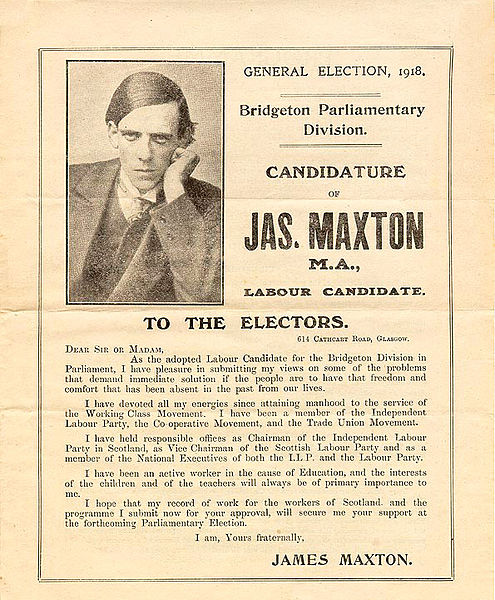
April 1926 had seen left wing firebrand James Maxton ascend to the chairmanship of the Independent Labour Party (ILP). He was a strong believer that Labour should stand on an unabashed platform of socialism and a fervent opponent of Macdonald’s strategy of gradualism, respectability and trying to appeal to voters.

Following the collapse of the strike, the ILP adopted its programme of action, “Socialism In Our Time.” This included such crazy notions as a living wage, family allowances and the nationalisation of banks.

Jimmy Maxton responds to research suggesting voters prefer candidates with a ‘sinister stare’

Back in 1926 Macdonald rejected the ILP programme out of hand. He wanted socialism, yes. “In our time” however, was way too immediate and way too specific for his tastes.  He was more “socialism some time, maybe sort of soon-ish, but not right now though.”

He said the ILP plans were   “a collection of flashy futilities… likely to involve in practice the postponement of all advance, because it would only frighten the electorate and ensure a crushing labour defeat.”

And Macdonald knew all about crushing Labour defeats, having helped bring about that last one by precipitating the fall of the first Labour government and disastrously mis-handling the Zinoviev letter.

Read the rest of this entry »

Facebook Twitter Digg Delicious StumbleUpon

UNCUT: Letter from Wales: Welsh democracy is in a ruinous state

14/06/2013, 10:31:16 AM

by Julian Ruck

If you politically aware folk across the Severn Seas, think Westminster is the political capital of greasy manipulation and ambitious malfeasance, then think again and try this on for size.

Old welsh Labour with its enforcers has now excelled itself, making sport out of the committee system of scrutiny and oversight where policy is concerned. If any member of said committee shows any sign at all of having an independent intellect (or indeed any intellect at all), or god forbid a view that may be deemed “principled”, then they are ignominiously ejected, without a safety harness.

You think I’m joking?

Well, let me appraise you of a recent Children and Young People’s committee, set up to consider the Welsh Assembly’s Social Services Bill.

By way of background, three of the Labour team were in support of a ban on physical chastisement of those objectionable urchins who fall by the parental wayside as it were, the minister overseeing all this, one Gwenda Thomas, was not.

Chance would have it, that just before the committee was due to convene, take evidence and consider an amendment to introduce the child-smacking ban into the Bill, old Labour’s chief whip-master sacked the three liberal musketeers, and without as much as a by your leave.

Christine Chapman (Chair), Julie Morgan and Jenny Rathbone were all replaced by more accommodating members with a more corporally inclined inclination than their predecessors.

When the meeting started, microphones were injudiciously turned off so that the new chair, one Ann Jones, was left to rather miserably explain that she had only just found out about her ‘calling’ to the committee – nothing like being prepared is there?

Read the rest of this entry »

Facebook Twitter Digg Delicious StumbleUpon