UNCUT: Brand the Tories right wing? I Woodwouldn’t

29/08/2011, 09:33:48 AM

by Rob Marchant

Oh dear. To read the Observer report of Shaun Woodward’s leaked memo on how Labour should attack the Tories, the question which springs to mind is not so much, is this going to be genuine Labour strategy as, what on earth was he thinking?

The thrust of the piece is that Labour should attack the Tories for reverting from their “cuddly conservative” projection to a more traditional right-wing positioning, and to make this the Brown-style “dividing line” between us and them, on which we should base our attack.

There is much to be said for dividing lines; indeed their judicious use has been a great help to Labour over the last twenty years. And there is no doubt that Cameron is now pursuing a more right-wing strategy than was being projected in the run-up to the general election. However, for a whole raft of reasons, Woodward has badly miscalculated.

First, he has missed that, in the current environment, being seen as right wing is not necessarily a bad thing electorally. In the wake of the riots – unlike various politicians and commentators – voters are in the main looking for punishment over understanding (whether they are right to do so is another matter). They trust the Tories over Labour on the economy. And they are not alone in a more international sense (perhaps someone should point out to Woodward the prevailing conservative hegemony across Europe).

Read the rest of this entry »

Facebook Twitter Digg Delicious StumbleUpon

UNBOUND: Monday News Review

29/08/2011, 06:59:45 AM

Ed’s new strategy

Labour is plotting a strategy to portray David Cameron as an old-style traditional Tory – despite warnings it will leave the party at odds with the public on crime, immigration and welfare. A leaked copy of a report ordered by Ed Miliband says Labour should launch a campaign to brand the Prime Minister as being ‘recognisably right-wing’. It accuses the Conservatives of taking ‘major strides back to their ideological roots’ since the election and points to the ‘increasingly shrill language the Tories are using as they vacate the centre ground’. In an analysis that will dismay senior Blairites in the party, the report suggests the Conservatives are too right-wing on crime, immigration and welfare – all areas where polling suggests the public would like to see even tougher policies. – Daily Mail

Labour is developing a new strategy to paint David Cameron as an old-style, traditional Tory, according to confidential documents obtained by the Observer, as the parties prepare to do battle during the coming conference season. The opposition believes the prime minister has abandoned the centre ground in recent months to adopt a more orthodox conservative stance on issues such as law and order, immigration and welfare. They are now set to launch a concerted campaign to brand Cameron as a “recognisably rightwing” leader in a move that will inevitably inflame political debate. The creation of the strategy follows reports last month that Cameron had polled negatively for the first time, with more people saying that the prime minister was doing a bad job than those backing him. The two-and-half-page paper written by the MP Shaun Woodward, a former Tory frontbencher and now head of Labour’s anti-Tory attack unit, and circulated among senior Labour officials, lays bare the areas where the opposition now believes Cameron is vulnerable. – the Guardian

David Cameron is to be depicted as an old-fashioned Tory in a new advertising campaign that is currently being developed by the Labour party, according to documents obtained by the Guardian. The campaign is being prepared into the crucial conference season, and the left are beginning to believe that Cameron has left the safe middle ground on issues such as law and order. Recent polls show that the approval rates of the incumbent Prime Minister in the Coalition government have plummeted. More people now disapprove of Cameron in the role than those who continue to support his leadership. There are also criticisms in a two-and-a-half-page document by anti-Tory campaigners that Cameron has abandoned the ‘compassionate conservatism’ stance that secured his party votes in May 2010. Leading policies, such as environmental affairs and preserving the National Health Service, have been ‘sidelined’ in favour of more traditional Conservative priorities. – Tucone.com

Free schools steam ahead

Twenty-four “free schools” are to open next month, the government has announced. The schools – state-funded and set up by teachers, charities, education experts and parents – are spread throughout the country but mainly concentrated in deprived areas with poor records of academic achievement. They have the same legal status as academies and do not have to follow the national curriculum, giving them more freedom than local authority schools. The Department for Education has confirmed that funding for all 24 schools has been signed and agreed. Under the coalition’s plans, the schools will also be able to prioritise the most disadvantaged children in their school admissions arrangements. – the Guardian

Some of the ‘free schools’ are existing schools that are taking up ‘free’ status. These include the Maharishi School, in Lancashire, which stresses the importance of yoga. A particularly vocal enthusiast of the ‘free school’ system is the journalist, Toby Young, who will be setting up his own school in West London. Young’s will have an academically rigorous curriculum, with an emphasis on Latin. Five different faith groups will be getting the chance to run their own state-financed schools. These include the first state-financed Sikh school, two Jewish primary schools, a Hindu school, a Hare Krishna School, and a Church of England school. The capital cost of setting up the 24 schools will range from £110m to £130m. They are a flagship policy from Conservative education policy. However, so far, only 32 of the 323 applications have been approved. – Huffington Post

You didn’t need an enquiry to tell you that

He went from hero to villain as the “Cleggmania” which swept Britain before last year’s election gave way to protests against his role in the Coalition Government. And now the Liberal Democrats have owned up to an uncomfortable truth: that targeted attacks on their leader, Nick Clegg, by political opponents are damaging the party’s electoral fortunes. An official internal inquiry into why the Lib Dems did so badly in this year’s local elections has pointed the finger at advertising campaigns such as one which portrayed the politician as “Cleggzilla”, trampling over public services. The Cleggzilla posters were funded by trade unions opposed to the Coalition’s cuts. Whilst some might argue that it is the job of political campaigners to criticise their opponents, the Lib Dems have cried foul, branding the attacks as “personal and vicious”. The complaint, in a report which will be presented to delegates at the Lib Dem conference in Birmingham next month, risks reopening a public debate into Mr Clegg’s state of mind. Since he became Deputy Prime Minister last year he has brushed aside suggestions that he is “fragile” and suffering from stress. – the Telegraph

Facebook Twitter Digg Delicious StumbleUpon

UNCUT: Sunday Review: There ain’t no black in the Union Jack, by Paul Gilroy

28/08/2011, 12:00:45 PM

by Anthony Painter

If the riots hadn’t spread beyond Tottenham, there is little doubt that we would now be having a far more heated discussion about “race” and British urban culture, rather than a generalised moral moan. The book that many would turn to would be Paul Gilroy’s 1987 classic: “There ain’t no black in the Union Jack”. In it, Gilroy outlines “race” as an agent of historical change alongside “class” or “gender” (note the inverted commas). And after riots in the early and mid-1980s that were more political in their nature than those we have just seen – in the sense that there was a deliberate political point being made – Gilroy’s theory of “race” as historical agent of mobilisation was forceful. But then things went a different way.

What marks out the latest edition of the book, is its introduction. Gilroy has substantially revised his approach. In fact, he declares that race is now “ordinary”. It has blended with poverty, material deprivation and inequality as a complex interplay of power, injustice and exclusion. Like other motivating social forces such as class, race has been shattered.

The “rise of identity politics, corporate multi-culture, and an imploded, narcissistic obsession with the minutiae of ethnicity” have fragmented “political blackness”. Bonds of solidarity have weakened. Rather than huddling together, the oppressed and excluded are wandering alone, facing the cold and the rain without protection. Where “blackness” was a motivating political force a quarter of a century ago, it no longer fulfils that role. Read the rest of this entry »

Facebook Twitter Digg Delicious StumbleUpon

HOME: The week Uncut

27/08/2011, 02:30:36 PM

In case you missed them, these were the best read pieces on Uncut in the last seven days:

Dan Hodges on DSK, the media and innocence

Atul Hatwal reports on the rise in gambling

Matt Cavanagh fact checks the government’s immigration claims

Inside: The second life of Keith Vaz

Peter Watt wants to know what conference is for

Jonathan Todd asks if Rick Perry is the Republican Bill Clinton

Peter Jefferys on a co-operative rebuilding of finance

Facebook Twitter Digg Delicious StumbleUpon

GRASSROOTS: YourKen: can a website really change the game?

27/08/2011, 12:24:47 PM

by Adam Richards

This week marked a big step forward for Labour in London and Ken Livingstone’s campaign to win back City Hall, with the launch of his campaign volunteer website, YourKen.org.

YourKen.org is clearly inspired by the success of Barack Obama’s 2008 presidential campaign, my.barackobama.com which did so much of the mobilising of his support during the Democrat primary contest, and to a lesser extent the SNP’s campaign during the recent Scottish elections.

The website is built on the same technology from the US-based company, NationBuilder. The founder, Jim Gilliam, talking about his tools said ‘too often, online efforts are seen as a sideline to the offline efforts of a campaign’.

The success of NationBuilder is bringing online and offline communities’ together, empowering volunteers and energising campaigns. And it works. One example makes the point. Thanks to an ingenious system 50 SNP party supporters instantaneously signalled on Facebook their “like” for a speech by Alex Salmond during the buildup to the Scottish elections; simultaneously a video of the speech appeared on their Facebook news feeds. That clever device meant that 60,000 people instantly became aware of the speech and had the opportunity to view it. Pretty powerful stuff.

The key theme that runs through YourKen.org is community  which is important to consider in light of recent events in London. Outside of the micro-community of the [extended] family the key next two obvious communities are those of interest and those of place- both in quite obviously in decline. Fewer people know their neighbours names now than in decades past, especially in London with its high levels of residential churn and population mobility.

In my view there is a third kind of community though, the most important- that of time-based, or temporal communities. These are communities that come together either intentionally or serendipitously, often as a one-off and to make a formal decision or declaration to take action at a moment in time. Like an election. Read the rest of this entry »

Facebook Twitter Digg Delicious StumbleUpon

UNCUT: Don’t promise what you can’t deliver on immigration

26/08/2011, 11:21:00 AM

by Matt Cavanagh

Yesterday’s ONS figures are a reminder of the risks of politicians promising what they can’t deliver, particularly on an issue as emotive as immigration.

Before the election, Conservatives and Liberal Democrats said immigration was out of control; afterwards, they said they would cut it dramatically. Neither was true.

The figures reinforce how stable immigration has been in recent years: non-British immigration is estimated at 455,000 in 2010, compared to 437,000 in 2009 – and broadly stable since 2006:

Long term immigration, emigration, and net migration of non-British nationals
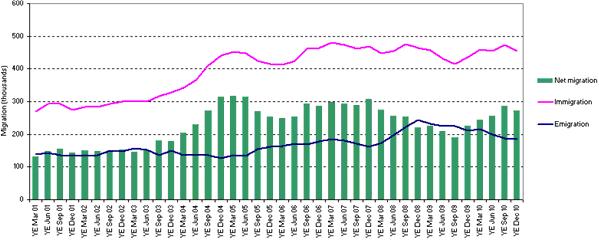
Source: IPS, ONS Migration statistics quarterly report, August 25 2011

The Government’s chosen target is not non-British immigration, but ‘net inward migration’: total (British and non-British) immigration, less total (British and non-British) emigration. As the above graph shows, non-British emigration is falling, and while British emigration has risen slightly over the last year, overall emigration remains down – with the result that the Government’s target of reducing net migration below 100,000 has moved further from their grasp since the election:

Long term immigration, emigration, and net migration of all nationals

Source: LTIM, ONS Migration statistics quarterly report, August 25 2011


Yesterday’s figures suggest the interim immigration ‘cap’ on working migrants from outside the EU had negligible effect in 2010. The Government has made further changes since relating to non-EU migrants, including closing Tier 1 (highly skilled) to all but the wealthiest migrants in December 2010; a number of changes to Tier 4 (students) in March 2011; and a permanent ‘cap’ on ‘Tier 2’ (skilled) workers in April.

The latest quarterly figures to June 2011, published by the Home Office yesterday, should show these changes starting to have an effect, and indeed there is a slight fall in people coming from outside the EU for work (down 2.7% compared to the year ending April 2011), almost all in Tier 1 rather than Tier 2. This fall is offset, however, by a rise in those coming from outside the EU to study (up 3.5% compared to year ending April 2011).

More significantly, any reduction in numbers coming from outside the EU is likely to be offset by the continuing rise in those coming from inside the EU, particularly from Eastern Europe – a category of immigration which the Government cannot control.

Yesterday’s figures show that immigration from Eastern Europe rose from 52,000 to 71,000 in 2010 – and emigration back to Eastern Europe fell from 47,000 to 31,000, adding further to overall net migration.

In terms of the number of Eastern Europeans in work – as opposed to new arrivals – recent Labour Force Survey figures confirm that, after being stable between 2008 and the first quarter of 2010, numbers have been rising steadily since the election:
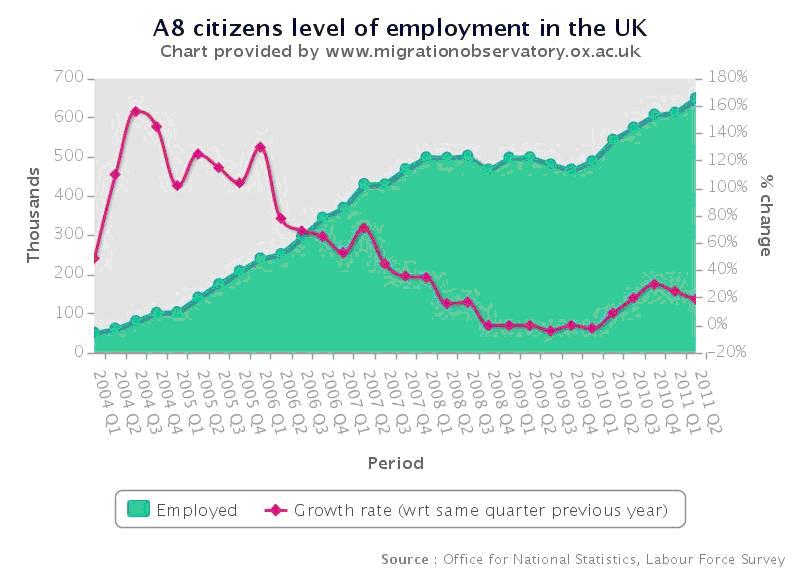
The changes the Government has made to immigration from outside the EU may well have more effect in the year to come – particularly on students and highly-skilled migrants.

But the rising trend in immigration from the EU looks set to continue. More recent figures from the Department of Work and Pensions, included in yesterday’s ONS report, show that for the year to March 2011, over 187,000 National Insurance numbers were allocated to Eastern European nationals, an increase of 24% on the previous 12 months.

In terms of employers’ future plans, a survey this week from the Chartered Institute for Personnel Development suggests that the number of private sector employers intending to hire migrant workers in the next quarter continues to rise. The CIPD survey also suggests that, if the ‘cap’ has any effect in future months, it is unlikely to deter employers from hiring migrant workers – it is more likely to make them switch to hiring migrants from inside the EU.

Ministers need to be more honest with the public about how far overall immigration numbers are really determined by government policy, rather than economic factors, and employer preferences. Ministers also need to avoid reacting to their difficulties with the net migration target by trying to clamp down further on those categories of migration which are the most economically valuable – and instead, start thinking about how to harness immigration to promote employment and growth. Conservative ministers in particular have consistently argued that welfare reform and immigration control are the answer to youth unemployment and worklessness. But with youth unemployment back over 20%, and NEETs at a record high, they need to look towards other policies if they are to prevent the creation of another ‘lost generation’.

Matt Cavanagh is Associate Director at the IPPR
Facebook Twitter Digg Delicious StumbleUpon

UNCUT: Revealed: £1.9bn surge in gambling as desperate Brits try to bet their way out of recession

26/08/2011, 08:00:27 AM

by Atul Hatwal

As George Osborne’s economic vice gets ever tighter, new HMRC figures show that struggling Britons gambled £1.9bn more than last year. It follows two years where the total amount gambled actually fell.

Based on government receipts from the duties levied on gambling since the start of this financial year, the projections for 2011/12 are of another big increase, by £3.5bn to £48bn.

This is the first time since government records began in the mid-1990s that gambling has risen while household incomes have fallen.

Earlier this year, a major survey by the gambling commission found that nearly three-quarters of Britons – 73% – had gambled in the past year, up from 63% in 2007 when the survey was last conducted.

Most worryingly of all, the numbers with a problem gambling habit was estimated to have risen to 451,000, an increase of 5% since 2007.

When in opposition, David Cameron was quick to position himself as an opponent of gambling.

In 2007 he over-ruled his shadow chancellor in opposing the Labour government’s plans on casinos and led the Tories in a U-turn on their previous commitment to support the proposals.

In the House of Commons, he was clear that his fears on problem gambling were at the heart of his concerns. Following the awarding of a super-casino for Manchester he said,

We congratulated Manchester, because we thought the review had been conducted properly, but then we found out that the decision to put it in Manchester, they hadn’t looked at really important issues, like will this encourage problem gambling”?

The current minister responsible for gambling, John Penrose, couldn’t have been clearer in his views in an EDM he tabled in 2006 on the problems of gambling addiction in his local area,

“I don’t want to see one form of addiction – drugs, being replaced by another – gambling”.

But since those early days in opposition, the Tories have adopted a very different approach. Read the rest of this entry »

Facebook Twitter Digg Delicious StumbleUpon

UNCUT: Dominique Strauss-Kahn is innocent

25/08/2011, 01:30:24 PM

by Dan Hodges

Was Dominique Strauss-Kahn on trial for rape? Or was he on trial for being a banker?

I ask that question because on Tuesday he was declared innocent of all charges, and freed. At least, I thought he’d been declared innocent. That was the story I read in the news reports. But the commentary that followed told a different tale.

In a nutshell: he did it. Forget the evidence. Or lack of it. Forget the fact that the case was so flimsy it never even got within a hundred miles of a jury. Forget ludicrously outdated concepts like presumption of innocence until proof of guilt. The guy’s a rapist. And he got away scott-free.

“What occurred in room 2806 will never be known”, wrote Hadley Freeman in the Guardian, before adding, “What has been proved, on an international scale, is that only women who have led lives as sheltered as Rapunzel and have memory recall as robotic as computers are capable of being raped. The rest are money-grabbing sluts with vaginal bruising”. Read the rest of this entry »

Facebook Twitter Digg Delicious StumbleUpon

UNCUT: What is party conference for?

25/08/2011, 08:00:01 AM

by Peter Watt

I have been pondering for a while what exactly party conferences are about. What are they for? This week Labour has announced that it will hold an “open day” at its conference in Liverpool.  Up to 2000 members of the public are invited to attend and can register online for a full day’s programme of policy discussions. Wednesday 28 September is described as:

“…the first of its kind from any political party, is an opportunity for you to join the conversation about the challenges our country faces and talk to Labour Leader, Ed Miliband, and the Shadow Cabinet face to face”.

I think that this is probably a good idea; well in a symbolic way at least. It sends a signal that the leadership is determined to open up the party beyond the dwindling band of party activists. And that has to be a good thing. It is clearly unsustainable for handfuls (relatively) of party activists to maintain the pretence that they alone should determine policy, choose candidates and so on. But does it go far enough and will anyone be interested? Read the rest of this entry »

Facebook Twitter Digg Delicious StumbleUpon

UNCUT: Will Rick Perry be the Republican Clinton?

24/08/2011, 12:53:57 PM

by Jonathan Todd

At the start of May I argued that President Obama was as vulnerable to a challenger emerging as the seemingly ascendant George W H Bush was at the same time in 1991. This view was then out of kilter with the beltway view of Obama as a two term president. Subsequently the US has suffered an unprecedented credit downgrade, its economy has continued to struggle and grumbles about Obama, most recently due to his holidaying at a “millionaires’ playground”, have got louder.

Republicans are increasingly confident that Obama is Jimmy Carter. But the election will be a choice, not a referendum on Obama. They need a more convincing choice to win. As the early Republican pacesetters have not convinced, the stage remains set for a Republican Bill Clinton.

To date, tea party favourite Michelle Bachmann has probably done the best job of appealing to Republicans with misgivings, such as Romneycare and Mormonism, about the frontrunner, Mitt Romney. There may be enough such conservative voters for Romney to be defeated in January’s Iowa caucuses. The former Baptist pastor Mike Huckerbee won in this first state to vote in 2008.

God isn’t calling Huckerbee to run this time. However, God is said to have called Rick Santorum and Rick Perry, as well as Bachmann. Either they are suffering crossed wires or God’s mind is yet to be made up. God wouldn’t be the only one. The Republican race is fluid.

While Rick Perry’s backing for the three-time married Rudy Giuliani in 2008 and rumours about his own marriage are concerns for some religious voters, his leading of vast prayer meetings enables him to pitch to the religious right. That 40 percent of new US jobs since June 2009 have been created in Texas, where Perry is governor, also creates the basis – though other aspects of Texas’ economy undermine this – for appeal to those (i.e. everyone) with economic worries. A candidate able to challenge Romney for his strongest card, economic competence, and rival Bachmann for the religious right vote has a shout of being the Republican candidate.

There are various ways that this could play out. Read the rest of this entry »

Facebook Twitter Digg Delicious StumbleUpon