


UNBOUND: Tuesday News Review

09/08/2011, 07:00:56 AM

Cameron and Boris return… finally

Prime Minister David Cameron has cut short his holiday in Tuscany to chair a Cobra emergency meeting at 9am this morning in Downing Street following a third consecutive night of violence in London. Mayor Boris Johnson is also on his way back to help take charge of the situation. Home Secretary Theresa May said the authorities “can bring an end to this” through “robust policing” and promised that those responsible would be brought to justice. She added that over 450 people had been arrested after looters and police clashed all over the capital, as well as a “significant number” in Birmingham, where looting also took place. There was also violence in Liverpool and Bristol. There have been numerous complaints about the police’s response, with Clapham Junction in south London singled out as an area where police were particularly slow to react. Reports showed that looters were able to attack the Debenham’s store for over two hours before order was restored. London’s Deputy Mayor for policing, Kit Malthouse, admitted to the BBC that police had been “incredibly stretched” and apologised for the slow response in some areas. – PoliticsHome

David Cameron cut short his holiday last night to fly back to Britain to take charge of the response to the wave of riots in London. Following three days of disturbances, he will today chair a meeting of the Government’s emergency Cobra committee after deciding to abandon his summer break at an Italian villa four days early. He will be joined by senior ministers, including the Deputy Prime Minister, Nick Clegg, and the Home Secretary, Theresa May, and police chiefs to co-ordinate action against the wave of lawlessness. Downing Street had earlier stressed that he was in constant touch with Whitehall officials, but his surprise decision to come back underlines the gravity with which the crisis is being treated within the Government. The Prime Minister’s move came hours after Boris Johnson, the Mayor of London, bowed to criticism and scrapped his holiday in Canada to return. Senior government sources had earlier expressed incredulity that Mr Johnson had chosen to remain on vacation in British Columbia when Ms May returned early from her break in Switzerland. Tellingly, neither Mr Cameron nor Ms May spoke to the Mayor in their rounds of calls to discuss the disturbances. “There was a strong feeling that he should have announced he was coming back sooner,” said a senior source in No 10. – the Independent

Violence spreads to Birmingham

Shop windows were smashed and furniture hurled at officers after a social media campaign was started yesterday afternoon urging people to copy events in London. As an estimated 200 youths, many of them hooded or masked, congregated, West Midlands police put up a half-mile exclusion zone around the Bullring shopping centre, which shut early at 6.40pm. They also blocked entry into Pallisades shopping centre above New Street station. Shoppers fled as what started as a peaceful gathering quickly turned ugly. Onlookers described thugs running with knives through New Street and one photographer was set upon by a group who beat him and stole his camera. – the Telegraph

Shares take dramatic tumble

In the first trading since the decision by the Standard & Poor’s ratings agency to strip the US of its AAA credit rating, shares on Wall Street recorded one of their worst one-day falls ever. Last night the Dow Jones Industrial Average closed down 635 points – 5.6 per cent – at 10,810 after a day of relentless selling. The index has fallen by more points on only five occasions. In London, the FTSE-100 index ended lower for the seventh day in a row, and has now lost over 800 points, or 13.7 per cent. By contrast gold, a traditional safe haven in troubled times, hit yet another all-time high, at over $1,700 an ounce. London shares are at their lowest since July 2010, just after George Osborne’s emergency Budget… The Bank of England is due to reveal its latest forecasts for inflation and growth tomorrow. It is expected to follow the Office for Budget Responsibility in admitting that its projections have not been borne out by reality. – the Independent

Clegg told to distance himself from Tories

Nick Clegg will face calls from senior Liberal Democrats to get “back to basics” and distance himself far more from David Cameron and the Conservatives over the coming month. Tim Farron, the party’s president, is expected to use the annual conference in September to warn the leadership that it needs to help members “hold [their] heads up high” and bring in policies to entice back the voters who have deserted the party. Liberal Democrats yesterday began to outline the policies they will put forward at the next election to put “clear orange water” between the Coalition parties. These include a comprehensive review of taxation policy – with proposals for a new “land tax” on the rich as well as major initiatives on criminal justice, immigration and political reform. – the Independent

Facebook Twitter Digg Delicious StumbleUpon

INSIDE: Osborne and Cameron’s eurozone delusion – the contagion is airborne and the UK is getting sicker

08/08/2011, 11:55:34 AM

George Osborne and David Cameron are deluded.

There’s a long list of topics to which that statement might apply, but right now, one is more important than the rest – contagion from the eurozone crisis.

Contagion normally refers to the transmission of eurozone woes to Britain via UK banks’ liabilities in the crisis areas. The greater the exposure, the worse the contagion.

This conventional view of contagion is based on direct contact between banks and infected areas. That’s how the Treasury looks at it and why the government thinks the UK is insulated. Last week George Osborne boasted that the UK was a “safe haven”. Then on Friday, William Hague declared “We’re not in the firing line”.

But what the Bullingdon boys haven’t understood is that the contagion is airborne.

A cursory look at movements in banks’ share prices shows how limited direct eurozone liabilities have translated into plunging prices.

Recent estimates of the exposure of UK banks to public and private debt in the trouble spots were £82.5bn for Ireland, £65.4bn for Spain, £40.5bn for Italy, £14.8bn for Portugal and £8.6bn for Greece.

These might seem like big figures, but for a sector as large as UK banking, worth £7000bn, they are worrying but hardly critical. The latest IMF healthcheck on the UK assessed banks’ exposure as “manageable”

In comparison, since the start of this financial year, the big banks’ share prices have plummeted – RBS has fallen 31%, Lloyds has fallen 46% and Barclays has fallen 35%. Only HSBC has been somewhat insulated, but even they have dropped 14%.

The reason for the collapse is that negative city sentiment has been turned into self-fulfilling fact by the stampede of the hedge fund herd.  The link to liabilities no longer needs to be real, it just has to exist in the fevered minds of city traders.

The result of this shift in transmission mechanism for contagion is that the economy is in far greater danger than the government understand or at least is letting on.

If the trend in bank share prices established since April continues, RBS and Lloyds will return to the level where the government had to intervene back in 2008, by Christmas.

Speak to any trader or analyst about what they think will happen if there is a crisis event in the eurozone, like a default, and they are all agreed: there will be a run on the banks similar to the crash of 2008.

The only thing they view with equal certainty is that there will be a defining crisis at some point.

Estimates on the scale of the carnage vary, but in this situation a single day’s losses across the banks would likely top one third of share value.

Anything on this scale, following on from the last few months will potentially send the most vulnerable – RBS, Barclays and Lloyds -into freefall. Sentiment is already too negative and the share prices already so low that one big shock could tip them over the edge.

That would bring Hobson’s choice for the government – bailout mark two accompanied by a massive rise in the deficit and a potential UK sovereign debt crisis or the collapse of some of the UK’s biggest banks.

Take your pick. Either way, we would be in the same position as Portugal, Ireland, Greece, Spain and Italy. No credit, no confidence, no money and too much debt.

The crisis would have been fully transmitted from the eurozone to the UK.

As Osborne and Cameron phone in government from their holidays, they are content in their contagion delusion. But the reality is that the UK is no more insulated from the impact of a eurozone crisis than the French were protected by the Maginot line at the start of World War 2.

Their criticism of Gordon Brown was that he failed to fix the roof when the sun was shining. There’s some truth in that.

Now, on their watch, it’s been raining for months, the water has soaked into the timbers of the house and the eaves are bowing. But still there is no action.

If and when the roof crashes in, they and they alone will be to blame.

Facebook Twitter Digg Delicious StumbleUpon

UNCUT: Party reform: In the hands of the many, not the few

08/08/2011, 10:11:16 AM

by Rob Marchant

So, we are having a debate about the role of unions in the Party. Perhaps Ed, as my Uncut colleague Peter Watt suggests, is on a hiding to nothing: he is paddling against a strong current of realpolitik that dictates that this cannot change, at least whilst the party is taking ninety per cent of its donations from unions.

But, this aside, perhaps we should examine something more important: rather than whether Ed will win, we should look at whether or not Ed is right.

Firstly let’s frame the debate: every time we try to have a debate about the right level of involvement for unions in party decision-making, the familiar refrain comes out from all corners of the labour movement: “man the barricades, someone is trying to break the link!” The siren goes up, we all rush to the defence of the link, the devilish intruders are repulsed, and the debate stops again.

But breaking the link is essentially a straw man: no serious, contemporary party figure is suggesting that we should do such a thing. Most of us are members of, and support, unions, even if we don’t always agree with everything they do. And how would we survive, let alone campaign? It is natural that, in part-funding the party and being linked to its decision-making mechanisms, unions should have a say.

However, the more nuanced debate that needs to be had is: how much of a say? Because, on the other hand, the current system does beg the question of whether or not it is right that three leaders, whose interests are naturally sometimes directly aligned with those of the party, and sometimes not, control a very sizeable block vote.

So, are we comfortable with that? Because perhaps we shouldn’t be, and it’s quite possible that the upcoming, wholly independent study into party funding may not be, either. Why? Read the rest of this entry »

Facebook Twitter Digg Delicious StumbleUpon

UNBOUND: Monday News Review

08/08/2011, 06:50:35 AM

London riots spread

More than 100 people have been arrested after bouts of rioting and looting broke out across London overnight. Emergency services were deployed to respond to “copycat criminal activity” across the capital late last night and early this morning, after trouble flared in Tottenham, north London, Scotland Yard said. Disturbances erupted in several boroughs in north, south and east London, with reports of trouble in Brixton, Enfield, Walthamstow and Islington. A Metropolitan Police spokesman said at least nine officers were injured, including three who were taken to hospital after being hit by a fast-moving vehicle at 12.45am. The officers had been in the process of making arrests in Chingford Mount, Waltham Forest, after a shop was looted by youths. Police said 16 people have been charged with offences in relation to the disorder, including burglary, theft, and violent disorder. Metropolitan Police Commander Christine Jones said officers were “shocked” at the level of violence directed towards them. She said: “Officers responding to sporadic disorder in a number of boroughs made more than 100 arrests throughout last night and early this morning. – the Independent

There was mounting evidence on Sunday night that some of the second night of rioting in London was part of an orchestrated plan, as violent disturbances broke out sporadically across parts of the capital. Police in riot gear were deployed across the city to deal with trouble in Enfield, six miles north of the site of riots in Tottenham, while looters later pillaged shops in Brixton. The scenes in Enfield, while reminiscent of Saturday night’s clashes, were smaller in scale, and they took place from about 7pm. Teenagers gathered on St Andrews Road – said to have been a preplanned destination – broke down walls on terraced streets so they could collect bricks to throw at police. About a dozen shops were ransacked and a police car smashed on Church Street. Riot police moved in to secure the area and train station. Shortly after 8.30pm, a crowd of about 100 mainly teenage boys broke into a jewellery store. When police arrived less than a minute later, there were chaotic scenes, with a number of people struck with batons and attacked by dogs. Resident Mizu Rahman, 34, said a plainclothes police officer had told him at around 2pm that there was intelligence that disorder was imminent. – the Guardian

ECB moves to avert crisis

The European Central Bank said on Sunday it would “actively implement” its bond-buying programme to fight the eurozone’s debt crisis, signalling it could start buying Spanish and Italian government bonds. The central bank welcomed new deficit reduction measures and economic reforms by Italy and Spain as well as a Franco-German pledge that the eurozone’s rescue fund will take responsibility for bond-buying once it is operational, probably in October. “It is on the basis of the above assessments that the ECB will actively implement its Securities Markets Programme,” the ECB said in a statement. It is understood ECB President Jean-Claude Trichet had been trying to extract an agreement from ECB members to buy Italian paper before Asian markets opened this morning. Some economists said last night the ECB’s move could improve Italian and Spanish bond yields by between 1pc and 1.5pc when they open this morning. – the Telegraph

The European Central Bank has moved to halt Europe’s runaway debt crisis by pledging to buy government bonds from Italy and Spain. The move to prop up Europe’s struggling nations came after a day of frantic discussions between the finance ministers of the world’s leading economies. Markets open for the first time since Standard & Poor’s decision to cut the US’s credit rating from AAA late on Friday. In a statement, the ECB said it welcomed announcements by Spain and Italy of “new measures and reforms” aimed at the financial problems and urged both governments to roll them out swiftly. The agreement of the bank’s policy-making governing council is a watershed moment for the ECB. The central bank has so far insisted that the main responsibility for acting lies with national governments. But last week a more modest bond buying effort failed to halt the European slide. The ECB said it had taken note of a statement by France and Germany released on Sunday stressing their commitment to European financial reforms. Silvio Berlusconi’s government cobbled together an emergency austerity package for Italy late on Friday to placate the bond markets. Italy’s borrowing costs shot up last week amid fears that its debts have become unsustainable. – the Guardian

NHS – second most cost effective health system in the developed world

The NHS is one of the most cost-effective health systems in the developed world, according to a study (pdf) published in the Journal of the Royal Society of Medicine. The “surprising” findings show the NHS saving more lives for each pound spent as a proportion of national wealth than any other country apart from Ireland over 25 years. Among the 17 countries considered, the United States healthcare system was among the least efficient and effective. Researchers said that this contradicted assertions by the health secretary, Andrew Lansley, that the NHS needed competition and choice to become more efficient. “The government proposals to change the NHS are largely based on the idea that the NHS is less efficient and effective than other countries, especially the US,” said Professor Colin Pritchard, of Bournemouth University, who analysed a quarter of a century’s data from 1980. “The results question why we need a big set of health reform proposals … The system works well. Look at the US and you can see where choice and competition gets you. Pretty dismal results.” – the Guardian

Facebook Twitter Digg Delicious StumbleUpon

GRASSROOTS: Governing for people; not property and profit

07/08/2011, 12:00:09 PM

by Robin Thorpe

In December last year, Neal Lawson and John Harrison presented an outline of their proposal for new socialism. With many European nations still circling the edge of the economic abyss and people starving to death in Africa is now a pertinent time to look again at the way in which we organise our world?

Each generation seemingly gets a chance to make a paradigm shift in the way in which their brand of civilisation is governed. Apart from a very few cases, they opt for evolution in the place of revolution. The consequence of this evolution is that despite the diminishing role of aristocracy and landed wealth, most world nations remain capitalist economies.

For the majority of the so-called civilised nations, the primary objective of governance has for centuries been as an enabler in the pursuit of profit and the expansion of capital. Historically this was because the ruler and the ruler’s peers were the primary holders of capital. More recently, because the professional political class are the acolytes of the wealthy and the preservers of the capitalist economy (particularly in the USA where election depends on the size of your marketing budget). Even our celebrated legal system only exists because of our forebear’s predilection to the preservation of private property rights. Read the rest of this entry »

Facebook Twitter Digg Delicious StumbleUpon

HOME: The week Uncut

06/08/2011, 02:00:43 PM

In case you missed them, these were the best read pieces on Uncut in the last seven days:

Michael Dugher reports on the governments attempts to sneak out the trash

Dan Hodges reveals his guilty crush: Ed Miliband

Atul Hatwal reports on the shadow cabinet’s secret makeovers

Peter Watt casts an expert eye over Labour party finances

Uncut asks: Louise Mensch a future Tory PM or a car crash waiting to happen?

Kevin Meagher feels sorry for Rupert Murdoch. No, really.

… and John Prescott asks #wheresthegovernment?

Facebook Twitter Digg Delicious StumbleUpon

UNCUT: Life, love and loyalty: in defence of nepotism

06/08/2011, 11:00:13 AM

by Michael Merrick

Relationships are a good thing. Even disciples of Hobbes and Rousseau will admit as much. The social sphere is, by its very nature, social. That is, it depends on relationships. And the more vibrant and diverse the relationships, the more vibrant and diverse the social sphere.

The more positive and virtuous those relationships, the more positive and virtuous the social sphere. This means that any resurrection of the social sphere as a safe and positive place of interaction (which includes economic interaction) must in some sense build upon an appraisal of the relationships we share with one another.

Nepotism is an important part of this drama.

Yet whenever the issue is discussed, particularly by those who place themselves on the left of the political spectrum, we are given naught but murky tales of powerful upper-class types jealously seeking to protect their social and professional circles from penetration by working-class oiks, often by treacherously bestowing opportunity and privilege solely upon their unworthy and less than capable nice-but-dim nephews and nieces.

Understandably enough we consider this an injustice. We shout loudly, we hold our banners and hone our slogans, we turn the pursuit into one of universal social justice for the working classes and wrench up the rhetoric against these evil nepotistic enemies of the people.

And in so doing, we get it entirely wrong. We get our accounts of human relationships wrong, we get our account of society wrong, and we get our account of nepotism itself wrong. We deny what is good and to be cherished in human relationships, in preference of a cold atomism only possible within a sanitised concept of the social sphere.

For nepotism is the natural by-product of healthy relationships. It is the urge and instinct toward fraternity. It is the outward manifestation of solidarity, the mortar that binds society together as a complex construction of personal and social relationships.  It is the external expression of love and loyalty, the social and filial fulfilment of duty and responsibility.  It spreads opportunity horizontally and vertically and it strengthens bonds of friendship, family and community.

Camaraderie spreads through it, comradeship flourishes within it, solidarity courses through its veins. Read the rest of this entry »

Facebook Twitter Digg Delicious StumbleUpon

UNBOUND: Saturday News Review

06/08/2011, 06:54:06 AM

AAA over

The credit rating agency Standard & Poor’s has stripped the US of its top-notch AAA credit rating, downgrading it to AA+ and warning of further future downgrades because of political and economic uncertainty. The humbling downgrade of the world’s economic superpower came late on Friday night, after news surfaced of a furious rearguard attempt by the White House to convince S&P that its figures were faulty. Remarkably, there was no immediate reaction from the White House after the downgrade was made public. But the Treasury attacked S&P’s calculations, saying: “A judgment flawed by a $2tn error speaks for itself”. The justification used by S&P – blaming the dysfunctional US political system for being unable to make significant fiscal reform – will set off another debate about US government spending and the shambolic process to raise the debt ceiling that ended earlier in the week. In particular, the news may force Republicans in Congress to reconsider measures to raise revenue – and strengthens President Obama’s hand in any plans to allow the Bush-era tax cuts to expire, raising an additional $3tn over the next decade. – the Guardian

Credit ratings agency Standard and Poor’s said early on Saturday morning they had downgraded the country from its top AAA rating to AA+. The loss of the rating could reignite panic on the markets as traders worry that the world’s biggest economy may be leading the way back into recession. Markets around the globe suffered huge falls this week, but the US Dow Jones ended higher on Friday after better-than-expected jobs growth figures. In London, the FTSE 100 index of leading UK shares closed the day at 5246.99, down 146 points or 2.71%. More than £148bn has been wiped off the FTSE’s value since trading opened on Monday – a plunge of 568.2 points or 10.15% – caused by the eurozone debt crisis and fears the economy is stalling. In other European markets, Germany’s DAX ended Friday down 2.8% and the CAC in France fell 1.2%. Italy was 1.7% lower and Spain dipped by 0.2%. – Sky News

Dave, Nick and George stay on holiday as markets crumble

Stock markets around the globe may be in crisis but the three most senior politicians in the UK are away on holiday. Foreign Secretary William Hague yesterday insisted the Government was still “fully functioning” as he chaired an urgent meeting in central London on the economic crisis. Mr Hague is the most senior Cabinet minister remaining in the UK, while the Prime Minister David Cameron holidays in Tuscany, Chancellor George Osborne is in the United States, and Deputy Prime Minister Nick Clegg is in France. Unlike in previous crises, there was “a gaping hole where British leadership should be” with the UK Government “absent from the global economic debate at this critical time”, said Ed Balls. – Belfast Telegraph

May overrules Cam on Met chief

David Cameron wanted a former American “supercop” to become Metropolitan Police Commissioner but was overruled by Theresa May, the Home Secretary, The Daily Telegraph can disclose. The move followed the resignation of Sir Paul Stephenson, the head of Scotland Yard, last month amid the phone hacking scandal. It is understood that Downing Street informally sounded out Bill Bratton, the former New York and Los Angeles police chief, to see if he would be interested in taking the country’s most senior policing job. But Mrs May was uncomfortable with the idea, which would have ripped up the centuries-old tradition of British citizens serving in the police. Any immediate move was effectively blocked when an advertisement for the post was issued by the Home Office that specified that “applicants must be British citizens”. – Daily Telegraph

Borrow books from your supermarket

Shoppers may soon be choosing their library books alongside baked beans and tea bags. Supermarkets are being invited to offer any spare room to public libraries in an attempt to save money and attract more borrowers. The proposal is included in a blueprint of ideas to help libraries survive, unveiled today by the Local Government Association and the Museums, Libraries and Archives Council. Bradford Council is already set to try self-service “book-borrowing points” in shops across the city for people use. Some libraries could be moved into retail stores with excess space. Another option is to run libraries in partnership with the private sector, charities and other councils. – Daily Express

Cam’s links to Bombardier rival

One of David Cameron’s top advisers was yesterday accused of helping Bombardier’s rival win the Thameslink rail contract. Michael Queen is among the Prime Minister’s cosy inner circle of economic experts. But he is also chief of Europe’s biggest buyout firm 3i group, which was involved in German firm Siemens securing the £1.4billion deal to build carriages for the Brighton to Bedford line. The decision was a devastating blow to Bombardier and triggered the loss of 1,400 jobs – with thousands more at risk. It also emerged yesterday the chairman of 3i is Sir Adrian Montague, once dubbed the “government’s favourite fixer”, who is close to the Coalition too. The revelations yesterday prompted MPs, union leaders and workers to demand an independent review of the whole Thameslink tendering process. – Daily Mirror

Facebook Twitter Digg Delicious StumbleUpon

HOME: Friday caption contest: #wheresthegovernment special

05/08/2011, 09:56:09 AM

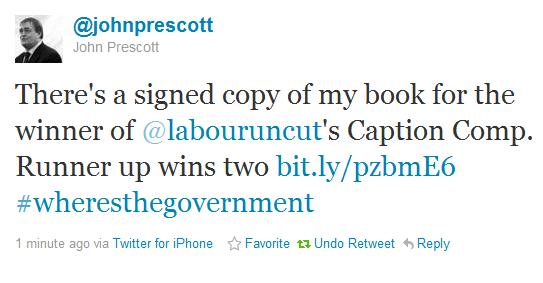
HT to the great @johnprescott

UPDATE: JP will be picking his favourite caption and the winner will receive a signed copy of his book. You’ve got until Saturday evening to get your efforts in…

Facebook Twitter Digg Delicious StumbleUpon

UNCUT: The shadcab mini-makeover – It’s not just the party’s policies that are getting refreshed

05/08/2011, 08:00:40 AM

by Atul Hatwal

Step back Gok Wan. Take a break Trinny and Susannah. Competition is on the way.

Although the identity of the new makeover maestro remains secret, what we do know is that they work with the Labour party and they are operating at the highest levels.

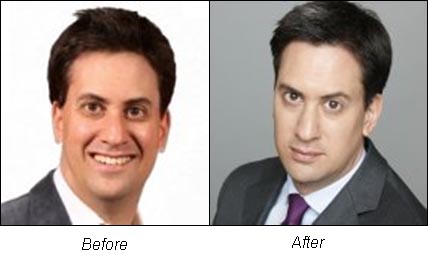
A few weeks ago the news section of the Labour Party website got a facelift. But it wasn’t just the site that changed its look. At the same time, a small number of the file photos of Labour’s top team were also miraculously transformed.

Amongst the lucky few, the leader of the Labour Party went through a metamorphosis.

Before the change, Ed Miliband’s manic grin and staring eyes were reminiscent of a crazed teddy bear. The composition of the picture and the stark white background made it look like something from a school year book:

“Ed Miliband, student most likely to join the U.S. postal service”

What a difference a simple snap makes.

In the new picture the grin is gone, the colours are more sobre and the little dab of white in his hair is in shot to lend gravitas. And then there’s the expression. He’s looking the viewer knowingly in eye, measured and focused. It’s an expression that’s strangely familiar.

Ah yes – Blue Steel. Read the rest of this entry »

Facebook Twitter Digg Delicious StumbleUpon