




Posts Tagged ‘Atul Hatwal’

Well done Yvette Cooper. Well done David Lammy. Shame on you Ed Miliband

19/05/2014, 02:32:47 PM

by Atul Hatwal

Another day, another shambolic intervention from Labour’s leader. This time it was about Nigel Farage and racism.

When asked the inevitable question on the Today programme, Ed Miliband said,

“I believe what Nigel Farage said a couple of days ago was deeply offensive. I said it was a ‘racial slur’. I think, though, our politics is disagreeable enough without political leaders saying about other political leaders ‘They’re a racist’.”

It’s excruciating. Ed Miliband might have been dragged kicking and screaming to acknowledge that Farage’s comments were a “racial slur,” but his refusal to follow through on his own logic and say that Farage was being racist is ludicrous.

The implication of Ed Miliband’s interview is that Nigel Farage can say whatever he likes, no matter how prejudiced or bigoted, and it still won’t be enough for the Labour leader to call him a racist.

It’s almost as if the Labour leader finds the act of calling someone a racist more disagreeable than the racism itself.

Contrast this with two interventions this lunchtime.

First, David Lammy on the Daily Politics. Same question, different answer.

“What Nigel Farage said over the weekend was racist. So I’m clear, he’s a racist.”

And then there was Yvette Cooper on ITV News,

It’s not racist to be worried about immigration or to want stronger controls, but it is racist to some how stir up fears about Romanians living next door. So Ukip should say they were wrong on that.”

Both Yvette Cooper and David Lammy are absolutely clear on condemning Nigel Farage’s racism. No caveats, attempts to soften the criticism or shy away from the ‘R’ word.

On the central issue in the European election campaign, Ukip’s racism, the Labour leader is now hopelessly isolated. Senior backbenchers like David Lammy, and senior frontbenchers like Yvette Cooper are both taking a very different line from him. His authority and judgement are in question on this, and a raft of other issues, as never before.

If Ukip beat Labour on Thursday in the European election, expect much of the dissent currently rumbling just beneath the surface across both the right and left of the PLP, to explode into public view.

Atul Hatwal is editor of Uncut

Facebook Twitter Digg Delicious StumbleUpon

Labour history uncut: The unions purge the left

15/05/2014, 06:50:21 PM

by Pete Goddard and Atul Hatwal

The Communists’ attempts to affiliate to the Labour party might have been resoundingly rejected at the 1936 Labour conference, but they didn’t give up that easily.

The Socialist League faction within the Labour party, led by ex-Communist J.T.Murphy, and funded by Stafford Cripps, convened three-way negotiations with the disaffiliated Independent Labour Party, and the Communist party to discuss a “united front.”

Few people were aware that Socialist League leader JT Murphy was a free-floating, disembodied head

Few people were aware that Socialist League leader JT Murphy was a free-floating, disembodied head

For People’s Front of Judea aficionados, it’s important to note the difference between a “united front” and the idea of a “popular front,” that was also gaining support at this time.

A “popular front” meant a broad coalition of Labour, Liberals and assorted leftish types, in the style of Leon Blum’s socialist-led French government or the Spanish republican government. Some by-elections at this time had seen successful co-operation between Liberals and Labour in this manner.

In contrast, the “united front” featured only organisations pure of heart, class-conscious and electorally irrelevant. This meant the ILP, the Socialist League and the Communist Party, who all wanted to join forces with the Labour party, mostly because of the ‘electorally irrelevant’ in the previous sentence.

(more…)

Facebook Twitter Digg Delicious StumbleUpon

As Labour’s poll ratings dive, finally, the scales begin to fall from the Milibelievers’ eyes

13/05/2014, 07:00:30 AM

by Atul Hatwal

The biggest surprise is the surprise. Shock and consternation were in plentiful evidence across Labour’s twitter base yesterday at the news that the party was lagging the Tories in two polls.

But this was not some bolt from the blue.

Over the past months Labour’s lead has been slipping steadily. Yesterday was the first polling evidence of the logical denouement of a long established trend. Labour will almost certainly bob back into the lead in future polls, but with every passing month, the party’s electoral waterline will dip ever lower.

Some will point to the shambolic European election campaign as a cause of the drop in ratings. But, poor as the campaign has been, its impact has surely just been to accelerate the inevitable.

The problems underlying Labour’s predicament remain the same as they were this time last year, and the year before that, and the year before that.

Labour has still not satisfactorily answered the two questions asked by the electorate at the 2010 election: Can we trust you with the economy? And is your leader a prime minister?

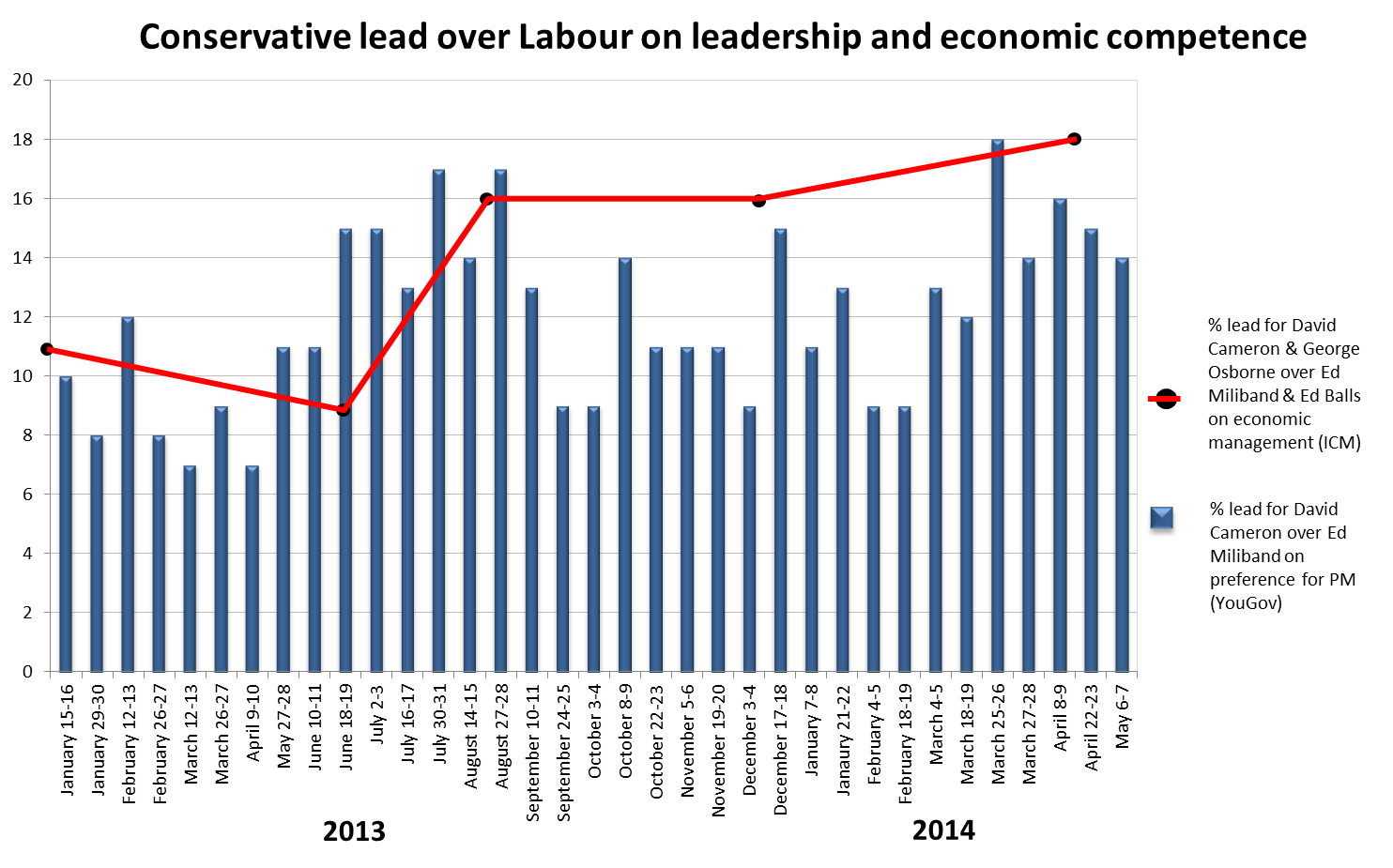
At the last election, in both cases, the answer was a narrow but clear no. According to ICM’s polling just before election day, David Cameron and George Osborne held a 1% lead on the economy over Gordon Brown and Alistair Darling. And on preference for prime minister, YouGov registered a 6% lead for David Cameron over Gordon Brown.

The chart below shows Labour’s performance on these two indicators since the start of 2013.

David Cameron and George Osborne now lead Ed Miliband and Ed Balls by 18% on the economy while David Cameron bests Ed Miliband on preference for PM by 14%.

At no point in the past four years has Labour narrowed the gap on either the economy or leadership to the level it achieved on the eve of the election in May 2010. An election where Labour polled a miserable 29%.

(more…)

Facebook Twitter Digg Delicious StumbleUpon

When did the Labour party give up on fighting racism?

06/05/2014, 09:03:14 AM

by Atul Hatwal

There was a time when Labour was the party that stood for equality. For people in a minority community, those of a different colour or heritage, Labour was the party that would fight for them.

No more.

The basic principle of confronting racism, once an irreducible element of Labour’s core, has been greyed into a guideline.

During the past few weeks Labour politicians have been complicit in allowing Ukip to redefine what is acceptable in our national debate.

When Nigel Farage used an interview in the Guardian to brand Romanians as having a “culture of criminality,” and said that British people were right to be worried if Romanian families moved in on their street, there was barely a murmur from Labour.

The party’s silence has helped validate an extraordinary shift: it’s now politically legitimate to say Britons should be scared of foreigners moving in next door.

Politics has just regressed 40 years.

Back then, as now, fear of the foreigner was a defining aspect of political debate. Rather than eastern Europeans, the targets in the 1970s were Asian and Afro-Caribbean immigrants, but the sentiment was exactly the same.

(more…)

Facebook Twitter Digg Delicious StumbleUpon

Blair switches on Syria: We need to do a deal with Assad and accept he’ll remain president

23/04/2014, 10:47:36 AM

by Atul Hatwal

In a wide-ranging speech on the middle east, Tony Blair today made a significant intervention to recast the British debate on Syria.

Until now, the assumption has been that President Assad would have to go as part of any peace deal. The dividing lines of the conflict seemed to be clear: Assad was the oppressor, responsible for the deaths of hundreds of thousands of his own people, while the opposition represented Syria’s best hope for a more democratic and enlightened future.

The idea of President Assad remaining in power was unthinkable.

But as the tide of the conflict has turned in Assad’s favour, and Islamist factions in the opposition have gained prominence, Blair’s speech signals a fundamental reappraisal of the negotiating position.

At the time of the parliamentary vote on military action in Syria, within Labour it was the Blairite wing of the party which was most in favour of punitive measures against President Assad. There remains an abiding sense of grievance among many in the party at the manner in which Ed Miliband first backed intervention, and then opposed it.

Now, however as the facts on the ground have changed, so has the solution – at least in Tony Blair’s view. In the Bloomberg speech he states,

“But the truth is that there are so many fissures and problems around elements within the Opposition that people are rightly wary now of any solution that is an outright victory for either side. Repugnant though it may seem, the only way forward is to conclude the best agreement possible even if it means in the interim President Assad stays for a period. Should even this not be acceptable to him, we should consider active measures to help the Opposition and force him to the negotiating table, including no fly zones whilst making it clear that the extremist groups should receive no support from any of the surrounding nations.”

Contrast this with his view in June last year,

(more…)

Facebook Twitter Digg Delicious StumbleUpon

As Labour attacks Sajid Javid’s appointment, new figures reveal how the party is failing on ethnic minority representation

10/04/2014, 02:37:01 PM

by Atul Hatwal

It’s not been a good twenty-four hours for Labour on diversity.

First, there was the ludicrous attack on the appointment of Sajid Javid to the equalities brief because he was a man, totally ignoring the fact he is the first British Asian to become a secretary of state as well as being someone who comes from a genuinely working class background.

Then there was the attack on him for having the temerity to be successful , so acutely dissected by Dan Hodges over at the Telegraph.

Now Uncut can reveal that Labour is failing on ethnic minority representation.

An analysis of selections in Labour’s 106 parliamentary target seats, and the 12 seats where current Labour MPs are standing down reveals that the party has managed to select just 13 candidates from minority backgrounds out of a total of 118 contests.

This means just 11% of Labour’s candidates in winnable seats will be from black and minority ethnic communities, compared to an ethnic minority population in the UK of 18% at the time of the 2011 census.

By the time of the next election, as the UK’s minority population approaches 20%, Labour’s best case scenario in the new intake will be non-white representation of just over 10%.

This is in stark contrast to the party’s performance in selecting women where shortlists have helped guarantee that 50% of all winnable seats will have female candidates.

Labour’s immediate response yesterday to Sajid Javid’s appointment was to complain that he wasn’t a woman. This mindset, where women seem to be considered more equal than ethnic minorities, clearly extends through the party into local selections.

Its a sad testament to the poverty of minority representation in the parliamentary Labour party that such a poor performance in selecting new candidates is still better than the current position where just 6% of the PLP is from a minority.

How the party addresses this abject failing is difficult: quotas are rife with problems, not least their political manipulation by those in control of which seats are designated as an exclusive short list.

However, what is undeniable is that Labour has a major problem.

Perhaps a little more attention to the party’s own record on minority representation and less flailing about to attack Sajid Javid is in order.

Atul Hatwal is editor of Uncut
Facebook Twitter Digg Delicious StumbleUpon

Miller’s gone but expenses are still toxic. What’s Labour’s plan?

09/04/2014, 11:18:59 AM

by Atul Hatwal

So Maria Miller has resigned and Sajid Javid has replaced her, meh. Contrary to some of the over-heated reports, Miller’s particular passing will have little lasting impact.

True, there’s one less woman in the cabinet, but Javid is from a minority community, an area where the Tories and Liberals are even less representative of Britain – let’s not forget that while there were previously 4 women in the full cabinet of 22 Ministers, there was no-one from a minority community.

The circus will soon  move on and there will be another crisis over which politicians and media can hyper-ventilate.

However, while Maria Miller’s political demise is ultimately unremarkable, there is a legacy from the affair; one that will persist regardless of whether she had stayed, resigned, or did the hokey-cokey daily on College Green.

The expenses issue is back as a fixture in British politics.

It won’t be as toxic as in 2009 (how could it be?), but as Andrew Lansley suggested on Newsnight last night, there are likely to be other Miller-type transgressions which come to light, that predate the new expenses regime.

And just as with Miller, each time the parliamentary standards committee (which is dominated by MPs) waters down or even changes the punctuation in a ruling by the parliamentary standards commissioner, the same battle-lines pitching media against politicians will be drawn.

The press will be in full cry and the most resonant soundbite to emerge in the past week will be repeatedly trotted out: “politicians should not be allowed to mark their own homework.”

The outrage of the fourth estate is understandable: a variant on this line was central to defining the public’s perception of the Leveson debate. In that case, it was the media who were not to be allowed to mark their own homework. 

Then, as now on expenses, the line also happens to be true.

Self-regulation doesn’t work. The experience across financial services, politics, media and schools everywhere is quite clear: teacher needs to mark the homework.

So politicians from all parties face a quandry.

(more…)

Facebook Twitter Digg Delicious StumbleUpon

Devolving £20bn is a big deal. Is Labour sure local councils can handle it? Really?

08/04/2014, 01:08:30 PM

by Atul Hatwal

Implicit in Ed Miliband’s big devolution speech today was a very, very large assumption.

When he promised that a Labour government would devolve £20bn of funding to partnerships of local authorities in the English regions, the Labour leader was assuming that local authorities are the best vehicles to distribute and administer the new funds.

This is far from proven.

It’s notable that the speech was made in Birmingham and marks the interim stage in Lord Adonis’ growth review. 

The track record of Birmingham council in typifies the sorts of problems that can occur when regional revival is left to traditional local authorities. Here’s none other than Lord Adonis on the subject, from earlier in this parliament,

“Let me give you my frank opinion, as one who has dealt with Birmingham City Council a good deal in recent years. The city needs to raise its game significantly in terms of leadership, performance and strategy…the city council has had…Weak strategic leadership alongside average (at best) improvement in the public services under its direct control.

Take education, which I know only too well from constant interaction with the city council…promoting reform to secondary education in the city has been like pulling teeth.”

Lord Adonis made these comments in a speech to the Lunar Society in March 2011, as Birmingham was preparing for a referendum on whether to move to a Mayoral system of local government.

Although the referendum was lost, the points made by Lord Adonis in favour of reforming the current system of local government still stand; all the more so if Labour is considering devolving such substantial amounts of funding to groups of local authorities.

(more…)

Facebook Twitter Digg Delicious StumbleUpon

Labour history uncut: The Communists come knocking

06/04/2014, 05:35:57 PM

by Pete Goddard and Atul Hatwal

In November 1935, a letter flopped onto the Labour party doormat.  It was from Harry Pollitt, boss of the Communist Party of Great Britain, wondering if the time was right for a left-wing super team-up.

In the application to affiliate his party to Labour, Pollitt stated the Communists were prepared to work, “honestly and sincerely,” as part of Labour, “not as a manoeuvre or for any concealed aims.”

NPG Ax136094; Harry Pollitt by Howard Coster

Harry Pollitt – Communist leader and G-man

He was half right – he certainly wasn’t concealing his aims. The following week Pollitt made a speech saying that the Communists wanted to join the Labour party to “transform it into a real broad federal organisation in spite of the intentions of the most reactionary Labour leaders.”

“The most reactionary Labour leaders,” turned out to be basically all of them. The NEC responded to Pollitt curtly with a missive that included the twin sentiments of “off” and “sod”, not necessarily in that order.  

Pollitt wasn’t so easily discouraged though and set a target of forcing a vote on affiliation at Labour’s conference in October 1936.

He had some grounds for optimism. While Labour’s leaders were implacably opposed to mucking in with commies, the grassroots were not so sure.

Fascism was on the march on the continent and Labour’s response was hardly a model of vigour.

(more…)

Facebook Twitter Digg Delicious StumbleUpon

Farage might have won the live debate but Clegg triumphed in the news packages. And more people watch the news

03/04/2014, 10:08:03 AM

by Atul Hatwal

A thumping victory for Farage. That was the consensus following last night’s big debate. The pundits said it, the polls said it; there was little doubt.

But for people like me, who didn’t see the debate, and whose only sight of the combatants was on the evening news, the result was very different.

In the contest of the clips, Clegg was the winner.

This doesn’t mean that the verdict of those who saw the live debate was wrong. Just that, as so often is the case, the highlights reel told a different story.

The BBC News at Ten package, which would have had the most viewers, focused on four passages in the debate: the clash over Putin, immigration, past Lib Dem promises of a referendum and the closing statements.

Nick Robinson’s report can be seen here.

While Farage had the upper hand in the latter two exchanges, the first two were the most resonant.

On Putin, the key moment was when David Dimbleby intervened to contradict Nigel Farage’s assertion that he had never said he “admired Putin.”

Although most viewers are likely to have minimal interest in Nigel Farage’s position on Vladimir Putin, it’s always extremely powerful when the neutral debate moderator intervenes against one of the participants.

Quite apart from the topic under discussion, it sends a clear message to the viewing public that this politician isn’t being straight with the audience.

(more…)

Facebook Twitter Digg Delicious StumbleUpon