




Posts Tagged ‘Atul Hatwal’

With Douglas Alexander in the firing line, cui bono?

01/04/2014, 12:37:22 PM

by Atul Hatwal

As Labour’s internal wrangles have spilled into the papers over the past week, there has been a single thread running through each story. Sam Coates at the Times summarised it well on Sunday when he tweeted,

One common theme in all Labour row stories this weekend (and my piece last week): all involve people having problem with Douglas Alexander

— Sam Coates Times (@SamCoatesTimes) March 30, 2014


Last week Douglas Alexander was vetoing John Cruddas’ expansive policy review proposals. Then on Saturday he was firing Arnie Graf, swiftly followed on Sunday with Alexander falling out with almost everyone involved in Labour’s campaign.

This last story in the Mail on Sunday was particularly jaw-dropping, even by Labour’s standards of red on red briefing. The incredible level of detail, the direct quotes and conspicuous subsequent silence from the principals on several of its specifics, speaks volumes about the splits at the top of the party.

The narrative seems set: Douglas Alexander is the problem.

But is this all rather too easy? Allies of Douglas Alexander and even neutrals are suggesting a rather different view of what is happening within Labour.

The missing element in all of these stories is some important context about the battles behind the scenes as Labour attempts to define its policy platform.

(more…)

Facebook Twitter Digg Delicious StumbleUpon

Labour’s right is rumbling. Not before time.

27/03/2014, 10:23:02 PM

by Atul Hatwal

Since 2010, one of the most successful operations mounted by Ed Miliband’s team has been to convince journalists that the party is at peace. That Labour has avoided the type of bitter in-fighting that characterised past ejections from government and is united around the leader.

This point is so core to the Miliband narrative that he repeats it in his stump speech to Labour audiences.

However, while it is true the 1980s haven’t been re-run, the absence of conflict is not the same as the presence of unity.

The reason Labour’s divisions have not been visible has been  a temporarily effective but ultimately unsustainable party management strategy; one that has combined Ed Miliband avoiding taking definite positions on the most contentious political questions with a concerted marginalisation of Labour’s right-wing.

When Gordon Brown was defeated in 2010, his electoral demise bequeathed two questions to Labour.

In a world of limited spending, what would Labour prioritise and what would it cut?

And how could more, be achieved from less, in the areas where money was to be spent?

From day one, Ed Miliband has run from these questions, in part for good reason.

Hamstrung by a lack of support in the parliamentary party and reliant on the unions’ succour to bolster his position, he has had to tack left to retain his union support while not straying so far from the more centrist concerns of the electorate that Labour’s poll rating collapses.

For Ed Miliband, to answer has been to lose – either the electorate or his political life support system on the left.

(more…)

Facebook Twitter Digg Delicious StumbleUpon

3 early warning signs that Labour’s poll-lead drama is about to become a full blown crisis

24/03/2014, 10:36:14 AM

by Atul Hatwal

It’s been a bracing week for Labour. A widely panned budget response from Ed Miliband, followed by weekend polls placing the poll lead at just one point, have brought Labour’s private jitters out into the open.

First, last week an MP briefed Uncut on the disconsolate mood in the PLP following Ed Miliband’s budget response, then, yesterday John Mann broke cover, publicly airing some of the concerns discussed daily in the PLP.

And now, even the world of Labour think tanks has got involved, with a coalition ranging from the Unite backed Class to the Blairite Policy Network calling on Ed Miliband to be “bold,” and “radical,” (though the bold and radical vision that could unify such an ideologically disparate group of signatories is singularly unclear.)

Polls go up and down, but the overall direction of travel is unmistakeable. As the Tories draw level, or even nose in front, in the coming months, Labour’s cracks are going to become ever more evident.

Here are 3 early warning signs to watch for from the PLP and Labour leadership that the party’s poll lead drama is turning into a full scale crisis.

1. Off-topic interventions from the shadow cabinet

When a party is riding high in the polls, the leader’s authority is absolute and members of the shadow cabinet stick obediently to their briefs. When the situation is less favourable, the temptation to answer interviewers’ questions on how the position can be improved, becomes much stronger.

In summer 2013, as the last crisis of confidence in Ed Miliband gathered momentum, Andy Burnham gave an extraordinary Guardian interview. In it, he talked of how Labour had “lost the art of thinking bigger,” and ranged widely, tackling political strategy, economic policy, as well as the importance of the two Eds’ green lighting his plans for integrating health and social care (which they pointedly haven’t.)

(more…)

Facebook Twitter Digg Delicious StumbleUpon

Please, let’s remember Tony Benn and Bob Crow for who they were, not bland Diana-fied national treasures

14/03/2014, 10:32:06 AM

by Atul Hatwal

To hear tributes to Tony Benn this morning and Bob Crow earlier in the week, is to enter an alternate reality, one of saccharine reflection and anodyne dolour.

In the myriad of CGI memories that are being publicly broadcast, the defining characteristic that made Tony Benn and Bob Crow national figures is all too often omitted: threat.

There are lots of committed socialists who lead their lives, unflinching in their beliefs and whose passing is not remembered.

What made Tony Benn and Bob Crow different was that they attained positions where their proximity to power meant they threatened the status quo in their respective worlds.

Threat isn’t a bad thing. It’s the essential precursor of change and both reveled in their ability to threaten the established order. But it brings with it costs: confrontation, fear and anger.

To overlook the visceral conflict which both generated is to suck the vigour and colour out of their professional lives. Without at least acknowledging this threat, the commemorations lapse into the North Korean.

We remember Tony Benn and Bob Crow because they were men of consequence. For many that consequence was far from benign. In the case of Tony Benn in the early 1980s, it threatened the future existence of the Labour party.

Both men were comfortable with confronting opposition and crushing it under foot. They were there to fight and be fought.

To recall the passion, bitterness and division does not sully their memory. Quite the reverse. It is why they are remembered, because they mattered and people cared enough about what they were doing to get involved, either for or against them.

The Dianafication of the deaths of Tony Benn and Bob Crow is perhaps the least fitting tribute possible to the lives they led. They were not bland national treasures but powerful and threatening political figures.

Along-side the warmer words about their personal virtues, it’s worth remembering this. For people in the business of attaining and wielding power, such as Tony Benn and Bob Crow, to adapt a common refrain following Diana’s death, it’s what they would have wanted.

Atul Hatwal is editor of Uncut

Facebook Twitter Digg Delicious StumbleUpon

Labour prepares to re-write Collins party reform package

13/03/2014, 01:08:46 PM

by Atul Hatwal

A fortnight on from Labour’s special conference and major change is on the agenda for Ed Miliband’s flagship party reforms.

The Labour leadership was able to secure strong backing for the Collins review from the unions largely because it delegated resolution of much of the contentious detail to a separate “implementation group”, to be set up following the special conference.

This group, comprising union and party representatives, has now been formed and outstanding questions need answers.

Immediately, problems are emerging in two areas: how the unions’ new political funds will be administered, and the role of union members in elections held before the end of the five year Collins’ process.

First, on the arrangements for the new structure of the political funds, the unions are split.

Broadly, the majority of the unions envisage a version of the Unison model.

This is where there are, in effect, two political funds: a general political fund, which is not used to fund Labour, and an affiliated or “Labour link” fund, which is used to support the party.

Where a trade unionist decides that they do not want their political fund contributions to support Labour, they all go into the general fund.

Where they want to financially support Labour, their contributions are split between the two funds.

The defining rule about the general fund is that its resources cannot be donated by the union to the Labour party.

Sounds simple.

(more…)

Facebook Twitter Digg Delicious StumbleUpon

Labour history uncut: “And a mouse shall lead them”

11/03/2014, 10:21:26 PM

by Pete Goddard and Atul Hatwal

In 1935 Labour hit on a new idea: a try-before-you-buy scheme for the leadership.

Just days before the November general election, Clement Attlee had been elected interim boss. Because nothing says “we’re ready to lead the country,” than having a temp at the helm.

The electorate agreed. With a disappointing 154 seats secured, it looked like Clement Attlee had no hope of going temp to perm and was about to become another victim of Britain’s insecure labour market.

Especially as now there was rather more choice on offer. The election, though uninspiring overall, had seen the return of several leading Labour politicians to the Commons, including Herbert Morrison, Hugh Dalton and John Clynes.

These new options, combined with over 100 more MPs to do the choosing, meant a change at the top seemed imminent when, barely a week after the national poll, the leadership election beckoned.

After some early jockeying for position and switches of allegiance in the manner of the children’s gameshow Runaround, the field of applicants was winnowed down to three.

Herbert Morrison, Clement Attlee and Arthur Greenwood remained, the last two of whom had also contested the leadership one month earlier.

Of the three, Morrison was the early favourite. He was the only one on the national executive in his own right, he had a track record of electoral success, and his dad was a policeman, so he could wheel his bike wherever in Westminster he wanted.

Morrison was on the right of the party, making him a right Herbert

Morrison was on the right of the party, making him a right Herbert

(more…)

Facebook Twitter Digg Delicious StumbleUpon

Labour history uncut: The Red Indian’s bomb fails to explode

25/02/2014, 07:39:47 PM

by Pete Goddard and Atul Hatwal

On the 23rd of October, Stanley Baldwin fired the starting pistol for the 1935 general election.

It was just two weeks since Clement Attlee had become temporary leader. Temporary because, although George Lansbury had resigned, the split over who should lead the party remained unresolved.

Not ideal preparation for battle. But as the party readied itself for a poll on the 14th November, there was still hope for things to improve for Labour in parliament. After all, given the disaster of the 1931 election, it would have taken a Katie Hopkinsesque effort to become any less popular.

But Labour dreamed big. Hugh Dalton noted in his diary an expectation of a rise from 52 seats to 240. Others dreamed bigger –an actual Labour majority.

But in real life, not all dreams come true. If they did, we’d be too busy financing the transformation of Crystal Palace into south London’s Barcelona to write this.

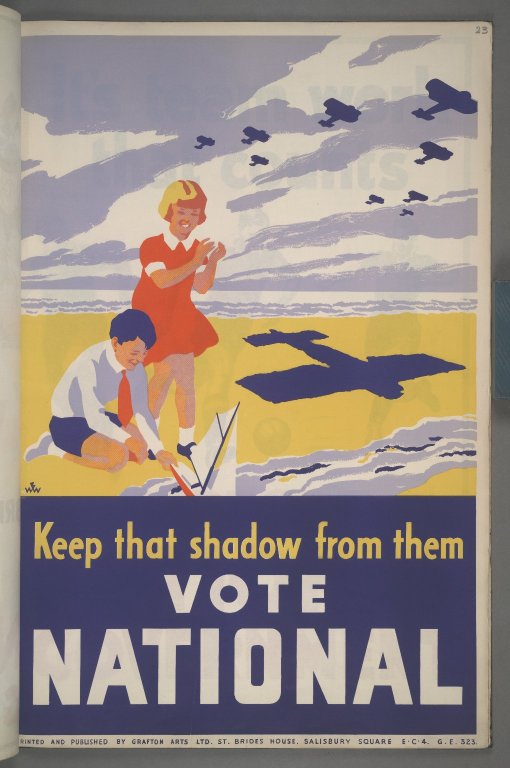
A National government poster comes out unexpectedly in favour of skin cancer for children

A National government poster comes out unexpectedly in favour of skin cancer for children

(more…)

Facebook Twitter Digg Delicious StumbleUpon

Just because its in the Mail doesn’t make it wrong. Harman, Hewitt and Dromey need to provide some answers

24/02/2014, 05:02:08 PM

by Atul Hatwal

Another day, another front page from the Daily Mail on the links between the National Council for Civil Liberties (NCCL) and the Paedophile Information Exchange (PIE) at a time when Harriet Harman, Patricia Hewitt and Jack Dromey held senior positions in the NCCL.

When the Daily Mail attacks Labour politicians there is a tendency to simply shrug the shoulders and move on. It’s in the nature of the beast, the Mail attacks the party because that’s what the Mail does. So what?

But that doesn’t mean everything it says is wrong.

In this case, the tone might be vituperative and the events almost faded into distant memory, but the Mail’s reports are backed up by hard evidence. Evidence that is difficult to ignore.

The most pointed allegations date from 1976 when Jack Dromey was a member of the NCCL executive and Patricia Hewitt was general secretary (Harriet Harman didn’t start working at the NCCL until 1978.)

In 1976 the NCCL made a submission to parliament on the Sexual Offences Act. In this paper are some extraordinary and inexplicable recommendations,

“(i) A person aged 14 or over should be legally capable of giving consent

(ii) A person aged under 10 should be presumed legally incapable of giving consent

(iii) Where both partners are aged 10 or over but under 14, a consenting sexual act should not be an offence.

(iv) Where one partner is aged 10 or over, the law should presume that consent was not present, unless it is demonstrated that it was genuinely given and the child understood the nature of the act.

(v) As the age of consent is arbitrary, we propose a an overlap of two years on either side of 14, so that, where the participants are 12 or over but under 16, a consenting sexual act will not be an offence.”

It might be that the NCCL’s parliamentary submissions were signed-off without recourse to the general secretary or the executive.

It might be that this particular paper was submitted without going through the proper processes, and Patricia Hewitt and Jack Dromey had no knowledge of it.

It might be any one of a range of reasons that could explain why they had nothing to do with the recommendations made in the NCCL’s parliamentary brief.

(more…)

Facebook Twitter Digg Delicious StumbleUpon

Oh dear Tony. Oh dear.

19/02/2014, 05:43:42 PM

by Atul Hatwal

If Rebekah Brooks’ e-mail to James Murdoch does give a fair account of her conversation with Tony Blair, then he’s been a very foolish ex-prime minister.

It’s not so much the apparent cynicism of the advice on how to manage the process, or even the reference to Hutton (which might be Brooks’ interpretation rather than a direct reference by Blair) but the crushing, ghastly, inescapable lack of judgement. What did he think he was doing?

One of the worst aspects of politics is the faux comity within which work relationships become wrapped.

It was evident at the Huhne trial in the cringeworthy string of BFF e-mails between Vicky Pryce and Isabel Oakeshott, where they discuss having a “fun” mini-break in Greece to work through the details of the story to bring down Huhne.

The chummy undercurrent is wholly at odds with the reality of what is happening.  These types of exchanges are not friends having a little chitter chatter, they are work transactions of significant gravity. Each participant has something the other wants. At stake are careers, livelihoods, and in the case of the Huhne fiasco, people’s liberty.

But it is the argot in which much modern politics is conducted and in Tony Blair’s case, he seems to have mistaken the artifice of sociability for the substance for friendship.

(more…)

Facebook Twitter Digg Delicious StumbleUpon

Your opinion on a Lib Lab coalition doesn’t matter. Labour are going for one anyway.

17/02/2014, 06:59:20 PM

by Atul Hatwal

Quite a little kerfuffle today as various Labour voices have sounded dissonant notes on the desirability of a coalition with the Lib Dems. The spark to ignite the Lib-Lab tinder was Nick Clegg’s open discussion about the possibility of a future coalition with Labour. The internal Labour discussion has been earnest and heartfelt, but above all, entirely pointless.

Labour activists and commentators can talk about the pros and cons of a coalition with the Lib Dems ad infinitum, but the decision has already been made. The opinions do not matter, Labour is going for a coalition with the Lib Dems come what may.

The evidence is apparent in the reprioritisation of Labour’s 106 key seats.

A month ago Uncut reported that Labour had significantly scaled back its key seat ambitions. This was always going to happen – there was no way a constituency on the list like Bermondsey and Southwark, held comfortably by Simon Hughes since 1983, was going to receive the same level of support as a seat like Stockton South where the Tories only have a majority of 332 and that Labour held solidly in 1997, 2001 and 2005.

But it is the scale of reprioritisation which effectively means Labour has abandoned thoughts of governing alone and is now aiming for coalition with Lib Dems.

Labour’s struggle in the south in particular is crippling the party’s ability to push for a clear majority. Party sources suggest that doubts among southern voters on Labour’s economic credibility and Ed Miliband’s leadership are making comparatively small Conservative majorities difficult to overturn.

One seasoned campaign professional with knowledge of the resources being allocated to key seats has indicated to Uncut that the high command now views majorities of over 2,400 in the south as increasingly beyond Labour’s reach.

(more…)

Facebook Twitter Digg Delicious StumbleUpon