




Posts Tagged ‘Atul Hatwal’

Labour is headed for trouble in next week’s spending review

18/06/2013, 04:30:24 PM

by Atul Hatwal

Next week, George Osborne will finally spring his long prepared spending review trap.

Here is the chancellor’s basic choreography: the Tories announce an eye-wateringly tight spending round, Labour opposes and the Tories attack Labour for being unreformed spendaholics.

Alternately, Labour back the government’s spending plans, in which case, the Tories attack Labour for being reluctant converts to fiscal responsibility and, as a happy sidebar, Labour’s Keynesian prescription for boosting spending to revive the economy is effectively de-funded.

Either Labour play to the stereotype of profligacy that lost the last election or become me-too Tories.

Ed Balls’ big speech a few weeks ago was intended to unpick this problem and re-position the party. The commitment to aggregate Tory spending plans covered the party’s fiscal flank while Ball’s retained the Keynesian differentiation with his £10bn capital spending boost, funded through increased borrowing.

On paper, it went some way to neutralising the chancellor’s likely attacks.

But there’s a problem.

Now Labour has shifted to a more politically realistic position on spending, it needs to robustly assert this new line.

It needs to use every opportunity to publicise the  new approach. To make the progressive case for adhering to overall Tory spending totals (while having different individual priorities) and ensure the public knows that a major change has just taken place.

Otherwise, next week, the Tories will hammer the party for running scared of its own policy. They will paint Labour as insincere and irresolute on spending. The taunts about whether Labour believes what it says will turn the party’s economic drama into a political crisis of leadership.

For the public, the net result will be little different to if Labour hadn’t changed its fiscal stance. Perhaps worse, when taking into account the collateral damage to Ed Miliband’s personal ratings from any squirming on policy.

(more…)

Facebook Twitter Digg Delicious StumbleUpon

Labour history uncut: What happened next after the general strike failed

14/06/2013, 04:47:16 PM

by Pete Goddard and Atul Hatwal

The general strike was lost. Bitterness and recriminations echoed across the Labour movement and the conflict between the left and Labour’s leadership, once again, took centre stage in Labour politics.

Back to business as usual, then.

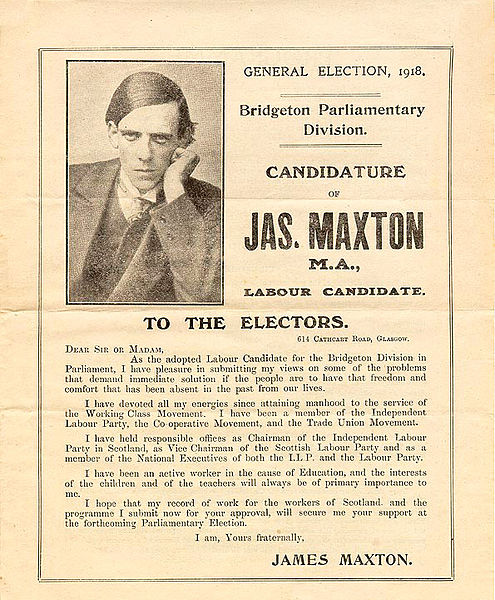
April 1926 had seen left wing firebrand James Maxton ascend to the chairmanship of the Independent Labour Party (ILP). He was a strong believer that Labour should stand on an unabashed platform of socialism and a fervent opponent of Macdonald’s strategy of gradualism, respectability and trying to appeal to voters.

Following the collapse of the strike, the ILP adopted its programme of action, “Socialism In Our Time.” This included such crazy notions as a living wage, family allowances and the nationalisation of banks.

Jimmy Maxton responds to research suggesting voters prefer candidates with a ‘sinister stare’

Back in 1926 Macdonald rejected the ILP programme out of hand. He wanted socialism, yes. “In our time” however, was way too immediate and way too specific for his tastes.  He was more “socialism some time, maybe sort of soon-ish, but not right now though.”

He said the ILP plans were   “a collection of flashy futilities… likely to involve in practice the postponement of all advance, because it would only frighten the electorate and ensure a crushing labour defeat.”

And Macdonald knew all about crushing Labour defeats, having helped bring about that last one by precipitating the fall of the first Labour government and disastrously mis-handling the Zinoviev letter.

(more…)

Facebook Twitter Digg Delicious StumbleUpon

Disunity at Unite means trouble for Labour

11/06/2013, 02:05:43 PM

by Atul Hatwal

Yesterday’s sudden departure of Unite’s long standing national political director, Steve Hart, was enough to make head’s turn in Labour leadership circles. That he then followed up with a tweet (now deleted) saying he was told that he was “too close to Labour,” will have set alarm bells ringing.

Given the apparent reason for Hart’s ejection, his replacement, Jennie Formby, seems an odd choice. Unlike Hart she sits on Labour’s ruling National Executive Committee. In terms of Labour’s structures, it’s difficult to be any closer to the party.

However, the organisation chart does not tell the real story of what has happened.

Three factors seem to have been pivotal in Steve Hart’s downfall: clashes at the top of Unite over the union’s proximity to Labour, Ed Balls’ speech last week and the fall-out from Unite’s ham fisted attempts at fixing candidate selections, particularly in London for the European elections.

Steve Hart has been at the heart of London Labour politics for over a decade, having forged close relations with Ken Livingstone’s mayoral administration. When Livingstone’s former chief of staff, Simon Fletcher moved in to a senior position at the London Labour party before the last election, Hart’s influence increased.

When the continuity Kennites took control of key positions in the London Labour party after the general election, Steve Hart’s role in London Labour grew.

And when Simon Fletcher joined Ed Miliband’s office with responsibility for union liaison, earlier this year, Hart’s personal connections extended right to the top of the party.

But unions are jealous, internecine places. Their internal politics are largely masked to the outside world but as with all large organisations, the competition and back stabbing are vicious.

Steve Hart’s increasing influence would not have been welcome, particularly to those on the left of the union vying for control of Unite’s political direction.

(more…)

Facebook Twitter Digg Delicious StumbleUpon

Labour history uncut: Everybody out!

05/06/2013, 06:00:12 PM

by Pete Goddard and Atul Hatwal

It’s somehow fitting that the fuse for the general strike was lit at the Daily Mail.

The government was still engaged in half-hearted negotiations with the unions when, on Sunday 2nd May 1926 the print compositors at the Mail refused to set an inflammatory editorial, entitled “For King and Country.” Although the companion piece, “Compositing print causes cancer” probably didn’t help either.

Seeing an opportunity to kick things off whilst still blaming the unions, the government summarily walked out of the talks muttering about threats to freedom of speech.

The unions thought, “Walk out will you? We’ll show you a thing or two about walking out.”

The next day letters went out to union members up and down the country and on Tuesday 4th May the whistle blew.

”Everybody out!”

The general strike had begun.

Around 1.5 million to 2 million workers took part in the strike. People downed tools all across the country.

Then, frequently, different people across the country picked those tools up again.

Approximately 300,000 volunteers had joined the overwhelmingly middle class and right-wing Organisation for Maintenance of Supplies. Their task was to help keep the country running during the period of the strike in a sort of extended “working class” themed fancy dress party.

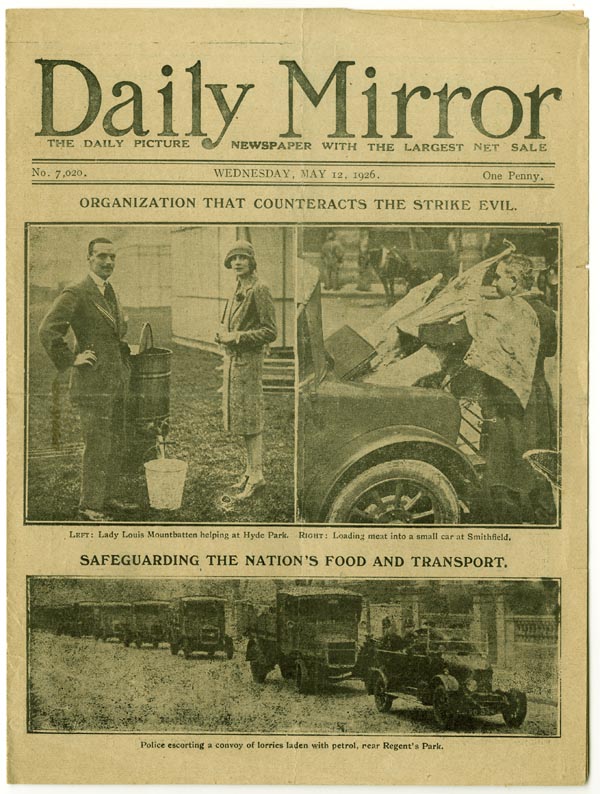
The general strike’s PR team knew it had an uphill battle when even the Mirror started calling the strike "evil"

At the same time, with the print setters on strike, someone had to provide the British public with a replacement for their daily sports news, Sudoku and political misinformation. And who had enough spare time to moonlight over hot metal at a time of enormous national economic crisis? The chancellor of the exchequer, of course. Winston Churchill was put in charge of producing the government’s British Gazette.

(more…)

Facebook Twitter Digg Delicious StumbleUpon

Labour history uncut: Industrial war beckons, Labour looks at its shoes

02/06/2013, 04:24:37 PM

by Pete Goddard and Atul Hatwal

On 31st July 1925, the unions celebrated “Red Friday.” The threat of general strike over miners’ wages had forced prime minister Stanley Baldwin to concede a 9 month wage subsidy. A royal commission had also been sent off to peer down a few mines and figure out how to fix everything.

It looked like a victory for the unions, but everyone knew it wasn’t over yet. When the commission reported, battle was likely to be resumed unless the deadlock could be broken in the intervening nine months.

The best hope for peace lay with the miners’ leader, Herbert Smith.  He was a realist and a moderate union man.

Unfortunately, standing right next to him was almost the biggest threat to peace. The increasingly influential miners’ union secretary AJ Cook was, in the words of TUC general secretary Fred Bramley, “a raving, tearing Communist.”

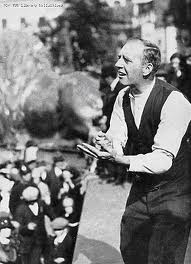
AJ Cook even did his own signing for the deaf

Cook was a syndicalist, a Marxist and a firm believer in the power of direct action. He was also extremely charismatic and, like the Yamaha YHT-893BL with 100W subwoofer, a very powerful speaker.

According to the home office, he was also “an agitator of the worst type.”  Although ironically, being the worst type of agitator in the home office’s eyes meant that he was actually very good at it.

Cook was, in contrast to the solution-seeking TUC and Herbert Smith, keen to get stuck in and challenge the status quo with a bit of workers’ power.

(more…)

Facebook Twitter Digg Delicious StumbleUpon

3 years on: The Labour party is allergic to making decisions

30/05/2013, 02:00:22 PM

It’s 3 years since Uncut started so, in a series of pieces, we’re taking stock of what has changed for Labour since 2010. Atul Hatwal looks at how Labour is led

When Gordon Brown departed the Labour leadership, there was a sigh of relief across Westminster on both the left and right of the party. For many, the problem with Gordon hadn’t been the policies, though there was clearly room for improvement, but leadership.

Decisions would sit on his desk for weeks and months, sometimes years. By the time a choice was made, the moment would have passed and after all the haggling and deliberation, those involved felt exhausted.

The advent of a new leader was meant to change that. Regardless of his politics, Ed Miliband’s swift and determined decision to stand against his brother boded well for his style of leadership.

Unfortunately it seems that was the last major decision Labour’s leader made. Stories abound about landmark speeches being constantly rewritten with endless debate in the leader’s court on the correctly nuanced line to take.

Everyone has an opinion and all are heard with the result that little substantive is ever said.

(more…)

Facebook Twitter Digg Delicious StumbleUpon

Revealed: Unite about to be investigated by the information commissioner for Falkirk fix

29/05/2013, 07:00:31 AM

by Atul Hatwal

This week, the Labour party report into irregularities in the selection process for Falkirk West’s prospective parliamentary candidate, will be published. The selection procedure was suspended two weeks ago following allegations that Unite was fixing the contest in favour of its candidate – Karie Murphy.

The party had hoped to draw a line under the affair with the publication of the report. But, regardless of the findings of the inquiry, the row is likely to rumble on with the government’s privacy watchdog, the information commissioner, set to be called in.

The suspension of the selection was prompted by two main charges: that Unite members were signed-up for Labour party membership, with their subscription paid, without being told; and Unite and Murphy had privileged access to the local Labour party membership list.

Last week in the Herald, details of a letter of complaint sent to the Scottish party emerged. In it, a Unite member, living in Falkirk West wrote,

“Myself and two family members have been enrolled by Unite…I or my family did not fill in or sign any forms and wish to know what information the party holds about my family.”

Further allegations have been made that Karie Murphy and Unite have used the Falkirk West membership list to contact CLP members without members’ permission on at least two occasions.

If either of these claims is found to be true, Unite will have significantly breached the Data Protection Act.

Under the terms of the Act, each individual must have agreed before their personal details are passed to a different organisation. The law could not be clearer: point 1 of schedule 2 of the Act, which governs the conditions for personal data being used or “processed” by an organisation, states

“The data subject has given his consent to the processing”

At the point where Unite members’ personal details were registered with the Labour party, without their consent being first granted, the law would have been broken.

At the point where Falkirk West Labour party members had their details passed to Unite, without their prior consent, the law would, once again, have been broken.

(more…)

Facebook Twitter Digg Delicious StumbleUpon

Labour history uncut: TFI its Red Friday

24/05/2013, 06:03:34 PM

by Pete Goddard and Atul Hatwal

“Every day they were in led us further from socialism.” Thus spake a disappointed Jimmy Maxton of the first, and brief, Labour government which had flopped out of power at the end of 1924 and was now back where it was most familiar, on the opposition benches.

Bitterness and recrimination reverberated across the Labour movement. Both the left and the right agreed that maybe it was time to replace Ramsay Macdonald as leader.

Philip Snowden, former resident of 11 Downing Street, tried to annoy his onetime prime ministerial neighbour by agitating for Arthur Henderson to challenge for the leadership, as well as mowing his lawn really early on Sundays.

Meanwhile, Jimmy Maxton and the red Clydesiders sounded out George Lansbury for similar purposes (the leadership, that is, not the lawn mowing).

The unions were busy grumbling too. The Labour government had proved just as happy to threaten them with the emergency powers act as the Tories and Ernest Bevin, leader of the T&G and one of politics’ all-time great haters, led the angry backlash from the brothers.

He had not forgiven Macdonald for the Labour government’s handling of the docks and tramway strikes in early 1924, telling all and sundry that he’d be happy with anyone but Macdonald as leader.

Bevin wasn’t alone either. They unions had shifted decisively left during the Labour government, partially as a result of their older leaders like Margaret Bondfield and dockers’ leader Harry Gosling, being made ministers in said government, clearing the way for more radical voices to take the reins.

Unfortunately for the serried ranks of the discontented though, they were to be disappointed. In line with the long PLP tradition of factional infighting, the only person each group of MPs disliked more than the current leader was the alternative favoured by the other lot.

(more…)

Facebook Twitter Digg Delicious StumbleUpon

The polling that shows why Labour’s lead is soft

22/05/2013, 03:32:53 PM

by Atul Hatwal

The terms of the debate are shifting within the Labour party. Since the underwhelming local elections, the question is no longer whether the poll lead is soft but why. Just this morning, one of Ed Miliband’s more doughty supporters in the media, Mary Riddell, penned her most pessimistic piece to date on Labour’s position.

This change has been partially obscured by the recent writhing of the Tory right over Europe and gay marriage but as the spending review approaches, it will come into sharp focus.

As ever, the answer to the question is to be found in voters’ views on the economy and specifically spending.

Labour’s case against the government has been clear: excessive Tory cuts killed off the flickering recovery of 2010 with the deficit rising as growth flatlines.

It is hard to disagree with the economics. But there’s a political problem.

More and more of the public back the cuts.

YouGov have asked a detailed series of questions on deficit reduction over the past three years and the shift in responses shines a light on why Labour’s poll lead isn’t so much soft as aqueous.

The public’s support for action on the deficit has been constant: at the start of March 2011, 57% felt that “the way the government is cutting spending” was necessary versus 32% who thought it unnecessary. Last week the figures were 57% and 29%, virtually no change over the past two years.

This should have been a warning that something wasn’t quite right with the poll lead: how could the public support Labour while also agreeing with the government’s approach to cuts.

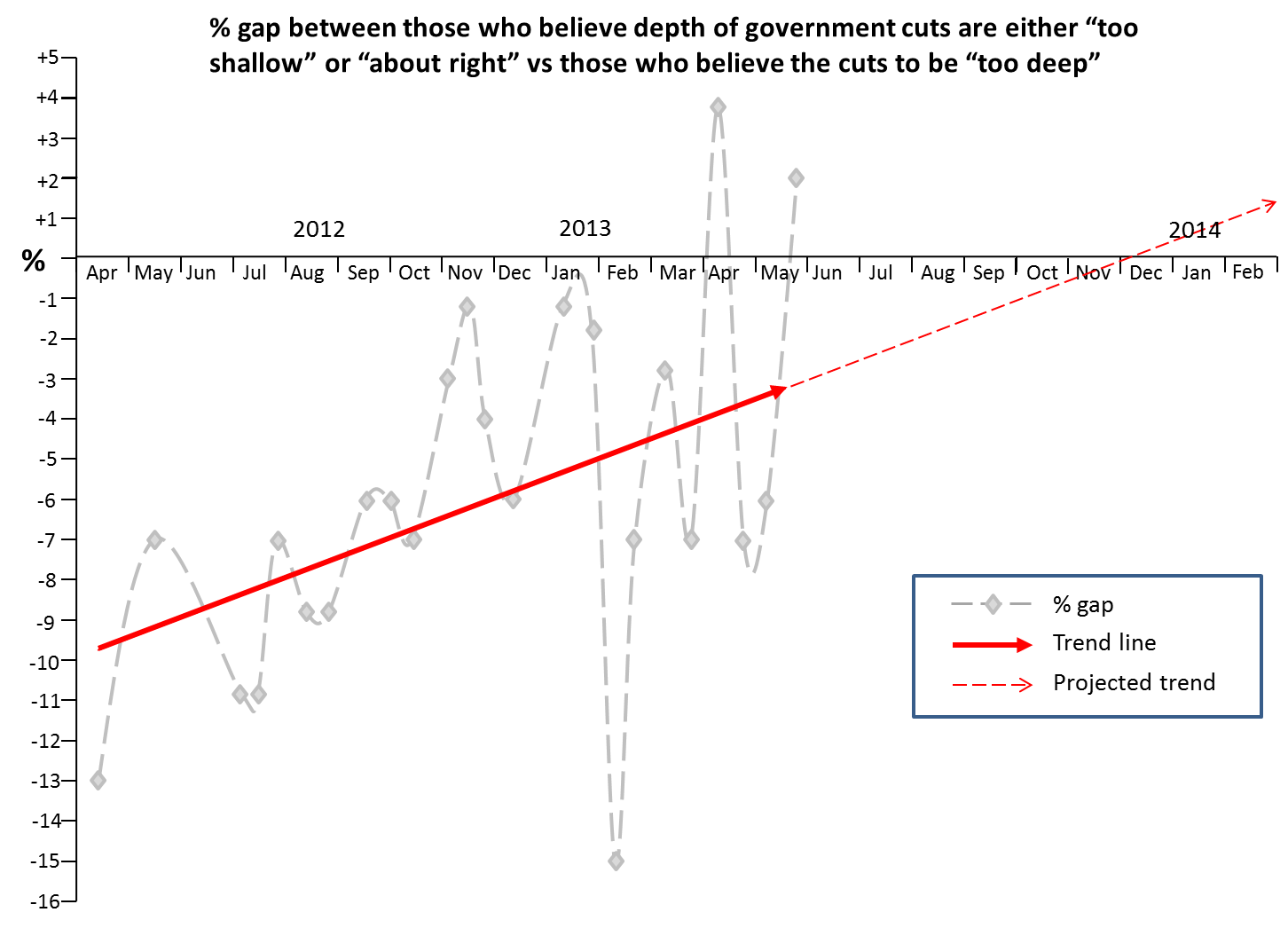
But the YouGov surveys also had seemingly contradictory responses. The key question is on whether the public believe the depth of the cuts to be “too shallow,” “about right,” or “too deep.” The answers to this question initially suggested a consensus that the cuts were too deep. But that is changing.

Source: YouGov

Since April 2012 when 13% more felt the cuts to be “too deep” than either “about right” or “too shallow”, the position has shifted radically. This week, the poll had the pro-cuts camp 2% ahead.

(more…)

Facebook Twitter Digg Delicious StumbleUpon

Labour history uncut: “We’re bunkered!” The red scare election of ‘24

20/05/2013, 07:17:07 PM

by Pete Goddard and Atul Hatwal

It was October 8th 1924 and Ramsay Macdonald was in high spirits. He noted in his diary,

“So the chapter ends after a great day when at the close we stood higher in the House of Commons than ever…We had knocked them all over the ring and they were ashamed of themselves”

Or to put it another way, “Good news everybody – our government has fallen,”

Parliament had voted for an inquiry into whether Labour pressure had caused the prosecution of the communist Workers Weekly editor, John Campbell, to be dropped. Macdonald had taken this to be a motion of censure, chucked himself out of office and called a new election for the 29th October.

He needn’t have, but there had been an election in each of the previous 2 years, so there was a certain symmetry to it at least.

Readers began to suspect a little bias in Shoot! comic

After a brief government characterised by caution and a gradual approach to social reform, Labour got its reward – accusations of communism and a campaign dominated by a virulent red scare.

The Times declared Labour’s commitment to establish a national network of electricity generating stations “a project dear to Lenin.” So think about that next time you’re boiling a kettle, you commie.

Conservative leaflets warned parents to be on their guard against “plausible men and women who invite their children to join Sunday school and clubs.” This was because such activities were, needless to say, a cover for children “to be baptised into the communistic faith.” Presumably the implausible men and women were absolutely fine.

(more…)

Facebook Twitter Digg Delicious StumbleUpon