




Posts Tagged ‘Atul Hatwal’

The press is about to turn on Ed Miliband

28/09/2012, 10:41:47 AM

by Atul Hatwal

A couple of weeks ago, the conversation among a small group of lobby journalists perched at a Westminster bar (what is the proper term for such a group: a conspiracy? A Pernod perhaps?) turned to an important question: do you think Ed Miliband can make it into Number 10?

Despite the polls, the government’s rolling omnishambles and even some of their own past articles, the answer was a resounding, “no.” No ifs. No buts.

So what, you might think. Just cynical noises off from Westminster insiders, irrelevant to most peoples’ lives.

True enough, but these are also the people who frame political debate in this country. The hive mind of the lobby, with its shared assumptions and outlook mediates political truth in this country.

It shapes the tenor of the articles across the press which then set the agenda for the broadcast media.

Since the budget, the lobby narrative about the Labour leader has been quite benign. It has run along the lines of, “Ed Miliband is underestimated and actually quite effective.”

It’s helped the Labour leader garner substantially more positive reviews from the media for his House of Commons performances, despite there being little substantive difference from the previous year when he was panned each week, and spawned a series of pieces talking up the prospect of Labour victory.

Fraser Nelson in the Spectator exemplified this tendency earlier in the month with his announcement of the “Age of Ed”. He declared, “Yes Ed is no showman. But maybe voters have had enough of charisma.”

For Labour’s spinners this has been manna from heaven: authoritative writing from the right that endorses the happy story of the headline polls. The twittering echo chamber of Labour activists, wannabe MPs, loyalist MPs, friendly bloggers and journalists has been ringing like Big Ben.

However, although this has been a relatively stable equilibrium for several months, there are signs that the situation might be about to change.

A few days after the Pernod of journalists wrote off Miliband’s chances, a poll came out which showed an absolutely enormous Labour lead – the Ipsos Mori survey which had the party 15 points ahead.

The poll was widely reported, but with a twist.

The articles all cited the large Labour advantage but then zeroed in on David Cameron’s commanding lead over Ed Miliband as peoples’ preference for prime minister. The story was the same from the New Statesman to the Daily Mail.

It was as notable as it was peculiar.

Ed Miliband has consistently trailed David Cameron in the leadership stakes in almost every poll, but this has rarely been such a prominent feature in reports of the polling. Almost every piece this time highlighted the gap between the leaders in the headline.

(more…)

Facebook Twitter Digg Delicious StumbleUpon

Ed Miliband’s money problem

17/09/2012, 09:40:20 AM

by Atul Hatwal

There he goes again. In Ed Miliband’s interview with the Telegraph on Saturday, the Labour leader was at it once more, opining on the right, and wrong, sort of wealth. Answering the question, is it good to be rich, his answer was “yes, if you make it the hard way.”

This instinctive response is revealing. Ed Miliband did not preface his response with some words celebrating ambition, or empathising with peoples’ aspiration to earn more, he cut straight to verdict.

His phraseology framed the conditions where the Labour leader found wealth to be tolerable. This does not suggest an intrinsic comfort with making money – something quite important to most voters.

Miliband sensed the dissonant note and moved to contextualise his statement in the interview: “It’s not for me to pass moral judgment. It’s the Jimmy Carr point; what are the rules?”

The clarification at least shifts the focus from moral judgement on the behaviour of wealthy individuals who have not broken any law. But the benefit of this refinement was then wasted when Miliband did not elaborate on which rules are to be changed.

Without defining the positive action that the party will take, Miliband’s, and so Labour’s position, is one of impotent moralising about the system.

We might as well just be blaming “the man.”

(more…)

Facebook Twitter Digg Delicious StumbleUpon

The unions are gunning for Ed Balls

14/09/2012, 05:00:37 PM

by Atul Hatwal

Something very important for Labour happened earlier this week.  At the TUC conference on Monday, Ed Balls was challenged during a Q&A session about his support for a public sector pay freeze.

He gave a robust response,

“When you are losing hundreds of thousands of jobs, you cannot say the first priority is more pay for public sector workers. That is the reality because of the government’s failure on the economy. We have always said let us put jobs first.”

The resulting boos gave reporters their headlines and the situation was mildly uncomfortable for the shadow chancellor.

In one sense, there’s not much new here. Balls was merely re-iterating a position from earlier this year and Labour politicians are often jeered by angry union delegates.

But this exchange has brought an underlying divide within Labour much nearer to an explicit schism.

Although issues such as redundancies, cuts in facilities and the lack of investment in public services are important for the unions, public sector pay is what really animates members and their union leadership.

Public sector workers make up 61% of the trade union movement. As damaging as redundancies are, the majority of public sector workers are not going to be sacked.  But what will hit all of them is the pay freeze.

The unions’ ability to defend their members’ pay levels is at the heart of their raison d’être. One union insider speaking to Uncut was blunt about their priorities,

“Forget the grandstanding on capitalism and economics. That’s an ego trip for the leaders and trots. What our members want from us is protect their jobs, and most of important all, their pay.”

In the past, commitments to restricted spending on public sector pay by future Labour governments could be sold to union leaders as central to winning back office and ejecting the Tories, who were, after all, the real enemy.

But times change.

Three factors have transformed the Labour’s relationship with the unions in a way that mean, following Ed Balls’ answer at the TUC Q&A, an almighty bust up between the shadow chancellor and the unions is now inevitable.

First there are the unions’ commitments to their members on public sector pay, second, the new politics of the union movement and third, the impending major union merger.

In terms of their rhetoric to members and the media, union leaders have been uncompromising on public sector pay.

(more…)

Facebook Twitter Digg Delicious StumbleUpon

Predistribution is just a meaningless word in place of actual policy

07/09/2012, 07:00:01 AM

by Atul Hatwal

There’s a great scene in I’m Alan Partridge where our hero has just been told by his BBC boss that he hasn’t got a second series. Alan frantically scrambles to come up with something, anything else that might be commissioned.

“Arm-wrestling with Chas and Dave”; “knowing  M.E. knowing you” and “inner city sumo” are just some of the suggestions he rattles off.

Nothing.

“A Partridge amongst the pigeons?”

The boss’s interest is piqued. “What’s that?” he asks.

Alan blurts out the truth, “it’s just a title.”

Armando Iannucci is a political doyenne because of the Thick Of It, but often politics more closely resembles his work with the redoubtable Alan.

What “a Partridge amongst the pigeons” is to primetime viewing, predistribution is to economic policy.

In case you missed it, predistribution is the new silver bullet. It’s how Labour can square the circle of a limited government spending while still bearing down on inequality.

Rather than rely on tax-payer backed redistribution, predistribution seems to entail regulating the market so outcomes are more equal and redistribution isn’t needed. At least, not on same scale as in the past.

The most frequently cited example is tax credits: if wages were higher we wouldn’t need to spend state funds on tax credits.

As an idea, predistribution has been floating around for a while, but was anointed by Ed Miliband this week, first in his interview with the New Statesman and then at the Policy Network economic wonkathon yesterday (rather snappily entitled  “the quest for growth: ideas for a new political economy and a more responsible capitalism,” though judging by the substantive output, finding Spock might have been a more attainable quest).

Already, think tankers and policy pointy heads are feverishly bashing out articles on what it means and how this is the big idea Labour has been waiting for.

Let me help. Sit back from the keyboard and take a deep breath.

It means nothing.

It’s just a title, and, in practical political terms, there’s nothing behind it.

In his speech yesterday, Ed Miliband tried to sketch out how his vision of predistribution would remove the need for redistribution spending:

“Our aim must be to transform our economy so it is a much higher skill, higher wage economy.”

Hmm. That sounds familiar. Where have we heard those words before?

(more…)

Facebook Twitter Digg Delicious StumbleUpon

Calm down Westminster, the reshuffle will change absolutely nothing

04/09/2012, 07:00:16 AM

by Atul Hatwal

It doesn’t matter. It really doesn’t. For all the chatter over the reshuffle, it will achieve nothing. No great new sense of direction will be imbued in the government, no re-vitalised mission.

There are three fundamental reasons that nothing will change, regardless of all of the hyperventilated twittering in Westminster, certainly not at this point in the electoral cycle: Cameron and Osborne’s relationship, the limited room for manoeuvre in making cabinet changes and the government’s inability to manage the media.

First, Cameron and Osborne both know they are bound together to the end of time. It rules out the one change that could have a profound impact the government: moving the chancellor.

Cameron and Osborne might recently have demonstrated bewildering political and economic incompetence, however, these two politicians have had the importance of unity between Number 10 and 11 indelibly impressed on them by visceral personal experience.

Through the 1990s and 2000s they had ring-side seats to the aftermath of prime ministers and chancellors falling out.

In the early 1990s they watched Major vs. Lamont (with the chancellor advised, lest we forget, by a fresh faced David Cameron while George Osborne was a researcher at Conservative Central Office); and then a decade later, Blair vs. Brown. The former conflict destroyed the foundations of Major’s authority while the latter consumed Labour’s will to govern.

For Cameron and Osborne, the ruin of the last Conservative and Labour governments both lay in the recurring war between Number 10 and 11. It is, in a sense, the defining experience of their political lives.

Second, there’s little room at the inn. The need to maintain the balance in posts between Tories and Lib Dems, men and women and right and left means there is exceptionally limited room to upgrade, let alone seat extra guests for dinner.

There’s no moving the Lib Dems from either chief secretary to the treasury, BIS or energy and climate change. Given the constitutional reform element of the deputy prime minister’s remit, a sizeable chunk of the justice secretary’s portfolio is also Lib Dem territory.

The small number of women in the cabinet means that any cull that included Caroline Spelman, Cheryl Gillan or Sayeeda Warsi would require three female replacements. This would anger the not-so-orderly queue of men waiting to get into the cabinet; some of whom thought they actually had cabinet jobs until the coalition agreement was hammered out.

Then there’s the delicate balance of right and left. Cameron’s preferred lieutenants such as Nick Boles and Nick Herbert are regarded as lily-livered quasi-Lib Dems by the snarling right. The backbench right-wing caucus will demand a bone to be thrown, but Cameron must also be wary of surrounding himself with ministers temperamentally hostile to his flavour of Conservatism.

It’s all tricky; so tricky in fact, that the least harmful option is to leave as much the same at the top table as is possible.

(more…)

Facebook Twitter Digg Delicious StumbleUpon

Why did the Labour party’s running costs go up by almost 20% last year?

24/08/2012, 07:00:51 AM

by Atul Hatwal

Earlier this week the Electoral Commission released the latest quarterly donation figures for the political parties. Once again, income across the board fell. Down for the Tories but more importantly, falling faster for Labour.

As my esteemed colleague Peter Watt said in his post yesterday when he reviewed these figures, “the party simply cannot go on like this indefinitely.”

In these uncertain times the one action the party can definitely take is to cut costs. Yet the latest financial accounts for the party for the 2011 calendar year, released at the start of this month, reveal a disturbing situation.

Yes, expenditure was lower in 2011 than 2010, dropping by £3.5m from £33.8m to £30.3m. But in 2010 there was a general election that cost £8m while in 2011 the local election campaign only cost £900k.

If the party had managed to keep all non-campaigning costs at roughly the same level as in 2010, the reduction in expenditure in 2011 should have been just over £7m (the difference between the cost of campaigning in 2010 and 2011).

But it wasn’t.

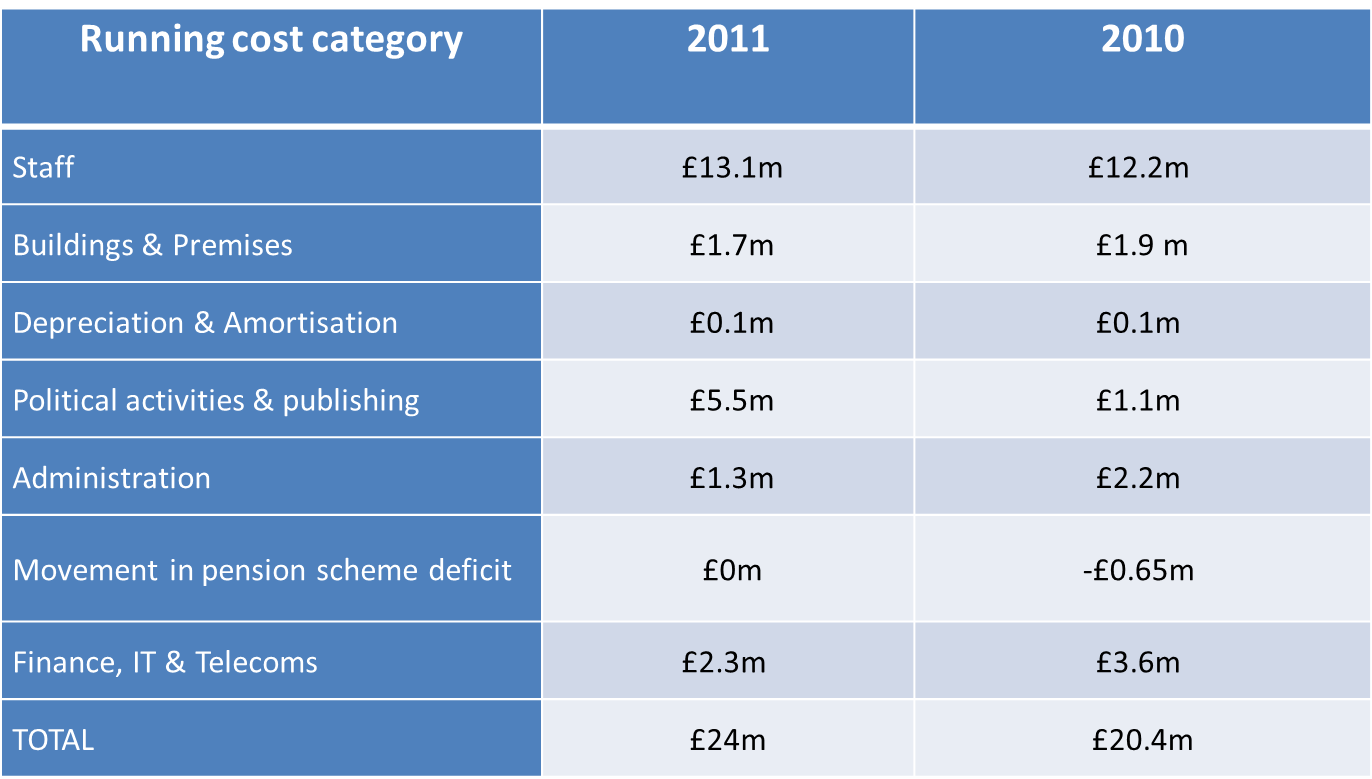
The reason was an 18% hike in running costs for the party. Running costs are the biggest single line item in the party’s expenditure making up 80% of total spending. In 2011 they went up by £3.6m to £24m, from £20.4m in 2010.

An almost 20% spike in running costs, when there is no general election or major campaign, is quite extraordinary.

Delving into the detail of accounts, there is a breakdown of running costs which sheds some light on where the money is being spent.

source: Labour party 2011 accounts

In the first line of the table, it is clear that there was a £900k rise in expenditure on staff from 2010 to 2011. A note in the accounts reveals that this equated to an increase in headcount from 287 to 307 staff.

(more…)

Facebook Twitter Digg Delicious StumbleUpon

Time to clean up the banking sector in London, New York style

17/08/2012, 07:00:48 AM

by Atul Hatwal

Ben Lawsky. Remember that name. This week he changed how banks and financial institutions across the world will be regulated.

While the UK relies on esteemed commissions like Vickers or waits for its parliamentarians to stroll through detail of the the Libor scandal, the state of New York has re-defined how to regulate.

Lawsky runs the department for financial services.  If a financial institution wants to do business in New York, they need a licence from Lawsky.

This week the superintendent – for that is Lawsky’s title – humbled Britain’s mighty Standard Chartered Bank (SCB).

Eleven days ago he issued an order against SCB on its failure to stop money laundering for Iranian organisations. The order was scathing, stating Standard Chartered was “rogue” and was engaged in “dealings that indisputably helped sustain a global threat to peace and stability.”

The bank pushed back strongly, other regulators briefed financial journalists that Lawsky was over playing his hand and even the governor of the Bank of England Mervyn King weighed in, rebuking Lawsky for his precipitate action.

The clue as to what would happen next was in Mervyn King’s intervention. Given his track record on effective banking sector regulation, there was only going to be one outcome.

Earlier this week Standard Chartered settled to the tune of $340m.

It is an enormous win for Lawsky and re-writes the rules for financial regulation in a way that will have major political ramifications in the UK.

(more…)

Facebook Twitter Digg Delicious StumbleUpon

The conventional wisdom is wrong: David Cameron and Nick Clegg are now bound even more tightly together

07/08/2012, 09:00:17 AM

by Atul Hatwal

Another pained press conference from Nick Clegg, another central plank of the Lib Dem’s beloved constitutional reform agenda disappears for a generation.

So farewell then Lords reform, we’ll see you in twenty-five years when all of the politicians who have witnessed first-hand the Lib Dem’s failure on the Lords and electoral reform, have passed from this parliamentary coil.

But, all this was known the moment 91 Tory backbenchers decided to use the Lords as an excuse to attack their leader. The votes weren’t there. The real news from Clegg’s study in sanctimonious defeat yesterday was confirmation of the tit for tat blocking of the Tories’ boundary review.

According to Lib Dem sources, Clegg attempted to mount a damage containment exercise when the extent of the Tory rebellion became obvious, sounding out MPs about the prospect of not vetoing the new boundaries.

As frustrated as Clegg was by the Tories, he privately accepted the position in which David Cameron has found himself. It’s a position Clegg empathises with and experiences himself with his own backbenches.

But the Lib Dem leader had to accept political reality. For all the fanciful recent talk of Vince Cable as a future leader of the party, the message went back to the Lib Dem leadership that there really might be regime change if Clegg did not strike back at the Tories.

The immediate reaction to this spat among much of the commentariat is to conclude that the coalition is headed for the rocks.

Certainly the massed off-the-record ranks of Tory backbenchers have done their bit to promote this notion with blood curdling talk of revenge on Clegg for the boundary betrayal.

But the reality is that the leaders of the Tories and Lib Dems are now bound even more tightly together. Assuming the projections of Tory advantage from the boundary review are correct, then David Cameron will need his Lib Dem coalition partners all the more if he is to stay in office after the next election.

(more…)

Facebook Twitter Digg Delicious StumbleUpon

What will it take for voters to choose Labour over the Tories on the economy?

27/07/2012, 07:00:25 AM

by Atul Hatwal

It’s the question on which the next election will turn.

David Cameron and George Osborne have been at the helm for just over two years and in that time the economy has been shrinking for five out of eight quarters.

While other countries that were also in the eye of the financial storm, such as the USA, have recouped their lost output since 2008 and are growing, our economy is still 4.5% smaller than when the banks collapsed.

Even in the nightmare of the Eurozone, only Italy is in a double dip recession like Britain.

The situation could hardly be worse, but still, almost beyond logic and certainly beyond the comprehension of most of the Labour movement, the public believe Cameron and Osborne to be more economically competent than Ed Miliband and Ed Balls by a double digit margin.

July’s ICM poll had the Tory incumbents in an 11% lead over Labour’s challengers. This lead actually grew between June and July by 2% from 9% to 11%.

So what would it take for the two Ed’s to take the lead or at least wipe out the deficit?

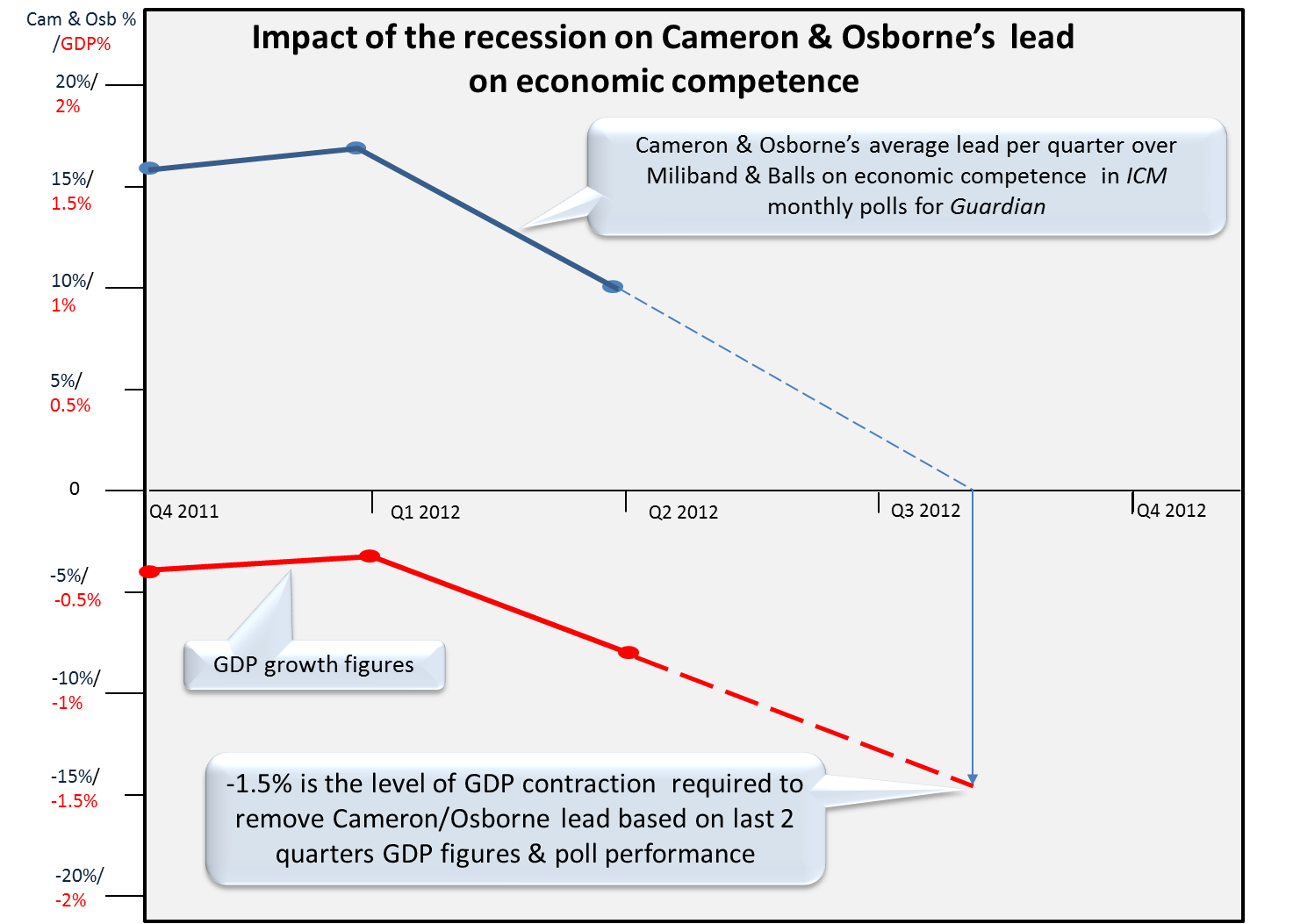
ICM has regularly asked voters which of the competing political duos they would prefer to be running the economy in their monthly polls for the Guardian, over the past nine months.

Mapping the Cameron/Osborne lead over Miliband/Balls against the actual movements in growth over these three quarters gives us a sense of whether there is a link between growth and the public’s preference, and if so, how bad the economic situation would need to become for Labour to be preferred.

Based on the last three quarters, it is clear there is a correlation between growth and the Cameron/Osborne lead.

The minor easing in the rate of economic contraction at the start of 2012 was mirrored in a slight increase in the Tory lead while the steep acceleration in decline in the second quarter this year was reflected in a sharp fall in the Cameron/Osborne lead from 17.5% to 10%.

Electorally for Labour, that’s the good news. Cameron and Osborne are definitely paying a price for their economic incompetence.

But then comes the very bad news.

(more…)

Facebook Twitter Digg Delicious StumbleUpon

Revealed: Unite boss’s plan to turn clock back to 1983 for Labour

20/07/2012, 07:00:45 AM

by Atul Hatwal

A few weeks ago Uncut revealed Unite’s political strategy. How the union intends to take control of local Labour constituency parties, influence parliamentary selections and extract maximum political return for their funding largesse.

The focus of the strategy was on the acquisition and retention of power within the Labour party. Now, one of the most senior officials in the union lays bare what Unite intends to do with that power.

Dave Quayle is chair of Unite’s national political committee. This is the body that is responsible for the management and delivery of the union’s political campaign, from national activity down to Unite’s constituency level plans.

Critically, it is the body that determines how Labour’s biggest donor spends its money in the party.

Comrade Quayle recently gave an interview to the Alliance for Workers’ Liberty (AWL) website. This would be the AWL that defines itself as an organisation committed to the ideas of “Marxism and revolutionary socialism”.

He clearly felt among friends as he held forth on how Unite plans to change the Labour party,

“We want a firmly class-based and left-wing general election campaign in 2015. We’ve got to say that Labour is the party of and for workers, not for neo-liberals, bankers, and the free market. That might alienate some people, but that’s tough.”

It’s an extraordinary statement for someone like Quayle to make. Unite’s plans for Labour, backed by the millions of pounds at their disposal, can be summarised: yes to class conflict; no to the free market; and forget about the votes of businessmen, Tory switchers or the centre ground. Anyone in the party disagree? Lump it.

Quayle’s vision genuinely involves turning the clock back to 1983 for Labour.

(more…)

Facebook Twitter Digg Delicious StumbleUpon