




Posts Tagged ‘David Cameron’

Cameron must rethink police cuts

11/08/2011, 02:14:05 PM

by Matt Cavanagh

Two weeks ago, I highlighted the embarrassing gulf between David Cameron’s pre-election promise that cuts would not affect the front line, and the reality of the planned police cuts, as set out in the recent report by Her Majesty’s Inspectorate of Constabulary.

There is undoubtedly scope for efficiency savings in the police, but as HMIC set out, with 81% of police funding going on staff costs, and another 10% going on areas like transport and premises, cuts of 20% were always going to cut deep into police numbers. HMIC’s report is the most systematic and rigorous attempt so far, to estimate not just the likely effect on total police numbers – a cut of 16,000 by 2015, ironically the exact number the Met have deployed on London’s streets in recent nights – but also the likely effect on the front line for different forces around the country.

This is relevant to Cameron’s defence of the policing cuts today, when he was confronted in the Commons by former Home Secretary Jack Straw. To justify his assertion that the cuts will not affect the front line, or visible patrolling, Cameron chose to discuss his own local force, Thames Valley. This choice was either ignorant, or disingenuous. A glance at the graph on page 22 of the HMIC report shows the difference in the scale of the challenge faced by Thames Valley Police, in trying to protect the front line from spending cuts, compared to those forces who have been dealing with the riots, including the West Midlands, Greater Manchester, and Merseyside. Thames Valley Police would have to reduce their non-front-line officers by just under 50%, in order to avoid cutting into the front line. That is challenging, but arguably possible. By contrast, the West Midlands, Greater Manchester, and Merseyside forces would have to cut their non-front-line officers by 100%. Even those who hold the simplistic view that almost all ‘back office’ jobs are unnecessary would have to admit that to cut at this level without affecting front line police numbers is simply impossible.

As public concern about crime and policing soars, the government seems to be trapped in defending two increasingly indefensible claims: first, that the cuts won’t reduce front line police numbers, and second, that anyway police numbers don’t affect crime. This position was already starting to look naïve or complacent before the riots, especially with the signs that the long downward trend in crime may be on the turn. Now it looks reckless and hopelessly out of touch, as even Conservative MPs and ‘ministerial sources’ admit.

It has been amusing, if also a bit depressing, to watch Tory cheerleaders like Tim Montgomerie suggest that the way out of this problem is for Theresa May to introduce a new target for how much time police officers actually spend doing visible work. In fact, May inherited such a target from Labour. Admittedly, it was applied only to Neighbourhood Policing Teams, but she could have chosen to extend it; instead, in those heady days of last summer when ministers were falling over themselves to mock Labour’s ‘top-down targets’, she scrapped it.

Even more ridiculous is the spectacle of Conservative MPs and Conservative-leaning think-tankers trying to use the riots to back up the case for elected police commissioners – just like they did with the scandal over the Met’s links to News International – without realising that the Met is precisely the one police force which is already very close to the elected commissioner model.

These rather desperate moves are not surprising, since other than elected commissioners, and some useful development of Labour’s introduction of online crime maps, the government doesn’t really have any crime policies – and yet they need to talk about something other than police cuts. But these moves aren’t working. As John McTernan noted this morning, Cameron’s reluctance to break off his holiday to grip the riots ignored the “basic political law, that if you’re going to have to do something, you should do it of your own free will, rather than being forced to.” He needs to realise that rethinking the police cuts falls in the same category.

Matt Cavanagh was a special adviser on crime and justice under the last Labour government.

Facebook Twitter Digg Delicious StumbleUpon

Not today

09/08/2011, 10:00:04 AM

by Dan Hodges

Not today. Please, just not today. Laurie Penny, I think you are a beautiful and gifted writer. But don’t tell me violence cannot be mindless. Or that it is all about catharsis. Not today.

Sunny Hundal, your real and passionate desire to break politics free from its straight jacket of committees and speeches and selection meetings does you credit. But please, don’t circulate any more time lapse photography of people’s homes burning and tell me it’s “brilliant” or that it’s “art’. Not today.

Owen Jones, the working class need a voice, and you are an articulate spokesman. But please, no more hand wringing about the dangers of an “authoritarian backlash” against those who tried to loot and burn our city to the ground. Not today.

Ken Livingstone, you were once a great and radical figure. But no one needs to hear your cheap politicking about your statesmanlike dash from the Olympic awards ceremony. Or your back of the envelope theories about how 14 and 15 year old rioters trashed JD sports because they are not able to provide for their wives and children. Not today.

Boris Johnson, I’d actually liked to have heard something from you. But instead I had to put up with your spokesman Kit Milhouse explaining why it was fit and proper for the Mayor of the world’s greatest capital city to watch from afar as his charge exploded in an orgy of destruction. We’ll no doubt hear the same excuses trotted out often this election year. If we must. But not today.

Theresa May, I understand being the only senior member of the government, (Nick Clegg hardly counts in these circumstances), is tough. But I don’t want to hear any more rubbish about “policing with consent” when that consent has been brutally withdrawn by a small but violent minority. And I’d park the protestations that cutting thousands of police officers won’t have had any operational impact. For today.

David Cameron, I don’t actually blame you for taking a much needed break in Tuscany. And it was nice you made friends with your waitress. But as you sit savouring the taste of your Tuscan Dream please, do one thing for me. For all of us. Don’t tell us we’re all in this together. We are, of course. But we don’t need to hear it from you. Not today.

There is lot we do need to hear.  And lots that needs to be said. About the dislocation of inner-city youth. About the link between crime and poverty. About race and resentment. About lack of employment and educational opportunities. The widening gap between the rich and poor. The politics and the sociology and the criminology. All deserve, indeed require, an airing.

We must debate, and examine, and interrogate. We must argue and enquire and report. We must ask ourselves what sort of society we really want to be, and take a deep look within our own communities, and souls.

We must do all of these things. Just not today.

Dan Hodges is contributing editor of Labour Uncut.

Facebook Twitter Digg Delicious StumbleUpon

Osborne and Cameron’s eurozone delusion – the contagion is airborne and the UK is getting sicker

08/08/2011, 11:55:34 AM

George Osborne and David Cameron are deluded.

There’s a long list of topics to which that statement might apply, but right now, one is more important than the rest – contagion from the eurozone crisis.

Contagion normally refers to the transmission of eurozone woes to Britain via UK banks’ liabilities in the crisis areas. The greater the exposure, the worse the contagion.

This conventional view of contagion is based on direct contact between banks and infected areas. That’s how the Treasury looks at it and why the government thinks the UK is insulated. Last week George Osborne boasted that the UK was a “safe haven”. Then on Friday, William Hague declared “We’re not in the firing line”.

But what the Bullingdon boys haven’t understood is that the contagion is airborne.

A cursory look at movements in banks’ share prices shows how limited direct eurozone liabilities have translated into plunging prices.

Recent estimates of the exposure of UK banks to public and private debt in the trouble spots were £82.5bn for Ireland, £65.4bn for Spain, £40.5bn for Italy, £14.8bn for Portugal and £8.6bn for Greece.

These might seem like big figures, but for a sector as large as UK banking, worth £7000bn, they are worrying but hardly critical. The latest IMF healthcheck on the UK assessed banks’ exposure as “manageable”

In comparison, since the start of this financial year, the big banks’ share prices have plummeted – RBS has fallen 31%, Lloyds has fallen 46% and Barclays has fallen 35%. Only HSBC has been somewhat insulated, but even they have dropped 14%.

The reason for the collapse is that negative city sentiment has been turned into self-fulfilling fact by the stampede of the hedge fund herd.  The link to liabilities no longer needs to be real, it just has to exist in the fevered minds of city traders.

The result of this shift in transmission mechanism for contagion is that the economy is in far greater danger than the government understand or at least is letting on.

If the trend in bank share prices established since April continues, RBS and Lloyds will return to the level where the government had to intervene back in 2008, by Christmas.

Speak to any trader or analyst about what they think will happen if there is a crisis event in the eurozone, like a default, and they are all agreed: there will be a run on the banks similar to the crash of 2008.

The only thing they view with equal certainty is that there will be a defining crisis at some point.

Estimates on the scale of the carnage vary, but in this situation a single day’s losses across the banks would likely top one third of share value.

Anything on this scale, following on from the last few months will potentially send the most vulnerable – RBS, Barclays and Lloyds -into freefall. Sentiment is already too negative and the share prices already so low that one big shock could tip them over the edge.

That would bring Hobson’s choice for the government – bailout mark two accompanied by a massive rise in the deficit and a potential UK sovereign debt crisis or the collapse of some of the UK’s biggest banks.

Take your pick. Either way, we would be in the same position as Portugal, Ireland, Greece, Spain and Italy. No credit, no confidence, no money and too much debt.

The crisis would have been fully transmitted from the eurozone to the UK.

As Osborne and Cameron phone in government from their holidays, they are content in their contagion delusion. But the reality is that the UK is no more insulated from the impact of a eurozone crisis than the French were protected by the Maginot line at the start of World War 2.

Their criticism of Gordon Brown was that he failed to fix the roof when the sun was shining. There’s some truth in that.

Now, on their watch, it’s been raining for months, the water has soaked into the timbers of the house and the eaves are bowing. But still there is no action.

If and when the roof crashes in, they and they alone will be to blame.

Facebook Twitter Digg Delicious StumbleUpon

Can Labour’s Cooler King make it over the wire?

02/08/2011, 12:43:18 PM

by Dan Hodges

Every Christmas evening my family and I would settle down for the same ritual. Excitement, mixed with anticipation, blended with hope.

Could this, we wondered, be the year Steve  McQueen finally makes it over the wire?

In the days before satellite television lured us out of our cosy viewing habits with “Ice Road Truckers” and “Extreme Animal Attacks 2”, the film the Great Escape was a festive staple. Cruel Gestapo hoods. A brutal execution of heroic allied officers. The perfect accompaniment to the season of peace and goodwill.

Though it was on every year, familiarity did not breed contempt. Instead it produced intrigue. Would James Garner check the fuel gauge before shepherding Donald Pleasence on his doomed flight to safety? Might Gordon Jackson hold his tongue when the suspicious German ticket collector wishes him “good luck”?

But most tantalising of all, what fate would befall Captain Virgil Hilts, ‘The Cooler King’, McQueen’s perpetually incarcerated US fighter pilot?  Every year he would gun his stolen BMW motorbike towards the snow capped mountains of neutral Switzerland. And every year his heroic bid for freedom would fall agonisingly short.

For the first year of his leadership Ed Miliband has been the Labour party’s Cooler King. Trapped by an inconclusive mandate, imprisoned by his own insecurity, held hostage by a party unable to come to terms with electoral defeat and the reality and demands of opposition.

No longer. Labour’s leader has awoken to find the cell door ajar, the guard towers deserted and the searchlights extinguished. Suddenly he sees the prospect of making his own great escape. (more…)

Facebook Twitter Digg Delicious StumbleUpon

The latest round of Army cuts confirms that the Conservative Party, like News International, use the military for their own ends

26/07/2011, 08:00:01 AM

by Matt Cavanagh

David Cameron’s Downing Street machine may have endured its biggest crisis so far over phone hacking, but at least its media strategy is working well in one area: defence cuts. As with October’s Strategic Defence and Security Review, bad news in defence is only cleared for release when there is enough other bad news to bury it. The SDSR announced the biggest defence cuts for 20 years, including cutting 7,000 soldiers, but with the spending review setting out even bigger cuts elsewhere the next day, the defence settlement didn’t make a single front page, and broadcast coverage was similarly muted. Likewise last week, when Defence Secretary Liam Fox announced that 10,000 more soldiers would be cut, even Telegraph readers had to turn past ten pages of hacking coverage before they saw it.

How much attention an announcement gets will always depend on what other news is around, and it would have been hard for any story to compete with the hacking scandal. But it is a shame for defence, because the Government’s treatment has been both dishonest and shambolic, and deserves greater scrutiny.

Fox’s dishonesty on Army numbers goes back many years. In opposition he repeatedly lied that Labour had ‘cut the Army by 10,000’: in fact, numbers remained fairly stable, and the Army was bigger in 2010 than 1997. He also promised that a Conservative government would give the Army ‘three new battalions’, a promise which Cameron endorsed in his Conference speech in 2007 at the end of another hard summer in Afghanistan and Iraq – a predictable move from a party which has long seen defence as an issue to be milked for maximum political effect. Some in the Army may be wishing they had paid less attention to these speeches and more attention to history. The bean-counters in the Ministry of Defence and the Treasury have always wanted to cut the Army – it is so much easier than dealing with the bigger problems in the defence budget – and generally it has been Conservative ministers who give them the go-ahead, perhaps because they think they can get away with it. In the 1990s, they cut the Army by 35,000, alongside deep cuts in the defence budget and reductions in military capability. The script has changed – then it was the ‘peace dividend’ after the Cold War, now it is the deficit – but from the Army’s point of view, they could be forgiven for thinking history is repeating itself.

Even now, with the Government’s real agenda for the Army exposed, ministers are still not being honest. In early July, Labour’s Dan Jarvis, a former Parachute Regiment major, confronted Fox at the despatch box and asked him whether he had any plans for further cuts to the Army. Fox replied that ‘nothing has changed since the SDSR’. This was two weeks before he announced further cuts of 10,000 soldiers. When he did finally announce the cuts, he attempted to preserve some semblance of consistency with the SDSR by claiming that none of this would happen before 2015, and that when it did, it would be offset by more generous funding. That was contradicted yesterday by a leaked letter in the Telegraph from the head of the Army, suggesting that 5,000 more soldiers will indeed be cut before 2015, biting deep into the combat units which have been serving in Afghanistan.

We should not deny that there is a funding crisis in the MOD – even if its true nature tends to be obscured by the ministerial rhetoric rather than illuminated by it. There is also a case to be made for a smaller Army. In the continuing absence of an existential threat of the kind we faced in the Cold War, and with the nation losing its appetite for manpower-intensive counter-insurgency, ministers could have come out and argued for a redistribution of resources away from a standing army and towards new threats and new capabilities – like cyber security, or drones and other surveillance. But they haven’t had the courage, or strategic vision, to do so. Fox did try to use the Reserves Review to put a strategic spin on last week’s cuts, arguing that overall ‘deployability’, across regular and reserve forces, is the key – with a reformed and more deployable T.A. offsetting cuts to regular soldiers. Leaving aside the hypocrisy of Fox objecting to Labour questions about overall numbers (“they talk about total numbers all the time”, he complains, “but they do not talk about deployability”) given his own approach in opposition, this is an dangerous tack for a Defence Secretary who has announced a radical cut of one-third in, precisely, deployability. (This was tucked away on p19 of the SDSR document, glossed over by Fox and Cameron in their statements at the time: the admission that in future, in a one-off operation like the invasion of Iraq, we will be able to deploy 30,000, rather than 45,000; and that in an enduring operation like Afghanistan, we will be able to deploy 6,500 rather than 10,000.) (more…)

Facebook Twitter Digg Delicious StumbleUpon

Tom Watson is readers’ hackgate hero

25/07/2011, 08:00:54 AM

In a close fought contest, Tom Watson has emerged as the Uncut readers’ hackgate hero.  His intervention on David Cameron during the Parliamentary statement was the public’s choice for goal of the month with 26% of the vote, 4% ahead of his other entry, the questioning of Rupert Murdoch at the Select Committee which secured 22%.

Ed Miliband’s pivotal PMQ performance from the start of July was joint third with Dennis Skinner on 20% of the vote, followed by Steve Coogan on 12%.

In voting throughout Friday, Ed Miliband built up a solid lead over the chasing pack, but was overhauled on Saturday by Watson’s two entries. Despite a late rally on Sunday, Miliband was not able to catch Watson.

The vote reflects the pivotal role Tom Watson has played in doggedly pursuing this issue for the past few years as well as the quality of his contributions in the Parliamentary statement and the Select Committee hearing.

As the scandal has unfolded, the twittersphere has been abuzz with who would play the central characters in the inevitable movie. This being a British scandal, the casting choices are somewhat different to the Redford and Hoffman partnership in All The President’s Men.

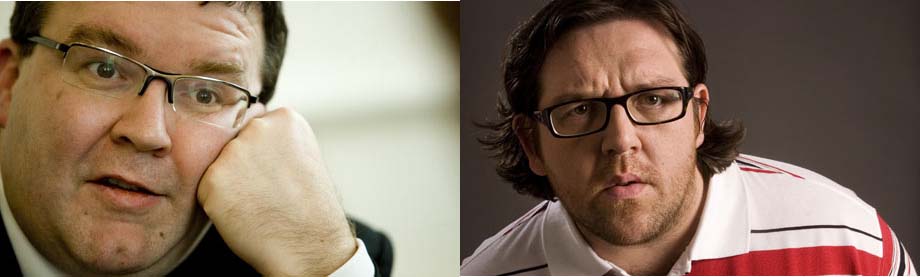
Currently the hot favourite to pick up the plum part of Tom Watson is Nick Frost.

They’ve been tweeting and agreeing though who Simon Pegg will play remains unclear. But given the nature of a scandal which continues to grow and grow, there are bound to be some new casting opportunities that emerge in the coming days.

Chief amongst these will potentially be the role of George Osborne. Studiously silent throughout proceedings so far, he has all the makings of a villain who emerges in the third reel as the puppet master, pulling the strings. (more…)

Facebook Twitter Digg Delicious StumbleUpon

The week Uncut

23/07/2011, 10:00:51 AM

In case you missed them, these were the best read pieces on Uncut in the last seven days:

Michael Dugher takes us behind the scenes of PMQs prep

Dan Hodges Commons sketch: Cameron’s escape

Tom Harris stands up for the off the record whisperers and backroom briefings

Kevin Meagher says Cameron is on the ropes, but he’ll last the distance

Matt Cavanagh reports on Cameron’s broken policing promises

Peter Watt offers a very personal account of the need for a work/life balance

Atul Hatwal asks you to pick your hacking heroes

…and a letter from Tom Watson to David Cameron from last year over Mr Coulson

Facebook Twitter Digg Delicious StumbleUpon

Cameron’s broken promises on policing

22/07/2011, 11:00:01 AM

by Matt Cavanagh

A few days before the general election, David Cameron famously promised that “Any Cabinet minister, if we win the election, who comes to me and says ‘here are my plans and they involve front line reductions’ will be sent back to their department to go away and think again.” As late as last September, home secretary Theresa May was insisting that “lower budgets do not mean lower numbers of police officers”. The breathtaking disingenuousness of these soundbites has been exposed again yesterday, as Her Majesty’s Inspectorate of Constabulary publish the first authorised estimate of how the government’s 20% cut in police funding, announced in October’s spending review, will affect police numbers – and in particular how it will affect the front line.

The report, based on detailed investigation of individual forces’ plans, estimates that 16,200 police officers will be cut between 2010 and 2015. This entirely undoes Labour’s investment between 2000 and 2010, taking police numbers back to 1997 levels.

There is undoubtedly scope for efficiency savings in the police. Some of these were already in train before the election (they are set out in Chapter 5 of the 2009 White Paper). But as is clear from the graph on p24 of the HMIC report, with 81% of police funding going on staff costs, and another 10% going on areas like transport and premises, the 20% cuts announced in the spending review were always going to cut deep into police numbers. (more…)

Facebook Twitter Digg Delicious StumbleUpon

Cameron’s on the ropes, but he will last the distance

21/07/2011, 04:13:40 PM

by Kevin Meagher

The parliamentary recess will be greeted by the prime minister in exactly the same way a wounded boxer welcomes the end of a gruelling round. Winded, bloodied and blurry-eyed, the prime minister staggers back to his corner. His legs are like lead. His arms ache. His body is battered and sore.

He put up a spirited defence in the Commons yesterday – penance for bobbing and weaving out of fronting-up the hacking issue on behalf of the government these past few weeks – but he is behind on points.

Despite his combativeness and bluster the reigning champ looked ring rusty. Belligerent where he should have been contrite, he struggled to read the fight and walked on the end of punches he is seasoned enough to avoid. His pledge to apologise if Andy Coulson is eventually found guilty of sanctioning phone hacking simply risks storing up the mea culpa to end all apologies.

“I’m enjoying this” he proclaimed amid the stinging blows; (an insensitive boast given the thousands of innocent victims swept in the phone hacking scandal) and a curious formulation for an under-fire Tory leader as it was last used by Margaret Thatcher in her swansong Commons performance.

Cameron’s technique, punching power and the strength of his chin have all been sorely tested these past few weeks – and more often than not they have been found lacking. As the unfortunate British heavyweight David Haye found to his cost against Wladimir Klitschko the other week, talking a good fight is not enough. (more…)

Facebook Twitter Digg Delicious StumbleUpon

Commons Sketch: Cameron’s escape

20/07/2011, 06:23:38 PM

by Dan Hodges

And with a single bound, he was free. Well, at least that was the plan.

David Cameron had been cornered. After a week on the run he had finally been tracked down to the Southern-most tip of the Dark Continent.

“The world has changed”, we are told. Well it may have, or it may not. But when a Conservative prime minister runs half way round the globe to find political solace in the arms of the ANC, you know something is up.

Yet while he could run, he could not hide. And hounded by a vengeful head of the metropolitan police, a rejuvenated Labour leader, and an increasingly worried and fractious Tory party, he was forced to turn and face his pursuers.

They met at the despatch box of the house of commons. There is a myth that our prime minister is a natural performer in the chamber. In reality he often appears poorly briefed, distracted and easily provoked.

But credit where credit is due. Where many men would have been cowed, David Cameron came out fighting. “A torrent”, of allegations had burst forth, he said. He would confront them all. He apologised to the speaker, but his response would be lengthy and fulsome. It was what the country demanded, and deserved.

He announced a panel of inquiry to look into the allegations that brought the British establishment to its knees. The greatest political scandal for a generation would be investigated by Shami Chakrabarti, Elinor Goodman and George Jones. A grateful nation let out an audible sigh. Shami, Elinor and George. There would be no whitewash in Whitehall.

Then it was time to deal with the personal allegations that had been made against him. Or rather those made against his chief of staff. Ed Llewellyn had been asked by the metropolitan police whether the prime minister wanted a briefing on possible corruption and law breaking that penetrated to the heart of Downing Street. Not on your nellie, Ed had replied. Quite right too, said the PM. There would have been “justifiable outrage” had he attempted to investigate this cancer at the heart of his government.

There had also been allegations made against a man called Neil Wallis, a former police officer who had done a brief stint of consultancy as deputy editor of the News of the World. Somewhere in between his busy schedule he’d managed to slip in the odd bit of work for the Tory party. “To the best of my knowledge”, said the prime minister, “I did not know anything about this until Sunday night”. The fact that the leader of the Conservative party hadn’t a clue who’d been working for him had the Tory back benches roaring in delight.

There was one final point he needed to address. Andy Coulson. Serious allegations had been made against him, said the prime minister. If they were proven he would be arrested, charged, incarcerated, hung, drawn and quartered and have his entrails scattered to the winds. It would be fitting. He would have lied to him, the police, a select committee and court of law. It was a terrible mistake to have ever employed this cad. With hindsight, he should never have touched him with a barge pole. “But”, he said, “I have an old fashioned belief that you are innocent until proven guilty”. Andy Coulson would no doubt have been delighted to hear it.

Ed Miliband rose. You can always tell if Ed is going to be a little off his game. He starts to speak with an exaggerated precision. So when his first words sounded like the leader of the Labour party had been kidnapped and replaced by a slightly nasal speak your weight machine, we feared the worst. In fairness, there were a couple of moments when it looked like he was starting to pin Cameron down. But just as he did, smack, he’d run right into an answer the prime minister had just given.

“He’s clearly written his questions before listening to my answers”, taunted Cameron. You could see the relief flowing from him. Behind him it was cascading down the government benches like a wave.

He’d done it. He was free.

Then a figure in a dirty raincoat rose from the Labour benches. “Er…prime minister. Before you go. I forgot. Just one more thing”. It was Tom Watson. The prime minister claimed he hadn’t been warned about Coulson. But that wasn’t true. And he, Tom Watson, had the letter to prove it.

Cameron attempted to brush him aside.

“Not so fast”. It was Dennis Skinner. The prime minister has been asked twice if he had discussed the BSKyB merger. He hadn’t answered the question. So had he discussed it? Or hadn’t he?

The prime minister again tried to dodge his inquisitor. But the spring had gone from his step.

David Cameron had escaped. But he was still not free.

Dan Hodges is contributing editor of Labour Uncut.

Facebook Twitter Digg Delicious StumbleUpon