




Posts Tagged ‘Ed Miliband’

If Labour were credible on the deficit, Cameron’s speech would have been a disaster

02/10/2014, 11:53:39 AM

by Atul Hatwal

Lucky David Cameron.

Lucky, because the global economic upturn has dealt him a kind hand on the economy, just as the crash dealt Labour a dud.

Lucky, because the lack of serious alternatives within the parliamentary Conservative party has assured his tenure as leader, no matter how jittery or demented his backbenchers have become (imagine how different the situation would have been had there been a Heseltine or Portillo lurking in the Commons’ corridors instead of Adam Afriye.)

And, most of all, lucky because David Cameron faces Ed Miliband’s Labour party.

A party so denuded of economic credibility that the Tories can increase the deficit by £75bn, miss all of their fiscal targets, and still maintain a double digit poll lead over Labour, on who is most trusted to manage the economy.

It’s why David Cameron could make the speech he did yesterday. A speech offering an unfunded £7bn+ tax cut just 48 hours after George Osborne talked up the need for an extra £25bn in cuts.

We have passed through the looking glass and entered a world of Wonderland economics: where tax cuts are all self-funding and public spending cuts have no consequence.

If Labour had done what it needed to four years ago; demonstrated that it understood the public’s anxieties over spending with the last Labour government, and moved to win back public trust, then David Cameron would now be in serious trouble.

The public would be listening as Labour spokespeople point out the political hypocrisy and economic insanity at the heart of David Cameron’s speech.

Years of Tory message discipline on the need for fiscal rectitude would be lying in ruins. Mistrust of the Tories on public spending would be taking off in the polls.

But none of that is happening.

Instead, as far as the public is concerned, Labour remains on mute. Whatever the party says on the economy is tuned out because of the deeply held belief that however bad the Tories are – and there’s lots of evidence that the public have little faith or confidence in Cameron and Osborne’s economic judgement – Labour will be worse.

(more…)

Facebook Twitter Digg Delicious StumbleUpon

Labour’s strategy for dealing with The Sun is ludicrous

29/09/2014, 12:15:05 PM

by Kevin Meagher

Last week, The Sun newspaper ran a feature inviting each party leader to wear a wristband showing their support for the Help for Heroes charity. David Cameron, Nick Clegg and Nigel Farage featured. Ed Miliband did not.

There are conflicting accounts about exactly what happened, with the paper maintaining it made several attempts to secure the Labour Leader’s buy-in; while party sources claim they weren’t given enough time to comply with the request. In the event, the paper ran its front page piece, with a blank space reserved for Miliband, blaming his no-show on a “fear of offending Labour lefties.”

Amid the accusations and counter-accusations, what is clear is that the party’s explanation for not co-operating – citing Ed Miliband’s prior diary commitments – was disingenuous nonsense. It would have taken a press officer five seconds to grab a quick photo. But worse than being disingenuous, it was stupid, too, given the paper would inevitably “empty chair” Miliband for refusing to participate.

In fact, it was so obvious how things would turn out that there must have been a deeper motive. Indeed, there remain many voices in the party that want to boycott the paper as punishment for its coverage of the Hillsborough tragedy as well as the illegal phone-hacking scandal; and the party’s strategy is clearly driven by these considerations.

But boycotting The Sun is a disastrous tactic, the worst form of gesture politics. What’s the desired result? To make a principled stand against the quality of its journalism? To hurt Rupert Murdoch commercially? Of course, if anyone’s serious about punishing Murdoch or boycotting The Sun, then why not its News UK stablemate, The Times, as well? Or, better still, cancel your Sky subscription.

Worse, Labour’s approach is unevenly implemented. Ed Miliband was content to pose with a World Cup edition of the paper back in June before u-turning and apologising for doing so after ruffling the feathers of some within the party.

Disgusting though The Sun’s coverage of Hillsborough was, many other papers at the time published similar slurs against Liverpool football fans, egged on by media briefings given by South Yorkshire Police. And now the Mirror Group has conceded that some if its staff were also eavesdropping on private voicemails, so will Labour figures shun The Mirror, too?

(more…)

Facebook Twitter Digg Delicious StumbleUpon

Milibelievers were thin on the ground at Labour conference

24/09/2014, 02:54:20 PM

by Jonathan Todd

Throughout Ed Miliband’s leadership there have been those at Labour Party conference prepared to mock and criticise him. There have also been Milibelivers. In between these pessimists and optimists have been pragmatists, seeing both positives and weaknesses in Miliband, seeking to accentuate the former and minimise the latter.

Milibelivers felt thin on the ground this week. I made a point of asking everyone I spoke to how they assessed the mood. “Flat,” was the usual response. After Miliband’s speech, I also enquired what they thought of it. The elderly delegate from a Labour constituency in the north east of England who described it as “the icing on the cake of his week” was the exception in speaking wholly warmly about it.

The dearth of Milibelivers had the effect that pragmatists felt less conference peer pressure to align themselves with the optimists and more to mirror the concerns of the pessimists. We entered a spiral of negativity. The conference vibe was much like twitter where the cheerleading tweets of MPs during Miliband’s speech were drowned out by the mirth of others.

The grounds for optimism cited by elected representatives, however, were not always without foundation. One told me of a Labour business breakfast attended by many more businesses and senior business people than in previous years. Public affairs agencies informed me that they were bringing more clients to conference than in recent years and clients were keener to attend.

Business is preparing for Labour government. They are right to do so. After Douglas Carswell’s defection to UKIP, presuming he succeeds in retaining his seat in the upcoming by election, the idea that UKIP will poll something in the order of 10 per cent in 2015 seems plausible. While an effective ground game is likely to secure the Liberal Democrats many more MPs than UKIP, probably somewhere between 30 and 40, their national polling has been on the floor for so long that it also seems plausible that they might poll somewhere in the same 10 per cent region. Both the persistence of UKIP and the non-recovery of the Liberal Democrats favour Labour over the Conservatives. As do the parliamentary boundaries. As does the incomplete nature of David Cameron’s half-baked detoxification of his party.

(more…)

Facebook Twitter Digg Delicious StumbleUpon

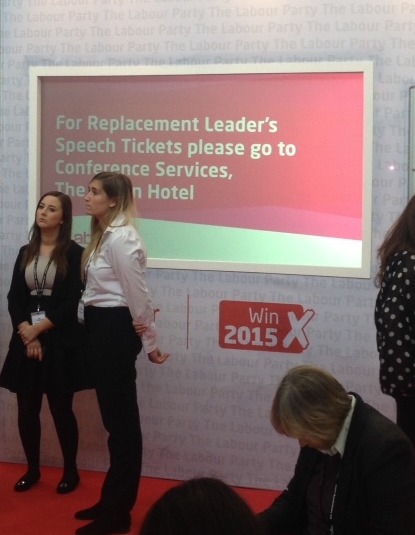
Spotted at conference: Who is the mystery replacement leader?

23/09/2014, 11:45:27 AM

IMG_1479 (2)

We knew times were tough for Ed, but does the party machine know something we don’t? Just who is the replacement leader?


Facebook Twitter Digg Delicious StumbleUpon

What we need to hear from Ed

23/09/2014, 11:13:15 AM

by Kevin Meagher

Given the tumultuous events in Scotland, Ed Miliband can be forgiven if he’s already ripped-up several drafts of his leader’s speech as he still works out how to respond. But putting that to one side, what is today about? What do we need to hear from Ed and what should he be looking to get out of his annual address to his party?

Ed needs to galvanise the Labour tribe. After all, that is technically why we are all here this week. Yet there’s a flat feeling to this conference. While many express cautious optimism that Labour will win next May, the next conversation comes with predictions of electoral doom, as Lib Dem floaters return home and Cameron rallies. Ed needs to convey, if not vision, then optimism about next year and transmit a sense of confidence that his troops can buy into.

He needs to transcend the party and speak to the electorate at large. This is now the real purpose of a leader’s conference speech. For one day a year, the spotlight falls on the Labour leader, who is given an opportunity to try and set the political agenda, and, even more importantly, show us what kind of person he is. Dog breeders would call it temperament. And while you can train yourself to recite a speech without notes, (a skill that’s frankly lost on a television audience) being likeable and spontaneous is a tad more difficult. But that’s what most non-committed voters will be looking for. This conference, the last before the general election, is, essentially, a job interview for becoming prime minister. So no pressure then.

Show Labour gets the need for further devolution. Calling for a constitutional convention – hitherto Labour’s response to the Scottish devolution result and demands for similar moves for England – is all very well, but it lacks urgency. Ed needs to use his speech to set out the principles that will inform his approach in coming months. Positioning Labour against the ridiculous idea of an English parliament is a start, but Ed needs to go further today and set out the conceptual framework for how power is devolved in England. If he doesn’t, he risks letting Cameron frame the agenda in his conference speech. So is it regions, city regions, strengthened local government or something else?

Do something to address the issue around leadership and economic credibility. Although the party maintains a steady opinion poll lead, the deficits the party continues to run on leadership and economic credibility makes many nervous that the headline poll lead will hold water the closer we get to next May. Let’s be clear: this is a legacy that anyone leading the Labour party would face, but it is, ultimately, Ed Miliband’s problem to fix. And, to put it bluntly, nowhere near enough has been done over the last four years. No-one in their heart of hearts will truly believe the party is set to win next year until these gaps narrow. (more…)

Facebook Twitter Digg Delicious StumbleUpon

What Ed must do in his speech: Respond to EVEL

22/09/2014, 06:30:10 PM

by Jonathan Todd

Quebec came close to voting for independence in the 1990s. It was then granted more powers and support for independence declined. It is to be hoped that Scotland follows the same trajectory. But it should be noted that Canada and Quebec achieved this in the much more economically benign era of the 1990s. When economies are growing and wages are rising, people display less of a tendency to be seduced by the false consolations of nationalism. Therefore, when Ed Balls in his conference speech moved quickly from English votes on English laws (EVEL) to the inequities of zero hour contracts, he was not talking about unrelated issues. But he was talking about distinct issues.

The core insight of Ed Miliband that we need an economy that better works for the broad mass of the population is correct. And while such an economy would diminish the charms of both UK breakup and UKIP, it does not adequately meet the challenge posed by proponents of EVEL. Without going further to address the constitutional implications raised by “the vow” made to the Scottish people and the ways in which EVEL would meet these implications by creating new problems, Miliband risks seeming to be a politician avoiding a simple solution (EVEL) simply because it doesn’t suit his narrow interests. He shouldn’t want to be such a politician and must ensure that he is not in his speech tomorrow.

Jonathan Todd is Deputy Editor of Labour Uncut

Facebook Twitter Digg Delicious StumbleUpon

The questions for #Lab14

22/09/2014, 07:00:06 AM

by Jonathan Todd

In 2010, Ed Miliband won the Labour leadership and started talking about the squeezed middle. The following year he gave us producers and predators. 2012 was the year of One Nation Labour. And last year the energy price freeze was the big thing.

Party conferences, as Kierkegaard might have understood, must be lived forwards but only understood backwards. There are various questions to reflect upon as we think how we might come to look back on this year’s conference:

Will Labour’s line on a constitutional convention hold?

“The vow” jointly made by David Cameron, Nick Clegg and Ed Miliband poses questions for Labour. The issues are whether the powers promised to Scotland will be granted and what the implications for the rest of the UK will be if they are. Cameron is clear that Scotland can have these powers but they will need to be accompanied by balancing reforms elsewhere, in particular provisions to ensure that MPs for non-English seats cannot vote on matters only impacting England.

Tom Freeman has explained why English votes on English laws could be destructive of good government and potentially even the UK. He’s also proposed what appears a sensible solution, which responds to concerns raised outside of Scotland by “the vow”, while avoiding the problems associated with English votes on English laws.

Freeman’s solution is not yet Labour’s solution. Labour doesn’t yet have a solution. Labour proposes a constitutional convention to find a solution. Such a slow paced approach is consistent with the preference of Vernon Bogdanor, Cameron’s ex university tutor, for not rushing. It’s not clear, though, that those outside of Scotland will have the patience for this.

Many have seen “the vow” and want to know how their rights and interests can be reconciled with it. Labour can’t tell them. Cameron can. With a response that creates the dangers Freeman flags. If Labour wants our line on a constitutional convention to hold, we might want to stop talking about “two classes of MP”, which we’ve had since 1999, and start talking in the terms of the problems Freeman describes.

How to play the A-Team away from Westminster more often ?

Keeping the UK together was arguably Gordon Brown’s finest honour. Jim Murphy also emerges enhanced. If they’d left the fight to Labour MSPs, Yes might well have won. Alex Salmond was given over a decade to dismantle the B-Team that Labour kept fielding in Scotland. We would be foolish if we think that we can allow Salmond’s successor the same easy ride.

(more…)

Facebook Twitter Digg Delicious StumbleUpon

If Labour’s serious about devolution, why not enshrine the commitment in a new Clause Four?

21/09/2014, 04:14:42 PM

by Kevin Meagher

It’s quite feasible that the Scottish independence referendum may be seen, in time, as merely a prelude to a much bigger reconfiguration where power sits and how it is used in Britain. For now, at least, the battle is on to grab the commanding heights of the debate about how we devolve power from Westminster and Whitehall to English localities.

Yet, the pursuit of English devolution, or localism, (or whatever we’re calling it these days) does not fit neatly on either the right or left of British politics. Both parties have had their moments. Labour introduced regional development agencies and planning strategies while the Tories have given councils more economic freedom through their city deals.

Equally, both have black marks against them. The last Labour government loved its top-down targets, while the Tories have always been happiest governing from the centre, stripping councils of their powers (particularly with the introduction of compulsory competitive tendering in the 1980s) and even going as far as abolishing the Greater London Council.

For Labour to fend off siren calls for an English Parliament, Ed Miliband needs to embrace devolution from first principles, accepting that in future the centre should not be able to dictate to local and devolved authorities and this may, in turn, lead to postcode lotteries in service provision.

Yet, the very thought of not being able to use the machinery of the state to drive micro-outcomes offends the Fabianist impulses of many Labour politicians. After all, it was Labour minister Douglas Jay who remarked that “the gentleman in Whitehall is usually right”.

Its twenty years ago since Tony Blair stood before the Labour party conference and signalled his intention to rewrite Labour’s constitution to “say what we mean and mean what we say.” Ed Miliband needs to do something similar this week. He could use his leader’s speech on Tuesday to make the case that Labour ‘s default impulse is now to devolve power from the centre to the lowest practicable level.

The revised version of Clause Four that was finally agreed by the party in 1995 pledged to create a society where “…power, wealth and opportunity are in the hands of the many, not the few”. Miliband could propose an alteration, committing his government to building a country where:

“…wealth and opportunity are in the hands of the many, not the few, and where power is exercised at the lowest possible level at all times.”

A political race is now on to make sense of our lopsided devolution settlement and symbolism matters. If Labour is serious about winning it, then, once again, it needs to say what it means and mean what it says.

Kevin Meagher is associate editor of Uncut

Facebook Twitter Digg Delicious StumbleUpon

Labour now has big questions to answer

19/09/2014, 12:35:07 PM

by Jonathan Todd

The Scottish referendum is the most tumultuous event in British politics in my lifetime. Writing on Labour Uncut in February, I anticipated that Scotland would stay together but potentially on bitter and cantankerous terms. What I didn’t see until much later was that Yes victory would seem a distinct possibility and that bitterness and rancour would spill from Scotland into the rest of the UK.

Kevin Meagher has catalogued on Uncut the failing of Better Together. The factor that he sees as common to all of these failings is that Westminster leaders “seriously underestimated the prospect of independence”. In so doing, these leaders also underestimated how profoundly they are mistrusted and how deeply angry many are. This frustration is so intense that many were prepared to take the gamble of UK breakup. Such a step would certainly have been a leap into the unknown but many calculated that this was the best option because the likelihood of anything worse than the status quo was minimal.

This calculus, in my view, was faulty. UK breakup would reduce the Scottish tax base and capacity to raise finance on money markets. Both of which would have increased pressure for public service cuts in Scotland, which many voting Yes thought they were voting against. All those who value well resourced public services, including all Labour party members, should be relieved that UK breakup has been averted.

But this certainly does not spell the end of Labour’s challenges. Broadly speaking, these now take two forms: cultural and constitutional. The cultural challenges are involved with the anger and mistrust that both Yes and UKIP have fed on, while the constitutional are concerned with resolving the west Lothian question in the context that now exists following “the vow” of additional powers for Scotland jointly made by David Cameron, Nick Clegg and Ed Miliband.

Yes and UKIP both have an appeal to some sections of traditional Labour support, particularly the disenfranchised working class. “UKIP is tearing off this section of the electorate”, Matthew Goodwin recently argued, “creating a fundamental divide in British politics between those with the skills, education and resources to adapt, and those who have little and feel intensely angry.” When we dissect why Yes won Glasgow, Scotland’s most working class city, I expect we’ll find similar voters to those that UKIP appeal to being decisive.

Yes was high on energy and short on detail. Nigel Farage has comparable energy. He was up early this morning posting letters to Scottish MPs asking them to not vote on English matters. He will be looking forward to getting his bandwagon into fifth gear in Clacton, seeking to trade on both English grievance at the strongly asymmetric devolution created by “the vow” and the anti-politics mood. Yes also benefitted from this mood, precipitating “the vow”, but Farage will now seek to augment his long-standing antipathy to the leading UK parties with the charge that they are a conspiracy against the English.

(more…)

Facebook Twitter Digg Delicious StumbleUpon

Ed Miliband should resign if Scotland votes Yes

08/09/2014, 11:00:27 AM

by Samuel Dale

It’s Friday September 19th, Alex Salmond is walking onto a podium in Edinburgh with Saltires waving all around him.

The autumn sunshine glistens as the camera pans to Nicola Sturgeon’s tears of joy as the lifelong dream of Scottish independence has become a reality.

It was nail-bitingly close but the polls narrowed in the final days.

Labour voters swung it with a 51-49 victory for the Yes campaign.

The UK is in shock. The markets are in turmoil as confusion reigns over currency, the EU, debt, financial regulation, tax and much else.

Next year’s general election has been rendered almost meaningless.

The UK has lost 8 million citizens in one stroke. It’s economic power catastrophically diminished. Already the blame game has begun with many calling for David Cameron to quit.

He has presided over the break-up of the UK and already he is struggling to get a grip on the ensuing chaos.

But what more could he do? Despised in Scotland he had, rightly, kept an arms’ length from the campaign only intervening in a careful, limited way.

So what about Alistair Darling? He led the Better Together campaign, taking part in public debates with Alex Salmond.

He must take some blame for a very winnable campaign that failed.

But the most blame would have to go to one man: Ed Miliband.

It was the hapless Labour campaign for the Scottish Parliament in 2011 that let the SNP in power.
It is a disaster that Miliband oversaw but has never been fully held to account for within Labour circles.

For the SNP to gain a majority required Labour ineptitude on a grand scale.

Ever since, Labour has provided woeful opposition to the SNP in Scotland.

Since the referendum campaign began it has been crystal clear that Labour voters would decide the vote.

Unlike David Cameron, Miliband had a chance to convince his own supporters and turn the referendum.

He did not intervene often enough or effectively in the campaign.

The consequences for Labour are severe. Shadow ministers such as Douglas Alexander and Gregg McClymont will not be MPs for much longer.

Stalwarts such as Alistair Darling and Gordon Brown have no official future in the UK parliament.

Losing dozens of MPs, Labour will find it much, much harder to gain power in the UK. It’s heartlands have been moved to another country.

All this was entirely preventable if the party had kept it’s eye on the ball north of the border.
And if it provided better opposition to the SNP and convinced it’s own supporters during the referendum campaign.

Labour lost this crucial campaign and Ed Miliband should pay the price and resign.

Sam Dale is a financial and political journalist

Facebook Twitter Digg Delicious StumbleUpon