




Posts Tagged ‘Ed Miliband’

Ukip could make Miliband prime minister but he’s not ready

29/08/2014, 02:17:48 PM

by Samuel Dale

Douglas Carswell’s defection to Ukip has brought parliament back with a bang.

The independent-minded Conservative MP is fighting a September by-election in Clacton as a Ukip candidate. He is odds-on favourite to win.

The Daily Mail claims eight more Tory MPs are in talks to defect.

Ukip leader Nigel Farage has told us to brace ourselves for more Tory and Labour MP defections.

The right is splintering as we head towards a tight election and it means only one thing: Ed Miliband is more likely to be in Downing Street next year.

Farage and Ukip want to pretend they have a broad base beyond the Conservatives but it is illusory.

Its northern presence is only in Labour bastions where the best they can hope for is to make up the opposition in a general election.

It is a party that has made a name for itself by collecting disillusioned ex-Tories and will continue to do so.

Neil Hamilton, Stuart Wheeler, Roger Helmer, Carswell and even Farage. Ex-Tories are their primary currency.

Carswell’s defection underlines that Ukip votes could stop enough Tory MPs being elected to seriously damage David Cameron.

Ed Miliband could be prime minister within months. That fact is more likely today than last week.

But our dear leader is still acting like a student politician. He needs to get serious about governing.

Bashing bankers, Murdoch and anyone wealthy is not an agenda for government.

What is Miliband’s foreign policy? How would he tackle the an emboldened Russia or rampant Isis?

(more…)

Facebook Twitter Digg Delicious StumbleUpon

If Johnson and Darling return to Labour’s frontbench, two other men are out

18/08/2014, 03:33:16 PM

by Kevin Meagher

The continuing chatter about whether Alan Johnson should return to the shadow cabinet prompts the intriguing question: where would Ed Miliband put him?

In government, Johnson held a number of senior roles including stints as secretary of state for work and pensions, education, health and a final stint as home secretary. As one of Labour’s best known faces, he would surely command a decent perch.

None of his previous postings, however, looks a likely bet. Rising stars Rachel Reeves and Tristram Hunt are making inroads in the welfare and education briefs while Andy Burnham at health and Yvette Cooper at home affairs are too powerful to move without causing Ed Miliband a major headache. Both are solid performers and harbour leadership hopes if Miliband doesn’t manage to cross the threshold of Number Ten next May.

The remaining top roles, shadowing the Treasury and the Foreign Office, are filled by Ed Balls and Douglas Alexander. And they aren’t going anywhere.

Miliband may calculate that he can move anyone he likes in the interests of bringing back a popular figure like Johnson to add weight to his team ahead of the general election. Of course, the dilemma will be doubled if Alastair Darling also returns – assuming the ‘No’ campaign he is leading in Scotland prevails next month.

Johnson’s attributes are obvious enough. A natural communicator, his easy-going, man-in-the-street style contrasts sharply with the crafted but stilted approach of most of the rest of the shadow cabinet. No-one describes him as weird or boring.

(more…)

Facebook Twitter Digg Delicious StumbleUpon

It’s “not flash, just Gordon” redux. And is likely to be even less successful.

25/07/2014, 01:47:16 PM

by Atul Hatwal

It’s been said that he is the son of Brown and today Ed Miliband made a quintessential Brownite move.

His speech on leadership could have been lifted wholesale from Gordon Brown’s back catalogue. In fact, if it wasn’t quite lifted, it was almost certainly written by some of the same hands that crafted Gordon Brown’s attempt to address his image problem.

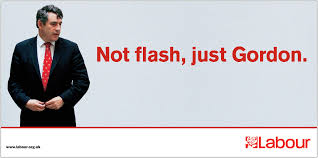
Back in 2007, Gordon Brown was struggling against a telegenic Conservative leader. Plus ça change. Brown seemed awkward and uncomfortable in his own skin. The response? “Not flash, just Gordon.” Saatchi & Saatchi designed the poster below and the message was clear: substance over style.

Not flash just Gordon

To bolster Gordon’s credentials as a serious but normal kind of guy, his wife was deployed for media opportunities.  A Mirror headline trumpeted in 2008 that she was to be Labour’s “secret weapon.”

Sound familiar?

Fast forward to today and its Ed’s turn to be self-deprecating about his media talents and attack and the emphasis on “photo-opp politics” in contrast to his own sincerity and conviction. And here’s the Huff Post headline for the Justine Thornton interview from 3 days ago, “Could Ed’s wife turn out to be his secret weapon?”

We’ve been here before and we know how this story ends. In fact, its likely to go even less well for Ed than it did for Gordon, for three reasons.

First, Brown was prime minister. Whatever the shortcomings of the politician, the office bestows authority and Gordon Brown’s experience at the top of British politics meant he did have a certain gravitas. The most successful line his team used in this campaign was “no time for a novice.” Not something Ed Miliband can say.

Second, Twitter was not a factor before the last election. It is now. As Ed Miliband delivered his speech, my timeline filled up with his photo-opps, from the 7,000 mile round trip for a photo with president Obama, to this absolute peach from the pasty tax campaign (h/t James Manning),

Photo opp

(more…)

Facebook Twitter Digg Delicious StumbleUpon

More fizzle than sizzle, Obama is yesterday’s man

23/07/2014, 04:37:40 PM

by Kevin Meagher

The central assumption underpinning Ed Miliband’s 25 minute meeting with Barack Obama the other day is that an audience with the US President makes a British politician walk taller in the eyes of the voters.

Indeed, it sometimes works the other way too. When candidate Obama was seeking to burnish his credentials as a nascent international statesman he met with Gordon Brown, David Cameron and Tony Blair. He is later said to have described, Brown as having “substance”, while Cameron was all “sizzle” but Blair was “sizzle and substance”.

But Obama himself has turned out to be more fizzle than sizzle. The 44th US president is now a busted flush. A let-down. A talker, not a do-er. Even his flagship achievement in office – state-subsidised healthcare – hit the legal buffers yesterday.

It may be recoverable, but the failure to implement Obamacare effectively is just the latest in a string of flops that have bedevilled his presidency. His famous campaign mantra of “yes we can” has been reduced to, “no we can’t”. Certainly when it comes to closing down Guantanamo Bay, making headway in the Middle East, protecting Christians from Genocide in Iraq and Syria or even, nearer to home, raising US living standards. Obama simply hasn’t delivered.

In fact, if Ed Miliband wanted to visit a world leader to learn about paying the price of promising big and delivering small, then he could have taken the Eurostar to Paris and met with Francois Hollande and saved himself the air fare to Washington.

The most maddening aspect about Obama – habitué of the golf course these days – is that he is content to just coast along, a second term bed-blocker. Like his infamous drones, he seems to operate on auto-pilot, presiding over an unprecedented retrenchment in US influence around the globe and a sluggish economy at home. (Indeed, a brutal editorial in this week’s Economist describes him as the least business-friendly president in decades).

(more…)

Facebook Twitter Digg Delicious StumbleUpon

Continuity Miliband: Why it’s likely Ed Miliband will fight on if Labour lose next year

02/07/2014, 10:54:17 AM

by Rob Marchant

It’s a rollercoaster ride, this one. On the one hand, we continue to have a recovering economy, a relentlessly-downward-trending poll lead and pretty horrific personal polling for the Labour leader. The head of the policy review says “interesting ideas and remedies are not going to emerge through Labour’s policy review”. A well-meant piece on LabourList tries to argue “Why Miliband still matters”. Senior party figures, sensing a possible future leadership contest, are clearly on manoeuvres. The impression of disarray in Labour ranks is hard to avoid.

On the other, we have Michael Ashcroft’s analysis which shows that, surprisingly, Labour is still ahead in the marginals, where it counts. Incumbent parties do not generally increase their vote-share, either (although neither have we had a coalition for 70 years, so who knows).

Wiser heads realise that this is because the election really is still too close to call, ten months out. We can but set out the possible scenarios, without any real idea which will prevail. Whatever the result, the one thing we can say with a reasonable probability is that no-one is going to get a landslide. And this one thing that we can say, the relative closeness of it all, brings its own consequences.

So, those scenarios.

One: Labour has won a majority. Theoretically possible and should always be the public aim but, at this point, surely more prayer than probability.

Two: Labour in minority government or coalition. Whilst not an ideal situation, it is possible to conceive a government that could go the full five years. And it’s better than being in opposition. Risk: “Hollande syndrome”. Government perceived as weak, we promise a bunch of things that we can’t deliver and end up out of government, quite probably for a long time. Note that this syndrome might also happen in scenario one, but the parliamentary arithmetic here makes it worse.

Three: Labour has lost, Miliband resigns. We explored that in another Uncut piece here. It’s not pretty: whether or not the Unite-PCS merger goes ahead, or Len McCluskey carries out his threat to disaffiliate from Labour, a much messier transition than 2010 seems certain and a battle for the heart and soul of the Labour Party quite a real possibility. All in the context of a not-yet-bedded-down set of rule changes over who gets to vote for the new leader. Not for the faint-hearted.

Four: Labour has lost, Miliband looks to stay on. This is a scenario which has been the subject of much speculation over recent days. While we must take the Daily Mail’s stirring on this with a pinch of salt, and it is easy to view such things as the feverish imaginings of over-ambitious colleagues with their eyes on the prize, Uncut’s intelligence indicates that it is, on the contrary, a real possibility.

Now think about why.

(more…)

Facebook Twitter Digg Delicious StumbleUpon

Brownian big numbers don’t persuade anyone, so why does Labour keep announcing them

01/07/2014, 12:59:44 PM

by Atul Hatwal

Today, the disconnect between Labour’s approach to political communications and the general public was on full display.

To accompany the launch of the Adonis Growth Review, the topline of Labour’s story was that it would devolve up to £30bn of central government funding to new regional partnerships of local authorities.

The model of regional co-operation that Labour is advocating has had demonstrable results in Greater Manchester, where 7 North West local authorities are working well together. The incentive of greater devolution of funds from central government would surely prompt other areas to follow Greater Manchester’s lead.

As a policy, there is much to recommend today’s announcement. Which is why the way it has been packaged for the media is so depressing.

Gordon Brown was notorious for bludgeoning audiences with lists of gargantuan numbers to demonstrate his commitment to Schools-n-Hospitals. Notorious because, while these types of big numbers have a certain resonance within the Westminster bubble, they are positively off-putting for most voters.

I’m currently conducting a series of focus groups for the day job, looking at how people understand political messages. The topic we’re looking at specifically is immigration, but the findings are applicable to most political issues.

When confronted with a statistic, particularly a Brownian big number, there is typically a two stage response: “I don’t understand your number,” swiftly followed by, “I don’t trust your number.”

Dealing with the first response is comparatively straight-forward. It’s all about context.

Abstract statistics mean very little to voters. Cash numbers in the billions or percentage growth rates lack any practical resonance with peoples’ lives.  They tend to simply fade into the white noise of politicos’ stat chat.

(more…)

Facebook Twitter Digg Delicious StumbleUpon

Reshuffles hardly ever make a difference. But that won’t stop the speculation

30/06/2014, 06:09:38 PM

by David Butler

David Cameron and Ed Miliband are preparing to shuffle their packs and make their final cut of this Parliament; for one, this will be the last reshuffle they preside over. Ministers and their shadows buzz around nervously awaiting the phone call that will determine the next few years of their political career. For a few, membership of the cabinet (or shadow cabinet) awaits. For others, the comfy leather of the commons backbenches is their destination. However, as much as fun discussing reshuffles can be, the act itself will be mostly irrelevant to either party’s prospects next year.

There is a media tendency to overhype the impact of reshuffles. In Miliband’s most recent shadow cabinet reshuffle was argued to be a cull of the Blairites. In fact, it was more of a replacement of Blairites associated with the Ancein Regime rather than Blairites per se. The 2012 government reshuffle was said to be a ‘rise of the right’ moment but has made little discernible effect on the overall direction of the government, aside from possibly the work done by Chris Grayling as justice secretary and Owen Paterson as environment secretary. Another discrepancy between media discussion and political reality is the perception that reshuffles are a political masterplans, executed with supreme efficiency; in fact, it is often the case that they are chaotic and messy. For example in 2012, the failure of Cameron to convince Iain Duncan Smith to move from the DWP to the MoJ caused a chaotic last minute rethink of the reshuffle and damaged relations between Number 10 and IDS.

The presence of a northern woman in the cabinet will not be the silver bullet to the issue of Tory unpopularity with urban voters and women, just as Sajid Javid’s appointment has not made the Tories more appealing to ethnic minorities. Without addressing the deeper roots of the problems – culture, policy, perception and history – that prevent the Tories from winning over said voters, such an appointment will have only the most marginal of impacts.

For Labour too, a few fresh faces, perhaps a promotion for Gloria de Piero or Dan Jarvis, won’t get over our problems of the lack of trust on the economy and Ed’s poor personal ratings. These are problems arising from strategy, communication and Ed himself. People don’t believe we will make the changes we have pledged and are sceptical that we can manage the economy and public finances well.

(more…)

Facebook Twitter Digg Delicious StumbleUpon

Hyperbole is becoming a bad habit for our political class

30/06/2014, 07:29:35 AM

by Kevin Meagher

If the Scottish referendum on independence is ‘lost’ in September it may be a tad late to reflect that apocalyptic warnings of Caledonia dystopia didn’t exactly help win the case.

Claims in February that Scotland wouldn’t be able to keep the pound – a “masterstroke” concocted by the three main Westminster parties’ frontbenches – were silly enough, leaving the electorate unmoved while playing into the SNP’s hands, showing-up the Westminster elite up as a cosy club.

Last week, however, the ‘hyper’ was well and truly put into ‘hyperbole’ when Ed Miliband floated the idea of border checkpoints if Scots opt for independence. The supplementary question are obvious enough.

Will these checkpoints come with watch towers and Alsatians? Will we see miles of unfurled razorwire stretched across the countryside, just like in The Great Escape?

Hell, why not just rebuild Hadrian’s Wall.

Why can’t we treat the Scots as rational adults?

“Sorry you’re thinking of going. We’ll miss you. There’s nothing at all wrong in embracing your nationhood, but there are a few serious practical downsides. We’ll respect your wishes, but, out of friendship, we want to discuss these and try to persuade you to stay.”

Surely that’s better than threatening them with Checkpoint Charlie?

Alas, too many Westminster politicians, schooled in that ghastly student union habit of painting debates into tiny corners in order to make broader points, think this is how you shape public opinion.

(more…)

Facebook Twitter Digg Delicious StumbleUpon

“290 seats and Ed stays”

27/06/2014, 03:32:37 PM

Much rumour and speculation in recent days on the aftermath of a potential Labour defeat next year. The Guardian splashed last Saturday with an anonymous frontbencher demanding Ed Miliband’s resignation if Labour loses the next election. The Mail followed up earlier this week with “friends” of the Labour leader talking up his chances of “doing a Kinnock” and fighting on in the event of a loss.

To party members these types of stories often seem to erupt into the news without warning.  But in reality they represent the cresting waves above currents that are surging below the surface.

Uncut has now spoken to four parliamentary sources that have highlighted a specific operation by team Miliband to reset expectations in the PLP. Rather than an outright victory, or even being the largest party, this endeavour is focused on setting a new benchmark: the minimum number of seats Ed Miliband needs to stay on as leader.

The magic number currently being touted is 290, a gain of 32 on Labour’s current voting strength.

290 seats for Labour would almost certainly mean the Tories were the largest party with the Lib Dems in the high 20s to low 30s. Labour would be facing another five years in opposition.

The leadership operation has involved senior parliamentarians, political advisers and friendly journalists, all giving a similar narrative on why Ed should stay. Common phrases include, “two term journey,” “changing the terms of the debate,” and “Labour needs to stay unified.”

In the event of Labour securing 290 seats, the leader’s pitch would offer the prospect of a return to office if Labour could stay unified under Miliband and make another 30 or so gains at the next election. He would have a track record on making this type of progress and the fear of a divisive leadership election would be used to discourage rival candidates supporters declaring publicly.

This is the context for the recent press stories. They haven’t just happened randomly. They are the reaction to a concerted lobbying campaign by the leader’s team that prepares the ground for defeat and the internal battle to come. Expect more over the coming weeks and months.

Facebook Twitter Digg Delicious StumbleUpon

How Labour is losing the battle for media relevance

26/06/2014, 07:00:08 AM

by Atul Hatwal

Last week Ed Miliband, gave a major policy speech at the IPPR. One of the biggest of his leadership. The Labour party mounted a significant press operation around it: there was the mandatory trail to the Guardian the previous night, lots of morning chatter on Twitter among Milibelievers about what a big deal this all was with shadow ministers deployed to comment immediately following the speech.

But within two hours of Ed Miliband finishing his Q&A, the story was elsewhere. Rather than discuss the deeper policy or electoral ramifications of the intervention, the media’s attention was captivated by something else entirely: owls.

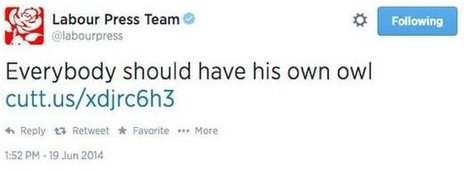
The Labour party’s twitter account was hacked with this tweet going out.

Owl Tweet

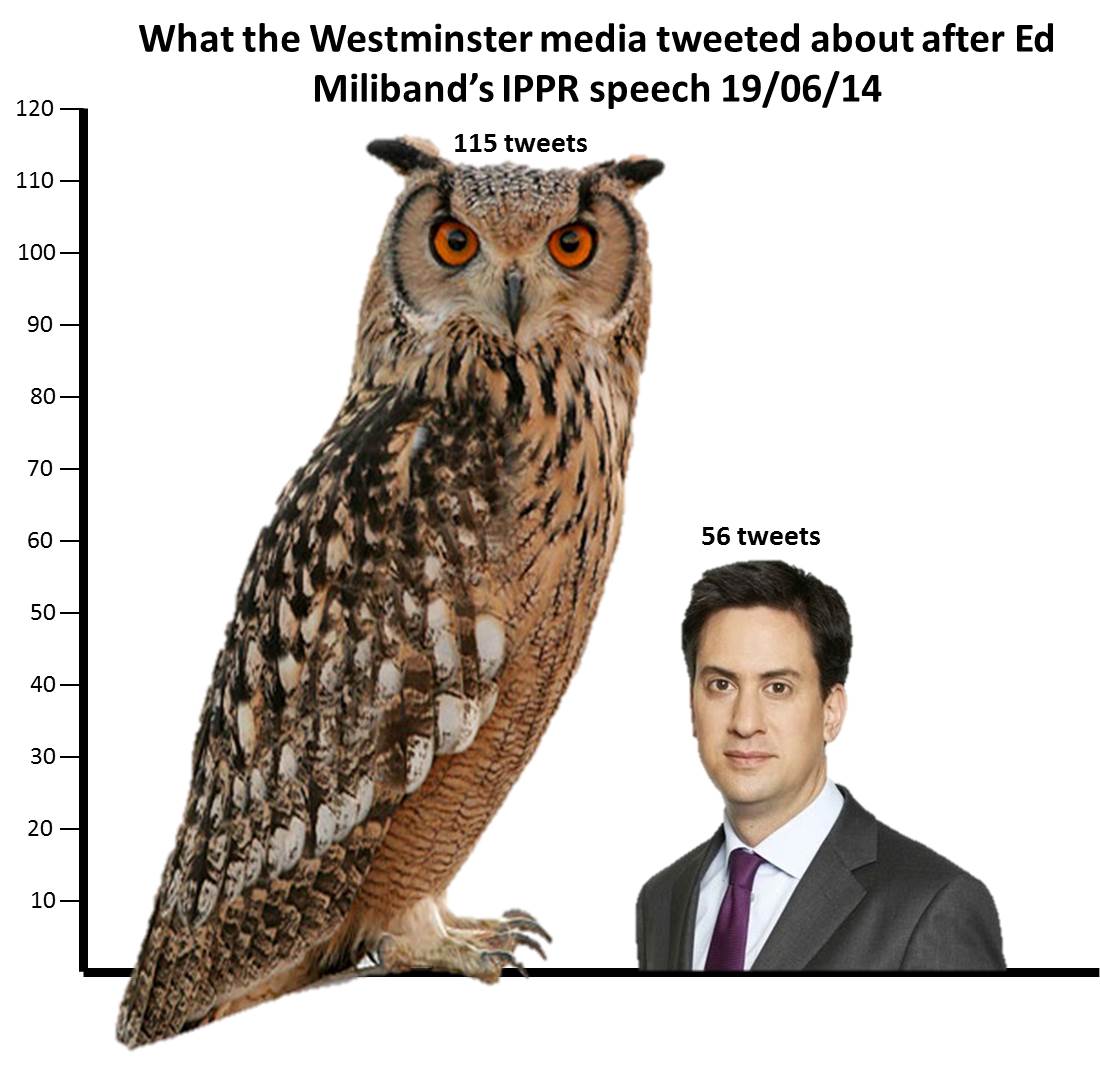
The rest is history. An analysis completed for Uncut by Twitter analytics experts, of tweets by the Westminster media (lobby, press gallery, columnists, political reporters and bloggers) illustrates the extent to which this one rogue tweet overshadowed the big Miliband speech.

From the point Ed Miliband stopped talking, to the end of the day, there were over double the number of media tweets about owls compared to Ed Miliband’s IPPR speech.

Owls vs Ed

By the early evening, loyalist MPs were having to use the owls meme to crowbar Ed Miliband’s speech back into the Westminster conversation.

(more…)

Facebook Twitter Digg Delicious StumbleUpon