


Posts Tagged ‘general election 2015’

“Much more of this and we are going to need a Devon Loch scenario to win”

19/03/2014, 05:07:33 PM

News reaches Uncut that Ed Miliband’s budget response has depressed spirits on the already gloomy Labour benches in the Commons.

After weeks of narrowing polls and increasing jitters in the tea room, today’s budget set-piece was widely viewed as an opportunity for Miliband to rally his troops.

The benign economic circumstances enjoyed by George Osborne had already been priced into PLP expectations, as had the difficulties faced by the leader of the opposition in delivering an instant budget response without having had the time to study its small print.

Few expected the Labour leader to fillet the detail of what was announced, but MPs were looking for a fighting performance from their leader. Something to settle the nerves and show some command at the despatch box.

But as the MPs filtered out of the chamber following the main speeches, the mood on the Labour side was sombre. One MP who spoke to Uncut shortly after leaving the debate was scathing, describing the performance as “embarrassing,” and that morale among their colleagues was now “really quite low.” 

Looking forward to the election next year, their assessment of Labour’s prospects was bleak, “Much more of this and we are going to need a Devon Loch scenario to win.”

For readers too young to either directly recall the Devon Loch Grand National in 1956, or to have seen countless repeats of the incident on Grand National specials through the years, the clip below should help.

For this MP, and many of their colleagues, unless Ed Miliband improves, Labour will require a slip from David Cameron equivalent to that of Devon Loch’s, to triumph in 2015 . 

Facebook Twitter Digg Delicious StumbleUpon

Oh dear Ed, this Europe policy is a disaster

12/03/2014, 11:53:18 AM

by Anthony Bonneville

Today, Ed Miliband blew it.

Contrary to some of the warm words from the likes of Martin Sorrell and Peter Mandelson, effectively ruling out a referendum has sabotaged Labour’s last chance to win over a strong coalition of business backers, not to mention irrevocably divide the Tories.

Labour is largely united on the benefits of staying in Europe. Trade, growth, jobs and the environment are all policy areas wholly dependent on our positive relations with the continent.

It’s a strong case but one that our frontbenchers seem reluctant to make.

The media is largely hostile and in the hurly burly of daily political debate, it’s understandable that Labour politicians prioritise issues more immediately relevant to voters.

Yes, today Ed Miliband gave a speech on Europe, but how many more times will he mention the subject in the next year?

It’s clear that today’s speech was an exercise in box ticking, in doing the bare minimum before abandoning the European battlefield.

If we, as pro-Europeans, want to play a positive role in Europe, we can’t do so without the engagement of the British public. There is a debate that is being conducted and right now Labour isn’t even in the chamber.

(more…)

Facebook Twitter Digg Delicious StumbleUpon

Can Ed and Nigel do a coalition deal?

28/02/2014, 01:52:39 PM

by Kevin Meagher

Did I hear that right? Nigel Farage is offering to form a coalition with Labour after the next general election. He referred to it as “doing a deal with the devil” to be sure, but I’m still ringing out my lug ‘ole in disbelief.

But hold on a minute. Think about it. UKIP only have two policies, both of which Labour half supports already. The first is a referendum on the EU (which might seem a no-brainer if May’s European elections are a bit icky) and a reduction in immigration (which, again, Labour can live with).

Beyond that, well, there’s not much else. There’s a great big purple haze where there should be ideas. As a political party, UKIP are the equivalent of an empty pint glass.

Whisper it, but they’re absolutely ideal coalition partners. I know, there would be the occasional bit of eye-rolling in Cabinet at some of their loopy suggestions, but they’re not really interested in policy.

And for that matter, they’re not much good at politics either. I know the Tories are quaking at the prospect of what they’ll do to them next May, but take the recent Wythenshawe by-election. Nigel Farage said it was “as dirty as they come” because some people on a poor Manchester council estate had a go at them and Labour got in early with the postal vote sign-ups while Farage’s troops were still trying to find somewhere to park their Range Rovers.

(more…)

Facebook Twitter Digg Delicious StumbleUpon

Osborne’s made his move. Now it’s Labour’s turn

14/01/2014, 09:37:04 AM

by Jonathan Todd

We are a nation seeking to rebuild from the economic calamity of the past half decade. You might think this task merits a chancellor focused upon it. But George Osborne doesn’t look to Keynes, Friedman or other economists. He prefers his own ‘baseline theory’ of politics.

As we grasp for an economic rubber ring, we’re thrown the thin gruel of his politics. To the extent that his actions are informed by any economic strategy, it envisages a state so shrunken as to be beyond the ken of post 1945 Britain. Yet his political logic is robust enough that this troubling scenario may come to pass after May 2015.

Osborne’s theory is informed by an impeccable reading of recent general elections. It holds that oppositions never form governments unless they match the fiscal plan of incumbents. Governing parties hold the privilege of being able to set the fiscal baseline. Any departures from this baseline by oppositions will be subject to intense scrutiny. In 1992, this resulted in the Labour opposition seeming to threaten a ‘tax bombshell’, while in 2001 and 2005, it resulted in the Conservatives appearing a menace to public services.

Over the next 18 months or so, the TUC’s Duncan Weldon suspects, the implausibility of Osborne’s baseline will stretch this theory – perhaps to destruction. In this baseline, £25bn of additional spending cuts – much of them from the welfare budget – come after the next election. But, as Weldon notes, the necessity of running a surplus by 2018/19, which motivates these cuts, is not set in stone. It is a political choice. The UK will only come apart if Scotland votes for it, not if a surplus isn’t run by 2018/19.

In fact, there appears more likelihood of grim things happening if Osborne’s baseline is kept to than if it isn’t. It’s delivery – assuming no further tax rises, protection for pensioner benefits and continued ringfences for the NHS, schools and DfID – requires a much reduced role for government outside of ringfenced areas and/or further cuts for the disabled, children and the working poor.

This delivery isn’t impossible but it is likely to be brutal. Perhaps so much so as to effectively be impossible. The social strain and political pain might just be too much. Maybe Osborne knows this and has no genuine intention of seeing this through in the event of being in office after May 2015. But, in indicating that he will, he’s presented Labour with a set of unattractive options.

One such option is for Labour to accept Osborne’s baseline. In its toughest form, this would mean not only accepting £25bn of extra cuts but accepting that half of them will come from welfare payments to working age adults. This would put Labour in a position that Nick Clegg has already castigated as unfair.

It seems unlikely, therefore, that this will come to be Labour’s position. Instead, Labour might match the Liberal Democrat position: acceptance of the £25bn but rejection of the depth of cuts to working age welfare. This rejection, however, only deepens questions as to how the £25bn will be made up.

(more…)

Facebook Twitter Digg Delicious StumbleUpon

The Milibelievers are destroying Labour’s chances for victory in 2015

06/01/2014, 10:47:37 AM

by Atul Hatwal

The polls are fine. Labour’s rating is holding firm in the high thirties, it will stay there because Lib Dem defectors will boost Labour’s core vote from 2010 and UKIP will squeeze the Tories’ vote.

This is the litany of the Milibelievers.  A group that is distinctly under-represented in the PLP but more vocal in the media community and believes Ed Miliband’s gameplan is working.

It was neatly summarised by George Eaton before Christmas and represents one the greatest threats to Labour success in 2015. Because unless Labour radically changes course and accepts the current gameplan is failing, defeat is increasingly likely.

There are two flaws to the Milibeliever prospectus.

First, Labour’s base is not the 29% achieved 2010.

Given how appalling Labour’s performance was in 2010, it’s tempting to believe that it represents rock bottom. 29% was derisory, but Labour can fall further. In polling for Uncut by YouGov in early September, just over 1 in 4 (26%) of Labour’s 2010 voters said they did not intend to vote for the party at the next election.

There may have been some minor movement in the attrition rate since Autumn, but given the broad similarity in the polls between then and now, it is unlikely to have changed significantly.

This means Labour’s current base is actually nearer 22% rather than 29% and unless something major changes, Labour will not even be the largest party, let alone a majority government, no matter how solid the block of Lib Dem defectors.

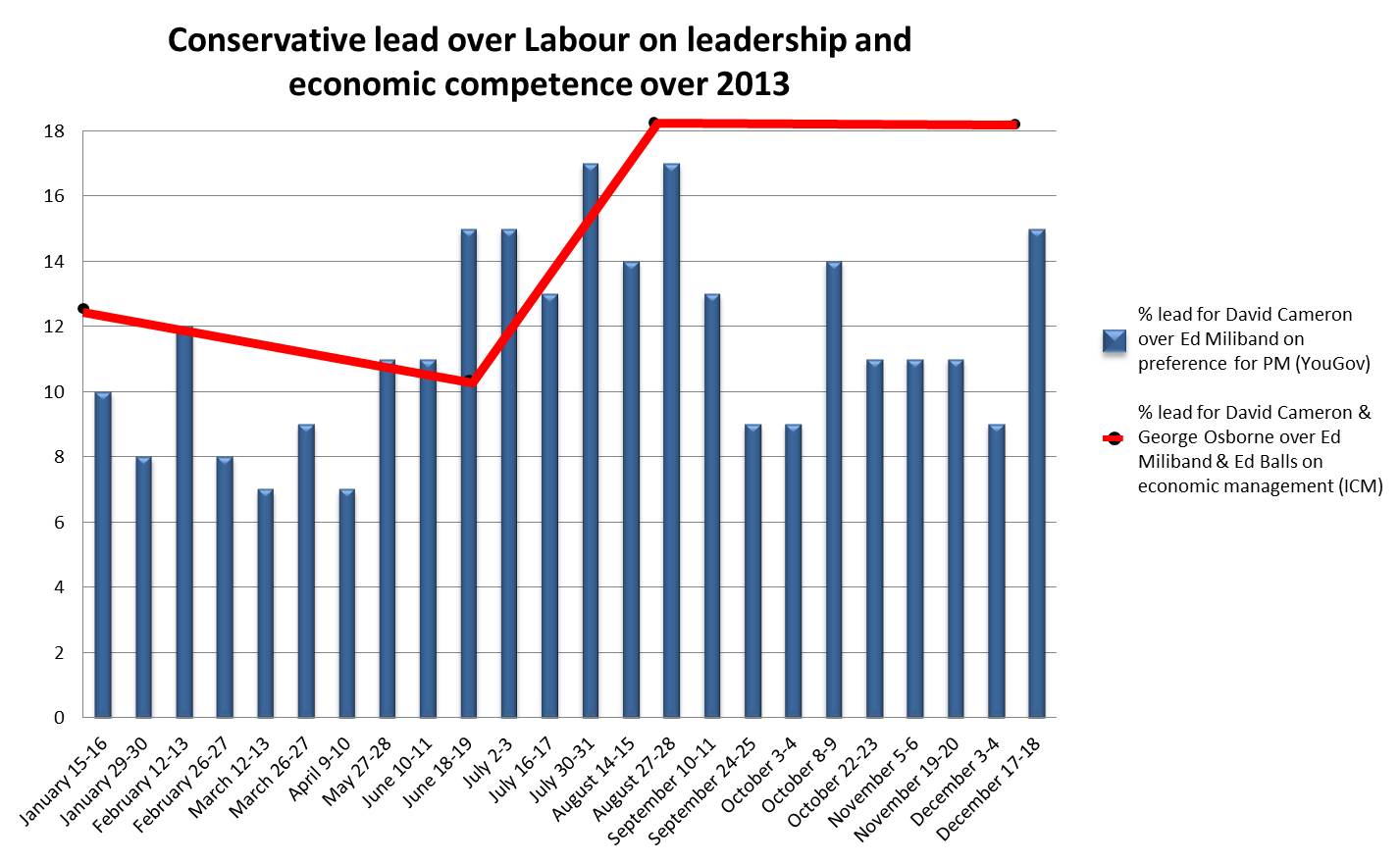
Second, Labour is losing the argument in terms of leadership and economic competence. This is the underlying reason why the party’s base vote has eroded since 2010, why it is overly optimistic to believe Labour can rely on legions of 2010 Lib Dem voters backing the party into the high thirties and why many UKIP converts are likely to lapse back into the Tory fold.

The chart below sets out the scale of Labour’s problem. No opposition has ever won while being behind on both leadership and the economy, and Labour now trails by double digits on both.

Con lead over Lab on PM and econ (more…)

Facebook Twitter Digg Delicious StumbleUpon

If Labour adopts the proposals of the Fabian spending commission, it will pay the price at the next election

21/10/2013, 11:11:21 AM

by Jonathan Todd

David Cameron – as, for some reason, he is always quick to do – taunted Labour thus in PMQs last week: “More spending, more borrowing, more debt. It is the same old Labour.” On the same day, a Fabian Society commission on the future of public spending reported that Labour could spend £20bn more in 2017-18 than the government currently plans.

If Labour were to adopt the recommendations of the Fabians, then the reaction of the prime minister is all too obvious. What is, though, more important to Labour’s 2015 chances is how the voters would react.

Polling by YouGov to support the book published by Labour Uncut at party conference gives us some indication.

This polling found that if Labour were to promise to keep most of the present government’s spending plans, but to borrow more specifically for public works such as building more homes, those who say this would make them more likely to vote Labour outnumber those who say it would make them less likely by 4% (17% more likely versus 13% less likely).

In contrast, a net 4% of voters say they would be less likely to vote Labour (12% more likely versus 16% less likely) if the party rejected any public spending cuts and instead allowed borrowing to rise.

The difference between these two strategies could be the difference between Labour winning and losing the election.

The Fabian proposal seems to fall somewhere between these two strategies. It doesn’t reject entirely spending cuts – a position that our polling indicates would be likely to cost Labour the election. Nor does it only go beyond the government’s plan exclusively for certain forms of investment – a strategy that our polling sees as compatible with Labour victory.

(more…)

Facebook Twitter Digg Delicious StumbleUpon

Ed is right to wait on policy, fixed term parliaments have changed the rhythm of politics

27/08/2013, 07:00:29 AM

by Ian Moss

In the summer of 2007 regional offices of the Labour party distributed leaflets to its constituencies and held briefing meetings with ward organisers to discuss the campaign plan for the forthcoming general election. Gordon Brown and his team kept open the possibility of going to the country whilst torturing themselves internally on whether to take the risk only two years into the third term Labour government.

As we all know this event is now commonly known as ‘the election that never was’. The point of regurgitating the painful memories of that story for everyone who watched it slowly reach its inevitable denouement is to emphasise one simple point: before the Fixed Term Parliaments Act of 2011 not even the government knew when the election was going to be and they were the ones that had the power to call it.

The Act has changed the rhythm of politics. At this time in the political cycle the government and opposition used to be playing a game of chicken over the election. Will they go the full term? Will they call early? How is the economic cycle looking? etc. etc. Instead, pretty much every major figure in politics went on a good long holiday.

This was sensible and calculated. They all know the election is in 2015, they all know next summer they will be in the middle of the long slog of a campaign that will last more than a year, starting in the autumn, and they all want to make sure they had a good break this summer so they can be prepared for it.

Why not?  The voters are switched off for the summer as well, and the political campaign over August is really an absurd prisoner’s dilemma. Every party thinks they have to do it because the other parties are. Every year the political parties spend their summers boxing shadows, or each other.  Every cabinet minister knows that this time next year they will be expected not to leave the country, to be on call, and to be attending campaign events across the UK.

(more…)

Facebook Twitter Digg Delicious StumbleUpon