


Posts Tagged ‘Jeremy Corbyn’

Want Labour to be a ‘safe space for Jews’? Here are the three steps Labour must take

26/09/2021, 08:52:00 AM

by Emma Picken and Euan Philipps

This piece is part of a new book “Labour’s reset: the path back to power” which Uncut will be launching at Labour conference . The book looks at the barriers for voters in picking Labour, what the party can do in opposition to tackle these issues and the type of policy platform that would attract switchers to Labour at the election.

On October 29th, 2020, something took place that would have seemed inconceivable had it been 10 years earlier: the Equalities and Human Rights Commission (EHRC) found that the Labour Party had breached equalities law and had acted illegally in its treatment of Jews[1].

This outcome was in part due to the vicious culture that had been imported during the Corbyn years. More importantly, however, the party was already ripe for infestation with a culture that contained both antisemitic individuals and ideas. It had little or no defence against either.

The following piece will not rehash how appalling Jeremy Corbyn’s behaviour is or the depths of antisemitism  found within his fellow travellers. No one has plumbed these depths more than Labour Against Antisemitism  (LAAS), as our 20,000-page submission to the EHRC attests. Nor will we go over how Labour got itself into the position of being led by an antisemite; this has already been extensively and eloquently covered by David Hirsh in Contemporary Left Antisemitism , Dave Rich in The Left’s Jewish Problem, Alan Johnson and many others[2].

Rather, we will discuss the main areas Labour needs to address in the immediate present in order to make the party an environment where antisemitism  is no longer tolerated; how Labour can sincerely atone for the damage done to the Jewish community and its vocal allies; and how Labour can turn the ‘safe space for Jews’ soundbite into a truly secure environment for its Jewish members.

There are three elements that must all be put in place to finally rid the Labour Party of antisemitism .

The first is tackling antizionist antisemitism .

Following our extensive reporting of antisemitism , our observation in LAAS is that contemporary antisemitic discourse centres around those claiming only to be ‘antizionist’. However, antizionism is at the heart of the issue – and, in our experience, is without fail antisemitic. Thus, without tackling antizionist antisemitism , ‘tearing antisemitism  out by its roots’ is frankly doomed to failure. While internally within the Jewish community there will always be a small minority with antizionist views, the vast majority identify as Zionist, with 93% saying Israel plays a central part in their identity. Antizionist antisemitism  harms them deeply and multiple ways[3].

What must be done?

Firstly, the party must sever all ties with the Palestine Solidarity Campaign (PSC). It is astonishing that a group so evidently steeped in antisemitism  is welcome within any antiracist movement; all the more so that this group is afforded so much influence within Labour policy on Israel that two out of the three leadership candidates in the last leadership elections backed the PSC pledges[4]. One of the candidates, Lisa Nandy, is now shadow Foreign Secretary[5].

There is extensive evidence of the extreme antisemitism  within the PSC[6], which stands opposed to the International Holocaust Remembrance Alliance (IHRA) definition of antisemitism  that Labour has adopted in full.

The unions, too, have not been aligned to such overt racism since the London dockers famously came out in support of Enoch Powell. The affiliation to the PSC of every single large union within Labour must be ended without delay. It is deeply ironic that Frances O’Grady feels bound to discuss ways in which the unions need to face up to their racist past, while ignoring the flourishing racism of today[7].

Secondly, Labour must firmly close its doors to the Boycott, Divestment, Sanctions movement (BDS), whose banner of ‘social justice’ serves to disguise a darker aim: the eradication of Israel. BDS initiatives remove agency from Jewish business, students and academics in the diaspora. These have no impact on Israeli governmental policies, however they are a conduit for some of the most vicious antisemitic intimidation seen since the 1930s.

No right-minded Labour member would admit to supporting BDS if the above points were included in its discussion on racism, and especially not if the movement ever reached its goal – so why is this tolerated? Why is this antizionist antisemitism  treated differently to other kinds of racism? In our view, the party should not treat adherents to BDS any differently to any other racist.

What many miss is the fact that BDS is both bigoted and discriminatory. It holds Israel to standards not required by any other democratically elected sovereign state. It’s clarion call of ‘to the River and the sea’ is the call for the destruction of Israel – the claiming of the land between the Jordan River and the Mediterranean Sea; the state of Israel. In fact, the logo on posters and T-shirts for the BDS and it’s sister organisation, The Palestine solidarity committee, clearly shows the entirety of Israel as being claimed for a Palestinian state. No two state solution or shared ownership, just the eradication of Israel.  The Labour Party must find a better way to legitimately support the cause of the Palestinian people without calling for the destruction of Israel and the alienation of the majority of Anglo Jewry.

The second element that the Labour Party needs to deal with is the appearance of its MPs and their tacit endorsement of antisemitism  at Israel/Palestine demonstrations.

(more…)

Facebook Twitter Digg Delicious StumbleUpon

Revealed: New poll shows 1 in 4 non-Labour voters considering backing Starmer but they want a decisive break from the Corbyn era – 60% say expel Corbyn if he doesn’t apologise over anti-Semitism

19/09/2021, 09:24:00 PM

by Atul Hatwal

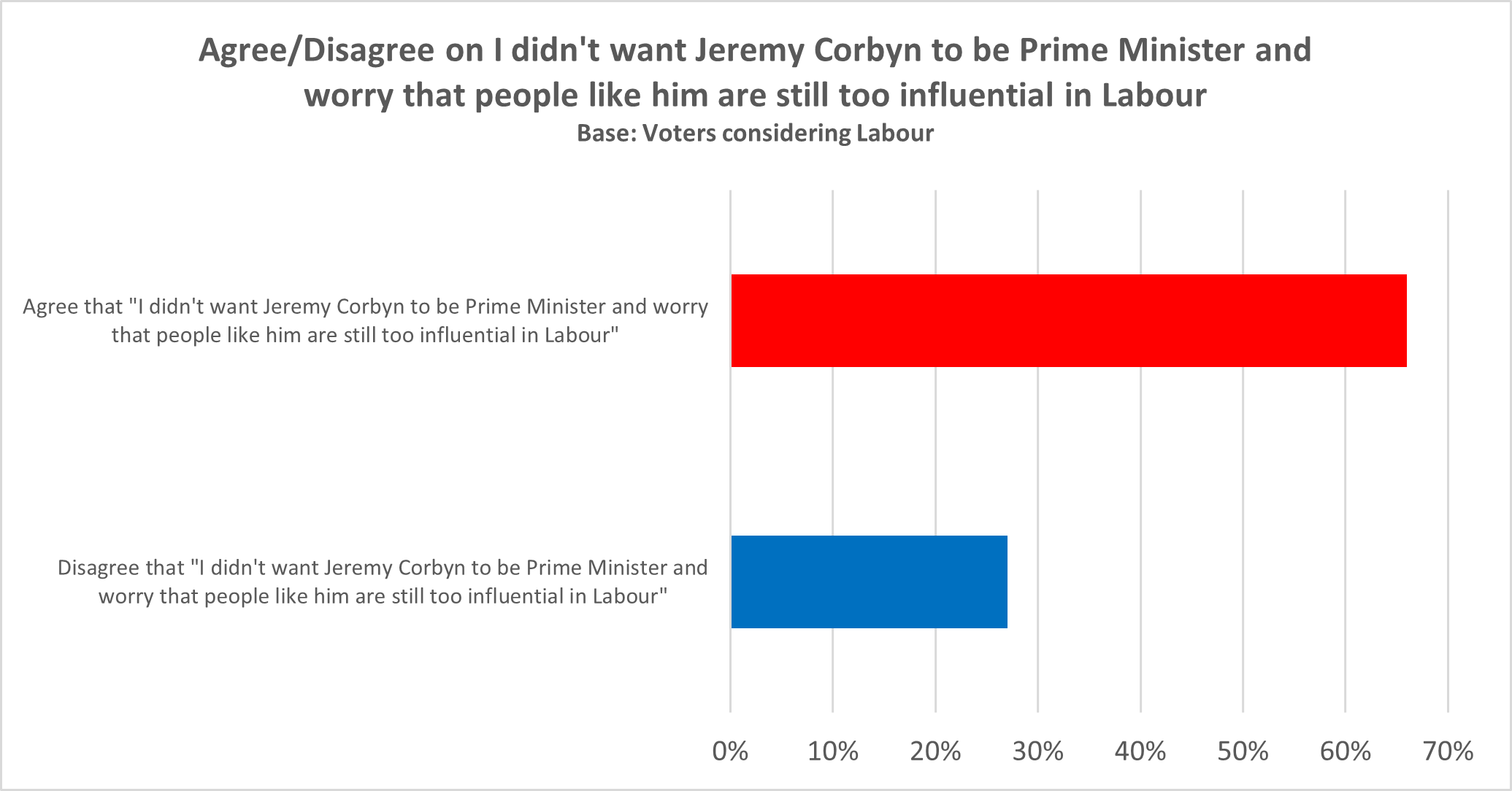
New research conducted for Labour Uncut by pollster Yonder (the new name for Populus) reveals that just over 1 in 4 non-Labour voters (26%) would consider voting Labour at the next election. But Jeremy Corbyn is still a huge negative with 66% of this group worried about the continued influence of Corbynites in Labour and 60% saying his expulsion from Labour, if he doesn’t apologise over anti-Semitism, would make them more likely to vote Labour.

The polling, conducted by Yonder between the 13th and 14th September with 2,010 respondents, revealed that 1 in 7 Conservative voters (14%), over half of Lib Dems (53%) and 1 in 4 SNP (26%) are considering voting Labour. Based on Labour’s current standing in the polls, attracting even half of those thinking about backing Keir Starmer and Labour would send the party into government with a vote share in the mid-forties.

However, Labour’s potential voters want a clear break from the Corbyn era.  A series of statements articulating potential reasons for not voting Labour, drawn from previous research, were put to this group and despite a clear appetite for policies such as higher spending on public services and a higher minimum wage, Jeremy Corbyn and his legacy remain toxic.

A net +39% agreed with the statement “I didn’t want Jeremy Corbyn to be Prime Minister and worry that people like him are still too influential in Labour”

Next week, at Labour conference Jeremy Corbyn will once again be in the spotlight and much of the debate about Labour will be defined through the prism of the former leader.

He’s currently suspended from the parliamentary party for saying that the extent of anti-Semitism in the party was “dramatically over-stated” following the publication of the EHRC report into Labour and anti-Semitism, but he had already been readmitted to the party at the point the report was published and so, as a party member not a Labour MP, will be speaking at various Labour conference fringe events. He’ll have a political and media retinue trailing along after him, distracting from the main conference, in the manner that Boris Johnson used to at Conservative conference in the early to mid-2010s.

(more…)

Facebook Twitter Digg Delicious StumbleUpon

Bercow is yesterday’s man, why is Labour indulging him?

22/06/2021, 01:56:09 PM

by Kevin Meagher

I am not sure what voters will make of John Bercow’s defection to Labour at the weekend. I suspect the answer is “not much.”

It is hard not to interpret the former commons speaker’s move as a fit of pique over the prime minister denying him a peerage, rather than some damascene conversion to socialism.

Spurned by his erstwhile colleagues, he’s just trying his luck on the other side of the political aisle, isn’t he?

Bercow implies this is not the case.

Speaking to Trevor Philips on Sunday, he claimed there had been ‘absolutely no conversations whatsoever’ about a peerage, either with Keir Starmer or his team.

He added: ‘And if I may very politely say so, and I do, the people who make what they think is that potent and coruscating criticism of me are operating according to their own low standards.’

Of course, denying there have been recent talks about Labour putting him forward for a peerage is not the same thing as Bercow rejecting the very notion that he would accept one.

Indeed, this morning’s Times reports that he met with Jeremy Corbyn’s team in the days following the 2019 general election to discuss his nomination to the Lords:

‘He then wrote to Corbyn’s office with a reference in which he boasted of his four honorary degrees, “no fewer than five shadow ministerial roles,” a stint as deputy leader of the Tory group on Lambeth council, and experience as a tennis coach.’

In his defence, Bercow was undoubtedly a fine speaker, certainly when it came to checking the authority of the executive and championing the rights of backbenchers.

However, does this wipe clean his previous form as a grisly ultra-right-wing Tory, on the lunatic fringe of his party. A former member of the fascistic Monday Club in his younger days, no less. The group that supported ‘assisted’ repatriation of Commonwealth migrants and loyalist terror in Northern Ireland.

Granted, Bercow’s politics seem to have undergone a dramatic conversion; the mellowing of middle-age, perhaps? Alas, his insufferable pomposity remains.

When asked if Keir Starmer would become prime minister, he told Trevor Philips that ‘the jury is out,’ adding that the Labour leader was ‘decent, honourable and intelligent,’ although not in the same league as Bill Clinton or Barack Obama.

Man of the people, Bercow is not.

There is also the fact (how can I put this delicately) that he’s a has-been.

Joining Labour straight after he quit the speaker’s chair, or as soon as Keir Starmer was elected Labour leader might have created a bit more of a stir, but it is hard to see what Labour gets from this move at this stage.

Apart from a few die-hard Remaniacs, who credit Bercow with trying to stymie Brexit, and a few constitutional bores who think it is somehow a big deal that a former speaker has not automatically been elevated to the peerage, who cares what he does?

Having ‘generally voted’ for a wholly elected House of Lords, according to TheyWorkForYou.com, perhaps Bercow can avoid any charge of hypocrisy and check his future ambitions by waiting  until there is an elected second chamber?

Kevin Meagher is associate editor of Uncut 

Facebook Twitter Digg Delicious StumbleUpon

Labour was right about Brexit in 2017 and wrong in 2019

05/01/2021, 11:20:30 PM

by Kevin Meagher

There was a pretty big irony about last week’s vote on the government’s Brexit bill.

By whipping his MPs into supporting Boris Johnson’s deal, Keir Starmer was making good on a manifesto commitment: ‘Labour accepts the [Brexit] referendum result and a Labour government will put the national interest first.’

Of course, this was from the 2017 Labour manifesto, not the 2019 edition.

That version, influenced by the lobbying of the second referendum mafia, gave a quite different commitment. It promised to ‘

give the people the final say on Brexit.’ After a period of renegotiation, a new deal would be put to the vote, ‘alongside the option to remain.’

It was a lousy policy.

It would have seen Labour ministers constructing a new deal that honoured the party’s red lines around labour market standards, environmental protections, and single market access, only for the party to campaign against it in a fresh referendum, in order to remain in the EU.

Voters are not as gullible as politicians consistently believe.

Right along the Brexit-supporting Red Wall, they smelled a rat, sensing that Labour had no intention of respecting their choice to leave the EU and made plain their displeasure. The rest is, well, history.

So last week’s vote was about earning a fresh hearing with voters. The rights and wrongs of Brexit (mainly wrongs) will have to come out in the wash. There are no votes to be gained in prolonging the agony any longer.

In seeking to modernise Labour after last year’s rout, Starmer will carry on repudiating Labour’s recent past. It is the equivalent of a spring clean, expunging mistakes and decluttering the record in a bid to win a second look from the voters. More often than not, it is an exercise that culminates in a gentle dagger thrust into the last guy’s rep.

In which respect, Keir Starmer was in effect knifing himself last week.

He was the architect of Labour’s policy to back a second referendum in 2019. Jeremy Corbyn must take the overall blame for the party’s various policy, strategy, and presentational mistakes, but he was only trying to keep the peace by backing the muddled Brexit policy that Starmer and others were so keen on.

Perhaps Corbyn should have put his foot down – his policy in 2017 was both straightforward and popular.

Indeed, if the party had stuck with the 2017 commitment – avoiding the impression that they were trying to usurp the voters’ decision about the referendum – there would have been more scope to criticise the final deal. As it was, most Labour MPs ended up voting for a package they don’t believe in and one that Keir Starmer himself conceded was ‘thin.’

Now it is done, Brexit is delivered, and Labour can finally move on. But there will be many other painful concessions to make on the journey towards 2024. Labour still has a mountain to climb and is barely out of the foothills.

Kevin Meagher is associate editor of Uncut

Facebook Twitter Digg Delicious StumbleUpon

The Uncuts 2020 (part II)

31/12/2020, 05:45:35 PM

Politician of the year: Keir Starmer

Politics is a trade conducted exclusively in the moment so it’s worth restating the position at the point Keir Starmer became leader. Just over a year ago, Labour crashed to its worst defeat since 1935, collapsing to 203 MPs and trailing the Tories by just over 11% in the popular vote. Few alive had seen the party laid so low.

Nine months on from the leadership election, Labour is currently level pegging with the Tories, Starmer himself is consistently ahead of Boris Johnson and the Conservatives have yet to work out a consistent line of attack on him. The process of returning Labour to electoral contention will be a work of years, but the early progress under Labour’s new leader is evident.

Keir Starmer’s resolution in winning back the Jewish community’s trust and tackling anti-Semitism with Labour has combined moral and political imperatives, establishing the clearest possible dividing line with the previous leadership (albeit, helped unintentionally by the hard left’s inexplicable decision that this is the hill to die on).

British politics in 2020 has spawned many losers. Boris Johnson has squandered the public’s trust following his victory and is vulnerable, Ed Davey isn’t yet a blip in the opinion polls and even Nicola Sturgeon faces unprecedented challenges with the burgeoning civil war within the SNP between her’s and Alex Salmond’s factions. Against this backdrop of political struggles and reverses, Keir Starmer is the one British party leader who has made significant progress over the year.

Nothwithstanding the recent intra-party challenges over Brexit, he enters 2021 with a level of momentum and an expectation of further progress.

Shortest-lived Frontbencher Award: Rebecca Long-Bailey

Perhaps against the better judgement of some of his more seasoned colleagues, in April Keir Starmer opted to appoint a few of the younger Corbynites to frontbench roles, in a “unifying” play to move on from the Corbyn years. Despite his best efforts, it didn’t last.

By June Rebecca Long-Bailey, the Momentum-anointed candidate to replace Corbyn as leader, had gushingly tweeted a Guardian article by resident hard-leftie-luvvie Maxine Peake, where she regurgitated an anti-Semitic conspiracy theory. While Peake herself later distanced herself from her own words as a mistake, Long-Bailey somewhat loftily refused to withdraw the tweet and apologise herself. This went down in the LOTO’s office like a lead balloon.

(more…)

Facebook Twitter Digg Delicious StumbleUpon

The Uncuts: 2020 Political Awards (part I)

30/12/2020, 10:30:02 PM

Best International Politician: Joe Biden  

Our hearts may have entered 2020 longing for it to be last year of Donald Trump’s presidency. But our heads should have told us that one term presidents are rarely beaten, especially when benefitting from a growing economy and strong approval ratings for economic management.

In early February, Joe Biden secured a lower vote share at the Iowa caucus than Bernie Sanders, Elizabeth Warren and Pete Buttigieg (we said, this time last year, he was one to watch and is now the President-elect’s nominee for Secretary of Transport).

Covid-19 transformed the Trump presidency and the Biden candidacy. It took a global pandemic to politically expose Trump’s inability to effectively run the federal government and make resonate Biden’s backstory of grief, resolve and decency.

While Covid-19 upended the presidential race, Biden deserves immense credit for fighting it on his own terms – not allowing himself to be goaded by Trump into spats on Twitter or elsewhere, failing to provide an easy target for Trump’s attacks on “radical socialism”, and maintaining consistent message discipline throughout the campaign.

Now this message – building back better for all Americans – needs to be made real. In a deeply divided country, with a political system grounded in bipartisanship, this will not be easy. But is a fight that Biden must win to overcome Trumpism, even if his victory over Trump makes him one of 2020’s heroes.

Political Self-Harm Award: Jeremy Corbyn.

In an unrivalled act of foot-shooting the former leader decided, after explicitly being asked not to undermine in any way the results of the EHRC report into anti-Semitism, did exactly that, declaring that said anti-Semitism had been “dramatically overstated for political reasons”.

For his trouble, he earned himself a suspension of the PLP whip and his party membership, suspensions which the party reportedly had not remotely planned to impose until his unwanted intervention.

While the party’s existing and undeniably flawed disciplinary procedure allowed his reinstatement as a party member, Keir Starmer informed him that the PLP whip, which was a matter for the leader personally, would not be reinstated and that Corbyn would sit for the present as an independent in the Commons.

(more…)

Facebook Twitter Digg Delicious StumbleUpon

Ignore the teenage scribblers on the left, Keir Starmer has got this

23/12/2020, 10:36:38 PM

by David Talbot

As dusk falls on the most punishing of years, the political fortunes of the Government has oscillated from “a fantastic year for Britain” to Christmas being cancelled across a country decimated by COVID-19, economic collapse at home, ostracisation abroad and uniform exhaustion at life being halted as we know it.

For the Prime Minister, who ushered in the New Year with what can now rightly be seen as one of the most macabre of reassurances, his bombastic optimistic, jingoism and bravado – which were all either once lauded or played significantly to his base – have become his wickeder traits as reality finally catches up with his fantasies and self-obsession.

For the Labour Party, the direction of travel has been diametrically opposed but no less difficult.
Jeremy Corbyn’s influence on the Labour Party had been profound. Corbyn, and Corbynism, was ushered into a party rootless after 13 years of power and the failure of Ed Miliband to carve out distinct ground to the left of his predecessors, whilst still appeasing a membership and trade union base yearning for “transformative” policies. The 2019 election result was the final sorry denouement to that particular thought exercise.

Labour has now been out of power for 10 years, half of that time under Jeremy Corbyn’s leadership. The hegemony that he held over the party, particularly post the 2017 general election defeat, has now been ceded.

One of the many early tasks for the new Labour leader, Sir Keir Starmer, was to establish himself before anyone else could define him.

The Conservatives’ inability to define and sustain a line of attack on the Labour leader is self-evident; he most obviously is not, for one, a far-left sympathiser of Jeremy Corbyn, nor is he – as has been highlighted to no great joy – Captain Hindsight.

Starmer rightly recognised early on in his leadership that he needed to earn the trust of the British public to be listened to again. It involves a long-term commitment to listening to and understanding why communities moved away from a party historically created to represent them.

Policies are, of course, important in politics. But so are people. Labour presented a dazzling array of policies at the general election last year which, whilst collectively popular, were holed by a complete lack of credibility and competence by those espousing them.

(more…)

Facebook Twitter Digg Delicious StumbleUpon

The EHRC report is conclusive and damning. But Corbyn’s suspension has now changed the game entirely

30/10/2020, 10:37:04 PM

by Rob Marchant

It was a day of shame for Labour, that is true. Never before had it been criticised so incontrovertibly about racism: something which a decade ago would have seemed to many unthinkable.

But it was also the day where an enormous boil seemed to be lanced and, at last, a road out of the mess of the last decade became clearly visible.

Pity the poor commentators up and down the country. All about to file their pieces about the EHRC report and Starmer’s reaction to it, when suddenly the massive news of Jeremy Corbyn’s suspension meant that all bets were off.

The content of the report, it therefore suffices to say at this point, was damning and conclusive: the party had broken equalities law and needed to make amends. Interestingly, although it confirmed that the Leader’s Office had clearly interfered with a large number of complaints, it did not call out Corbyn himself specifically. In fact, although the report’s author did comment in an interview that obviously the person at the head of the party at that time needed to carry some responsibility, Corbyn actually got off rather lightly.

This is not, we need to underline, because Corbyn was not responsible. It is because the limited terms of the report addressed the specific question of institutional anti-Semitism, and did not answer the simple question being asked by Jewish activists on Twitter: why was there such a massive upsurge in anti-Semitism on Corbyn’s watch? If that question, to which the answer seems perfectly obvious, had been asked and data sought, Corbyn would have been in a much more sticky situation.

(more…)

Facebook Twitter Digg Delicious StumbleUpon

Corbyn’s toxic legacy lingers on in Unite

08/10/2020, 10:43:56 PM

by David Talbot

The seeds of Unite the Union’s recent act of self-immolation were sown in early 2018. In an article for the New Statesman, Len McCluskey opined that Labour MPs who were hostile to Jeremy Corbyn’s then leadership were using antisemitism as part of a “sustained smearing” campaign against the embattled Labour leader. Praising “the great advances” made in the previous year’s general election, the party’s third historic defeat in a row, he vowed that Corbyn’s critics would have to face the consequences.

The following morning the then shadow Brexit Secretary, and now leader of the Labour Party, Keir Starmer, popped up on the Today programme to disavow the party of the General Secretary’s comments. It was “obvious” the party had a sustained problem with antisemitism, Starmer said, and that “denying the problem is part of the problem.”

McCluskey, for all his written word to the contrary, has a repeated history of lashing out against opponents of antisemitism in the Labour Party. A longstanding Jewish Labour Member of Parliament, Margaret Hodge, was “disgraceful and despicable”, British Jewish leaders demonstrated “truculent hostility” and he was “disappointed” in the Jewish Labour Movement when it published a dossier full of testimonies of antisemitism in the party, noting rather darkly that it “doesn’t support Jeremy Corbyn”.

McCluskey had his rematch with Starmer over Rebecca Long-Bailey’s sacking from the Shadow Cabinet in June, calling the left’s fallen protégé sacking “an unnecessary overreaction to a confected row”.

In August, the Unite leader laid the foundations for this week’s announcement telling the Observer that he was infuriated with the Labour leader’s decision to pay substantial damages to seven former party staff who had appeared in the BBC’s Panorama documentary. As the Board of Deputies has rightly noted, it is both ironic and deeply shameful that the leader of a trade union should so disparage and attack party workers for the treatment they endured at the hands of their employers.

(more…)

Facebook Twitter Digg Delicious StumbleUpon

“Incompetence” is the most dangerous word in politics. Boris beware

20/08/2020, 10:45:53 PM

by David Talbot

In the Autumn of 2007, a resurgent Labour Party, galvanised by Gordon Brown’s elevation to Number Ten, met in Bournemouth buoyant at the prospect of an early general election. Under the banner ‘The strength to succeed’ Brown had spent the first few months of his ultimately doomed premiership reassuring the nation. From donning his wellies in flooded, predominantly Conservative-dwelling, shires, to soothing the nation following terrorist attacks in Glasgow and London, Brown’s early brand was based on solidity and, most of all, competence.

The problem of creeping incompetence usually arises towards the end of a government’s life, when Ministers are tired and a smell of decay whiffs through the air. But this government has developed a competence problem after merely a year in office.

COVID-19 was not, of course, the design of Boris Johnson’s government but its response to it has been lamentable and incompetent in the extreme. It squandered two precious months to prepare the nation, its much vaunted “world beating” track and trace system is a disgrace, it failed to protect frontline NHS staff through the heat of the pandemic, and it turned the nation’s care homes into breeding grounds for a disease whose mortality is intertwined with those aged 65 years and above.

From surcharges for migrant NHS workers, school meal vouchers for the nation’s most vulnerable schoolchildren to levelling down students’ futures, this government has exuded wanton incompetence in every nuance of an increasingly desperate defences. Even on its flagship raison d’être, Brexit, its “oven ready” deal has been strangely aloof since it was lauded every day for two months late last year.

Johnson’s limitations have been well-known and widespread for years; his disorganisation, his lack of attention to detail, his bluster and bumbling incompetence. In politics, if you take an ideological stance it will always mean you lose someone. But develop a reputation for incompetence, and you lose everybody.

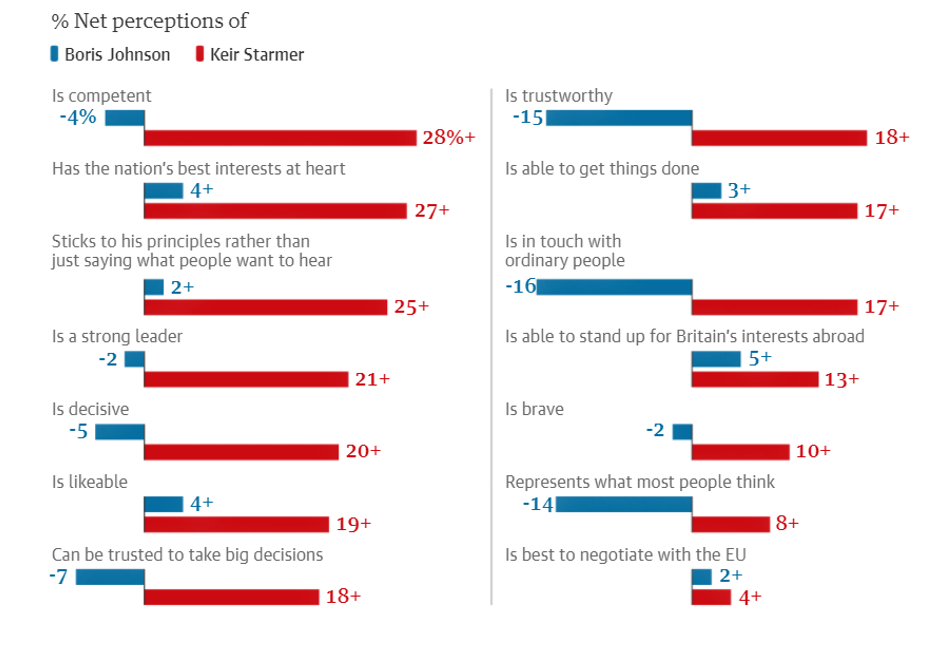
And it is on this ground that Sir Keir Starmer has staked his early strategy. Through demonstrating competence, severely lacking for years under the previous administration, Labour has at last emerged as a serious party determined on seeking power. It is easy to see why this attribute is so important to Labour, not only as a core prerequisite for any party seeking power, but through polling – such as the Observer last month on the perceptions of the two party’s leaders:

(more…)

Facebook Twitter Digg Delicious StumbleUpon