




UNCUT: Labour shouldn’t stand a candidate against Mark Reckless

28/09/2014, 08:30:51 AM

by Kevin Meagher

Everything about politics is relative and after a stinker of a week for Labour, it’s clear the Tories’ conference this week is going to be even worse after the shock defection of Rochester and Strood MP, Mark Reckless, to Ukip.

All those sneering gags about Ed Miliband that David Cameron had planned for this week will fall flat as the edges of the Prime Minister’s authority over his own party continue to fray and his future now firmly lies in the hands of Ukip’s “fruitcakes, loonies and closet racists”.

In saying that, it is only fair to concede that by resigning his seat as part of his defection, Reckless is allowing the electorate to determine what they make of his decision. It takes bravado, and, frankly, some measure of integrity to do so. Defecting Labour and Tory MPs have never taken the risk of triggering a by-election in such circumstances.

So this is a high-wire act for Ukip and if they fail to win Clacton in two weeks’ time and now Rochester and Strood, then they will land hard. But if they win, the political pay-off will be enormous, and their insurgency will quicken.

How should Labour react? Party chiefs need to make a quick calculation about whether they can benefit from a Conservative-Ukip dog-fight and sneak through the middle. Conversely, the risk is that failing to win this by-election will serve to dampen expectations about Labour’s ability to win southern English seats more generally.

In 2010, Labour came second in Rochester and Strood with 28.5 per cent of the vote. This belies the fact that the seat (or most of it before boundary changes) was represented between 1997 and 2010 by maverick Labour MP, Bob Marshall-Andrews.

But if not now deemed winnable, Labour should move quickly to rule out standing a candidate. Ukip didn’t field anyone against Reckless in 2010 because of his strong Eurosceptic credentials. Labour should recycle the tactic for its own benefit.

This has two effects. First, it guarantees the race turns into a slugfest between Reckless and the Tories and, just as importantly, it insulates Labour from the charge that it isn’t making headway in seats it once used to hold. (A stark reminder is Newark, which Labour held between 1997 and 2001, yet could only manage a dismal third place in last June’s by-election).

In fact, putting up token resistance could see Labour aid the Tories in holding the seat, with Anthony Wells from UK Polling Report cautioning that it won’t be a “walk in the park” for Ukip. Better to give Cameron a few more of those sleepness nights about Ukip that Ed Miliband joked about last week.

Kevin Meagher is associate editor of Labour Uncut

Facebook Twitter Digg Delicious StumbleUpon

UNCUT: Let us build our way to growth and well-being

26/09/2014, 06:02:30 PM

by Kieran Quinn

Many of us have direct experience of friends and family that aspire to own their own home but fail at the first hurdle due to the spiraling cost.

According to the latest census information, meeting housing demand will require the building of 245,000 new homes each year. This is 145,000 more than is currently being built per year. House building levels are now only slowly rising from the lowest level of activity since the 1920s.

This housing shortage has led to a massive increase in the price of housing, excluding many young first time buyers from getting their first foot on the property ladders

In 1997 it took an average family 3 years to save up for a proper deposit on a home, today this can take 22 years. Ed Miliband announced plans that go someway towards addressing this. The pledge to commit the Labour Party to increase the level of house building in the UK to 200,000 homes per year is a welcome step.

A key part of stimulating new house building will be to unlock capacity in small house builders.

25 years ago 2/3 of new homes were built by small builders, this has fallen to less than 1/3 today. The number of firms building between 1-500 units has also fallen from 12,000 to less than 3,000 over the same period. Labour’s “Help to Build” scheme will attempt to address this through improving access to finance by guaranteeing a proportion of bank loans to small house builders.

Read the rest of this entry »

Facebook Twitter Digg Delicious StumbleUpon

UNCUT: The politics of mutualising the NHS and reviving National Insurance offers Labour a big opportunity

25/09/2014, 06:20:52 PM

In the second of an occasional series of posts, from Uncut contributors, that look at the policies and political positioning needed to win the next election, Jonathan Todd reflects on Frank Field’s case for restructuring how the NHS is funded.  

by Jonathan Todd

In March 1992, 22 per cent of voters thought the Conservatives had the best policies on the NHS. 52 per cent thought Labour did. This didn’t stop the Tories winning the general election two months later. This experience should caution us against seeing the lead that Labour currently enjoys on the NHS as sufficient to secure Labour general election victory. Labour’s trust and popularity on this issue is not a passport to election victory. But it is a political asset that might be deployed to create such a passport.

Some perceptions of Labour strength and weakness that are relevant are:

The support Labour enjoys on the NHS is emblematic of the sense that Labour’s heart is in the right place. No one believes that Labour enjoys seeing nurses being made redundant, whereas there is a lingering suspicion, perhaps unfairly, that Conservatives do. Nonetheless, there is also a widespread recognition that government involves taking tough decisions, as well as a sense that the Conservatives are more prepared to take such decisions than Labour. While there are relatively few doubts about Labour’s heart, there may be more about Labour’s judgment and resolve around difficult decisions.

As popular as the NHS is, there is also a recognition that tough choices need to be made on healthcare. Nearly three-quarters (73 per cent) consider the NHS to be one of the UK’s greatest achievements. Yet more than four in ten believe the NHS will not survive in its current form to the end of the current decade.

Read the rest of this entry »

Facebook Twitter Digg Delicious StumbleUpon

UNCUT: The Labour case for an NHS mutual

25/09/2014, 11:42:22 AM

In the first of an occasional series of Uncut posts that look at the policies and political positioning needed to win the next election, today we are looking at the NHS. Here, Frank Field sets out the policy case for a radical restructuring of how the NHS is funded.  

by Frank Field

A programme of fundamental NHS reform – on financing and ownership – could, paradoxically, convince the electorate of Labour’s financial competence and play a crucial role in rebuilding Labour’s fast collapsing core vote.

Labour has to combine two financially opposing objectives.  About two thirds of the structural budget deficit remains to be eliminated.  So, while cutting at twice the scale of the so-called ‘tough’ Coalition, Labour will face the mother of all NHS crises.  The Coalition’s pledge of maintaining the real value of the £95 billion NHS budget is now hardly a mirage.  Real cuts in the NHS budget have been in progress over most of this Parliament and there is an impressive array of witnesses reporting to this effect.

Differential NHS inflation, a growing aged population that makes disproportionate health and social care demands, and an abundance of advances in ever more expensive medical technology, will take an even greater toll on NHS budgets during the next Parliament.  NHS England estimates a deficit to end all deficits of £30 billion in 2020-21 – very nearly a third of current NHS expenditure.

The electorate senses the NHS is facing mounting difficulties.  They are willing to input additional monies into their NHS.  But, despite the supportive showing the polls for significant increases in NHS contributions, neither Labour nor the Coalition is currently prepared to address the issue.  They present getting through the election without seeking a mandate on NHS finance as what the clever boys do.

But, as events all too often show, the clever boys – and they are still largely boys in every sense of the word – have lost the plot.  Either the NHS is refinanced or, during the next Parliament, it will cease to exist as we have known it.

We can conclude that, as the collapse of the NHS as we have known it will send the electorate into a god almighty spin, there will be a major injection of new funds into the NHS during the next Parliament.  But, if the current cross-party evasion continues, the next government will have no mandate to raise new revenue.  Ever greater cynicism will be the result of what will inevitably be a broken promise. But will the current Tory position hold?

Read the rest of this entry »

Facebook Twitter Digg Delicious StumbleUpon

INSIDE: Conference diary

24/09/2014, 04:09:45 PM

How big has the Labour conference been this year? With the party looking to form a government next May this was the last chance for the usual retinue of lobbyists and influence peddlers to ply their trade to shadow ministers who just might be making actual decisions in a few months’ time.

Certainly the ring of steel surrounding the conference centre here in Manchester seemed smaller than in recent years and the security was noticeably less oppressive.

But how do you measure the size of a conference and whether you’re attracting the movers and shakers? Square footage of steel fencing? Numbers queuing at the Midland Hotel bar?

“Young women” says a journalist at one of the better newspapers. “That’s how you tell if you’re winning, how many young women are attending.”
……………

Metaphor of the week: Labour’s Shadow Transport Secretary, Mary Creagh, describing buses as a “Cinderella service”. But didn’t Cinders prefer to travel by coach and horse?

……………

Conference hall Kremlinology. Former Countryfile presenter, Miriam O’Reilly, who successfully sued the BBC over ageism, was in action on Tuesday, chairing a session of conference.

A favourite of Harriet Harman, O’Reilly was shortlisted for the Heywood and Middleton by-election, despite having no obvious connection to the area. This led to a peasants’ revolt against and an effort to back eventual winner Liz McInnes.

But O’Reilly is nothing if not tenacious and her appearance on the platform guarantees we haven’t seen the last of her.

………………

One of the undoubted benefits of holding political conferences in cities is the range of pubs and restaurants available.

One of the downsides is that delegates disperse to the four winds leaving many evening fringe events and the main conference hotel bars half empty – until they return in the wee small hours because its the only place left open.

Welcome competition this year came from a food and drink festival in St Peter’s Square which became a favourite of conference-goers.

And the top tipple for a party once committed to unilateral nuclear disarmament and slashing defence spending? ’13 Guns.’
……………

Who says Labour can’t identify any cuts. Over at the New Statesman, the enterprising Harry Lambert has calculated that frontbench speeches were on average just 1,200 words long, with rumours of a word count to corral any windy shadow ministers.

Tough on boilerplate rhetoric, tough on the cause of boilerplate rhetoric? We approve.

Facebook Twitter Digg Delicious StumbleUpon

UNCUT: Milibelievers were thin on the ground at Labour conference

24/09/2014, 02:54:20 PM

by Jonathan Todd

Throughout Ed Miliband’s leadership there have been those at Labour Party conference prepared to mock and criticise him. There have also been Milibelivers. In between these pessimists and optimists have been pragmatists, seeing both positives and weaknesses in Miliband, seeking to accentuate the former and minimise the latter.

Milibelivers felt thin on the ground this week. I made a point of asking everyone I spoke to how they assessed the mood. “Flat,” was the usual response. After Miliband’s speech, I also enquired what they thought of it. The elderly delegate from a Labour constituency in the north east of England who described it as “the icing on the cake of his week” was the exception in speaking wholly warmly about it.

The dearth of Milibelivers had the effect that pragmatists felt less conference peer pressure to align themselves with the optimists and more to mirror the concerns of the pessimists. We entered a spiral of negativity. The conference vibe was much like twitter where the cheerleading tweets of MPs during Miliband’s speech were drowned out by the mirth of others.

The grounds for optimism cited by elected representatives, however, were not always without foundation. One told me of a Labour business breakfast attended by many more businesses and senior business people than in previous years. Public affairs agencies informed me that they were bringing more clients to conference than in recent years and clients were keener to attend.

Business is preparing for Labour government. They are right to do so. After Douglas Carswell’s defection to UKIP, presuming he succeeds in retaining his seat in the upcoming by election, the idea that UKIP will poll something in the order of 10 per cent in 2015 seems plausible. While an effective ground game is likely to secure the Liberal Democrats many more MPs than UKIP, probably somewhere between 30 and 40, their national polling has been on the floor for so long that it also seems plausible that they might poll somewhere in the same 10 per cent region. Both the persistence of UKIP and the non-recovery of the Liberal Democrats favour Labour over the Conservatives. As do the parliamentary boundaries. As does the incomplete nature of David Cameron’s half-baked detoxification of his party.

Read the rest of this entry »

Facebook Twitter Digg Delicious StumbleUpon

UNCUT: Ed’s speech needed to change the political weather. It didn’t

24/09/2014, 12:53:19 PM

by Rob Marchant

23 September, 2014: the culmination of four years as leader. Milliband’s last major pitch to lead the country, for this parliament at least.

From now, time can only tell whether it has been the gateway to a whole new vista of politics for Miliband and the keys to No. 10; an attempt to convince his party that he would be still the best option after a narrow defeat; or some kind of a swansong.

Now, the central message of the speech is one which resonates – with the Tories, you’re on your own. The many not the few. We all believe in that, it’s what makes us Labour. And Miliband rightly points up the transparent makeover that David Cameron made of his party, in order to get elected, only to be swiftly ditched shortly thereafter. Good attack lines.

The question is, of course, with eight months to a general election, whether we are perceived as offering a credible, viable alternative. But we are getting ahead of ourselves.

Presentationally, the decision to offer a ten-year plan, while admirably long-term thinking, seems a tactical error (at least we might thank our lucky stars it was not a five-year plan, although the echo of Chairman Mao was still enough to please the headline-writers).

And let’s be honest: after four years, the “I met this guy” format is starting to look a little tired. As the Guardian’s Andrew Sparrow put it: “if I were David Cameron’s speechwriter, I would already be working up a passage for Cameron’s conference speech about how Labour policy is now being decided…by whichever stranger Miliband happens to meet in his local park.”

But these are quibbles. It is the meat we need to evaluate.

To start with, it was telling that the centerpiece of the speech is a conversation with a former Lib Dem voter. Worryingly, whether or not we believe in the existence of the fabled “35% strategy” of attracting former Lib Dem voters, we certainly still seem to be aiming for the Lib-Dems-plus-a-few-other-odds-and-sods strategy, a patchwork quilt of support from different interest groups.

And we can see it in the speech – there is a nod to practically everyone. While some of this is normal in a conference speech, here it veered towards the extreme: the gay vote, pro-Europe liberals, public service workers, boxes were being ticked for parcels of leftish voters in every other sentence. To ensure we don’t lose either Muslim or Jewish voters, dammit, the man is even going to bring peace between Israel and Palestine.

Read the rest of this entry »

Facebook Twitter Digg Delicious StumbleUpon

UNCUT: The lessons for Labour from Bill de Blasio’s New York success are limited

24/09/2014, 07:00:50 AM

by Rob Philpot

New York mayor Bill de Blasio is not a man for understatement. Since taking office in January, he’s described everything from his own election to the opening of a new park in Brooklyn as ‘transcendent’. Alongside ‘historic’, it’s a term he has used over 80 times in the last nine months to describe the changes he is bringing to the city.

No doubt he’ll apply one of his two favourite accolades to his address to the Labour party conference in Manchester today. As the party’s guest international speaker, he is, after all, following in the footsteps of Bill Clinton, Nelson Mandela and Hamid Karzai.

But Labour should avoid getting too carried away by de Blasio’s lofty rhetoric. Take that ‘transcendent’ election last year. De Blasio’s populist campaign, with its focus on inequality, promise to govern on behalf of the ’99 per cent’ and pledge to raise taxes on the very rich, certainly appeared to ‘break every rule in the New Labour playbook’, as Diane Abbott crowed the day after the Democrats beat the Republicans by a near-50 point margin.

However, de Blasio didn’t exactly storm a citadel of conservatism.

New York is a city where Democrats outnumber Republicans six to one, which awarded Barack Obama 81 per cent of its votes when he ran for re-election in 2012, and which no Republican presidential candidate has carried since Calvin Coolidge in 1924. In his piece trumpeting the election as proof that ‘a different kind of progressive politics can capture the imagination of a public ground down by economic crisis’, Ed Miliband’s strategy adviser, Stewart Wood, admitted that ‘New York City is not the UK, and a mayoral race is not the same as a British general election’. Slightly more fundamentally, New York can’t even be said to be the US; its politics are representative of virtually nowhere else.

Read the rest of this entry »

Facebook Twitter Digg Delicious StumbleUpon

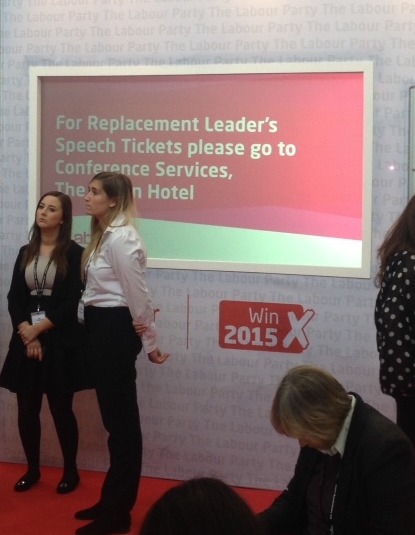
UNBOUND: Spotted at conference: Who is the mystery replacement leader?

23/09/2014, 11:45:27 AM

IMG_1479 (2)

We knew times were tough for Ed, but does the party machine know something we don’t? Just who is the replacement leader?


Facebook Twitter Digg Delicious StumbleUpon

UNCUT: What we need to hear from Ed

23/09/2014, 11:13:15 AM

by Kevin Meagher

Given the tumultuous events in Scotland, Ed Miliband can be forgiven if he’s already ripped-up several drafts of his leader’s speech as he still works out how to respond. But putting that to one side, what is today about? What do we need to hear from Ed and what should he be looking to get out of his annual address to his party?

Ed needs to galvanise the Labour tribe. After all, that is technically why we are all here this week. Yet there’s a flat feeling to this conference. While many express cautious optimism that Labour will win next May, the next conversation comes with predictions of electoral doom, as Lib Dem floaters return home and Cameron rallies. Ed needs to convey, if not vision, then optimism about next year and transmit a sense of confidence that his troops can buy into.

He needs to transcend the party and speak to the electorate at large. This is now the real purpose of a leader’s conference speech. For one day a year, the spotlight falls on the Labour leader, who is given an opportunity to try and set the political agenda, and, even more importantly, show us what kind of person he is. Dog breeders would call it temperament. And while you can train yourself to recite a speech without notes, (a skill that’s frankly lost on a television audience) being likeable and spontaneous is a tad more difficult. But that’s what most non-committed voters will be looking for. This conference, the last before the general election, is, essentially, a job interview for becoming prime minister. So no pressure then.

Show Labour gets the need for further devolution. Calling for a constitutional convention – hitherto Labour’s response to the Scottish devolution result and demands for similar moves for England – is all very well, but it lacks urgency. Ed needs to use his speech to set out the principles that will inform his approach in coming months. Positioning Labour against the ridiculous idea of an English parliament is a start, but Ed needs to go further today and set out the conceptual framework for how power is devolved in England. If he doesn’t, he risks letting Cameron frame the agenda in his conference speech. So is it regions, city regions, strengthened local government or something else?

Do something to address the issue around leadership and economic credibility. Although the party maintains a steady opinion poll lead, the deficits the party continues to run on leadership and economic credibility makes many nervous that the headline poll lead will hold water the closer we get to next May. Let’s be clear: this is a legacy that anyone leading the Labour party would face, but it is, ultimately, Ed Miliband’s problem to fix. And, to put it bluntly, nowhere near enough has been done over the last four years. No-one in their heart of hearts will truly believe the party is set to win next year until these gaps narrow. Read the rest of this entry »

Facebook Twitter Digg Delicious StumbleUpon