




UNCUT: Want Labour to be a ‘safe space for Jews’? Here are the three steps Labour must take

26/09/2021, 08:52:00 AM

by Emma Picken and Euan Philipps

This piece is part of a new book “Labour’s reset: the path back to power” which Uncut will be launching at Labour conference . The book looks at the barriers for voters in picking Labour, what the party can do in opposition to tackle these issues and the type of policy platform that would attract switchers to Labour at the election.

On October 29th, 2020, something took place that would have seemed inconceivable had it been 10 years earlier: the Equalities and Human Rights Commission (EHRC) found that the Labour Party had breached equalities law and had acted illegally in its treatment of Jews[1].

This outcome was in part due to the vicious culture that had been imported during the Corbyn years. More importantly, however, the party was already ripe for infestation with a culture that contained both antisemitic individuals and ideas. It had little or no defence against either.

The following piece will not rehash how appalling Jeremy Corbyn’s behaviour is or the depths of antisemitism  found within his fellow travellers. No one has plumbed these depths more than Labour Against Antisemitism  (LAAS), as our 20,000-page submission to the EHRC attests. Nor will we go over how Labour got itself into the position of being led by an antisemite; this has already been extensively and eloquently covered by David Hirsh in Contemporary Left Antisemitism , Dave Rich in The Left’s Jewish Problem, Alan Johnson and many others[2].

Rather, we will discuss the main areas Labour needs to address in the immediate present in order to make the party an environment where antisemitism  is no longer tolerated; how Labour can sincerely atone for the damage done to the Jewish community and its vocal allies; and how Labour can turn the ‘safe space for Jews’ soundbite into a truly secure environment for its Jewish members.

There are three elements that must all be put in place to finally rid the Labour Party of antisemitism .

The first is tackling antizionist antisemitism .

Following our extensive reporting of antisemitism , our observation in LAAS is that contemporary antisemitic discourse centres around those claiming only to be ‘antizionist’. However, antizionism is at the heart of the issue – and, in our experience, is without fail antisemitic. Thus, without tackling antizionist antisemitism , ‘tearing antisemitism  out by its roots’ is frankly doomed to failure. While internally within the Jewish community there will always be a small minority with antizionist views, the vast majority identify as Zionist, with 93% saying Israel plays a central part in their identity. Antizionist antisemitism  harms them deeply and multiple ways[3].

What must be done?

Firstly, the party must sever all ties with the Palestine Solidarity Campaign (PSC). It is astonishing that a group so evidently steeped in antisemitism  is welcome within any antiracist movement; all the more so that this group is afforded so much influence within Labour policy on Israel that two out of the three leadership candidates in the last leadership elections backed the PSC pledges[4]. One of the candidates, Lisa Nandy, is now shadow Foreign Secretary[5].

There is extensive evidence of the extreme antisemitism  within the PSC[6], which stands opposed to the International Holocaust Remembrance Alliance (IHRA) definition of antisemitism  that Labour has adopted in full.

The unions, too, have not been aligned to such overt racism since the London dockers famously came out in support of Enoch Powell. The affiliation to the PSC of every single large union within Labour must be ended without delay. It is deeply ironic that Frances O’Grady feels bound to discuss ways in which the unions need to face up to their racist past, while ignoring the flourishing racism of today[7].

Secondly, Labour must firmly close its doors to the Boycott, Divestment, Sanctions movement (BDS), whose banner of ‘social justice’ serves to disguise a darker aim: the eradication of Israel. BDS initiatives remove agency from Jewish business, students and academics in the diaspora. These have no impact on Israeli governmental policies, however they are a conduit for some of the most vicious antisemitic intimidation seen since the 1930s.

No right-minded Labour member would admit to supporting BDS if the above points were included in its discussion on racism, and especially not if the movement ever reached its goal – so why is this tolerated? Why is this antizionist antisemitism  treated differently to other kinds of racism? In our view, the party should not treat adherents to BDS any differently to any other racist.

What many miss is the fact that BDS is both bigoted and discriminatory. It holds Israel to standards not required by any other democratically elected sovereign state. It’s clarion call of ‘to the River and the sea’ is the call for the destruction of Israel – the claiming of the land between the Jordan River and the Mediterranean Sea; the state of Israel. In fact, the logo on posters and T-shirts for the BDS and it’s sister organisation, The Palestine solidarity committee, clearly shows the entirety of Israel as being claimed for a Palestinian state. No two state solution or shared ownership, just the eradication of Israel.  The Labour Party must find a better way to legitimately support the cause of the Palestinian people without calling for the destruction of Israel and the alienation of the majority of Anglo Jewry.

The second element that the Labour Party needs to deal with is the appearance of its MPs and their tacit endorsement of antisemitism  at Israel/Palestine demonstrations.

Read the rest of this entry »

Facebook Twitter Digg Delicious StumbleUpon

GRASSROOTS: Jack Lesgrin’s week: Time for pledges not pamphlets Keir

25/09/2021, 10:05:21 PM

by Jack Lesgrin

Time for pledges not pamphlets Keir

This week Labour leader Keir Starmer published a 14,000 word essay. My immediate thought was that this risks getting us into ‘longest suicide note in history’ territory (after the labour manifesto of 1983 was so described by a Gerald Kaufman). Maybe he should have spent a bit more time inspecting plans for internal party reform than writing this opus.

Do Sir K’s PR advisors not think through the optics of such news? Perhaps the strategy is to set expectations so low that a grateful public will be relieved when instead of having to read 14,000 words they hear a few soundbites on the news?

Or is it an authenticity strategy: it worked for Jeremy Corbyn after all. I recall much hyperbole from MPs I know, as well as normally sensible activists, coming back from Corbyn rallies satiated with the industrial strength Kool-Aid dispensed both by cults and political leaders who tell their supporters what they want to hear, no matter how magical.

But the essay story projects the kind of authenticity that reinforces negative stereotypes of scholarly intellectual debate among and for socialists.

If the rise of Mr B Johnson has taught us anything, it is that the next election will not be won or lost on the intellectual coherence of an exceedingly long Master’s thesis.

Perhaps one or two other lessons might be learnt, and rapidly, if we are to have any hope of winning the next election. The first is that people want to hear what labour will actually do about any given issue. Not why the Tories are wicked, but how Labour would do things better. It’s a simple concept that is often lost by oppositions.

Then they want to hear an optimistic vision, set out in a clearly understandable narrative that tells a credible story about why voting labour is better for them and for the whole country, underpinned with policies that validate this.

Read the rest of this entry »

Facebook Twitter Digg Delicious StumbleUpon

UNCUT: Labour is losing women. It could cost the party the next election. It doesn’t have to be this way

22/09/2021, 09:45:33 PM

by Nicole Lampert

This piece is part of a new book “Labour’s reset: the path back to power” which Uncut will be launching at Labour conference next week. The book looks at the barriers for voters in picking Labour, what the party can do in opposition to tackle these issues and the type of policy platform that would attract switchers to Labour at the election.

Labour is losing women. It is losing its female activists, its putative politicians, its core voters. And the trans debate could even see it lose the country at large. Again.

There’s a female MP, Rosie Duffield, who is too frightened to appear at Labour conference because so many trans rights activists – whipped up into a fury by people within the party – have threatened violence against her.

A long-awaited statement yesterday by Keir Starmer was the usual fence sitting – asserting the Party supports the Equality Act which legislates for single sex spaces but adding that trans people should mainly be allowed in them – while also reasserting plans for self-identification. They leadership must have hoped that this would dampen down the row but, in fact, it served to only add fuel to the fire. Did they learn nothing from the Brexit fudge which managed to infuriate both sides and lost them votes from Brexiters and Remainers?

Women’s rights are being removed all over the world; in the last few weeks we’ve seen it from America to Afghanistan. And that is why women will not take this lying down, even from a party that they have always supported.

Sara, whose parents and grandparents were Labour councillors, and has campaigned on doorsteps for the party since she was a child, calls it: ‘The toxic nail in the coffin of my support for Labour. I cannot support Labour because of this.’

Joan, who with her partner made up the only gay couple in her CLP, says: ‘When I asked for help from our Labour candidate in keeping hospital wards single sex, I was told that I was, ‘irrationally prejudiced against trans people.’ I’d rather spoil my ballot than vote for Labour.’

Nicola, a Labour veteran, is almost in tears when she tells me: ‘The Tories are not competent. They are pushing more people into poverty. But I can’t vote for a party that prioritises the interests – political, economic, social – of males over the reality of women’s experiences.’

While Sally, a trans woman, says the debate feels equally poisonous for the trans community. ‘Self ID is a long-term negative for trans people because the barrier to a protected characteristic is too low and Labour needs to recognise that,’ she says. ‘Look at things like Wi Spa in America [when a self-identifying trans woman with a history of sex offences exposed their penis in a room full of naked women and girls]. People are beginning to think we’re all perverts and someone needs to talk about this sensibly.’

I haven’t given any of them their real names because this is the most toxic row that Labour is involved in today. Women don’t feel just ignored but demonised. They are being pushed out of the party and, in the wider world, losing their jobs. A writer friend lost work solely because she followed a gender critical feminist on Twitter. Aside from a brave few, Labour MPs are terrified about speaking up, because they know trans rights activists will then demand they are sacked and the leadership will do nothing to stop the bullying. Even the trans people who speak up against the activism orthodoxy are labelled transphobes.

Read the rest of this entry »

Facebook Twitter Digg Delicious StumbleUpon

UNCUT: Revealed: New poll shows 1 in 4 non-Labour voters considering backing Starmer but they want a decisive break from the Corbyn era – 60% say expel Corbyn if he doesn’t apologise over anti-Semitism

19/09/2021, 09:24:00 PM

by Atul Hatwal

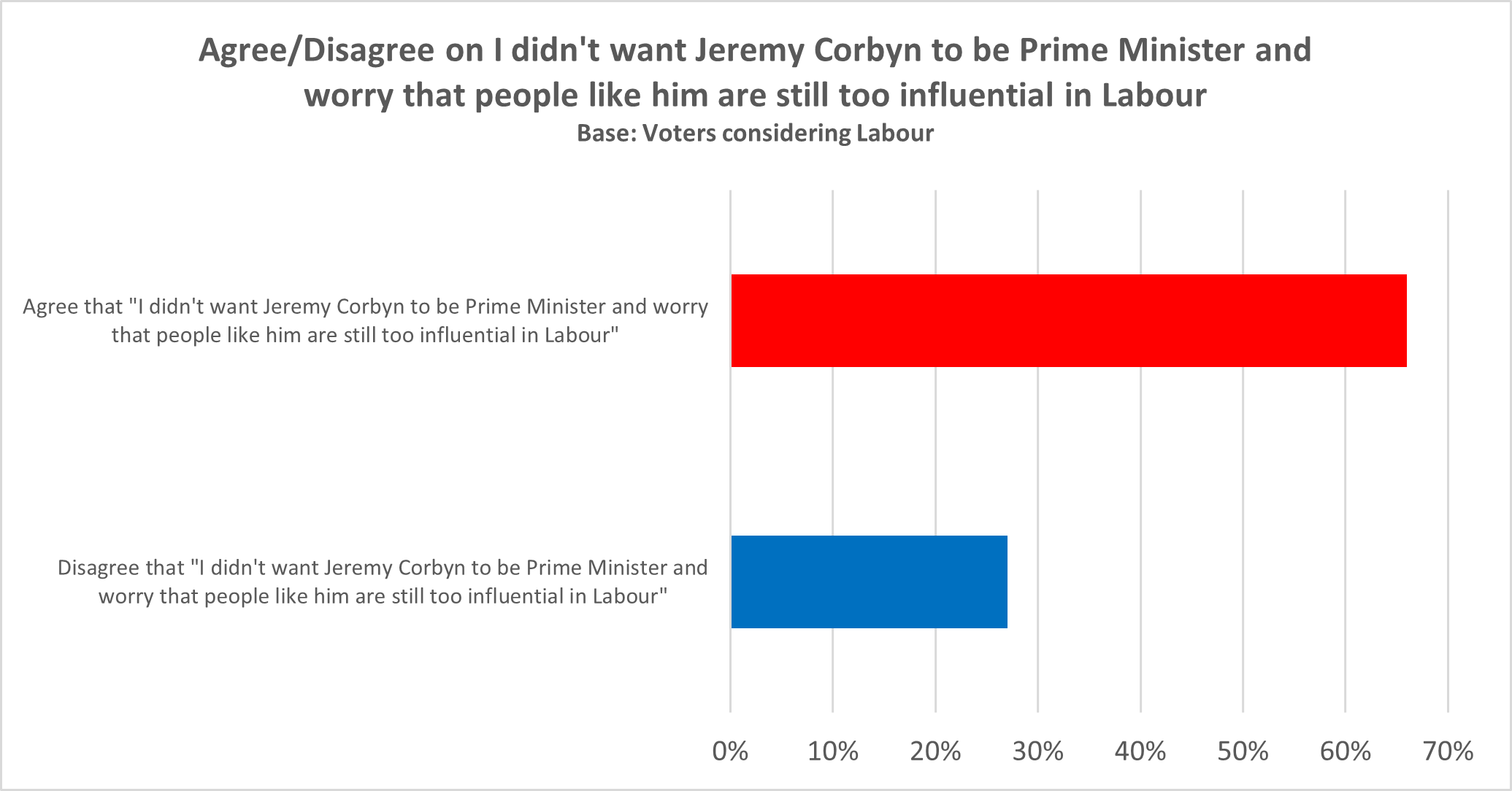
New research conducted for Labour Uncut by pollster Yonder (the new name for Populus) reveals that just over 1 in 4 non-Labour voters (26%) would consider voting Labour at the next election. But Jeremy Corbyn is still a huge negative with 66% of this group worried about the continued influence of Corbynites in Labour and 60% saying his expulsion from Labour, if he doesn’t apologise over anti-Semitism, would make them more likely to vote Labour.

The polling, conducted by Yonder between the 13th and 14th September with 2,010 respondents, revealed that 1 in 7 Conservative voters (14%), over half of Lib Dems (53%) and 1 in 4 SNP (26%) are considering voting Labour. Based on Labour’s current standing in the polls, attracting even half of those thinking about backing Keir Starmer and Labour would send the party into government with a vote share in the mid-forties.

However, Labour’s potential voters want a clear break from the Corbyn era.  A series of statements articulating potential reasons for not voting Labour, drawn from previous research, were put to this group and despite a clear appetite for policies such as higher spending on public services and a higher minimum wage, Jeremy Corbyn and his legacy remain toxic.

A net +39% agreed with the statement “I didn’t want Jeremy Corbyn to be Prime Minister and worry that people like him are still too influential in Labour”

Next week, at Labour conference Jeremy Corbyn will once again be in the spotlight and much of the debate about Labour will be defined through the prism of the former leader.

He’s currently suspended from the parliamentary party for saying that the extent of anti-Semitism in the party was “dramatically over-stated” following the publication of the EHRC report into Labour and anti-Semitism, but he had already been readmitted to the party at the point the report was published and so, as a party member not a Labour MP, will be speaking at various Labour conference fringe events. He’ll have a political and media retinue trailing along after him, distracting from the main conference, in the manner that Boris Johnson used to at Conservative conference in the early to mid-2010s.

Read the rest of this entry »

Facebook Twitter Digg Delicious StumbleUpon

UNCUT: This was a self-serving reshuffle designed only to level up Boris Johnson’s standing in the Tory party

16/09/2021, 10:32:38 PM

by David Talbot

For someone who supposedly dislikes upsetting people, the Prime Minister has a unique way of showing it. During his twenty six months in power, Johnson has sacked twenty seven Cabinet Ministers – an attrition rate worse than Donald Trump’s tumultuous administration.

The long-mooted reshuffle was previewed as “uniting and levelling up the whole country”. The reshuffle confirmed, though, if nothing else, that the only levelling up the Prime Minister is preoccupied with is with himself. Johnson has never sought to assemble the strongest possible Cabinet to the benefit of the country. He is perpetually afraid of being outshone, which has directly led to the lack of clarity on the central purpose of his government. Despite most of the media gushing that the Prime Minister was ‘ruthless’ he has still surrounded himself with Brexit and personal loyalists.

The Prime Minister fell back on his oldest tried and tested trick; to please the party faithful. Nadine Dorries may well have been an effective and diligent Health Minister during the pandemic, but her views on cultural issues are well-known and demonstrably offensive to many. Indeed, if her promotion was based on the success of her book sales, as the Defence Secretary has suggested, then – to use a Johnsonian turn of phrase – one can object purely on literary grounds alone.

This is a government which, having taken credit for the successful vaccination rollout that the NHS devised and then implemented, is bereft of ideas and purpose. If, as reports suggest, the Prime Minister truly is intent on fighting the next general election on Brexit – and supposedly how the dastardly EU would scupper ‘freeports’, for instance – then this repeat will be much like the digital ABBA concerts for once popular concepts which should have long since been retired. Leave won the argument, many years ago, it needs to own it, and start delivering on its promise to voters which either backed it in 2016 or wanted rid of the ongoing trauma of it in 2019.

Read the rest of this entry »

Facebook Twitter Digg Delicious StumbleUpon

GRASSROOTS: Jack Lesgrin’s week: Government U-turns on Triple Lock and National Insurance, but still the young lose out

12/09/2021, 11:13:00 PM

by Jack Lesgrin

Double U-turn on Triple Lock and NI, but not on preferencing old over young 

Last week saw two U-turns by the government. First, they temporarily suspended the Triple Lock for pensioners because of an unusual and statistically anomalous rapid rise in earnings caused by the pandemic.

The second U-turn saw Johnson finally putting meat on the bones of his famous pledge, delivered in his first ever speech as PM in Downing Street in July 2019, to “fix the crisis in social care…with a clear plan we have prepared”. Tuesday’s mini-budget announced a National Insurance-funded Health and Social Care Levy. Note the sentence that preceded this: “My job is to protect you or your parents or grandparents from the fear of having to sell your home to pay for the costs of care.”

The government made the levy apply to some share income and on state pensioners’ income if they continued to work, in an attempt to mitigate criticism that using the National Insurance mechanism makes younger people, by definition of working age, subsidise benefits enjoyed by the elderly.

Yet this was only a fig-leaf, covering the sensitive nether regions of our system of taxation: namely that we have for too long preferred to tax income from work over other forms of income derived from other forms of wealth. Labour’s Shadow Chancellor, the excellent Rachel Reeves, eloquently put it thus: “Which types of income will be paying no additional tax after today? They include those who get their income from financial assets, stocks and shares, sales of property, pension income, annuity income, interest income, property rental income and inheritance income… Some 95% of the revenue the government plan to raise from this tax bombshell comes from employment. What a contrast.”

Read the rest of this entry »

Facebook Twitter Digg Delicious StumbleUpon

UNCUT: The west is dead, long live the west!

23/08/2021, 10:32:16 PM

by Jonathan Todd

“The ground under the German town of Erftstadt is torn apart like tissue paper by flood waters; Lytton in British Columbia is burned from the map just a day after setting a freakishly high temperature record; cars float like dead fish through the streets-turned-canals in the Chinese city of Zhengzhou.

“The most terrible thing,” according to a Leader in The Economist a month ago, “about the spectacular scenes of destruction that have played out around the world over the past weeks is that there is no safe place from which to observe them.”

In the intervening period, safety has deteriorated, for different reasons, in Afghanistan. The US could have acted to prevent this. Other NATO members could have better supported the US toward this end.

But even if Taliban recapture of the country had been prevented (or, at least, delayed), we would still be awaiting a durable settlement between Afghanistan’s warring factions. In the world we are in, we hope for the same.

In both scenarios, we wait for a reconciliation that has been illusive for decades. One comes with more deaths for NATO soldiers. The other with more refugees for NATO countries. There are no perfect options.

We arrived with the option that we did because the US, the indispensable nation, decided that it is dispensable. Or, more precisely, American interests are less dispensable than non-American interests.

Read the rest of this entry »

Facebook Twitter Digg Delicious StumbleUpon

GRASSROOTS: Jack Lesgrin’s week: Sleazy does it

12/08/2021, 10:30:49 AM

by Jack Lesgrin

Sleazy does it

Last week, domestic politics was somewhat dominated by allegations that, as one paper put it, “the chairman of the Conservative Party [Ben Elliott, nephew of Prince Charles] is using his business partner in a secretive company to help manage party donors and arrange access to Boris Jonson.” Journalists had not previously reported the existence of this company. Other companies he is apparently associated with, such as public affairs consultancy Hawthorn Advisers and Quintessentially, a luxury concierge service. A hugely murky picture is painted. It ticks all the mental boxes of conspiratorial journalists and opposition party activists. Lobbying company: tick. Company servicing the high-end whims of UHNWIs: tick. Connections to the Royal Family: tick. Political donations: tick. Access to government ministers and the PM: tick. All sounds awful, no?

Here’s a thought experiment. Imagine a range of political pantomime villains guaranteed to tweak the anger sensors of devout Tories (instead of devout anti-Tories, as above). Let’s tell the story again. Mr A, a general secretary of a large and influential trade union, has set up a secretive sub-committee (because it would have to be a sub-committee, wouldn’t it!) of fellow trade unionists. The committee’s purpose seems to be to coordinate fundraising for local Constituency Labour Parties. Since the story broke, some right-wing journalists have alleged that this influence enabled the committee to pressurise local CLPs to select union-friendly parliamentary candidates and CLP chairs. Although this has been denied, the close former union colleague of Mr A, Mr B, has been selected for a safe Labour seat. The sub-committee’s existence and terms were not made public and the members have said that there was no requirement to do so and that nothing they did was illegal or immoral. Sunday’s papers revealed that the sub-committee had also arranged private meetings with the PM and Business Secretary in the run up to Labour Party conference and a contentious new bill on employment rights.

Tories would perhaps find this offensive. But things like it occur all the time. None are illegal. Many don’t particularly like them, but until our system of political funding is reformed and, more broadly, our party system is opened up, through genuine proportional representation, the major parties will continue to have their pantomime villains of access and funding. The noises off are off target.

Read the rest of this entry »

Facebook Twitter Digg Delicious StumbleUpon

UNCUT: Why is Keir Starmer playing the Orange card?

02/08/2021, 10:48:44 PM

by Kevin Meagher

You might have missed it because it didn’t really register in the British media (quelle surprise), but Keir Starmer’s trip to Belfast last month caused something of a stir.

While Starmer used the trip to meet victims of the Troubles and to voice his support for the controversial Northern Ireland Protocol – chiding Boris Johnson for not being ‘straight’ with voters in the process – he also dismissed any prospect of Irish unity and indicated that he strongly backs Northern Ireland remaining part of the United Kingdom.

In a tough interview with the BBC’s new Northern Ireland political editor, Enda McLafferty, the Labour leader was quizzed about how support for holding a border poll – the colloquial term for a referendum in Irish unification – might be measured, perhaps by the performance of pro or anti unity parties in an assembly election?

Starmer replied: ‘I don’t think that’s a particularly accurate way of measuring it.’

Really? Surely, it’s the most accurate way of accessing whether there is support for a change in Northern Ireland’s constitutional position? Each of the party’s views on the matter are well-established, so it offers a pretty good measure of the state of the debate. Notwithstanding the fact we have an assembly election next May.

McLafferty pressed Starmer for further clarification. ‘I think there have to be conditions,’ before any vote could be held, he said. ‘I think there have to be lots of discussions. Look, I don’t think [a border poll] is in sight and this is a very hypothetical discussion.’

Asked whether he would campaign with unionists in the event of a vote, Starmer replied: ‘I personally, as leader of the Labour Party, believe in the United Kingdom, strongly, and want to make the case for the United Kingdom, strongly, and will be doing that.’

Read the rest of this entry »

Facebook Twitter Digg Delicious StumbleUpon

GRASSROOTS: Jack Lesgrin’s week: Is it time for UN climate-keepers for Brazil’s rainforest?

01/08/2021, 12:44:04 AM

by Jack Lesgrin

Is it time for UN climate-keepers for Brazil’s rainforest?

Thursday before last, we learnt that the appalling, man-made destruction of the Amazon rainforest in Brazil has meant that this, the world’s largest carbon sink, may for the first time be emitting more CO2 than it consumes.

Here’s a thought experiment. Most people (although not many of the hard left) think that state sovereignty should be overruled when a genocide is happening, to protect victims, prevent broader instability and deter future violators by punishing those who commit crimes against humanity. What if a state, through act or omission, was causing environmental and ecological damage that will affect the long-term health of not only the citizens of their own territory but the whole world? What if this damage caused not merely ill-health, but the long-term viability of life as we know across vast swathes of the world?

We might be reaching a time when the egregious actions in the Amazon, of far-right populist, President Jair Bolsonaro, may require the international community to take action that prevents the destruction of what is a global environmental asset, as well as a national territorial possession. Of course, the first steps would need to be diplomatic and seek to induce better behaviour. Next might come sanctions of some kind. But countless cases in recent geopolitics show that diplomacy, international sanctions and strong words often have no effect. The time might soon come when the international community will have to be far more robust with states that cause irreparable damage to our environment.

Fortunately, the UN Environment Programme is doing interesting work in this area and in June, an international panel of legal experts defined and proposed a new category of international crime – ‘ecocide’ that if taken up by the Parties to the International Criminal Court, would become the fifth category of offences prosecuted by the court alongside war crimes and so-on. Increasingly, legal cases are being taken by campaigners and individuals to hold companies to account for the environmental damage they cause. But as countless victims of oppression or genocide know only too well, international law normally only has effect after massacres have occurred, to prosecute only a tiny minority of offenders, decades later. In other words: ‘too late’. As recent news about how the UK climate has already undergone damaging change shows, we cannot wait before acting. What if the whole of the Amazon was destroyed? Would anti-interventionists cling to the notion that ‘sanctions and diplomacy works’ or that ‘state sovereignty is everything’ or that ‘the UN Security Council didn’t pass a resolution, so your intervention was illegal’? Or might we need a UN climate-keeping force to protect the rainforests?

Premium presenters promoted to plum positions preventing progression

I’ve been on holiday so have been listening to even more Radio 4 than normal, hearing its talented journalists, producers and editors, creating content that by itself is more than worth the licence fee. You can deduce that I’m a fan. So what I’m about to say is in no way a criticism of the individual presenters or journalists, all of whom are brilliant and I’m sure decent people who try to help out their colleagues.

I have a hunch that the BBC management, like management everywhere, decides who are the golden boys/girls and gives them the most challenging and often rewarding roles to the exclusion of others. A couple of years ago, in a single weekend, Andrew Marr presented a TV political documentary on Saturday, the Andrew Marr Show on Sunday, followed by Start The Week on Radio 4 on Monday. I thought this must be an aberration, for surely it would be more equitable to share these prize positions around the BBC stock.

Read the rest of this entry »

Facebook Twitter Digg Delicious StumbleUpon