




UNCUT: At least Ukip’s EU and immigration policies are consistent. John Denham can’t even manage that.

03/06/2014, 01:47:18 PM

by Atul Hatwal

John Denham’s article about immigration on Labour List yesterday was a disgrace. Not because of his anti-immigration stance – it’s perfectly possible to disagree with a view without believing it to be disgraceful – but because of the incoherent politics at the heart of his argument.

Within the Labour party, two distinct groups have now emerged on the anti-immigration side of the debate.

One is consistent and has a coherent case, albeit with potentially major deleterious economic consequences. The other is muddled and guarantees a disastrous electoral denouement for Labour. John Denham’s post was a case study in the latter.

The starting point for the first group is scepticism about the EU. There is a legitimate case to be argued for applying the same entry rules to all migrants, whether from the EU or outside and that if the EU does not change on freedom of movement, Britain will withdraw.

Central to this argument is an acceptance that a British exit from the EU is likely.

When Angela Merkel visited Britain in February she made the German position on reform of freedom of movement abundantly clear, “freedom of movement is intended to allow people to work in different countries, not immigration into social systems.”

There might be some tightening of access to benefits and public services for EU migrants but no fundamental change in freedom of movement across the EU.

Given the government’s own figures indicate that only 4 in every 100 EU migrants claim Job Seekers Allowance, it’s a fair assumption that benefit restrictions will have virtually zero impact on the net flow of EU migrants into Britain.

It’s evident from what MPs like Frank Field, Kate Hoey and John Mann have said in the past that they are prepared for a British withdrawal from the EU and there is a small but growing group within the PLP who take this view.

This is broadly also the official Ukip position. Stripped of the inflammatory and racist language sometimes used by Ukip representatives, it has the merit, at least, of being internally consistent and demonstrates clearly how EU migration would be reduced.

Read the rest of this entry »

Facebook Twitter Digg Delicious StumbleUpon

UNCUT: Progress Annual Conference 2014: Labour slowly faces up to reality

02/06/2014, 09:26:36 AM

by Jonathan Todd

The Progress annual conference 2014 was a conversation in slow motion. The political context means there is little point in discussing much besides three questions: Is Labour on track to win next year? If not, why not? Given this, what strategy should Labour adopt?

Peter Kellner drew gasps in answering the first of these questions – even though he said little that he hasn’t elsewhere. Only fleetingly did we get on to two and three. However, being queasy about engaging with reality isn’t an anecdote to Labour’s building fatalism.

My view is that Labour is not doing as well as we might because we haven’t done enough in the past four years to respond to the messages of the 2010 general election. We now have less than 12 months till the next election. This implies a number of approaches to the period between now and then.

Keep going as we are – putting most of our eggs in the cost of living basket. I wrote for Progress magazine at the end of last year about my concern that this campaigning would be overtaken by events in advance of May 2015. I’m also not convinced that such focus on the cost of living does enough to show that Labour can rise to the national challenges that the governing parties are failing.

Another approach would be to attempt to do in one year what we might have done in five. 2010 confirmed that public trust in Labour as responsible custodians of public money has corroded, which undermines Labour’s capacity to win on other issues. In the book that we published for Labour party conference last year, Uncut set out a strategy for recovering this trust and building from this recovery to a credible and compelling Labour alternative.

Read the rest of this entry »

Facebook Twitter Digg Delicious StumbleUpon

GRASSROOTS: Labour should use the language of social justice and ambition to connect with voters

30/05/2014, 12:51:29 PM

by Glenn Edwards

It’s less than a year till the general election and there’s been a lot of talk about Labour alienating itself from business interests and lurching too far to the left. But even if Labour hasn’t been effective in courting corporate leaders this doesn’t mean that it is anti-ambition. Current policies actually seem to have a lot in common with Tony Blair’s once cherished idea of combining social justice with ambition, even if they differ from the ‘third way’ in practice. We just need to start thinking about ambition in a much broader light and therein could lie a key part of the Party’s message over the next year.

Labour is pursuing a political approach that views everyone as potential success stories and not just winners or losers, as people pursuing their own human development and not just static stereotypes and as having a stake in this economy rather than just being compensated for their loss. We need a country that doesn’t wield clout in the world simply through a privileged elite in London but on the backs of a vast army of clever and confident people. Labour’s aim to redirect the economy towards high-skill jobs and create a world-class workforce is a policy example par excellence.

There is a feeling that many politicians, particularly on the right, are pandering to the short term interests of a wealthy few at the expense of the long term prosperity of the nation. In no clearer way is this expressed than the political divide over the treatment of the banks. Labour’s policy of taxing banker’s bonuses in order to create jobs for the long term unemployed isn’t a tax on ambition, it’s a tax on greed. It’s a sensible way of bringing back confidence and self esteem to those who lost it so long ago whilst simultaneously helping expand business.

Read the rest of this entry »

Facebook Twitter Digg Delicious StumbleUpon

UNCUT: Shunning the EU will damage the prospects for foreign investment in Britain

29/05/2014, 06:39:48 PM

by Callum Anderson

With the dust just beginning to settle on the European election, it has become clear that only Labour can effectively present the case for the UKs EU membership in the run up to the 2015 General Election and beyond.

For those of us, who believe that Britain can only be prosperous by engaging with our EU partners and not isolating ourselves, this only highlights what we have known for months. That is, those of us who are in the incamp – regardless of party affiliation, must begin to illustrate the benefits of Britains EU  membership.

As you may have noticed, I have tried to do my part, and, this time round, lets look at foreign investment.

In 2011, the UK had the second largest stock of inward foreign direct investment (FDI) – attracting $1.2 trillion of investment – in the world, behind only the United States, was recognised the most attractive location for investment in the EU in the 2013 Ernst and Young European Attractiveness Survey. For example, the UK has been successful in attracting Chinese investment; from the EU27, only France attracted more Chinese FDI between 2003 and 2011.

Whats more, over 1,500 investment projects were set up by foreign businesses in Britain during 2012, creating and protecting 170,000 jobs. Investors from America, France, Germany and India saw Britain as a stable and exciting place to invest. For instance, the Tata Group, which owns Jaguar Land Rover, created thousands of jobs in Britain last year, whilst a Malaysia-led consortium led the £8 billion redevelopment of Battersea Power Station, which is expected to provide 20,000 construction jobs and 13,000 permanent jobs.

Similarly, the UKhas been the second most attractive place in the world (behind the United States for FDI in the aerospace sector, with EADS, Bombardier and General Electric heavily investing in Britain, as well as Europes top location for investment in pharmaceutical and biotechnology research and development (R&D), which is the largest contributor to R&D in both the UK1000 and the G1000 in 2008.

So, how would a so-called Brexitaffect investment from our European neighbours. Would it, as many Eurosceptics claim, change nothing? After all, Britain has so many other advantages, both economic and social, that it wouldnt be in the interest of no one to cease investing in the UK. Its difficult
Read the rest of this entry »

Facebook Twitter Digg Delicious StumbleUpon

UNCUT: The elections weren’t an earthquake but a confirmation of what we already knew

29/05/2014, 08:00:23 AM

by Jonathan Todd

It would, obviously, be wrong to wholly attribute to Nigel Farage responsibility for Nick Clegg’s political predicament. They are largely trading in different parts of the political market and the Oakeshott disaster is a wholly home-grown crisis for the Liberal Democrats.

Instead, Clegg’s low share price derives from decisions – in particular, betraying the platform on which he stood in 2010 – taken long before his debates with Farage.

Clegg isn’t fighting for his political life because of Farage. The blood on Farage’s hands is that of Nick Griffin’s. The real UKIP earthquake didn’t happen in Westminster but beneath the BNP, revealing part of UKIP’s appeal.

As well as taking support from the BNP, half of UKIP voters in the European elections voted Tory in the last general election. It would be a potentially decisive boost to David Cameron’s hopes of remaining in Downing Street to get these voters back. Hoping that this doesn’t happen, and that Lib Dem recovery is also avoided, is perilous for Labour.

There are other factors beyond Labour’s control that help Ed Miliband toward Number 10, such as the vagaries of our constituency boundaries and Cameron’s incomplete Tory decontamination project, which means that mistrust of his party remains more pervasive than it would otherwise be. Rather than speculate as to how low a ceiling this places on Tory support, and whether it is lowest among ethnic minorities, northerners or women, Labour should be seeking to complete the decontamination project that the last general election confirmed we require.

The trouble is that this project has barely begun. Miliband launched his bid for the party leadership talking about immigration. But it’s not clear that Labour are now any more convincing on this contentious topic than when we were ejected from office. Even more damagingly, we also left office with trust corroded in us as responsible custodian’s of public money. In austere times, we seem over keen on spending other people’s money, whether that of taxpayers or private businesses, and disinclined to make savings. While Miliband has spoken more frequently about welfare than fiscal discipline, this is another big negative exposed in 2010 that we’ve failed to recover.

Read the rest of this entry »

Facebook Twitter Digg Delicious StumbleUpon

UNCUT: In Croydon, we beat the Tories AND Ukip. Here’s how

28/05/2014, 01:33:46 PM

by Sarah Jones 

Last week, hard work and better tactics led the Labour party to election victory in Croydon.  And we can do the same again in 2015.

The Conservative campaign in Croydon was flawed for three reasons.

First, they had no message – treating the electorate with so little respect they didn’t even produce a manifesto.  Their focus instead was to run a negative and personal campaign, falsely claiming Labour would put up council tax by 27%. The voters didn’t buy it.

Second, they didn’t listen to local people.  We had talked to people across Croydon who had told us their priorities were cleaning up Croydon, tackling crime, and building more schools.  If the Conservatives had had those conversations, maybe they would have known what people’s priorities were. Instead they had nothing to say.

Finally, their tactics were all wrong.  They focused their attentions on a Labour ward, where they made small but not significant gains. They missed the real battle ground completely, despite us tweeting where we were there every day.  We were able to mobilise more people to get out and vote.  We ran a better campaign.

Those are the reasons why they lost. Looking at the Tory response, I think there’s a danger for them that they will keep on losing.

They will keep on losing if they convince themselves it is all down to UKIP. Yes UKIP was absolutely a factor, but it’s a worry for all the main parties.  Labour lost votes to UKIP as well.

On the doorstep, people say they are voting UKIP for two reasons.  First, and I get this more than anything else, because they are fed up with all the political parties after the expenses scandal and promises broken.  Second, it’s all about immigration.

Read the rest of this entry »

Facebook Twitter Digg Delicious StumbleUpon

UNCUT: Europe has seen gains for the radical right, yes, but not for the simplistic reasons we think

28/05/2014, 09:10:32 AM

by Rob Marchant

“Earthquake”, screamed the headlines of even reputable news outlets on Monday. Witnessing them, it seems as if a large chunk of the Europe’s 400-odd million voters had got up one morning, and said to themselves in unison, “instead of supporting the mainstream parties I’ve voted for all my life, you know what, I now really like all the policies of the radical right. What the hell.”

Indeed, it makes scant sense, if you choose to look at it as part of the normal ebb and flow of left-right politics. Yes, we haven’t had quite enough of austerity yet, so let’s move a bit further to the right, shall we? I don’t think that harsh medicine is really tough enough. Said no-one at all.

No, to understand it all, we must dig a little deeper. There was a rather good cartoon doing the rounds yesterday which explained the phenomenon in Europe’s three largest states: Hollande and Cameron were shown being eaten whole by large dogs, called “Front National” and “UKIP”. Angela Merkel was shown with a little dog called “NPD” (the German far right), snapping ineffectually at her ankles.

The comparison is accurate: for different reasons, governments in France and Britain have been beset by effective attacks from their right flanks, while Germany has not. The picture is, in fact, much more mixed than the headlines might suggest.

Hollande has been, sadly for us on the left, a pretty much unmitigated disaster as president. Almost as soon as they elected him, the French public regretted it. He promised things he was patently unable to deliver, and now the electorate are punishing him by voting Front National.

Read the rest of this entry »

Facebook Twitter Digg Delicious StumbleUpon

UNCUT: The real lesson from the Euro-campaign is that taking on Ukip works

27/05/2014, 12:11:10 PM

by Atul Hatwal

Take a step back. From the Farage-mania, the pre-written headlines about Ukip surges and growing hysteria that is enveloping the main parties. Take a step back and look at the evidence. Of what actually happened during the European election campaign.

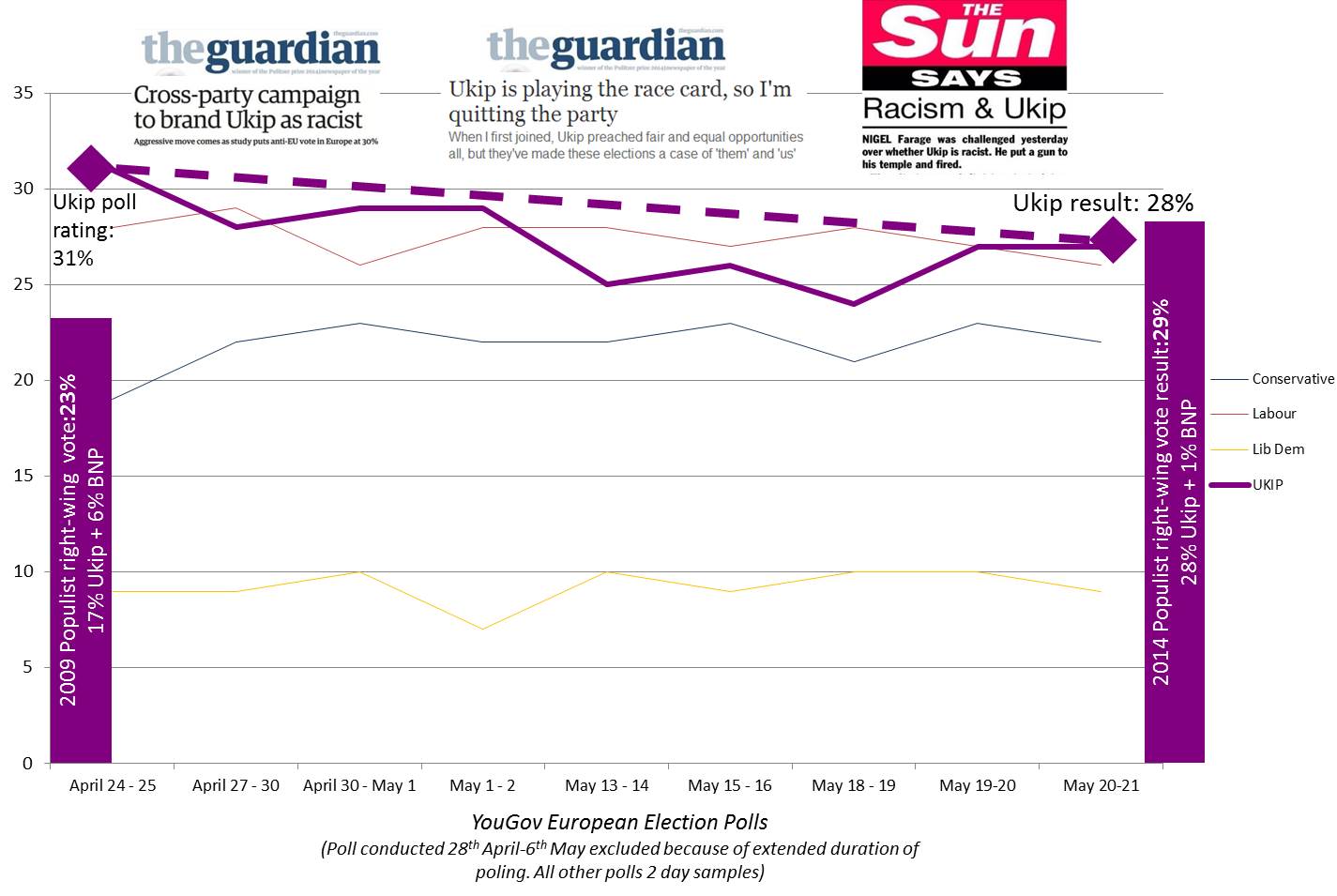
Ukip started this contest with a floor for their support of 23%. This was the total vote for anti-EU, populist parties of the fringe right at the last European election in 2009– 17% for Ukip and 6% for the BNP. Given the collapse of the BNP, Ukip were the sole heir for this populist right constituency.

By the end of April this year, Ukip’s momentum had carried them from their base of 23% to 31% according to YouGov. The highest they had ever registered in a European election poll with that pollster.

Up to this point, the direction of travel for Ukip’s poll European election rating had only been one way – up. There genuinely did seem to be a major electoral breakthrough in prospect.

But then something happened. The trend-line changed direction.

Euro elex pic

Ukip’s poll slide began when Farage’s comments about Romanians were first called out as racism. There was a lot of controversy at the time and a debate raged on the progressive side of the argument as to whether Ukip’s campaign should have been branded racist.

Setting aside the slightly ludicrous contention that racism should be allowed to simply pass without comment, the debate over whether confronting Ukip’s racism was electorally the right strategy can now be conclusively resolved.

Read the rest of this entry »

Facebook Twitter Digg Delicious StumbleUpon

UNCUT: The story from the local elections isn’t that Ukip is popular. It’s that Labour is not.

23/05/2014, 11:11:18 AM

by Atul Hatwal

Last night Labour was busily managing expectations that 150 gains in the local elections would have constituted a good result. Naturally, the final haul is likely to significantly exceed that number, but it is quite extraordinary that a total as low as 150 gains was even vaguely plausible.

The last time most of these council seats were contested was on the same day as the general election, when Labour slumped to its second worst post-war result.

Inevitably the focus for much of the media has been Ukip but the obsession with Farage and his out-sized personality misses the most salient political point: Ukip only exist because Labour is not the vehicle for popular protest.

When Labour previously made the transition from opposition to government, it brought together a voter coalition that extended from the left all the way into parts of the centre right. The breadth of this coalition and its sheer reach wasn’t based on ideology or policy but emotion.

The feeling that voters who may not traditionally have been Labour supporters, could safely lend the party their votes, to teach the Tories a lesson. That even if they disagreed with some aspects of policy, they could confidently project their personal hopes and aspirations onto the party’s leaders and supporting Labour meant backing the winner.

The stardust of success is beguiling. It creates an aura of optimism that lowers voter reservations attracts support. Everyone loves a winner.

But this stardust is missing from today’s Labour party. And in the absence of a confident and successful opposition to challenge a tired and uninspiring government, fringe populism flourishes.

Read the rest of this entry »

Facebook Twitter Digg Delicious StumbleUpon

INSIDE: Unite-PCS merger in trouble at PCS conference

21/05/2014, 12:32:39 PM

It’s been a busy morning in Brighton, with a debate taking place that will have major implications for the future of the Labour party. The non-party affiliated civil service union, PCS, is having its annual conference and top of the bill for discussion has been the impending merger with Unite.

The PCS NEC proposed a motion that would have allowed them to continue negotiations with Unite, without conditions. The pace of discussions has accelerated in recent months with the merger process now due to complete in January 2015.

However, this timeline may now be in doubt as PCS members rejected their leaders’ motion by a significant majority – 109,326 t0 73,212. A subsequent motion allowing the NEC to continue negotiations subject to minimum conditions did pass on a hand vote, but the warning signal from the PCS membership was very clear: they still prize their independence.

Although PCS has a substantial pensions deficit, its immediate solvency isn’t threatened and questions have been raised by many members as to the benefits of subsuming their union into Unite. The debate in the hall was particularly characterised by hostility to joining a Labour affiliated union with speakers citing the level of civil service cuts implemented by the last Labour government.

Notably, one of the conditions stipulated for future PCS-Unite merger talks is that there would need to be an independent political fund.

PCS members’ suspicion of Labour will heap further pressure on Unite, in addition to its own internal rumblings, to revisit its relationship with Labour.

Recently, Len McCluskey envisaged a scenario where Unite could disaffiliate from the party if Labour lost the next general election. Given the recent polls, and the views of the PCS rank and file, Unite’s long term relationship with the Labour party is now looking increasingly tenuous.

Facebook Twitter Digg Delicious StumbleUpon