




INSIDE: Is the Labour leader’s office spinning for Nigel Farage?

21/05/2014, 09:19:01 AM

A strange story in the Guardian this morning: “Labour and Conservative attacks on Ukip backfire,” booms the headline. Mention is made in the first line of Labour and Conservative polling that shows “attacks claiming  Nigel Farage is a racist have backfired.”  The piece is neatly set up. But then something strange happens.

Where normally there would be evidence, some figures from the aforementioned polling, maybe some quotes from a focus group, there is nothing. Just a lacuna at the heart of the story. The only hard numbers referenced in the piece are from the published polls, which tell quite a different story. One where Ukip’s ratings have clearly slid backwards over the past fortnight.

So how to explain such a story? Certainly, the way its written would seem to treat Joseph Pulitzer’s three rules of journalism – accuracy, accuracy, accuracy – as merely the vaguest of guidelines.

But there’s a clue. A big fat fingerprint. It’s a quote from the ubiquitous “source,” which pops up in the third paragraph: “Calling people names does not work. It confirms the old politics.”

Given the story refers to private Labour and Conservative polling, it’s clear the quote is from someone in one of the two main parties.

And in the absence of any actual evidence to stand up the assertion in the headline, the person giving the quote would need to carry some political heft. No major news outlet could run such a big story, without any facts, on the word of a normal MP or adviser. This would have to come from the top.

Which prompts the obvious question, cui bono: Number 10 or Ed Miliband’s office? In whose interest is a piece saying that attacking Nigel Farage as a racist doesn’t work? And who would frame it as confirming, “the old politics.”

The culprit becomes clearer.

Read the rest of this entry »

Facebook Twitter Digg Delicious StumbleUpon

UNCUT: Well done Yvette Cooper. Well done David Lammy. Shame on you Ed Miliband

19/05/2014, 02:32:47 PM

by Atul Hatwal

Another day, another shambolic intervention from Labour’s leader. This time it was about Nigel Farage and racism.

When asked the inevitable question on the Today programme, Ed Miliband said,

“I believe what Nigel Farage said a couple of days ago was deeply offensive. I said it was a ‘racial slur’. I think, though, our politics is disagreeable enough without political leaders saying about other political leaders ‘They’re a racist’.”

It’s excruciating. Ed Miliband might have been dragged kicking and screaming to acknowledge that Farage’s comments were a “racial slur,” but his refusal to follow through on his own logic and say that Farage was being racist is ludicrous.

The implication of Ed Miliband’s interview is that Nigel Farage can say whatever he likes, no matter how prejudiced or bigoted, and it still won’t be enough for the Labour leader to call him a racist.

It’s almost as if the Labour leader finds the act of calling someone a racist more disagreeable than the racism itself.

Contrast this with two interventions this lunchtime.

First, David Lammy on the Daily Politics. Same question, different answer.

“What Nigel Farage said over the weekend was racist. So I’m clear, he’s a racist.”

And then there was Yvette Cooper on ITV News,

It’s not racist to be worried about immigration or to want stronger controls, but it is racist to some how stir up fears about Romanians living next door. So Ukip should say they were wrong on that.”

Both Yvette Cooper and David Lammy are absolutely clear on condemning Nigel Farage’s racism. No caveats, attempts to soften the criticism or shy away from the ‘R’ word.

On the central issue in the European election campaign, Ukip’s racism, the Labour leader is now hopelessly isolated. Senior backbenchers like David Lammy, and senior frontbenchers like Yvette Cooper are both taking a very different line from him. His authority and judgement are in question on this, and a raft of other issues, as never before.

If Ukip beat Labour on Thursday in the European election, expect much of the dissent currently rumbling just beneath the surface across both the right and left of the PLP, to explode into public view.

Atul Hatwal is editor of Uncut

Facebook Twitter Digg Delicious StumbleUpon

INSIDE: David Axelrod is Douglas Alexander’s “sock puppet consultant”

16/05/2014, 06:56:40 PM

No, it’s not a term of abuse, well not quite. Rather, it’s a description of David Axelrod’s role according to Westminster murmurings that have reached Uncut’s ears.

For all the fanboy gushing in Labour circles at the coup of hiring Axelrod (although given Axelrod’s core business is as a consultant for hire, Uncut wonders whether it’s quite such an achievement; will the party next be trumpeting how Ed Miliband went to Kwik Fit and successfully secured the services of a mechanic?) the motivation for handing over six figures to David Axelrod seems to have less to do with his counsel and more with the divisions at the top of the party.

The split between Douglas Alexander and Spencer Livermore on one side and the shadow chancellor’s team on the other, is well documented. That Ed Balls didn’t even receive a sign-off on last week’s much derided VAT poster, and the alacrity with which his team were keen to let the world know this fact, speaks volumes for the dysfunction in Labour’s campaign machine.

While Douglas Alexander nominally has the lead on campaign decisions, the political heft of the shadow chancellor means that it’s difficult for Alexander to blithely over-rule Balls.

This is where David Axelrod comes in.

He has been positioned as the swing voter. Prior to each key decision, Axelrod will be consulted, briefed and guided, by, yes, you guessed it, Douglas Alexander. And when the time comes to decide in the meeting, Axelrod will cast his vote with Douglas Alexander.

Axelrod’s American stardust and substantial remuneration mean it’s difficult for the shadow chancellor to simply ignore him. After all, given the party is paying so much money for one person’s advice, there would have to be an incredibly good reason to reject it.

This approach, of hiring a high end consultant to validate existing plans and insulate the internal decision-maker from criticism, is common-place in the public sector. These hires have even got a generic name: “sock puppet consultants.” Now the practice seems to have been imported into the Labour party.

Read the rest of this entry »

Facebook Twitter Digg Delicious StumbleUpon

UNCUT: Labour history uncut: The unions purge the left

15/05/2014, 06:50:21 PM

by Pete Goddard and Atul Hatwal

The Communists’ attempts to affiliate to the Labour party might have been resoundingly rejected at the 1936 Labour conference, but they didn’t give up that easily.

The Socialist League faction within the Labour party, led by ex-Communist J.T.Murphy, and funded by Stafford Cripps, convened three-way negotiations with the disaffiliated Independent Labour Party, and the Communist party to discuss a “united front.”

Few people were aware that Socialist League leader JT Murphy was a free-floating, disembodied head

Few people were aware that Socialist League leader JT Murphy was a free-floating, disembodied head

For People’s Front of Judea aficionados, it’s important to note the difference between a “united front” and the idea of a “popular front,” that was also gaining support at this time.

A “popular front” meant a broad coalition of Labour, Liberals and assorted leftish types, in the style of Leon Blum’s socialist-led French government or the Spanish republican government. Some by-elections at this time had seen successful co-operation between Liberals and Labour in this manner.

In contrast, the “united front” featured only organisations pure of heart, class-conscious and electorally irrelevant. This meant the ILP, the Socialist League and the Communist Party, who all wanted to join forces with the Labour party, mostly because of the ‘electorally irrelevant’ in the previous sentence.

Read the rest of this entry »

Facebook Twitter Digg Delicious StumbleUpon

UNCUT: The Tories have recovered a poll lead exactly when we predicted. Time for Labour’s optimistic alternative

15/05/2014, 07:22:11 AM

by Jonathan Todd

Last October, Uncut ran a regression on economic sentiment and Labour’s poll lead. This indicated that the Conservatives would start to overhaul Labour in the polls when a quarter of the electorate feel that the economy is “doing well”.

The last two times YouGov asked people whether they think the economy is doing well on 1/2 May and 8/9 May, 24% of them indicated that they think it is. By Monday evening, 12 May, the Guardian was reporting two polls that showed the Tories ahead of Labour.

It could be that between the last YouGov tracker on economic sentiment and the polls reported by the Guardian an extra 1% of the electorate decided that the economy is doing well. It might be that Uncut got something wrong with our regression or our interpretation of it.

But 24% is pretty darn close to 25% in most people’s books. So, while Labour’s slipping lead may have produced surprise in some quarters, what has happened is virtually exactly what Uncut postulated would happen.

The economy is improving. Voters can see this and are rewarding the Conservatives. This has happened sufficiently to give them a poll lead. While this should be placed in political context, Labour would be foolhardy to not recognise the direction of travel and recalibrate accordingly.

The political context is that in both polls in which the Tories led, they were only polling just above a third of the electorate, well below the 40% that they may well need to win an overall majority. Given the economic headwinds now blowing in the Tories favour, this should, however, be scant consolation for Labour.

Read the rest of this entry »

Facebook Twitter Digg Delicious StumbleUpon

UNCUT: The Euros are the elections that don’t matter. Except they do.

14/05/2014, 08:50:50 AM

by Rob Marchant

It’s complicated. Next week’s election will not change very much in itself. We will send members of our favourite parties off to Brussels again in greater or lesser numbers to vote on things that, we tell pollsters on a regular basis, we care little about. Everyone’s eyes will be on the greater prize of a general election, less than twelve months away.

And you can forget the polling around this election; it means very little. Rarely has there been an election with so much of the electorate avowedly committed to protest voting, often for parties they don’t even really like.

A friend of mine, traditionally to the left of me, is voting UKIP. Why? Not because he likes them. Because he’s fed up with both right and left. “Because there’s a chance, just a chance”, he says, “that something might change”.

Now, I believe him to be wrong. But his vote forms part of an anti-establishment effect, which transcends right and left and which has blossomed in recent troubled times right across the developed world. It is not just UKIP, but Respect. It is the People’s Assembly, UK Uncut and other anti-austerity groups. The Occupy crowd. The other nationalists and secessionists. The Spanish “Indignados”. The Tea Party. The list is long.

The principal common trait of all these groups is being against the political establishment and, with the possible exception of the nationalists, if ever confronted with the tedious demands of actually having to do something in office, most would surely run in horror in the opposite direction.

So, forget the Euro-election polling and results. They tell us nothing. Things will blip up for UKIP and punish the main parties, and then in all probability blip back down by the end of the year, well in time for a distinctly lukewarm performance at the general election.

Read the rest of this entry »

Facebook Twitter Digg Delicious StumbleUpon

UNBOUND: Policy in the pub is back! This evening, plot the digital revolution over a pint

13/05/2014, 04:55:49 PM

What are you doing this evening? Well, if you’re in and around Westminster, cancel your plans and get yourself down to the Two Chairmen (39 Dartmouth St, London SW1H 9BP – nearest tube St James’ Park) for a spot of policy in the pub from 18.30.

You know the format: pitch a policy idea in just ONE minute, followed by TWO minutes of questions from the audience’s Q&A, culminating in a vote for ONE Top Policy. The Policy must be fiscally neutral, funded and well thought out to sustain scrutiny from the floor/Chair.

This week its all about the digital revolution, with Labour Digital’s Lord Parry Mitchell in the chair and sponsored by O2 (who are paying for all those lovely non-digital pints).

So what are you waiting for? Stop reading this on your computer or checking twitter on your phone and get down the pub for some face to face digital policy-making.

Facebook Twitter Digg Delicious StumbleUpon

UNCUT: As Labour’s poll ratings dive, finally, the scales begin to fall from the Milibelievers’ eyes

13/05/2014, 07:00:30 AM

by Atul Hatwal

The biggest surprise is the surprise. Shock and consternation were in plentiful evidence across Labour’s twitter base yesterday at the news that the party was lagging the Tories in two polls.

But this was not some bolt from the blue.

Over the past months Labour’s lead has been slipping steadily. Yesterday was the first polling evidence of the logical denouement of a long established trend. Labour will almost certainly bob back into the lead in future polls, but with every passing month, the party’s electoral waterline will dip ever lower.

Some will point to the shambolic European election campaign as a cause of the drop in ratings. But, poor as the campaign has been, its impact has surely just been to accelerate the inevitable.

The problems underlying Labour’s predicament remain the same as they were this time last year, and the year before that, and the year before that.

Labour has still not satisfactorily answered the two questions asked by the electorate at the 2010 election: Can we trust you with the economy? And is your leader a prime minister?

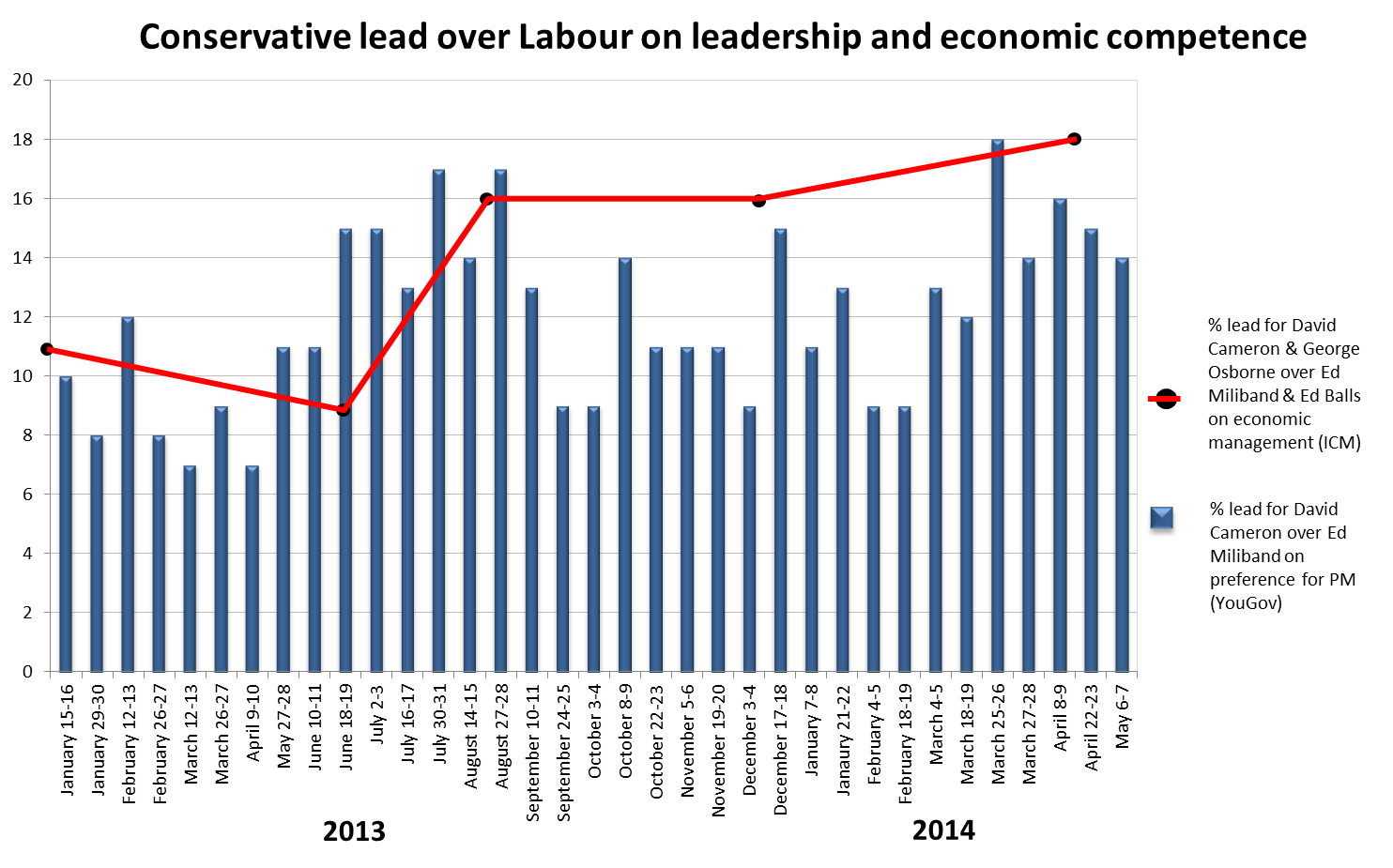
At the last election, in both cases, the answer was a narrow but clear no. According to ICM’s polling just before election day, David Cameron and George Osborne held a 1% lead on the economy over Gordon Brown and Alistair Darling. And on preference for prime minister, YouGov registered a 6% lead for David Cameron over Gordon Brown.

The chart below shows Labour’s performance on these two indicators since the start of 2013.

David Cameron and George Osborne now lead Ed Miliband and Ed Balls by 18% on the economy while David Cameron bests Ed Miliband on preference for PM by 14%.

At no point in the past four years has Labour narrowed the gap on either the economy or leadership to the level it achieved on the eve of the election in May 2010. An election where Labour polled a miserable 29%.

Read the rest of this entry »

Facebook Twitter Digg Delicious StumbleUpon

GRASSROOTS: Negative campaigning works. But on the issues not the personalities

12/05/2014, 11:02:07 AM

by Pete Heskett

Labour’s task for May 2015 is complex. Clearly the party needs a powerful narrative that gives people positive reasons to vote Labour. However, history also shows that in many instances the electorate vote the incumbents out as much as the vote a new party in – Mrs Thatcher’s victory in 1979 was to a large extent a rejection of Labour, unemployment and the three-day-week, Tony Blair’s victory in 1997 was boosted by a rejection of sleaze, and John Major’s benign under-panted leadership.

If Labour’s recent party political broadcast is anything to go by then we seem to be asking the electorate to get rid of the coalition because Nick Clegg is shallow and weak and the Tories a bunch of mean toffs. Now I’m sure there are many Labour loyalists who agree with this character assessment. However, it’s communication that speaks to the prejudices of those already converted not the broad-based liberal coalition that Jonathan Todd rightly identifies as the target Labour needs to attract to form a government in 2015.

For me this raises an important strategic point for Labour’s communications team. Negative campaigning in the UK at least tends to be most effective when it makes a political point rather than when it tries to make a personal point. Or to use a gender-biased footballing analogy, Labour is now looking guilty of playing the man and not the ball.

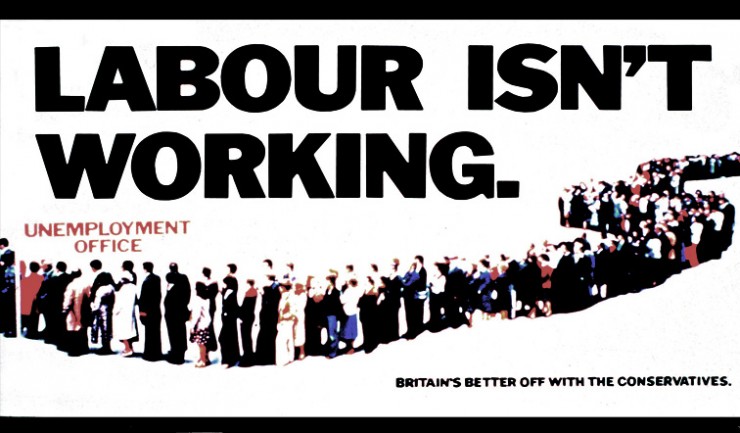
Let’s look at some of the most effective political ads in UK history. “Labour isn’t working” was a poster that helped bring Thatcher to power. It didn’t attack Jim Callaghan as a person – wise as he was generally rightly perceived as nice guy – but it linked the Labour government with unemployment. A strategic masterstroke that hit straight at the heart of Labour’s credibility – how could a party of ‘labour’ be responsible for extending the dole queue? Mrs Thatcher rose to power with a greater proportion of working class votes than even the worst nightmares of the Labour leadership would have thought possible.

Labour working not

Read the rest of this entry »

Facebook Twitter Digg Delicious StumbleUpon

UNCUT: Labour’s populism is all about redistributing wealth. Creating it matters too

09/05/2014, 10:47:18 AM

by Jonathan Todd

Labour forms a majority government, Alan Milburn wrote in the FT on 13 April, when focused as much on creating wealth as distributing it. Pat McFadden used a very similar line when speaking to Newsnight the same week. McFadden used to work with Peter Mandelson as a minister at BIS. Now Chuka Umunna is shadow secretary of state to this department and consciously echoed Mandelson when he recently said: “I don’t have a problem with people making a lot of money, so long as they pay their taxes.”

Similarly, I’ve argued that Labour should focus on growth as well as the cost of living; in other words, making the economic pie bigger, in addition to sharing it more equitably; being a party of increased production, not simply fairer distribution. Whether when Harold Wilson proclaimed ‘the white heat of technology’ or when Tony Blair unrelentingly championed aspiration, Labour has advanced as a party of growth and production. This is not to downplay the redistributive gains that Labour made during these periods. We had our first statutory minimum wage under Blair and got rid of the eleven-plus under Wilson.

These redistributive gains were facilitated by Labour’s strength on production. In crude policy terms, when economic growth is robust, it’s easier to find resources to redistribute to the less well-off. The politics are simpler too. Voters are less likely to withdraw their support from a redistributive party for self-interested reasons if they are reassured that this party is also capable of delivering the growth that will help their back pockets.

Read the rest of this entry »

Facebook Twitter Digg Delicious StumbleUpon