



UNCUT: Ed Miliband needs to tell us what he stands for

04/06/2013, 09:55:11 AM

by Dan McCurry

So YouGov tell us that Ed Miliband is regarded as “honest but untrustworthy”? What to make of it all? I’m sure his speech on Thursday will sort out all the confusion. What I think he need is to show us what he stands for.

There has been recent comment about whether Labour should reveal it’s policies, with Alan Johnson arguing that Miliband has already “shown too much leg”. Others, including myself, argue that a lack of openness creates a lack of trust. We’re both right and wrong. The confusion is in the distinction between policy, and aims/values.

The media always demand to know what the policies are, but the public want to know what the aims and values are. Policies are a list of promises while aims and values represent what we care about and what kind of a world we want to live in. It’s our aims and values to stick up for the small guy. It’s the aims and values of the Tories to stick up for big business and lobbyists.

Both parties try to present aims and values through slogans. The Tories say “We’re all in this together”, while Labour talk of “One Nation”. The Tory slogan is better because it’s about their intention to reduce the deficit. Ours was created as an attack on Tory hypocrisy, but has since been shown to mean little else.

It seems to me that Ed Miliband is forever working on the manifesto, instead of communicating what he stands for. Welfare is an obvious example. He chose to rise to the bait when Cameron challenged him on welfare, but then failed to put a lid on things when the “bedroom tax” got out of control.

Read the rest of this entry »

Facebook Twitter Digg Delicious StumbleUpon

UNCUT: Balls is no Churchill

03/06/2013, 05:40:13 PM

by Jonathan Todd

Politics, as Churchill said, is the ability to foretell what is going to happen tomorrow, next week, next month and next year. Much of the theatre of politics exists, however, in the unanticipated events to which Macmillan attributed the failure of political plans. While, to paraphrase Lennon, politics is what happens when you are making other plans, plans are politically necessary and should be attuned to the likely and inevitable.

Political tacticians specialise in events. Political strategists identify trends and plan accordingly. The character of politicians is revealed in their handling of events but they are exposed without convincing strategy. And the strategic context that was obvious from the outset of this parliament was the politics of the deficit.

We might have thought in May 2010 that the government’s economic strategy of tough deficit reduction would fail and the public would then turn to Labour. Perhaps we thought that this strategy would fail, causing the government to adopt the Plan B that Labour called for and the public to conclude that Labour was right all along.

Few seriously thought that things would work out precisely as George Osborne forecast in his hopelessly optimistic 2010 budget. The real debate was always about whether this failure in itself would be enough to return support to Labour.

Unsurprisingly, Osborne has not said: “Ed Balls was always right”. We don’t need the spending review to know, however, that the government is failing. But polling published by Labour List contains scant evidence that this failure builds support for Labour on the economy.

As Osborne scraps around to increase the capital budget and Vince Cable cobbles together the kind of active industrial strategy that he previously denounced, agreement with Balls is implicit in their actions. Government policy inches towards Plan B but recognition that this constitutes a Plan B is politically impossible.

Read the rest of this entry »

Facebook Twitter Digg Delicious StumbleUpon

UNCUT: 3 years on: Five years’ hard Labour?

03/06/2013, 07:00:47 AM

It’s 3 years since Uncut started so, in a series of pieces we’ve been taking stock of what has changed for Labour since 2010. In the last of the pieces, Rob Marchant looks back at this parliament, and forward to 2015

Obviously, we’re only halfway through the parliament, but what would be a celebration of our third birthday without a look back at the immediate past and a little look to the future.

2010: the year of purgatory. Uncut is born out of the ashes of Labour’s electoral disaster in May. The country still in economic crisis. It takes six months, however, for the party to get itself together and organise a leadership election, in which David Miliband, the seeming heir apparent, is effectively defenestrated. Most of the year is wasted, politically.

2011: the year of innocence. There is the sad departure of Alan Johnson, but a fresh-faced Fotherington-Miliband has skipped into public view. Hullo clouds, hullo sky, says he. We are going to do a new kind of politics. There are good people and bad people, for example in business there are producers (good) and predators (bad). Eh? says the public, a bit confused, and rather more concerned about their jobs and mortgages. Much work to be done.

2012: the Tories’ annus horribilis. A disastrous budget, coalition scandals and the travails of the Murdoch press mark the year. Miliband plays a blinder on the conference speech and the party discovers One Nation Labour. There is hope.

2013: the year of drift. One Nation Labour stays a slogan. The Tories start to recover. Disappointing election results. Trouble with the unions looms. The party organisation, unreformed, falters over controversial candidate selections.

And some thoughts about a possible future:

Read the rest of this entry »

Facebook Twitter Digg Delicious StumbleUpon

UNCUT: Labour history uncut: Industrial war beckons, Labour looks at its shoes

02/06/2013, 04:24:37 PM

by Pete Goddard and Atul Hatwal

On 31st July 1925, the unions celebrated “Red Friday.” The threat of general strike over miners’ wages had forced prime minister Stanley Baldwin to concede a 9 month wage subsidy. A royal commission had also been sent off to peer down a few mines and figure out how to fix everything.

It looked like a victory for the unions, but everyone knew it wasn’t over yet. When the commission reported, battle was likely to be resumed unless the deadlock could be broken in the intervening nine months.

The best hope for peace lay with the miners’ leader, Herbert Smith.  He was a realist and a moderate union man.

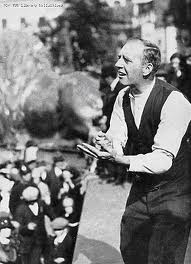
Unfortunately, standing right next to him was almost the biggest threat to peace. The increasingly influential miners’ union secretary AJ Cook was, in the words of TUC general secretary Fred Bramley, “a raving, tearing Communist.”

AJ Cook even did his own signing for the deaf

Cook was a syndicalist, a Marxist and a firm believer in the power of direct action. He was also extremely charismatic and, like the Yamaha YHT-893BL with 100W subwoofer, a very powerful speaker.

According to the home office, he was also “an agitator of the worst type.”  Although ironically, being the worst type of agitator in the home office’s eyes meant that he was actually very good at it.

Cook was, in contrast to the solution-seeking TUC and Herbert Smith, keen to get stuck in and challenge the status quo with a bit of workers’ power.

Read the rest of this entry »

Facebook Twitter Digg Delicious StumbleUpon

INSIDE: Can anyone explain Labour’s euro-list ranking system?

01/06/2013, 03:24:16 PM

Here is a  paragraph from an e-mail Labour party members will have received in the past 24hrs; it explains the way our European candidates will be ranked on the party list following the membership vote:

“If a male candidate secures the most preferences, then the highest-placed female candidate will come next on the list, followed by the next highest male candidate and then by the female and so on. If a female candidate secures the most preferences, then the highest-placed male will come next on the list, followed by the next female candidate and then by the male.

This process is known as zipping and is used by the Labour Party in European candidate selections to help to balance male and female candidates.”

All clear? Thought so.

At a time when there is widespread mistrust in politicians and disengagement in politics, does this really represent the most transparent way of selecting candidates?

Is “zipping” what the new politics is all about?

Answers on a postcard please to the Labour party, One Brewer’s Green, London SW1H 0RH.

Facebook Twitter Digg Delicious StumbleUpon

GRASSROOTS: Cameron has blundered on the EU

31/05/2013, 04:09:46 PM

by Malcolm Clarke

There cannot possibly be a more endearing sight for the left of centre politician than the sight of Tory MPs rabidly attacking one another over the issue of Europe, their reaction to the word ‘Europe’ as predictable as the salivating dogs trained by Pavlov’s bell.

But I do not believe that the issue of Europe is solely about UKIP, although they have seen big gains as a result of this issue. Europe severs the right and UKIP could have expected better results having mopped up floating Tory voters who are Euro-sceptic, the standard protest voters who used to vote Lib Dem and also the mid-term ‘we hate politics’ voters who look to inflict damage on the main parties.

If you consider the positive climate for UKIP gains given the heightened public consciousness on issues surrounding EU membership, getting 25% of the vote is underwhelming and I question the extent of the success that the media are heralding for UKIP. They have filled a void in protest politics, nothing more. That is not to say their position will not develop in time to a more established position, but as we saw in Scotland two days ago, there is no Cleggmania-like wave for Nigel Farage at present.

At Westminster, the Tories are treading familiar ground with a virile battle raging over the issue of Europe once again. The Tories just cannot resist a good row over Europe but I believe they should be dealing with the difficult domestic situation we face like the ever-increasing cuts to public services, the ideological attack on councils and the flat-lining economy. They have reverted to type and it’s the same old Tories. They showed it over the NHS and they are showing it over Europe.

Many of their ills are self-inflicted by a strategic error by David Cameron. By declaring that he will defer an in-out referendum until after the next general election and after a renegotiation on our terms of membership within the European Union, he walked headlong into three big problems.

Firstly, whilst in opposition Cameron gave a ‘cast-iron guarantee’ for an in-out referendum. Now he has gone back on his word and people have noticed, particularly those in his own party who were previously appeased by this pledge. Cameron now faces distrust to the extent that a private members bill has been tabled by Conservative MP for Stockton South, James Wharton, to ensure the matter is cast out in binding legislation. As no party can legislate to bind their successors, Cameron is dangling a carrot to the electorate and to his disparate MPs saying, ‘stick with me and get your referendum’. Unfortunately for Dave, they electorate may well kick him out of Number 10 for not delivering an in-out referendum now.

Read the rest of this entry »

Facebook Twitter Digg Delicious StumbleUpon

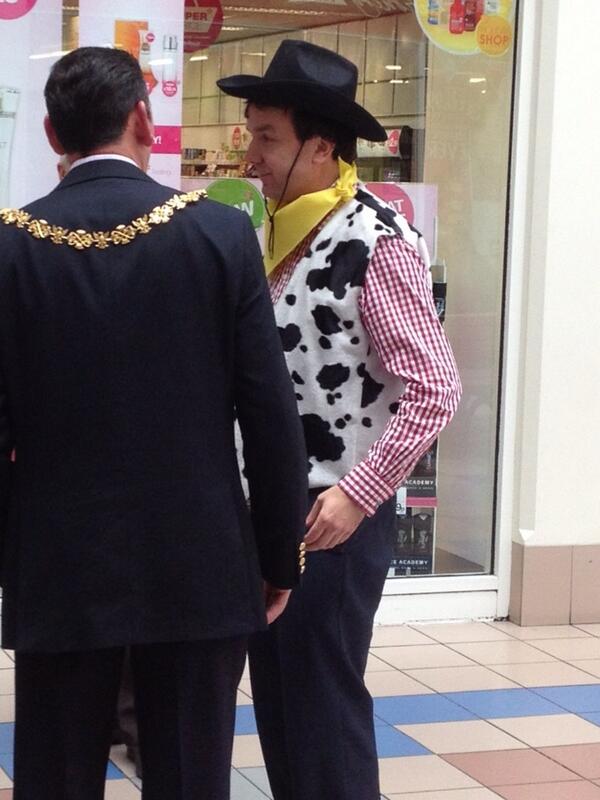
UNCUT: Friday caption competition: YMCA special

31/05/2013, 01:39:24 PM

h/t @planbsean

Just what is the mayor saying to the Tories’ cowboy MP for Burton & Uttoxeter, Andrew Griffith?

Captions please.

Facebook Twitter Digg Delicious StumbleUpon

UNCUT: Letter from Wales: Despite the cuts, money keeps getting poured down the Welsh language drain

31/05/2013, 10:31:26 AM

by Julian Ruck

Welsh Labour isn’t red, it isn’t new and it most definitely isn’t blue, it’s just plain old and totally out of date. The Welsh Labour government holds on to an exclusive reliance on the state with a stubbornness that would have made even Pyrrhus think again!

It continues to obsess on policies of devolved isolationism and ‘You don’t give….but you get, get get as much as you like and to hell with the British tax-payer!’

England owes us.

For an example of profound arrogance and a total denial of austere times where the ruling Welsh ‘elites’ are concerned, consider the following.

A separatist Welsh language, that has had literally billions of tax-payers’ money thrown at it over the last 40 years, has resulted in bi-lingual signs that few understand, pyramids of bi-lingual paperwork that the overwhelming majority of Welsh folk throw straight into the bin, a Welsh Health Service smartphone ‘app’ for Welsh speakers costing £26,000 being dumped because less than a 1000 people used it, a Welsh language S4C television channel that  no-one watches (and not to mention its history of rampant management skulduggery), and a radio station – Radio Cymru – that demands £13 million pa of license fee  money.

A couple of weeks ago Radio Cymru’s audience figures dropped to their lowest level ever (119,000 listeners per week), according to respected Radio Joint Audience Research (16.5.13).

In comparison BBC Radio Cornwall receives a modest £1.3 million and yet it has higher audience figures!

Overall, BBC Wales receives £167 million pa of tax-payers’ money for Welsh language broadcasting, which some might feel is fair enough. After all, in any civilised society minorities should be respected and their views always accommodated where possible; but here’s the rub, none of this money has resulted in any kind of increase in Welsh speakers, indeed the opposite obtains.

10 years ago 40% of welsh schoolchildren could speak Welsh, now it’s only a paltry 24%.

Read the rest of this entry »

Facebook Twitter Digg Delicious StumbleUpon

UNCUT: 3 years on: Labour is a happier place

30/05/2013, 09:25:51 PM

It’s 3 years since Uncut started so, in a series of pieces, we’re taking stock of what has changed for Labour since 2010. Kevin Meagher looks at party morale

“Let sunshine win the day” urged David Cameron speaking to his party’s conference a few years ago. Derided at the time, “Ibiza Dave” was on to something.

One of the noticeable changes to Labour over the past few years is that it’s a happier party. Not pleased to be in opposition (I don’t think), but a party, relatively speaking, at ease with itself.

After a decade and a half of the Blair/Brown psychodrama it is a welcome change of mood. Labour is more open these days. The era of top-down party management, vibrating pagers and lines-to-take are largely over. Not rejected per se, more absorbed into the party’s bloodstream. This is a sensible, social democratic party of incremental reform. We have made our peace with the pager.

What has been rejected though is overbearing centralisation. The days when frontbenchers actually shaved off their moustaches and beards at the behest of image consultants are thankfully long gone. The obsession with the media has eased, driven by the increasingly pluralistic ways of talking to voters and getting the party’s message heard.

Indeed, it is interesting to think how a Blair or Brown leadership would react to the rise of digital media, which has done so much to alter the terms of political discourse in the past few years. A gust of free speech has blown through the Labour party, allowing members far more say over its direction. The world has not ended.

In terms of the leader, there is no cabal of Millibandites (the Milliband perhaps?) running around stitching up their rivals. Spats between Unite, Labour’s main trade union backer on the left and Progress on the right are, in Labour party terms, fairly anaemic.

Read the rest of this entry »

Facebook Twitter Digg Delicious StumbleUpon

UNCUT: 3 years on: Ed isn’t in the Hobbit and needs to bin the invisibility cloak

30/05/2013, 07:39:44 PM

It’s 3 years since Uncut started so, in a series of pieces, we’re taking stock of what has changed for Labour since 2010. David Talbot looks at Ed Miliband’s public profile

Ah, the Daily Express. What to say about this esteemed presence amongst our media? Last content sometime during the Boer war, today its coverage sticks to the traditional middle class issues of house prices, cancer survival rates and Princess Diana. A friend to the Labour party it almost certainly is not. Indeed, under the tutelage of its chief political commentator, one Patrick O’Flynn, the Daily Express can have a serious claim to be amongst the first members of the fourth estate to take the UKIP threat seriously.

O’Flynn seems an amicable, if slightly misguided, chap who nonetheless stumbled across pertinent analysis as we consider the three year anniversary of Labour’s demise, and Uncut’s rise from the ashes.

Three years on the Labour party is out of government, out of sight and out of mind. O’Flynn dubbed this Labour’s “invisibility cloak” in his leader last week, which was a charitable way of highlighting that three years on from a historic defeat, the party’s hierarchy has not constructed a coherent strategy for Labour’s return to power.

Ed Miliband continues to be Labour’s invisible man. Still virtually unknown to the British public this void in the British political realm can surely continue no more. Cameron was known to taunt the then novice Labour leader at the back end of 2010 noting that “he had been in the job for the past few months” before adding, woundingly, “people are wondering when he’s going to start?”

Too much of Labour’s strategy at present appears to be based on the coalition’s unpopularity, and frankly keeping low and not saying anything too stupid.

Indeed, as a political strategy it is well worn and often successful in the short-term. But three years on, Labour has rightly set itself an ambitious target of returning to power after just a single term out of office – a feat, historically, that has been near impossible to muster. Wearing an invisibility cloak for the next two years simply won’t achieve that high aim.

David Talbot is a political consultant

Facebook Twitter Digg Delicious StumbleUpon