




UNCUT: At last, some Labour pains

10/06/2013, 07:37:34 AM

by David Talbot

Labour might still easily lose, in 2015, an election it really ought to win. If that is indeed what happens, the reason, as so often with the Labour party, is that it will have operated in the world it so dearly wishes it to be, rather than the cold, rather more sobering, reality.

It will be because it didn’t understand what voters told it in 2010. It will be because unveiling daft posters, available, incidentally, at the not very One Nation price of £35, and talking of the “same old Tories”, lamenting their cuts and their rich friends, is far easier than undertaking a soul-searching examination of why the party was so comprehensively buried in 2010. It will be because it preferred to spend time in the seminar room, talking to nobody but itself, pontificating wildly on the politics of Neverland. This will be, as always, most soothing for the Labour movement. It will have its high-mindedness, and its piety, and it will lose.

The Labour party cannot win in this state of deluded comfort, revelling in the opportunities for moral indignation that austerity affords, whilst simultaneously saying nothing of note to the nation.

If there was a pain-free option, the Labour party would, of course, take it. In this make-believe world of Labour thinking, when, not if, Labour are elected in 2015 the party will have to impose no cuts, spending will be allowed to increase on nice things like the health service, and grateful voters will at last acknowledge they made a dreadful mistake in 2010 by voting for those ghastly Tories. This inability to face the truth is deeply worrying for those, which now include, seemingly, the Labour leadership, who believe the party has spent the past three years either saying the wrong thing or nothing at all.

On the great issues of the day too often there has come has come either silence from the Labour party or scorn from the labour movement. By wallowing in the trough of political invective, the Labour party doesn’t seem to have realised that it long ago lost the argument.

Read the rest of this entry »

Facebook Twitter Digg Delicious StumbleUpon

INSIDE: Selection round-up

09/06/2013, 04:51:21 PM

We’ve looked at results in City of Chester and Weaver Vale, but there were four other results in yesterday:

Jeff Smith (Manchester Withington) won on the second ballot, beating Unison official Angela Rayner followed by Josie Teublet and local councillor Andrew Simcock.

Born and bred in the constituency and a local councillor since 1997, Smith is now executive member for finance on Manchester City Council and was the local favourite to win.

His first electoral success in the constituency came as a ten year-old schoolboy in a mock election at Old Moat Primary School in Withington (he won).

Despite being at the Labourish end of the Liberal Democrats, current MP John Leech is something of a hate figure among Labour campaigners locally, having first defeated former government deputy chief whip, Keith Bradley, back in 2005, by claiming the Labour government was set to close Withington Hospital (it wasn’t).

Lucy Powell ran Leech close in 2010, but this time the Lib Dems will pay for being in government, with Smith’s task in overturning Leech’s small 1,894 majority seemingly a cake walk.

Karin Smyth (Bristol South), a local NHS manager, inherits a 4,734 majority from former Treasury minister Dawn Primarolo who is retiring in 2015 after serving her current term as Deputy Speaker of the House of Commons. She beat Uncut columnist Amanda Ramsay into second place.

Although the seat saw a sharp 10 per cent drop in Labour’s vote in 2010, it split evenly between the second placed Lib Dems and third placed Tories making it a much safer bet for Smyth in future.

Todd Foreman (NE Somerset) has a harder task in overturning the 4,914 majority of Tory curiosity Jacob Rees-Mogg. Yet the US-born solicitor is also a Westminster City Councillor, so will relish a challenge in ‘enemy’ territory.

Finally councillor Neil Coyle (Bermondsey and Old Southwark) has been selected to fight Deputy Leader of the Lib Dems Simon Hughes.

Coyle, the director of policy at campaign group Disability Alliance beat a strong field which included Gavin Edwards, Stephanie Cryan, Prem Goyal and Richard Livingstone.

Hughes had an 8,530 majority in 2015.

Facebook Twitter Digg Delicious StumbleUpon

INSIDE: Wine buff has nose for victory

08/06/2013, 02:58:02 PM

Julia Tickridge has this afternoon been selected as Labour’s parliamentary candidate for Weaver Vale.

The Cheshire West and Chester borough councillor beat off a strong challenge from party organiser Lauren Cassidy, with solicitor Rebecca Long-Baliey coming third. North West Party Board Chair, Sue Pugh was the fourth shortlisted candidate.

The final run off saw Tickridge beat Cassidy by 66 votes to 61.

Tickridge is a languages graduate and formerly worked for chemicals giant ICI in Germany. She also has a background in further education and is a qualified International Wine Challenge judge.

It is believed that just twelve candidates applied for the seat, designated an All-Women Shortlist (AWS) by the party’s National Executive Committee.

However this is the second AWS selection process in the area where relatively few women candidates applied. Nearby Wirral West saw NHS campaigner Margaret Greenwood selected from a field of just a dozen candidates.

The Weaver Vale seat is currently held by Conservative Graham Evans with a majority of just 991.

Facebook Twitter Digg Delicious StumbleUpon

INSIDE: Party veteran wins nomination for home seat in Chester

08/06/2013, 11:40:55 AM

Chris Matheson was last night selected as Labour’s prospective parliamentary candidate for the City of Chester constituency.

A veteran of the North West party board, Matheson works for Unite the union as an industrial officer and lives in the constituency. He based his campaign on combining “local roots and national experience.”

He beat development economist Peter D’Souza into second place, with local councillor Sam Dixon coming third. Matheson won on the third ballot.

In a leaflet distributed in the final few days of campaigning, Matheson outlined his vision of ‘Chester 2020’, promising if elected to galvanise businesses and the local university behind a drive for to improve local skills and bring in new investment.

Although Chester is usually regarded as one of the most affluent boroughs in the North West, the Campaign to End Child Poverty (a collection of anti-poverty groups) found that 17% of children in the City of Chester constituency are currently living in poverty.

Also, the Chester and Ellesmere Port foodbank, set up last November, has recently seen the number of people it helps treble.

Sitting Conservative MP Stephen Moseley has a majority of 2,583.

Facebook Twitter Digg Delicious StumbleUpon

UNCUT: Letter from Wales: Let’s see if the Welsh gravy train survives a collision with Ed Balls’ fiscal reality

07/06/2013, 11:34:11 AM

by Julian Ruck

The other day Ed Balls said, “We need to look ruthlessly at how every pound is spent.”

He obviously has yet to travel on the Welsh express gravy train.

Devolution has allowed the ancient Labour enthusiasm for small-town political monopoly and personal fiefdom to run riot – for the impotence of democratic principle and challenge, look no further than Wales with its happy coteries, self-serving cabals and “all the usual suspects” political foxhole mentality.

Like the rest of the UK, there are three sectors in Wales. The public, the private sectors and  of course the third Sector which is not for profit and seeks to help citizens in varying and various ways eg health charities, CAB’s etc.

As alluded to in previous “Letters,” Wales is a tax-payer junky, it cannot and will not move away from the divine right of tax-payer subsidy in all things – as least Westminster subsidy that is.

Wales is small, many in Westminster may even think insignificant, its population not even  half of London’s. But should this smallness negate any scrutiny by its paymasters? Any accountability?

In Wales, criticism of the ruling party is viewed with suspicion and superior arrogance. The elite potentates of Old Labour carte blanche carry on with a 90 year mandate as if Blair never existed and the unions still rule the ghostly memories of coal and steel grandeur.

London must and always will, pay up.

Dissent is for the birds. Outspoken truth to be sneered at and discredited wherever possible. The Welsh will always vote old Labour.

So why don’t even a minority of the Welsh speak up? The answer is simple. All three sectors are in the tax-payer pocket, in some way or another. Even the private sector relies heavily on public subsidy, although it is debateable whether there is a Welsh private sector at all. To get on in Wales one has to be Old Labour, one has to toe an outdated and defunct Clause IV line and ignore what is going on in the rest of the world.

Read the rest of this entry »

Facebook Twitter Digg Delicious StumbleUpon

UNCUT: John Mills, tax and dishonesty

07/06/2013, 08:41:55 AM

by Dan McCurry

On the issue of taxation abuse, we need to move on from the oversimplified distinction between legal avoidance and illegal evasion.

At the moment some avoidance has shocked people, while other avoidance, such as my tax free savings, is not an abuse. In order to sort out the difference between good and bad avoidance, I suggest people concern themselves with whether the avoidance was dishonest or not.

In the case of George Osborne’s complaint about a Labour donation, we need to ask, was John Mills dishonest in his method of avoiding tax in this donation? If he was, then Labour is in trouble, if he wasn’t then we are not. Mr Mills chose not to sell the £1.5m of shares and give the cash to Labour, as that would have been taxed as a capital gain. By giving Labour the shares, then Labour will be taxed on the dividends, but only liable to the capital gains if they are sold.

I have some of my savings in an ISA as a tax efficient method of building a pension. I can invest £11,250 per year in my ISA and this will be exempt from taxation both on the dividends and on the capital gains. The same applies to a donation I might give to charity that can be given with “Gift Aid” so that the tax paid amount is passed on to the charity. Is that dishonest? No.

This is quite different from the case of Jimmy Carr who passed his money to an Isle of Man, company who then provided him with same amount back but called it a loan. A loan isn’t taxable, so he avoided tax. Now, any sensible person would describe that as completely dishonest, but because tax law is based on a set of rules, he wasn’t prosecuted.

Criminal law is a different set of law and can take precedence if policy makers wish it to. If the authorities wished to prosecute him for fraud, they could have done so, but if they had, then they would probably have to prosecute everyone else who has done similar, and that is a prospect that can be frightening to the people who run this country.

Fraud is when someone commits a dishonest act which makes a gain for himself, or a loss to another.

The other problem that exists with tax is that countries tend to have bilateral treaties with each other.

Read the rest of this entry »

Facebook Twitter Digg Delicious StumbleUpon

INSIDE: Short queue of applicants looking to take on Clegg

06/06/2013, 01:00:09 PM

Just twelve hopefuls applied to stand against Nick Clegg at the 2015 general election as Labour’s parliamentary candidate in Sheffield Hallam.

Party officials have whittled this down to a shortlist of four comprising of Mark Gill, Mark Russell, Oliver Coppard and Martin Mayer. All have local roots.

Gill is a pollster and a former Head of Political Research at Ipsos MORI.

Russell is chief executive of the Church Army charity which is based in Sheffield.

Coppard is a former partnership manager for Barnsley Council and headed an innovative Olympics partnership between Barnsley and Newham.

Meanwhile Martin Mayer is a Unite branch secretary and a working bus driver from Sheffield. He is backed by shadow cabinet office minister Jon Trickett and Sheffield South East MP Clive Betts.

The hustings takes place on June 24.

Clegg has a 15,284 majority, although the seat includes a high number of public sector managers and students from the city’s two universities and three teaching hospitals. In fact, it is said the Hallam constituency has the highest number of people with a PhD degree in the country.

What of Clegg, is he beatable? The backlash from the student fees debacle will still do him harm, as will the impact of local spending cuts and public sector job losses.

However a recent by-election in the Fulwood ward in the heart of the constituency actually saw the Lib Dems increase their majority, with a four per cent swing away from Labour. They have a formidable local campaigning organisation with most of their city councillors clustered in the constituency.

Worth remembering too that a third of families here live in detached houses, with nearly a fifth of these having five or more bedrooms (the national average is less than 5%).

This is not, it is fair to say, the Sheffield of The Full Monty.

Facebook Twitter Digg Delicious StumbleUpon

GRASSROOTS: Why I spoiled my Labour Euro-selections ballot paper

06/06/2013, 07:00:27 AM

by Ben Cobley

Electoral Reform Services will have received my ballot paper by now.

I had thought of writing rude messages on it, or tearing it into small pieces and dropping them into the envelope as a mark of my disdain, but on the balance I plumped for a classic piece of English fudge/moderation: a big X scrawled across the page and a little message offering my unsolicited opinion on the Labour party’s approach to democracy.

This is the first time I have ever treated a ballot paper in such a way. I used to approach them with a form of reverence, taking voting as a privilege and a pleasure.

Then I joined the Labour party.

These latest selections for European Parliament candidates are just the latest example of an approach to democracy within Labour that Erich Honecker would have recognised and admired (and which I like to call institutionalised fixing”.

Let’s put aside the ceaseless cascade of emails that have been filling members’ inboxes with blandities, platitudes and waffle (though any more talk of “campaigning”, “a fairer Europe” or “Labour values” and I might run for the hills).

Instead, let’s talk about choice.

As a Londoner, I am faced with no choice in whether I wish to re-select Mary Honeyball and Claude Moraes, despite them having a track record for which they can be held accountable. They will automatically come top of the ballot.

Then I am given a clutch of six other candidates whose views seem to be almost interchangeable (unless you can see beyond the double-speak which hides their more interesting and contentious views).

Read the rest of this entry »

Facebook Twitter Digg Delicious StumbleUpon

UNCUT: Labour history uncut: Everybody out!

05/06/2013, 06:00:12 PM

by Pete Goddard and Atul Hatwal

It’s somehow fitting that the fuse for the general strike was lit at the Daily Mail.

The government was still engaged in half-hearted negotiations with the unions when, on Sunday 2nd May 1926 the print compositors at the Mail refused to set an inflammatory editorial, entitled “For King and Country.” Although the companion piece, “Compositing print causes cancer” probably didn’t help either.

Seeing an opportunity to kick things off whilst still blaming the unions, the government summarily walked out of the talks muttering about threats to freedom of speech.

The unions thought, “Walk out will you? We’ll show you a thing or two about walking out.”

The next day letters went out to union members up and down the country and on Tuesday 4th May the whistle blew.

”Everybody out!”

The general strike had begun.

Around 1.5 million to 2 million workers took part in the strike. People downed tools all across the country.

Then, frequently, different people across the country picked those tools up again.

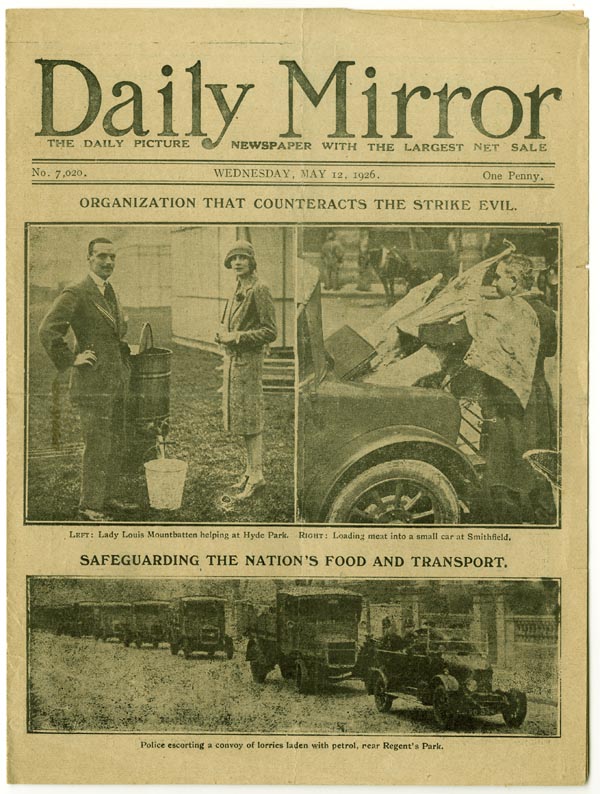
Approximately 300,000 volunteers had joined the overwhelmingly middle class and right-wing Organisation for Maintenance of Supplies. Their task was to help keep the country running during the period of the strike in a sort of extended “working class” themed fancy dress party.

The general strike’s PR team knew it had an uphill battle when even the Mirror started calling the strike "evil"

At the same time, with the print setters on strike, someone had to provide the British public with a replacement for their daily sports news, Sudoku and political misinformation. And who had enough spare time to moonlight over hot metal at a time of enormous national economic crisis? The chancellor of the exchequer, of course. Winston Churchill was put in charge of producing the government’s British Gazette.

Read the rest of this entry »

Facebook Twitter Digg Delicious StumbleUpon

INSIDE: Councillor complains that Liverpool MP made his life “unbearable”

05/06/2013, 07:00:48 AM

The spat between Liverpool Wavertree MP Luciana Berger and one of her local councillors is hardly in the same league as the epic battles fought within the Liverpool Labour party – (remembered this month as its thirty years since Militant seized control of the city council) – but it’s a strange little row nonetheless.

To recap, a messy war of words between Berger and one of her local councillors, Jake Morrison, has poured forth into the public domain – largely thanks to Morrison publishing the contents of a letter of complaint he received from Berger last Friday.

In it, Berger, the upwardly-mobile shadow minister for climate change, complains to Morrison about “your complete lack of team work and respect for other members.”

She alleges he “ignored” emails about a training session with Ed Miliband’s campaign guru, Arnie Graf, and that he is the only councillor in her constituency who doesn’t “engage with my office”.

The letter was copied to Liverpool Mayor, Joe Anderson and the party’s chief whip.

Morrison published the letter on his Facebook page before responding with his own complaint to Ed Miliband about Berger’s behaviour.

He alleges that Berger and her constituency aide, Sheila Murphy, “orchestrated” a campaign enlisting party members in a bid to put pressure on him to quit before his term of office ends after announcing last month that he will not contest his seat at the next election in 2015.

He protests to Miliband that Berger has made his life “unbearable” and that “at every opportunity Luciana has undermined me, rather than supported.”

Sensationally elected to Liverpool City Council in 2011 having only just turned 18, Morrison managed a notable giant-slaying, beating formidable ex-Lib Dem council leader Lord Mike Storey.

At the time, Ed Miliband telephoned to congratulate him.

Morrison says that he wasn’t invited to the session with Graf, but fully supports his campaigning methods, which seek to develop a more meaningful conversation with the electorate rather than just identifying voting intentions – an approach he already uses as a local councillor for the Wavertree ward.

Read the rest of this entry »

Facebook Twitter Digg Delicious StumbleUpon