




UNCUT: Labour is headed for trouble in next week’s spending review

18/06/2013, 04:30:24 PM

by Atul Hatwal

Next week, George Osborne will finally spring his long prepared spending review trap.

Here is the chancellor’s basic choreography: the Tories announce an eye-wateringly tight spending round, Labour opposes and the Tories attack Labour for being unreformed spendaholics.

Alternately, Labour back the government’s spending plans, in which case, the Tories attack Labour for being reluctant converts to fiscal responsibility and, as a happy sidebar, Labour’s Keynesian prescription for boosting spending to revive the economy is effectively de-funded.

Either Labour play to the stereotype of profligacy that lost the last election or become me-too Tories.

Ed Balls’ big speech a few weeks ago was intended to unpick this problem and re-position the party. The commitment to aggregate Tory spending plans covered the party’s fiscal flank while Ball’s retained the Keynesian differentiation with his £10bn capital spending boost, funded through increased borrowing.

On paper, it went some way to neutralising the chancellor’s likely attacks.

But there’s a problem.

Now Labour has shifted to a more politically realistic position on spending, it needs to robustly assert this new line.

It needs to use every opportunity to publicise the  new approach. To make the progressive case for adhering to overall Tory spending totals (while having different individual priorities) and ensure the public knows that a major change has just taken place.

Otherwise, next week, the Tories will hammer the party for running scared of its own policy. They will paint Labour as insincere and irresolute on spending. The taunts about whether Labour believes what it says will turn the party’s economic drama into a political crisis of leadership.

For the public, the net result will be little different to if Labour hadn’t changed its fiscal stance. Perhaps worse, when taking into account the collateral damage to Ed Miliband’s personal ratings from any squirming on policy.

Read the rest of this entry »

Facebook Twitter Digg Delicious StumbleUpon

UNCUT: Remember how Clinton sealed the deal for Obama last year? Blair could do that for Miliband

17/06/2013, 08:00:16 AM

by Dan McCurry

I was once in a rock band for whom stardom beckoned. We were 16 years old and practiced in the music room at school, playing ‘60s music. The lead singer, John O’Dea, was a mod whose hobby was to beat up punks and skinheads. He was quite embarrassing. The reason he had something to prove was that back in ‘80s, the mods had a reputation for being soft.

One day John wrote some lyrics to a song called “Bollocks to a tramp”, and although we didn’t want to encourage him, the words were good so we added a guitar riff and it rocked.

Up the west end every Saturday,

The Mods, Punks and Skinheads all come out to play,

They really make me sick,

I could hit ‘em with a brick,

Say bollocks to a tramp,

Bollocks to a tramp,

Punks and Skins are tramps,

Say BOLLOCKSSSSSSSSS!!!

We got our first gig at a Mod all-dayer at the Ilford Palais. The crowd went crazy with 2,000 mods cheering at every line, and we were invited everywhere. Unfortunately the band fell at the first hurdle when the bass player got jealous and wanted to take over the vocals, so arranged for O’Dea to be kicked out. At the next gig, we opened with the bass player singing Bollocks to a tramp, and the audience sat all the way through, then clapped politely at the end of it. The magic was gone and the band soon split.

When Labour got rid of Tony Blair, I reflected on the sacking of John O’Dea. Even though I was politically closer to Gordon, I didn’t think it was a good idea to make the bass player into the Prime Minister when we had a star singer in Tony Blair.

Bill Clinton was another star. It’s questionable as to whether Obama would have won last year’s election without his help. Tony Blair could do the same thing for Ed Miliband, but Miliband wants to put space between Labour’s past and present.

Economic consensus has changed since the time of Clinton and Blair. We used to agree that aspiring to owning a house would lift people out of poverty. Even George W. Bush saw sub-prime mortgages as a way of ending poverty. The idea was that people instilled with aspiration lifted themselves up.

Read the rest of this entry »

Facebook Twitter Digg Delicious StumbleUpon

UNCUT: Labour history uncut: What happened next after the general strike failed

14/06/2013, 04:47:16 PM

by Pete Goddard and Atul Hatwal

The general strike was lost. Bitterness and recriminations echoed across the Labour movement and the conflict between the left and Labour’s leadership, once again, took centre stage in Labour politics.

Back to business as usual, then.

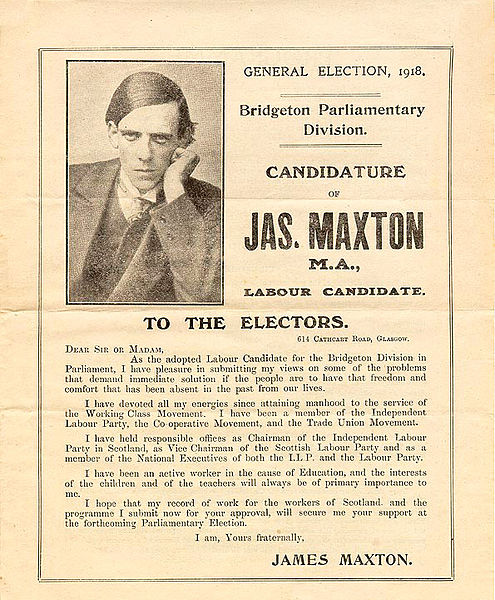
April 1926 had seen left wing firebrand James Maxton ascend to the chairmanship of the Independent Labour Party (ILP). He was a strong believer that Labour should stand on an unabashed platform of socialism and a fervent opponent of Macdonald’s strategy of gradualism, respectability and trying to appeal to voters.

Following the collapse of the strike, the ILP adopted its programme of action, “Socialism In Our Time.” This included such crazy notions as a living wage, family allowances and the nationalisation of banks.

Jimmy Maxton responds to research suggesting voters prefer candidates with a ‘sinister stare’

Back in 1926 Macdonald rejected the ILP programme out of hand. He wanted socialism, yes. “In our time” however, was way too immediate and way too specific for his tastes.  He was more “socialism some time, maybe sort of soon-ish, but not right now though.”

He said the ILP plans were   “a collection of flashy futilities… likely to involve in practice the postponement of all advance, because it would only frighten the electorate and ensure a crushing labour defeat.”

And Macdonald knew all about crushing Labour defeats, having helped bring about that last one by precipitating the fall of the first Labour government and disastrously mis-handling the Zinoviev letter.

Read the rest of this entry »

Facebook Twitter Digg Delicious StumbleUpon

UNCUT: Letter from Wales: Welsh democracy is in a ruinous state

14/06/2013, 10:31:16 AM

by Julian Ruck

If you politically aware folk across the Severn Seas, think Westminster is the political capital of greasy manipulation and ambitious malfeasance, then think again and try this on for size.

Old welsh Labour with its enforcers has now excelled itself, making sport out of the committee system of scrutiny and oversight where policy is concerned. If any member of said committee shows any sign at all of having an independent intellect (or indeed any intellect at all), or god forbid a view that may be deemed “principled”, then they are ignominiously ejected, without a safety harness.

You think I’m joking?

Well, let me appraise you of a recent Children and Young People’s committee, set up to consider the Welsh Assembly’s Social Services Bill.

By way of background, three of the Labour team were in support of a ban on physical chastisement of those objectionable urchins who fall by the parental wayside as it were, the minister overseeing all this, one Gwenda Thomas, was not.

Chance would have it, that just before the committee was due to convene, take evidence and consider an amendment to introduce the child-smacking ban into the Bill, old Labour’s chief whip-master sacked the three liberal musketeers, and without as much as a by your leave.

Christine Chapman (Chair), Julie Morgan and Jenny Rathbone were all replaced by more accommodating members with a more corporally inclined inclination than their predecessors.

When the meeting started, microphones were injudiciously turned off so that the new chair, one Ann Jones, was left to rather miserably explain that she had only just found out about her ‘calling’ to the committee – nothing like being prepared is there?

Read the rest of this entry »

Facebook Twitter Digg Delicious StumbleUpon

GRASSROOTS: The International Labour Organisation offers Ed the policies for jobs and growth

13/06/2013, 05:09:39 PM

by Robin Thorpe

“Women and men without jobs or livelihoods really don’t care if their economies grow at 3, 5 or 10 per cent a year, if such growth leaves them behind and without protection. They do care whether their leaders and their societies promote policies to provide jobs and justice, bread and dignity, and freedom to voice their needs, their hopes and their dreams” -Juan Somavia

Juan Somavia was the Director-General of the International Labour Organisation (ILO) until 2012. The ILO was founded in 1919, in the wake of a destructive war, to pursue a vision based on the premise that universal, lasting peace can be established only if it is based on social justice. The ILO became the first specialized agency of the UN in 1946.

From the 5th to the 20th of June 2013 the ILO are holding the 102nd International Labour Conference in Geneva. On the agenda are several themes that have been prevalent in the UK media recently and have relevance to the lives of the UK population. These are;

  1. Sustainable development, decent work and green jobs
  2. Employment and social protection in the new demographic context
  3. Social Dialogue

OK so they don’t sound relevant in the bureaucratese in which they are written, however these issues could all have a profound impact on our quality of life. I shall attempt to decipher them for you.

The first of these deals with the two most significant challenges facing humanity in the 21st Century; achieving environmental sustainability and ensuring decent work for all. The ILO report on this topic states that “The shift to a sustainable, greener economy offers major opportunities for social development: (1) the creation of more jobs; (2) improvement in the quality of large numbers of jobs; and (3) social inclusion on a massive scale.”

The report goes onto to say that “an assessment of a broad range of green jobs in the United States, for example, concluded that they compare favourably with non-green jobs in similar sectors in terms of skill levels and wages. Research in China, Germany and Spain has also found the quality of new renewable energy jobs to be good.”

Major investment both in terms of policy and money will therefore only reap rewards; if we are to gain the most from this opportunity then we can’t simply play at building wind-farms.

Long-term policy commitments must be made to ensure that private investment is forthcoming, something not helped by last week’s UK parliamentary vote against a clean power target, which will also affect the motor manufacturing industry.

Read the rest of this entry »

Facebook Twitter Digg Delicious StumbleUpon

UNCUT: Would we really welcome the end of the data state?

13/06/2013, 09:46:22 AM

by Dan McCurry

Ever wondered how mobile phone companies know where you are, in order to route the phone calls through to you? The phone in your pocket is keeping a constant “chatter” with the network informing them of your location. That’s how the police can track you down if you ever become a fugitive. They can tell where you are within a 10ft radius. And if you run, every 30 seconds your phone will inform them, and inform them, and inform them. You were never told this when you bought your phone. No one ever told you your privacy was being compromised on such a scale.

We live in a world where we are recorded by video dozens of times a day, simply while shopping for groceries. At the checkout, our bonus cards record the frequency and breadth of our purchases, and even the times of day of our habits and movements.

Our websites download “cookies” to our computer hard drives which record and survey our surfing, in order to guide us toward the products they’d like to us to buy.

The credit card companies constantly trade information with the credit reference agencies who have a record of every time you’ve paid your phone bill (late or on time), every application to take out a loan (successful or not), and every move of address and consequent new post code. They use this information to judge you, your character, whether you can be trusted with the money they lent you.

Don’t you feel uncomfortable? Don’t you just feel slightly nervous about it all? The sheer size and scale of all the information being collected about you, your habits, what you own and where you shop and whether you can be trusted anymore.

How about if I told you we could end it all with one sweep of a politician’s pen? You could get rid of the lot. Would you vote for it? Would you vote to end all the surveillance and data gathering that swims around you every second of the day?

What if I told you that by pressing a single button you would be able to wipe all the information kept on you and you’d able to start your life afresh knowing that not one single sinister agency would have one single sinister fact about you, would you press that button?

Now, imagine I can make this happen. I have just such a device and I’m putting it in front of you now. All you have to do is press the button. Why don’t you do it? The button is in front of you. Press it and let’s see how it can feel to be free.

Read the rest of this entry »

Facebook Twitter Digg Delicious StumbleUpon

GRASSROOTS: Labour is losing the fight for the political narrative

12/06/2013, 04:38:45 PM

by Sam Fowles

Ed Miliband’s “party of work” rhetoric may have stuck an important blow in the battle with the Conservatives but he’s lost a march in the war.

At first glance last weeks economic policy speeches from the Eds (Balls and Miliband)  set out sensible policy and may even go some way to helping Labour win back our lost “credibility” on the economy. But only at first glance. While the desire to remove Cameron and co from office at the earliest possible opportunity (and by any means short of a military coup) is understandable, it’s mistaken. Miliband’s speech was an attempt to gain economic credibility on Tory terms. And, as any good general knows, you never fight a war on the ground your enemy chooses. Ask anyone who’s invaded Russia.

By buying into the Conservative’s narrative Miliband risks creating a situation where economic credibility only ever means one thing. And, worse, leaving the Conservatives to decide what that thing is. He’s surrendered control of the narrative and that is political suicide, perhaps not for himself, but certainly for his party.

This Conservative party has pursued two distinct and important narratives.

The first is that economic credibility means cutting in the short term. It doesn’t matter that this policy has actually failed in its stated goal of bringing down the deficit, what matters is the electorate believes that cuts = responsibility.

The second narrative is a classic tale of the “internal enemy”. In this case there are two: the unemployed and immigrants. Again, it doesn’t matter if either of these actually are a threat to the “hard working people of Britain”. What matters is that the electorate believes they are and thus turns to their friendly neighborhood Tories for protection. Putting immigrants aside for the moment (and how I wish the press would), by trailing their economic policy by telling us what they’d cut and defining themselves against those “who refuse to work” the Eds have indirectly bolstered both of those Tory narratives.

And the thing about a Tory narrative is: it’s always going to make the Tories look best.

Allowing one side of the political spectrum to dominate the narrative means the political debate becomes about perception rather than truth. Margaret Thatcher is talked of as a model of fiscal responsibility by both the left and right. Yet she squandered billions in North Sea oil revenues on a short term tax cut rather than securing the long term economic strength of the country by investing it.

Why is she not ridiculed for so dramatically putting ideology before country? Because her party told us that cutting spending equals fiscal responsibility and she cut spending. Then they kept telling us the same thing in the face of all contrary evidence and eventually Labour stopped arguing.

The internal enemy narrative is a classic ploy for right wing parties. When we feel threatened by forces within our own community we look to protect ourselves and our families in the short term and thus turn to conservative parties.

Read the rest of this entry »

Facebook Twitter Digg Delicious StumbleUpon

UNCUT: It’s not the despair Ed, it’s the hope

12/06/2013, 10:20:06 AM

by Rob Marchant

So, a week in which, to the great surprise of practically everyone, last week the two Eds came up with a set of policy announcements – or at least, position statements – to “get their retaliation in first” in advance of the government’s spending review. U-turning on a range of issues which they previously stood up for since January 2010 when they first formed their leadership tag team. This could just have been the week when history will remember that it all changed.

Could, not necessarily will, as we shall see.

But good things: child benefit, for example, where Balls has finally accepted the self-evident reality that if he does grant it to rich people, he will have to find a couple of billion from somewhere else, something which will hurt much more. Or the pretty-much-confirmation, by Ed Balls to Andrew Neil, of adherence to Tory spending limits, something which, ahem, Labour Uncut suggested two years ago.

The thing is, we should all be delighted. At the very least, it looks like Labour are finally getting serious about winning, they have paid attention to the polls showing that it’s not where it needs to be, as well as the election results which backed them up. It would, really, be entirely churlish to be critical at this point.

So, as regards the rest of this piece, the nice people can go home and you others, this one’s for you: all you churls out there.

One criticism is that, although the symbolism of the change is hugely important, the change itself doesn’t necessarily go far enough and is flawed in places (such as the house-building programme, as John Rentoul argues here). There are plenty more areas where things need to change.

But, fair enough, it’s a start. As the veteran MP – and welfare specialist – Frank Field brilliantly put it: “Today Ed Miliband said ‘I’m in a hole and I’ve stopped digging’. He’s now got to get us out the hole.”

The second is simple: that this may just be too little, too late. If this is the turning point, it comes more than two-and-a-half years into a parliamentary term. In other words, we now have less time to spend changing people’s perceptions than the time we have already spent letting them form the wrong ones. It will be hard. But it is possible.

The third is: do they really believe in this stuff, or are they just saying it because they think it’s what people want to hear? If they don’t truly believe it, they’ll convince no-one in the long run. Hopi Sen generously extends his belief metaphor to include the coalition as well, but it’s clear who’s the least likely to be believed:

“…with the best will in the world…any British politician standing up and swearing fiscal responsibility is, at best, like a reformed alcoholic declaring teetotalism. Even if you believe their sincerity, you don’t want to give them the key to the drinks cabinet, just in case.”

Read the rest of this entry »

Facebook Twitter Digg Delicious StumbleUpon

UNBOUND: Time for policy in the pub with Chuka Umunna

11/06/2013, 03:48:36 PM

You like pubs? You like policy? Ok, are mildly interested in policy? Well, good news. Back by public demand is policy in the pub. Tonight it’s all about business with the shadow secretary of state for business, Chuka Umunna.

So, if you want to know how a Labour government should support start-ups, entrepreneurs and small businesses, get yourself down to the Barley Mow pub on Horseferry Road SW1P 2EE this evening. The fun kicks off at 1900 and runs till 2100.

For those that haven’t been to one of these Pragmatic Radicalism events before, it’s a quick fire format with 90 seconds for speakers to present a policy idea, 2 minutes for questions and answers and then a vote at the end on the best policy.

There’s even free food and drink, so what’s not to like?

See you in pub.

Facebook Twitter Digg Delicious StumbleUpon

UNCUT: Disunity at Unite means trouble for Labour

11/06/2013, 02:05:43 PM

by Atul Hatwal

Yesterday’s sudden departure of Unite’s long standing national political director, Steve Hart, was enough to make head’s turn in Labour leadership circles. That he then followed up with a tweet (now deleted) saying he was told that he was “too close to Labour,” will have set alarm bells ringing.

Given the apparent reason for Hart’s ejection, his replacement, Jennie Formby, seems an odd choice. Unlike Hart she sits on Labour’s ruling National Executive Committee. In terms of Labour’s structures, it’s difficult to be any closer to the party.

However, the organisation chart does not tell the real story of what has happened.

Three factors seem to have been pivotal in Steve Hart’s downfall: clashes at the top of Unite over the union’s proximity to Labour, Ed Balls’ speech last week and the fall-out from Unite’s ham fisted attempts at fixing candidate selections, particularly in London for the European elections.

Steve Hart has been at the heart of London Labour politics for over a decade, having forged close relations with Ken Livingstone’s mayoral administration. When Livingstone’s former chief of staff, Simon Fletcher moved in to a senior position at the London Labour party before the last election, Hart’s influence increased.

When the continuity Kennites took control of key positions in the London Labour party after the general election, Steve Hart’s role in London Labour grew.

And when Simon Fletcher joined Ed Miliband’s office with responsibility for union liaison, earlier this year, Hart’s personal connections extended right to the top of the party.

But unions are jealous, internecine places. Their internal politics are largely masked to the outside world but as with all large organisations, the competition and back stabbing are vicious.

Steve Hart’s increasing influence would not have been welcome, particularly to those on the left of the union vying for control of Unite’s political direction.

Read the rest of this entry »

Facebook Twitter Digg Delicious StumbleUpon