




GRASSROOTS: Class war? No thanks

13/04/2012, 03:54:13 PM

by Amanda Ramsay

The Labour Party should be seen as heroes not villains when it comes to the economy. Don’t let anyone tell you any differently. Having Labour leaders that understood economics with Gordon Brown and Alistair Darling at the helm, meant the global financial crisis of 2008 did not turn into a depression as might otherwise have happened.

Can you imagine U-turn Dave, multi-million pound wallpaper trust fund beneficiary George Osborne or calamity Clegg running the show then?

“We don’t live in isolation, as the crash of 2008-09 illustrates as do the riots of last year. These events highlight our mutual dependence,” Chuka Umunna, shadow business, innovation and skills secretary told a group of Labour supporters this week.

“The key is active government strategy, to create more productive capitalism, working in partnership with business. It’s incredibly important to get the policy framework right. The progressive offer should be a common sense approach and then people will vote for us.

“Not in terms of being left or right, but you’re either right or you’re wrong. Giving a tax break to 14,000 millionaires, that’s just wrong.”

In the wake of a global banking-led crisis, the backlash against wealth and privilege aimed at bonus-rich bankers and the UK’s cabinet of millionaires, is understandable.

Class war has always been a factor in British politics, but as a narrative is not the canvass with which to paint our policies to win us government again. The politics of fairness and efficiency is where Labour will win.

With such a huge middle class in this country, traditional working class and also large non-working class on benefits or with caring responsibilities or disabilities, the politics of class is a minefield in its complexity and as divisive as the politics of elitism or envy.

Who gets up in the morning thinking about class?

The issues that matter most to voters are anti-social behaviour, the economy and jobs. The issues that come up time and time again on the doorstep in Bristol South, even in areas that are seemingly peaceful and quiet residential areas. Our policies need to clearly demonstrate that our solutions are interlinked.

Read the rest of this entry »

Facebook Twitter Digg Delicious StumbleUpon

UNCUT: Livingstone’s scripted tears

13/04/2012, 08:00:54 AM

by Atul Hatwal

16/04/12 10.30 Update: Fair’s fair: it looks like the party press officer who told the Guardian that the PEB used actors, was wrong. We know that some weren’t and the Guardian piece was at least partially incorrect.

So the record needs to be set straight for this article. It looks likely that the people featured in the PEB weren’t professional actors, they were supporters. It is certainly the case that no-one has contradicted the Livingstone team’s contention that they were supporters.

But whether these were actors or carefully selected supporters, the central point of the piece remains the same: to cry in response to a video montage of your own supporters, reading your script , about how much they want you to be mayor, that you have already seen, is more Pyongyang than London.

13/04/12 10:51 Update: Well, there’s been quite the flap following this piece. The Livingstone campaign are resolutely denying that any of the people in the PEB are actors. This is the relevant section from the Guardian on which the article is based:

On Wednesday Ken Livingstone revealed his emotional side, sniffling at a launch of his new party political broadcast. “The people you saw on the screen represent hundreds of thousands of Londoners who desperately want a mayor who is going to make their life easier in this city,” Ken said, as Ed Miliband patted him on the back. For sure, the broadcast is slicker than anything his team has previously produced; it features a boxer, a groundsman, one posh woman and an extremely cute baby. But who exactly are they? The Labour party confessed yesterday that the Londoners are all actors – but actors who support Ken. Of the crying, it said: “It was very genuine. It really was.”

Clearly there has been some form of breakdown in communication between the Livingstone campaign and the Labour party press office. The issue at the heart of this article is authenticity. The key question is: were  the people in the PEB were scripted?

If their words were drafted by the campaign team then it is disingenuous to claim these are the authentic responses of ordinary Londoners that prompted a heartfelt reaction from Livingstone. If their words were their own, then patently that is more powerful.

At the moment it looks like team Ken are saying that people were scripted. We will update as we receive more information.

***

Another week, another new depth plumbed in the mayoral campaign.

In yesterday’s Guardian diary, there was a little snippet about Labour’s latest party election broadcast (PEB).

For those who haven’t seen it, the PEB is very effective. Engaging and well-paced, above all it shows rather than tells. It features Londoners speaking about their issues, directly into camera, edited tightly together. The climax at the end where they each ask Ken to win for them carries some real emotional weight.

I’m no fan of Labour’s candidate but even I was impressed.

Until, that is, I read the Guardian diary. This told me that the plaintive and persuasive Londoners were in fact all actors. Not a boxer, a mother, a groundsman or a businessman. Just actors, hired to do a job.  “Labour supporting actors” is how the party press office described them, as if this somehow helped.

This mini-revelation robs the PEB of its authenticity. It remains a very good piece of political communication, but watching the broadcast again, knowing that these folk were shipped in from London’s version of central casting, drains the emotion out of the piece.

Oh well. “Disappointing” was my take. And then I thought, “hang on.”

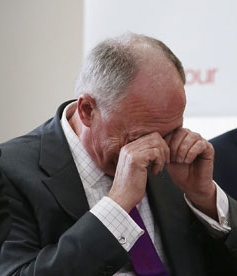
Most people will have seen this photo of Ken Livingstone, overcome by emotion, crying at the screening of his election broadcast.

At the time the explanation given to reporters was that Ken was moved by the genuine words of Londoners and the responsibility he felt to win the election for them.

Stirring stuff. Shame it was rubbish.

The actual situation in the room was this: Livingstone was crying after watching a series of actors that had been carefully selected by his team, read out lines that his writers had penned, in a style directed by his staff. He knew that these were not typical Londoners. He knew that this was his script.

But still the tears flowed.

Read the rest of this entry »

Facebook Twitter Digg Delicious StumbleUpon

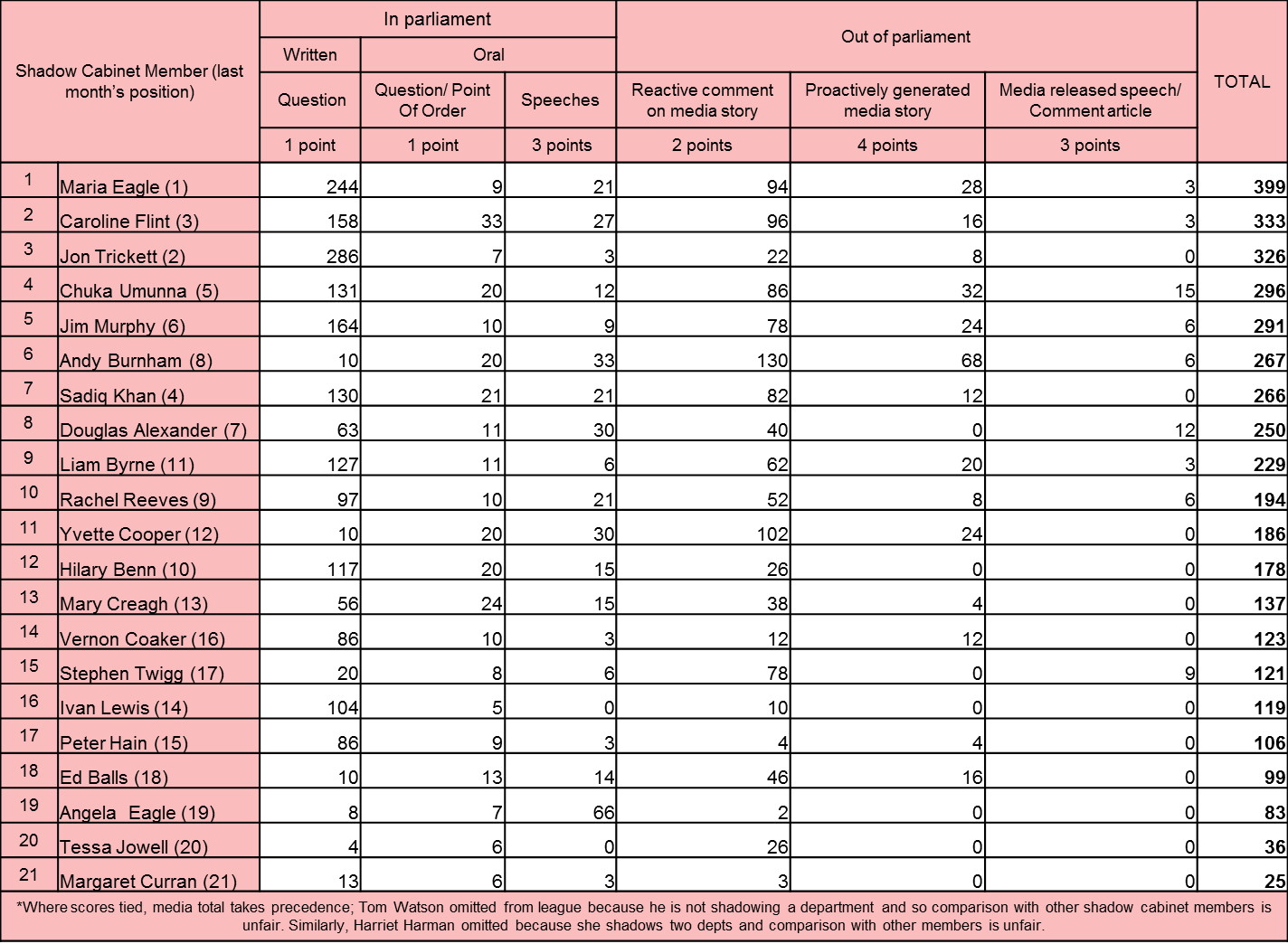
UNCUT: The April shadow cabinet league

12/04/2012, 08:30:36 AM

by Atul Hatwal

It’s become a tedious holiday tradition: MPs tweeting about their various constituency appointments and local campaign meetings, furiously reassuring voters and party members that they are busy at work, despite the long parliamentary recess.

The world really doesn’t need another tweet telling us yet again about a “good reaction on the #Labour doorstep” and for Labour’s shadow cabinet, many (though not all) should just take their break with good grace – they have earned it.

The first three months of this year have seen an unprecedented work rate: over 400 press releases, nearly 1000 written questions and almost 50 speeches from the despatch box.

Compared to last year, at this stage in the parliament, the shadow cabinet’s total score indicates a 54% hike in effort. In every category, the shadow cabinet has done more and worked harder.

While doubts will persist on the effectiveness of the party’s overall strategy, and Bradford West might be a prologue to greater disappointments in the May elections, it is hard to criticise the work ethic of many at Labour’s top table.

Since the last league in early February there has been a minor shuffling of the pack with three shadow cabinet members posting notable performances: Caroline Flint, Chuka Umunna and Andy Burnham.

Read the rest of this entry »

Facebook Twitter Digg Delicious StumbleUpon

UNCUT: Time to put away the needle and thread and stop stitching up selections

11/04/2012, 08:30:59 AM

by Peter Watt

If I was sat in Labour party HQ in Victoria Street right now, staring down the barrel of further financial strife, then I would be tempted to do everything I could to minimise unnecessary expenditure.  And I would be right to do so.  If the reports are true that the party overspent last year by £1.7 million then it is quite a big gun after all!

But if it really is financial strife that has apparently lead to a proposal to ban sitting MPs from standing for election to directly elected mayors or police and crime commissioners later this year, then that is a terrible error.

It is however an error that merely highlights a serious malaise at the heart of our politics, and to be fair, the politics of all of the major parties.

On the face of it, the argument for the decision to ban ambitious MP’s from standing is persuasive.  Each by-election will cost £70 – £100,000 or so.  We might lose to another (popular) candidate.  Why take the risk?

But these reasons are all predicated on an out-of-date thought process.

The assumption is that the only way to win is for the party to impose the “right” candidate. That the campaign must be run using the central party machine which imposes the will of the “experts” on the locals.  And finally that the campaign must then spend on staff, hotels, travel, campaign HQ and lots of flash literature.  All spending money that the party doesn’t actually have.

To be fair, for many years this model served the party pretty well.  As I know well because I have worked on, planned, set budgets for and managed selections (read into that what you will) for more by-elections than I care to remember.  But it is a model that is simply no longer fit for purpose.

Read the rest of this entry »

Facebook Twitter Digg Delicious StumbleUpon

INSIDE: Proxy voting to be allowed in Manchester Central selection

11/04/2012, 07:00:34 AM

Party bosses in the Manchester Central parliamentary selection have been forced to back down and allow proxy voting, following the threat of legal action.

The party had originally taken the highly unusual step of banning postal voting on the grounds that the process was being run on a tight timescale.

However Labour Uncut learns that Anna Hutchinson, the party’s regional director in the north west, who is acting as procedures secretary, has now written to candidates confirming that proxy voting will be allowed during the selection meeting next Monday (16 April).

This followed complaints by at least two of the four candidates – Manchester councillors Mike Amesbury and Rosa Battle – together with constituency party officers, local councillors and several party members who feared many elderly and disabled members would effectively have been disenfranchised by the ban on postal voting.

It is believed one of the members who complained sought legal advice on the basis that the party’s draconian ruling infringed the Disability Discrimination Act.

As well as Amesbury and Battle, the nomination is being contested by Ed Miliband’s deputy chief of staff, Lucy Powell, and Patrick Vernon who runs a health charity in London.

The Manchester Central selection is caused by the decision of sitting MP Tony Lloyd to contest the new role as Greater Manchester’s Police and Crime Commissioner. He held the seat at the last election with a majority of 10,430.

The by-election is scheduled to be held on 15 November, the same day as elections for the 41 police commissioners.

Facebook Twitter Digg Delicious StumbleUpon

UNCUT: Why nobody “likes” Ed Miliband

10/04/2012, 07:00:49 AM

by Peter Goddard

Who likes Ed Miliband? Not the world of Facebook apparently. A quick look at each of the party leaders’ Facebook pages shows David Cameron out in front with 160,514 “likes”, Nick Clegg on 85,488 and Ed Miliband on 13,942.

It seems that Ed is trailing when it comes to the personal touch. Not that any of them are doing stratospherically well in comparison to some of Facebook’s most loved; for example Barack Obama clocks in with just under 26 million “likes” while Rhianna has a little over 54 million admirers.

OK, it’s hardly surprising that none of the leaders can touch the popularity of a US President or a foxy pop sensation, and posting exclusive pics of Ed Miliband in a boob tube probably isn’t the way forward, but these numbers do provide some idea of the potential benefits and audience available from a canny use of social media.

A quick visit to the Labour website indicates the party has some awareness of this. The site is well laid out and clean. It has a clear set of calls to action – it offers you options of joining, volunteering and donating most obviously.

Below this, it provides a neat set of active opportunities for the visitor including “protect pensioners” and “defend working families”.

It’s clear that some learnings from the social media side of things have been applied, demonstrated by the live feed of “recent actions” which shows us what other people are supporting and campaigning for.

The only problem is, Labour.org.uk is not a diverse social media site, it is a special interest site. Whilst they are useful, these functions are primarily preaching to the converted.

Read the rest of this entry »

Facebook Twitter Digg Delicious StumbleUpon

GRASSROOTS: As the government abandons women, where is Labour on equality?

09/04/2012, 12:00:38 PM

by Mike Eakins

The 27th April 2011 was a missed opportunity for the Labour party. On that day the debate surrounding gender inequality did, briefly, rear its head at the forefront of the British political agenda.

David Cameron’s quip advising Angela Eagle to “calm down, dear” brought two distinct reactions with many in the Labour party outraged at the prime minister’s remark. Those with profiles to enhance such as MP Heidi Alexander asserted that “people will rightly be asking how someone with such disgraceful views came to be selected as a Conservative candidate in the first place… David Cameron should apologise and make clear that there is no room for sexism in Britain today”. At the same time some commentators berated those on the left for overreacting to what they insisted was nothing more than a humorous remark.

Amidst all the posturing and prevaricating Yvette Cooper was the sole frontbench Labour voice to look deeper into the prime minister’s comments and question whether they were symbolic of a wider “blind spot” that this government has in relation to women.

In an interview with the New Statesman, the shadow home secretary described what she called a “toxic combination” between the traditional conservative view that the woman’s place is in the home, and the liberal objective to withdraw the state from family life.

The lack of analysis of what lay behind Cameron’s attitude towards women is an indication of how the world in which the equality debate now operates is one of tax policies centred on pasties, government ministers taking blame for individual stupidity, funding scandals, fuel panic and George Galloway MP.

Read the rest of this entry »

Facebook Twitter Digg Delicious StumbleUpon

GRASSROOTS: The Lib Dems’ amazing adventure

09/04/2012, 07:00:05 AM

by Ben Mitchell

Once upon a time there was a political party who believed in something. Who stood for something. Who held views other parties rejected. Who campaigned on issues that weren’t always universally popular.

They then had a leader who grew and grew in stature. Who charmed and won over the electorate in a series of pre-general election televised debates.

But, unfortunately, for said party, this never translated into votes on polling day. Blame our antiquated voting system they raged. We sympathised.

But then, when all seemed lost, along came a smart and convincing salesman offering them the chance of a lifetime. This jolly, chirpy, chappy, waved the prospect of power-sharing under their disillusioned noses.

What’s more, this guy looked and sounded very much like our guy, thought the party faithful.

They hit it off instantly. The public were taken aback: two sworn enemies jumping into bed with each other; governing together? But, their politics are so different. How will they ever get anything done, asked a sceptical media?

Won’t they bicker and argue constantly?

But, they didn’t. In fact, they seemed to quite like each other. A lot. That other bunch aren’t so bad after all, they thought to themselves. We’ve been unfair to them all these years.

Anyway, the party thought, we’ve still got our beliefs and our principles. We’ll never sacrifice them.

Read the rest of this entry »

Facebook Twitter Digg Delicious StumbleUpon

GRASSROOTS: In defence of trade unions and Labour’s union link

06/04/2012, 03:42:17 PM

by Amanda Ramsay

When Ed Miliband published his list of meetings with party funders, unsurprisingly several were with Unite’s general secretary Len McCluskey.  This was widely reported in the press but in the articles there was scant mention of the myriad of sectors a huge union like Unite represents: millions of individuals, working people, 20 sectors at the last count including agricultural, health as well as industrial.

As if one meeting every year or so would be enough time to discuss the huge swathe of complex issues that unions like Unite, the GMB and Unison are dealing with on a daily basis.

The contrast with the elite vested interests of the Tory party, as personified by the  likes of Lord Ashcroft and former Conservative Party Treasurer Peter Cruddas, could not be more stark.

But it’s not just the so-called right-wing press who are complicit in the misrepresentation in the media. Last Saturday, the Independent referred to Len McCluskey donating £5million, as if it were a personal donation, like he just wrote a cheque out of his own money!

“The Labour Party has benefitted from the publicly known link to working people and their views and needs,” Esther Pickup-Keller, president of the Aspect group of the major professionals’ and managers’ union Prospect tells me. “This type of democratic channel is a long, long way from secretive private dinners and meetings with senior politicians by capital corporate interests and donors.”

It’s offensive to hard-working people that the very small amounts of money paid by individual trade union members to the political funds of our unions are portrayed as somehow wrong by certain right-wing commentators and MPs. Where’s the balance?

I’m no militant, but let’s remember what this is all really about. One of the most poignant stories to learn as a teenager, to spark my imagination and social conscience, was that of the Tolpuddle Martyrs; their story speaks about something universal, way beyond party politics – shock and awe that these men could be shipped-off to be imprisoned on the other side of the world, for standing-up for their rights in the workplace, civil rights, human rights, call it what you will.

This is still the case today, for those of us who believe in trades unionism, the relevance of trade union membership is as relevant now as it’s ever been.

Read the rest of this entry »

Facebook Twitter Digg Delicious StumbleUpon

UNCUT: Livingstone NIC-ed on tax avoidance

06/04/2012, 08:04:03 AM

by Atul Hatwal

The hand to hand combat of a mayoral campaign is hardly the ideal environment for sober reflection, but for the Labour party, it’s time to have a long hard think.

After yesterday’s partial release of the mayoral contenders’ tax and earnings details, there is now a threat that Ken Livingstone will not just lose the London election, but will seriously damage the national party in the process.

The full nature of this danger is not quite apparent yet. The media focus over the last 24hours has been on examining the total tax paid by each of the candidates, looking at who paid the most. This is understandable but misses the point.

The issue is not about the absolute amounts handed over to HMRC, but whether these figures demonstrate that the candidates have, or have not, lived up to their rhetoric.

It’s about trust, not finance and for one of Labour’s most high profile figures, who has volubly railed against tax avoidance, the figures are damning.

In 2010/11, setting aside pension contributions, Ken Livingstone received 92% of his income – £63,333 – through dividends and just 8% or £5,700 through a normal salary where tax was deducted on a pay as you earn (PAYE) basis.

This approach is a standard and perfectly legal way of drawing down money from a company and is used by hundreds of thousands of people for one simple reason: it avoids national insurance contributions (NICs).

Dividends are not liable for NICs, so being paid principally through dividends reduces or completely removes NICs payments.

In 2010/11 the threshold to start paying NICs was £5,720 per year and as if by magic, Ken Livingstone’s PAYE income for the year was £20 below the level where any NICs would have to be paid.

Fancy that.

The only reason £5,700 was paid as PAYE income at all is that that there needs to be a  level of PAYE earnings each year above a minimum threshold (£5,044 in 2010/11) to  build eligibility for certain benefits. For example, the state pension, for which Ken Livingstone qualified, during 2010/11.

Again, to be clear, this is not tax evasion, and it’s certainly not illegal, but avoiding NICs is tax avoidance for most voters.

Read the rest of this entry »

Facebook Twitter Digg Delicious StumbleUpon