UNCUT: The government’s NHS changes tell you everything you need to know about the Tories

06/06/2011, 08:29:05 AM

by Michael Dugher

When Parliament returns this week after the half-term recess, the spotlight will once again return to the battle over the government’s changes to the NHS. The so-called “listening period” is at an end and we will see if Andrew Lansley has really listened, or if the pause to the health and social care bill was merely a cynical, cosmetic exercise designed to shore up Nick Clegg’s position and maintain the coalition as a going concern. John Healey, Labour’s shadow health secretary, has done a brilliant job exposing the true nature of the government’s proposals for the NHS. He will table nearly 40 amendments once the bill comes back to the Commons to test the government’s willingness to listen and think again. But the government’s approach to the NHS tells us everything we need to know about the Tories and Labour’s attack might similarly apply to other areas of government policy too.

First, the changes to the NHS demonstrate that the Tories are reckless. Like in other areas – the so-called strategic defence and security review leaps to mind – the changes were rushed, careless and ill-thought through. The new bill is the largest legislative document in the history of the NHS. With its 136 clauses, the original text of the bill was so large that the chief executive of the NHS, David Nicholson, joked that it was “the only reorganisation you can see from space”.  The coalition agreement stated that it was the government’s intention to “cut the bureaucracy at the heart of the NHS”.  Yet the British medical association (BMA) claimed that the changes will “replace one bureaucracy with a perhaps even more dangerous one”. As John Healey has highlighted, the usual process for sound public policy, namely that of consultation-legislation-implementation, has been reversed.

David Cameron has tried desperately to “detoxify” the Conservative brand. He knew that central to the old image of the Tories as the “nasty party” was consistently polling so badly in the “who do you most trust to protect the NHS” question. Cameron has also read Tony Blair’s book. Blair once famously said: “Every time I’ve ever introduced a reform, I wish in retrospect I had gone further”.  But when it comes to the proposed changes to the NHS, the Conservatives are guilty of seriously over-reaching themselves. They simply do not understand that the national health service is a cherished institution for the British people.  We all want to see improvements – big ones – but all governments must proceed with care.

Read the rest of this entry »

Facebook Twitter Digg Delicious StumbleUpon

UNBOUND: Monday News Review

06/06/2011, 07:00:56 AM

Cameron to make desperate bid to convince public to trust him on NHS

David Cameron will commit to “five guarantees” on the future of the National Health Service in a speech on Tuesday designed to reassure critics of his controversial health reforms, The Daily Telegraph can disclose. The Prime Minister will promise to keep waiting lists low, maintain spending, not to privatise the NHS, to keep care integrated and to remain committed to the “national” part of the health service. Such is the concern in Downing Street at the damage the issue of NHS reform is causing the Government, that Mr Cameron will put his reputation on the line with a personal pledge to protect its core values. It represents his boldest attempt yet to assuage criticism from his Liberal Democrat Coalition partners and from many health professionals over the impact of the reforms. In his speech, the Prime Minister will admit that he is willing to act on their concerns after listening to the “profession and patients” during a two-month exercise which was held after Mr Cameron called for a “pause” in the Health Bill’s passage. His “five guarantees” are designed to show the Prime Minister is committed to the NHS, and “he is hearing what is being said”, according to one source. Mr Cameron’s promise on integrated care is designed to ensure patients receive continuity of treatment, without having to explain their condition from scratch each time to different doctors. – the Telegraph

We are told that he is in part moved by the polling evidence put before him by Andrew Cooper which shows the public losing confidence in the Coalition’s reliability on the NHS. Hence the panic in No10, where along with the economy and keeping the Lib Dems on board, keeping credible on health is considered an existential pre-requisite. Which explains tomorrow’s announcement, even if the detail is underwhelming. The pledges amount to the same message – the NHS is safe with us – but said with more words. The one about waiting lists has implications for spending, as the four per cent efficiency squeeze imposed by new spending realities are predicted to have dire consequences for what patients will experience. Last week, amid the quiet of the recess, it was evident in conversations with No10 that this issue remains the big preoccupation. Andrew Lansley’s ‘reform or die’ warning, with its prediction of £20bn a year shortfalls, underscored the anxiety (and not just about his job). Health still has the potential to derail all George Osborne’s election plans. Which is why Mr Cameron is wasting no time on his return to address the issue. He’s that worried. – the Telegraph

Lib Dems face wipe out

The Liberal Democrats face losing up to a quarter of their seats when a Tory-imposed plan to redraw the entire electoral map comes into force from September, figures seen by the Guardian suggest. The boundary review to equalise constituencies and reduce their number by 50, agreed by Nick Clegg in exchange for the AV referendum in the coalition agreement, is threatening the biggest upheaval to the Commons of this parliament. MPs have been warned that almost no seat is safe. The issue could force a mutiny in the coalition amid mounting evidence that the Liberal Democrats will fare far worse than predicted and withDavid Cameron facing further tensions with his backbenchers, some of whom are certain to lose their seats. The four Boundary Commissions of England, Scotland, Wales and Northern Ireland are preparing to announce the new electoral map in September. But the most detailed analysis yet of what those new seats might look like, conducted by academics based at Liverpool University and published by the Guardian, suggests the Liberal Democrats will lose the greatest proportion of their seats. Fourteen out of 57 could be wiped off the electoral map. – the Guardian

The Liberal Democrats could lose a quarter of their seats under boundary changes currently being drawn up by the Government, more than four times that of Labour, according to a new study. Academics at Liverpool University found that the Liberal Democrats would lose 14 of their 57 seats, or 24.6 per cent, under the proposed changes. Labour would lose 17 (6.6 per cent), while the Tories would be least harmed, losing 16 seats, or 5.5 per cent. The current review on constituency boundaries was agreed by the Liberal Democrat leader Nick Clegg in return for a referendum on the Alternative Vote, and aims to reduce the number of MPs by 50. The study, published in The Guardian, was conducted by Democratic Audit, a research group working out of Liverpool University. It is the most detailed of its kind, and paints a much bleaker picture for the Liberal Democrats than previous studies. – the Independent

Cable warning to Unions

Union chiefs will be warned by a cabinet minister today that a concerted programme of industrial action against the Government’s austerity measures could result in anti-strike laws. Up to one million workers are expected to walk out on 30 June in protest against the spending cuts, and further shows of union strength are planned for the autumn. Vince Cable, the Liberal Democrat Business Secretary, will tell a union conference that such moves could backfire by playing into the hands of senior Tories pressing for fresh controls on industrial action. Speaking at the conference of the GMB union in Brighton, he will acknowledge that “feelings are running high” in the union movement, but call for “cool heads” on all sides. He will say: “The usual suspects will call for general strikes and widespread disruption. This will excite the usual media comments about ‘a summer’ or ‘an autumn’ of discontent. And another group of the usual suspects will exploit the situation to call for the tightening of strike law. “We are undoubtedly entering a difficult period. Cool heads will be required all round. Despite occasional blips, I know that strike levels remain historically low, especially in the private sector. On that basis, and assuming this pattern continues, the case for changing strike law is not compelling.” – the Independent


Facebook Twitter Digg Delicious StumbleUpon

UNCUT: The Sunday Review: The Master Switch, by Tim Wu

05/06/2011, 05:37:27 PM

by Anthony Painter

The information and communication revolutions of the last few decades have given us access to more content than we could possibly have dreamed of. Imagine what it would have taken to establish Labour Uncut just twenty years ago. You’d need an investor, an office, professional writers, paying subscribers, access to a printing press, and some form of retail and/or mail order distribution. The chances that it would exist are slight.

Labour Uncut is not alone- there is a huge diversity of political blogs and websites providing access to an enormous range of voices. That’s before Twitter or Facebook are even factored in. This is a golden age of access to content diversity. We are fortunate because if the history of the information industries is anything to go buy, these periods of openness are relatively short-lived. The age of the open internet is precious.

It is not the only time such a diverse range of content has been publicly accessible. In the US in the 1920s, radio was a cacophony. It was limited by frequency and amplitude in a way that the internet in the broadband age isn’t but it bears a striking similarity to the internet of today. Local enthusiasts would broadcast their take on the world, local gossip, critical community information; it was a true people’s medium. Alongside that there were the early radio networks: Radio Corporation of America and AT&T’s National Broadcasting Service who merged in 1926 to become what we know today as NBC. Thus, radio of the mid-1920s was a blend of national commercial might and enthusiastic amateurism- much like today’s internet.

Could the two sit together in perpetuity? Of course not. And the big guy won. It wasn’t even a fair fight. The Federal Radio Commission stepped in and, in the interests of clearing the airwaves to enable a higher quality service, all but killed amateur radio. The master switch had been flipped. In Nazi Germany, Goebbels centralised radio in the interests of the creation of bringing ‘a nation together.’ The US did it in the interests of corporate power and customer service. In each case, however, they chose a closed over an open form of information provision and carriage. Read the rest of this entry »

Facebook Twitter Digg Delicious StumbleUpon

GRASSROOTS: Labour should lead on constitutional reform

04/06/2011, 01:00:43 PM

The first few years of the last Labour government were radical in a number of ways, and particularly in the way we tried to reform our constitution. We (mostly) swept away the hereditary peers in the House of Lords, threw open a lot of doors and windows onto the workings of government with the freedom of information act and devolved power to Scotland and Wales. This led – not as critics predicted at the time to the formation of a pair of jumped-up local councils – but two thriving institutions that have helped to foster new political systems, a process given expression in spectacular fashion in Scotland a few weeks ago.

As with other areas of policy, we began to lose our radicalism the longer we were in government and our enthusiasm for constitutional reform petered out almost to nothing. We set up a commission to examine electoral reform and then rejected Jenkins’ sensible, moderate proposals for entirely political reasons.· Lords reform was voted on innumerable times and the last proposal – when MPs finally stopped rejecting all of the permutations put to them – got nowhere.

Had we pressed ahead with our plans for a mostly or wholly elected Lords there would have been a second chamber election mid-way though this parliamentary term, giving us a chance to put a new Labour agenda to the public and – in the event of a win – prove to ourselves and to the country that we can be election winners again. A Labour win would have inflicted a mortal wound on the government and provided the perfect springboard from which to launch a general election campaign.

In the end, we didn’t go ahead and now Cameron has assured himself a strong position in the Lords by stuffing the upper house with Tory and Lib Dem apparatchiks. Had we gone ahead with Jenkins’ AV+, then the progressive majority that exists in the country would have been translated into the election results and the progressive rainbow coalition touted last May that was a nice-but-impossible idea would have been entirely workable.

Ed Miliband shouldn’t let his recent unhappy dalliance with electoral reform blunt his aspirations for changes in the way we conduct public affairs, nor convince him that the British public have no appetite for changes to the way we do politics. As a result of the way it was conceived – a Liberal Democrat demand for entering into coalition – the referendum was seen by most through an entirely party political lens and became a referendum on the deputy prime minister and not on the change he was proposing. Read the rest of this entry »

Facebook Twitter Digg Delicious StumbleUpon

HOME: The week Uncut

04/06/2011, 10:31:10 AM

In case you missed them, these were the best read pieces on Uncut in the last seven days:

Peter Watt says it’s time to stop calling Dave posh

Atul Hatwal looks at Labour’s London problem

Kevin Meagher calls time on gesture politics

Dan Hodges on a party scared of its own shadow

John Woodcock warns of the Lib Dem threat

Sunder Katwala on the make up of the green benches

Jonathan Todd says Labour needs to realign with ordinary people

Facebook Twitter Digg Delicious StumbleUpon

UNBOUND: Saturday News Review

04/06/2011, 09:00:16 AM

Campaigners warn council soup ran ban human rights breach

A proposal to outlaw soup runs for homeless people in one of the country’s most affluent areas would breach human rights laws, campaigners have warned. Westminster council has become embroiled in the row after threatening the crackdown on the service around Westminster Cathedral Piazza, central London, in an effort to discourage rough sleeping. The Conservative-run council is considering criminalising free food for the homeless amid claims it causes litter problems and creates disturbance to local residents throughout the area, one of the capital’s most affluent. Officials claim up to seven soup runs feed about 150 homeless people outside the cathedral each night, giving out hot drinks and making it a “no-go area” for residents and businesses. But human rights campaigners them as “wholly unacceptable in a civilised society”. Volunteers have also accused the council of being anti-Christian. The claim is denied by officials. – the Telegraph

Cameron backs plans to protect children from sexualised imagery

David Cameron is to back a plan to stop retailers selling inappropriate clothes for pre-teens and shield children from sexualised imagery across all media, including selling “lads magazines” in brown covers and making the watchdog Ofcom more answerable to the views of parents. Retailers would be required to sign up to a new code preventing the sale of items for pre-teens with suggestive slogans, which the prime minister has repeatedly criticised. The proposals come in a long-awaited report, leaked to the Guardian, on the commercialisation of childhood. It was commissioned by Cameron and is due to be published on Monday with strong support from Downing Street. The report, which was prepared by Reg Bailey, the chief executive of the Christian charity Mothers’ Union, finds “sexualised and gender stereotyped clothing, products and services for children are the biggest concerns for parents and many non-commercial organisations”. In response to his recommendations on clothing, it is expected that the British Retail Consortium, following consultation with Mumsnet, the web-based parents’ forum, will announce a new code next week. – the Guardian

Shops should have to display “lads’ mags” in plain covers and stop selling suggestive clothes to pre-teens under a range of measures backed by David Cameron to protect children from sexualised imagery. Music videos should carry cinema-style certificates, advertisers should be discouraged from putting up raunchy posters near schools and broadcasting regulators should be instructed to clamp down on explicit programmes before the 9pm watershed. The plans will be set out next week in a report commissioned by the Prime Minister on combating the sexualisation of young children. The report, Let Children Be Children, was drawn up by Reg Bailey, the chief executive of the Mothers’ Union. It warns: “Sexualised and gender-stereotyped clothing, products and services for children are the biggest concerns for parents.” – the Independent

Vocational training should start earlier

At least 40 per cent of pupils should take high-quality vocational training that leads directly to a job to cut the youth unemployment rate and boost economic competitiveness, according to Tim Oates, director of research at the Cambridge Assessment exam board. He suggested the Government should also consider giving children more job-based tuition at the age of 14 or even as young as 11. The recommendations are likely to form part of a wide-ranging review of the National Curriculum to be published later this year. In an interview with The Daily Telegraph, Mr Oates said England risks being left behind other developed nations because the country fails to offer students the chance to go down a “rigorous vocational route” at the end of secondary education. – the Telegraph

Crack down on high earning council tenants

Tenants who earn more than £100,000 a year could be removed from their council houses under plans being examined by the Government. Housing Minister Grant Shapps complained that some wealthy people were living in properties that should be kept for the least well off. “With so many people in housing need languishing on the waiting lists which doubled under Labour, it’s right to consider whether people on £100,000-plus salaries should get their rent subsidised by the taxpayer,” he told the Daily Telegraph. “Social housing is an expensive and scarce resource which should be targeted on supporting those in real need.” Up to 6,000 people could be affected, according to figures prepared by officials, and ministers are ready to change the law if necessary to ensure local councils and social landlords can evict those who refuse to leave, the newspaper reported. The lower rents charged by social housing meant people in some parts of London could save as much as £70,000 a year compared with the price of a similar property in the private-rented sector, it said. – the Independent

Facebook Twitter Digg Delicious StumbleUpon

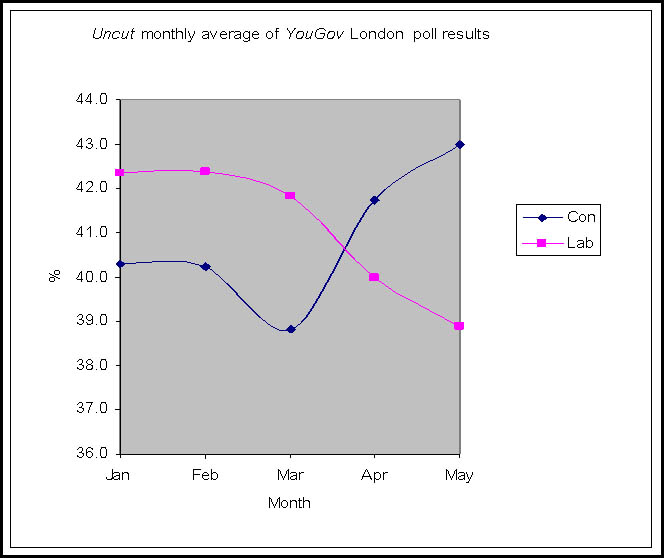
UNCUT: No way back from losing London?

03/06/2011, 07:30:54 AM

by Atul Hatwal

Can you hear it? That creaking, grinding metallic sound, emanating from the capital.

Even faintly in the background?

No? Well, it will get louder in the coming months till it’s deafening.

It is the sound of the clock being turned back twenty years to a time when London was a Tory town.

Labour might have lost the 2010 general election, but London remained a last redoubt in the south. Despite all the troubles, Labour was still the dominant party, winning 36.6% compared to the Tories on 34.5% and the Lib Dems on 22.1%.

In terms of seats, the result was even better with Labour taking 38 seats, the Tories 28 seats and the Lib Dems just 7 seats.

But that was then and a year is an eternity in politics.

2011 could go down as the year in which the Tories turned back a generation of Labour ascendancy in London and pulled decisively ahead.

A new Uncut analysis of YouGov polling shows how a Labour lead of 2% in January had become a deficit of 4% by the start of June.

Polls can be deceptive and there is always a debate to be had about the extent to which they really reflect voting intentions, but two factors make these figures particularly worrying for Labour.

Read the rest of this entry »

Facebook Twitter Digg Delicious StumbleUpon

UNBOUND: Friday News Review

03/06/2011, 07:00:22 AM

Government fails to get to grip on immigration

Labour have hit out at the Government over its failure to clear a backlog of asylum applications. Shadow Immigration Minister Gerry Sutcliffe told BBC News: “This Government came into power saying they were going to deal with immigration but they’ve cut the resources, cut the budget… The rhetoric doesn’t fit the reality.” Immigration minister Damian Green denied there was an “amnesty” on asylum seekers, saying: “There’s absolutely no amnesty. There’s been no change in policy – we look at each case on its merits and indeed the number of people applying for asylum is at a 20-year low at the moment.” The Home Affairs Select Committee said so many people had been granted leave to remain in the UK that it “amounts to an amnesty”. Figures show that only 9% of the 403,500 cases processed by the UK Border Agency resulted in removal, with 40% given leave to stay. – Politics Home

Government criticised over arts funding

The former Poet Laureate Sir Andrew Motion accused ministers of adopting a “shoot first, aim later” policy towards cutting the arts, singling out Culture Secretary Jeremy Hunt and Arts minister Ed Vaizey. “Jeremy Hunt… from the word go has seemed more determined to get into George Osborne’s good books as a macho money saver and quango-burner than to serve his sector well,” he said in the annual Romanes lecture at Oxford’s Sheldonian Theatre. “Ed Vaizey… does seem to have a genuine love of the arts but no ideas about how to defend them in difficult times.” He added that he could not recall “a single remark has ever been uttered about the arts and humanities by our Prime Minister and his deputy”. The result was wholesale closure of libraries, the axeing of bodies like the Film Council and the museum, Libraries and Archives Council and the slashing of funds to the Arts Council (£118 million had been cut from its budget). In addition, music services to schools had been cut by local authorities and Education Secretary Michael Gove was introducing a new English Baccalaureate certificate for which a\n arts GCSE would not qualify. – the Independent

Time for Labour to rethink aid policy

Little has emerged from the Labour party on international development in its first year of opposition, which is understandable given the priorities it is facing and the fact the shadow team has only been in place for six months. What we have heard has centred on a campaign to keep to the0.7% pledge, and a focus on women’s rights. All good, but perhaps a little conservative for a party expected to lead the agenda on poverty and international development. The world has changed beyond recognition, and the Labour opposition’s international development policy needs to change too. It will be reviewed as part of Ed Miliband’s comprehensive rethink of Labour policy. During his leadership bid, Miliband said the biggest question for Britain for the next decade is “whether we head towards an increasingly US-style capitalism – more unequal, more brutish, more unjust – or whether we can build a different model, a capitalism that works for people and not the other way around”. That’s a good question, but not just for Britain, for the rest of the world as well. Unfortunately, attempts to set out a distinctive Labour vision for international development are hampered by the desire of the main parties to project unity on major issues of development. – the Guardian Read the rest of this entry »

Facebook Twitter Digg Delicious StumbleUpon

UNCUT: Break down the Berlin Wall at FIFA

02/06/2011, 02:00:16 PM

by Jonathan Todd

What power have you got? Where did you get it from? In whose interests do you use it? To whom are you accountable? How do we get rid of you?

Tony Benn wants these questions to be put to any powerful person. If Sepp Blatter retains any self-awareness whatsoever, which is doubtful, then he must cringe to have these questions applied to him.

He has great power as the president of football’s global governing body, FIFA. Following the “temporary exclusion” by FIFA’s ethics committee from football posts of Mohamed Bin Hammam, who was challenging Blatter for this post, he was yesterday re-elected, unopposed, for another four year term. The coronation of Blatter came from a body that has seen nine of its 24 executive committee members accused of corruption in recent months. While FIFA’s motto is “for the game, for the world”, the power bestowed in Blatter may not always further such high-minded ends. He seems accountable only to the executive committee, who exclusively appear able to remove the man in charge of a game loved with passion by billions.

Read the rest of this entry »

Facebook Twitter Digg Delicious StumbleUpon

UNCUT: Our class based attacks on Cameron are missing the mark

02/06/2011, 07:46:31 AM

by Peter Watt

To paraphrase Sun Tzu in The Art of War, you need to know your enemy. But does Labour know who David William Donald Cameron is? Understanding him, his relationship with voters and his party is an important part of Labour’s preparation for the tough elections to come.

I suspect that while we think that we understand him, we are deluded. Instead we are judging him through our own partisan prism, which is in contrast to much of the electorate. Ask most Labour party folk what they think of Cameron and they will emphasise his class. They will talk of Eton and the Bullingdon club, of the baronets in his lineage and the millions he has in the bank. This all adds up, so the theory goes, to one seriously out of touch (and obviously posh) politician.

But this emphasis on his “poshness” is currently cold comfort. Let us start with first principles: he is likeable and popular with voters. According to the latest You Gov poll for the Sunday Times, his approval ratings are at +2, with 48% saying he is doing very well or fairly well. Nearly one in five Labour 2010 voters agree. And popular leaders tend to win elections more often than not. As importantly, according to a Populus poll, in early May, Cameron is comfortably beating the other party leaders on leadership attributes like “standing up for Britain”, “determination” and “competence”. It is true that Ed does have a lead on “shares my values” and “on my side”, but these leads are small.

Read the rest of this entry »

Facebook Twitter Digg Delicious StumbleUpon