Archive for 2012

Crime and communities in the spotlight in Bristol’s “City Conversation”

04/08/2012, 08:00:12 AM

by Amanda Ramsay

Thursday night was the crime and communities’ roundtable, the fifth in a series of Marvin Rees’ “City Conversations” which will inform his mayoral manifesto.

Past events have been chaired by shadow ministers such as Stephen Twigg and Hilary Benn with Thursday night’s event featuring Bob Ashford, Labour’s candidate to be the first police and crime commissioner for Avon and Somerset, as co-host.

The focus on Thursday was on how Bristol can build stronger communities to prevent and tackle crime and reoffending.

Attended by youth workers, councillors, crime enforcement representatives and people from victim support groups, community and pressure groups, Rees was clear about his intentions to the audience:

“It’s critical that we get people from across the city working better together.

We must always remember, it’s the most vulnerable who will pay the heaviest price if we don’t get this right. It costs us all of course, but it’s the most vulnerable who pay the most.”

Like or loathe the idea of elected police and crime commissioners they are coming soon, with the poll due on 15th November. Labour need to secure these pivotal roles to protect policing and the public from the type of populist button-pressing right wingers that have emerged in similar US elections. Who knows where that may take British policing?

(more…)

Facebook Twitter Digg Delicious StumbleUpon

Chilcot remains the test of Labour’s new unity

03/08/2012, 07:00:40 AM

by Kevin Meagher

The ripples in Labour’s millpond have stilled. An eerie, becalmed peace is left. Nothing succeeds like success and Ed Miliband has reached the summer recess with reason to feel quiet satisfaction. His frontbench team has become more effective, the government benches less so. His party is united, the coalition fractious and sclerotic.

The prime minister will have his work cut out ahead of the party conference season, repairing relations with his backbenchers, keeping the Lib Dems sweet and removing Boris Johnson’s tanks from his lawn as a seemingly smooth-running Olympics emboldens the London Mayor in his bid to one day replace Cameron.

Ed Miliband, in contrast, can kick back and plough through his summer reading list uninterrupted. Labour’s opinion poll lead remains, if not spectacular, then the next best thing: consistent. Miliband has developed themes around responsibility and fairness which continue to resonate. He has also been lucky in his opponents too. His ‘predators’ speech at last year’s Labour conference, much maligned at the time, is vindicated with every new detail that emerges from London’s square mile, with allegations of HSBC laundering drugs money the latest seamy instalment.

But Miliband has started to make his own luck too. Tales of chaotic organisation and accusations of gauche appearances in the media and at prime minister’s questions are no longer made. The Labour machine, replete with a new top team of senior directors, is beginning to purr once again. Candidates for November’s police commissioner elections – the next big electoral test – are already in place while the Conservatives struggle to fill the roles.

Meanwhile, prolonged recession is hardening the public mood against ministers’ hoary claim that they are “dealing with the mess Labour left”. Their excuses have rapidly declining purchase as the economy flatlines. The writing is on the wall when even the IMF starts inching away from George Osborne’s deficit-masochism.

Voters’ acceptance of belt-tightening was only ever going to be short-term. Each tale of corporate and banking excess tests the patience of a frustrated public which contrasts its own sacrifices with our mangy corporate elite’s lack of restraint.

The result? All the big problems in British politics are shovelled against David Cameron’s door this summer. A one-time (self-styled) ‘heir to Blair’ he lacks the older man’s panache and luck. This is painfully evident with Blair now returning to British public life in a series of carefully choreographed interviews and appearances.

His re-entry into Labour’s orbit has been especially tentative. His presence at the party’s gala sports dinner recently and the announcement that he will take on a role advising Ed Miliband on the Olympics’ legacy generated a frisson of controversy on Labour’s left, but it was largely synthetic. And predictable. Those who dislike Tony Blair will always now dislike him, whatever he says or does.

His new advisory role is free-form and, in reality, little more than an organising concept for either man. For Ed Miliband the value of a returning Blair is to show that the Labour tribe is reuniting, cynically, perhaps, given the growing sense that David Cameron seems set on emulating Ted Heath as a one-term Tory prime minister; but coming together nonetheless. Talent from across the party now supplicates itself to a leader many did not want but who all now realise is going to lead Labour into the 2015 general election, come what may.

(more…)
Facebook Twitter Digg Delicious StumbleUpon

Labour needs to stop moralising about tax

02/08/2012, 07:00:40 AM

by Peter Watt

Is paying tax a moral duty?  It is the sort of question that has those on the left and right frothing at the mouth.

The question has recently come to the fore once again with row after row over tax avoidance by some of the rich and famous.  On the face of it the case is obvious.

At a time when budgets are being squeezed and services cut there are people who are really suffering.  Jobs are going and much valued support services to some of our most vulnerable are being cut so that we can reduce the amount we are borrowing as a country.

We all need to do our bit by paying our taxes and if you choose to deliberately avoid paying yours then what does that make you?  Selfish?  Unfair?  That’s certainly the common view; and with George Osborne and Ed balls united in a desire to clamp down on such “aggressive” schemes it seems that there is a degree of consensus; paying tax is our moral duty.

But, on the other hand I have an ISA that means that I don’t have to pay tax on any interest I accrue.  I take advantage of duty free (tax free) shopping when I travel abroad.  I took advice on planning my pension and made sure that my arrangements were tax efficient.  And I am hardly alone, millions of people do it.  If you have to undertake a self-assessment then you don’t start the process trying to maximise what you have to pay you look to minimise it.

It may not be in the same league as the Jersey based K2 scheme made famous by Jimmy Carr, but it is still tax avoidance.

And companies rightly look to make tax-efficient investment decisions.  Their duty is to maximise returns for shareholders and part of that is to legally minimise the tax that they have to pay.  Paying less tax means that they can maximise reinvestment in innovation and jobs; which will in turn generate more tax.

Bigger profits mean better returns for shareholders, many of whom are millions of people with savings and pensions schemes.

When the Labour party bought a London property a few years ago, it used a company to buy it.  The party did that so that when they sold the property it would be more tax efficient and indeed, when it was sold it saved tens of thousands of pounds as a result.  Quite right too!

(more…)

Facebook Twitter Digg Delicious StumbleUpon

Bringing the “service ethos” into schools is already making a difference

01/08/2012, 07:00:03 AM

by Kevan Jones

Last month Labour’s education and defence spokesmen, Stephen Twigg and Jim Murphy, outlined some ideas on how the role of the armed forces and the “service ethos” could be expanded across our education system.

Their ideas included having mentoring services run by veterans or reservists, increasing the number of former service personnel trained as teachers, having more Combined Cadet Forces (CCF) in state schools and developing specialist “service schools”, including academies, all in order to boost achievement and social mobility. This week Labour released a paper on the proposals as part of our policy review.

Perhaps predictably a chorus of groans followed the announcement, much of it from the Labour blogosphere, about how this showed Labour betraying its working class origins and aligning itself with “militaristic” values.  Not only do the criticisms misunderstand or misrepresent the aims of these ideas, but they fail to understand the military in ways that can be as short-sighted as they are offensive.

Many of the criticisms also overlooked the fact that many of the ideas proposed already exist to the huge benefit of schools in the state sector. I know this from the experience of Walker Technology College in Newcastle.

Walker Technology College was set up during the last Labour Government in 2009 as a pathfinder school, with a Combined Cadet Force (CCF) contingent of 20 cadets. It now has over 100 cadets enrolled and pupils have the opportunity to choose CCF as a curriculum subject.

As part of this, students are able to achieve an army proficiency course accreditation, the Duke of Edinburgh award, a BTEC in public uniformed service and a young first aiders’ award. Since the course was established it has consistently proved to be one of the highest performing and popular awards in the school.

Hard-work, comradeship, respect, responsibility and team work are the essential “soft skills” that have the CCF contingent have brought to Walker College. The “service ethos” that underpins the CCF develops and hones this vital set of life skills, which are highly sought after in a jobs market that is only getting tougher for young people.

It is essential that we maximise the impressive leadership skills that service men and women develop during their time with the armed forces. The CCF course at Walker College has provided former service personnel with a challenging, fulfilling post-service career, which has been to the benefit of young people in Newcastle, increasing attainment, confidence and opportunity.

(more…)

Facebook Twitter Digg Delicious StumbleUpon

Is Mitt Romney the worst ever presidential candidate from a major party?

31/07/2012, 07:00:04 AM

by Nikhil Dyundi

Carl Lewis said it best about Mitt Romney’s little foreign tour: “Seriously, some Americans just shouldn’t leave the country.”

Damn right.

I can say that, I’m American. But based on Mittens’ performance in the UK, Israel and Poland, you are fine to think it too.

It’s not just Romney saying he wasn’t sure about how the London Olympics would turn out as he began his visit to er, London, or that Israel’s superior culture is the reason for their greater wealth than the Palestinians. These are individual pratfalls. To get to the heart of Romney’s true anti-genius you need to understand that it’s his instinct which is truly remarkable.

No politician in modern times has had a more unerring ability to make the wrong judgement in any given situation. Sure there have been politicians that have been on the wrong side of public opinion. Lots of guys have taken a beating in a poll.

The Dems had George McGovern in 1972 crash to a truly epic defeat and there was Barry Goldwater for the GOP in 1964 bringing tea party crazy to the peace and love decade. Walter Mondale was wiped out by Reagan in 1984 – he lost every state but his own and DC – and Bob Dole never got near to Clinton in 1996.

But in each of these defeats, the candidates were out of step with their time and the electorate. As professional politicians, they might not have been the outstanding talents of their generation, but they were competent. Most of the time, you don’t get to be the nominee unless there is some ability there.

In this country, you’ve had people like Michael Foot and William Hague. Neither would make a pantheon of great party leaders, but as statesmen they had their talents.

The thing with Mittens is that unlike this list of gallant trans-atlantic losers, he doesn’t even have the basics.

Romney gets everything, be it major or minor, wrong.

(more…)

Facebook Twitter Digg Delicious StumbleUpon

Aidan Burley equal opportunities photo special

30/07/2012, 07:00:50 AM

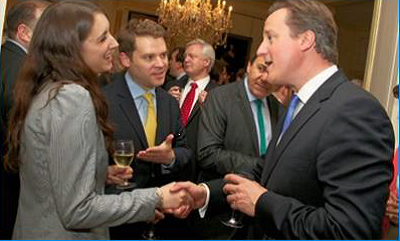
Why, who’s this cheeky little scamp? It’s only misunderstood Twitter führer Aidan Burley. Here he is in a photo from his latest constituency e-bulletin, hard at work introducing a local councillor to the prime minister.

Well done Aidan, it’s good to motivate the local troops and what better opportunity than a glittering Number 10 reception. This councillor was probably selected for such an exclusive invitation because of some form of outstanding local community contribution.  That would probably explain why she is featured so prominently is Aidan’s e-bulletin.

But hang on, she looks familiar. What’s that name again? The bulletin tells us it’s Jodie Jones.

Surely not the Jodie Jones who also works for one Aidan Burley? And it can’t be the Jodie Jones that young Aidan is currently squiring around the bright lights of Cannock Chase?

Because, if it were that Jodie Jones, in a spirit of openness and transparency, we know Aidan would have made it clear in the bulletin.

Otherwise people could get confused again, much as they did over his Olympic tweets, and there might another terrible misunderstanding.

Silly, wrong-headed people might draw erroneous conclusions about the type of outstanding local contribution needed to secure an invite from Aidan to meet the PM and quaff free vino.

That would never do, because as we know from Aidan’s Friday night tweeting and subsequent clarifications, no one is more dedicated to the cause of equality of opportunity than Cannock Chase’s MP.

(more…)

Facebook Twitter Digg Delicious StumbleUpon

What will it take for voters to choose Labour over the Tories on the economy?

27/07/2012, 07:00:25 AM

by Atul Hatwal

It’s the question on which the next election will turn.

David Cameron and George Osborne have been at the helm for just over two years and in that time the economy has been shrinking for five out of eight quarters.

While other countries that were also in the eye of the financial storm, such as the USA, have recouped their lost output since 2008 and are growing, our economy is still 4.5% smaller than when the banks collapsed.

Even in the nightmare of the Eurozone, only Italy is in a double dip recession like Britain.

The situation could hardly be worse, but still, almost beyond logic and certainly beyond the comprehension of most of the Labour movement, the public believe Cameron and Osborne to be more economically competent than Ed Miliband and Ed Balls by a double digit margin.

July’s ICM poll had the Tory incumbents in an 11% lead over Labour’s challengers. This lead actually grew between June and July by 2% from 9% to 11%.

So what would it take for the two Ed’s to take the lead or at least wipe out the deficit?

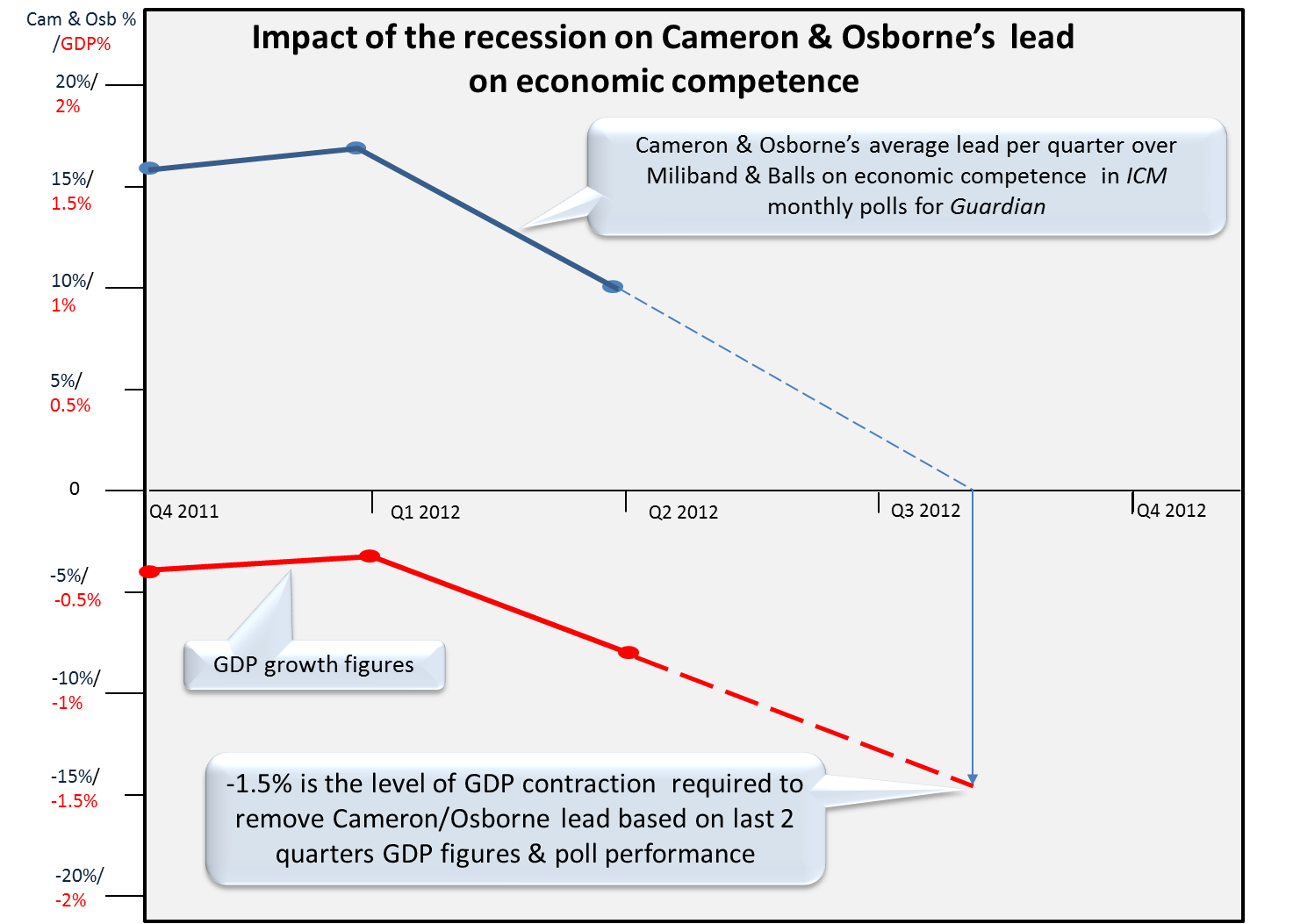
ICM has regularly asked voters which of the competing political duos they would prefer to be running the economy in their monthly polls for the Guardian, over the past nine months.

Mapping the Cameron/Osborne lead over Miliband/Balls against the actual movements in growth over these three quarters gives us a sense of whether there is a link between growth and the public’s preference, and if so, how bad the economic situation would need to become for Labour to be preferred.

Based on the last three quarters, it is clear there is a correlation between growth and the Cameron/Osborne lead.

The minor easing in the rate of economic contraction at the start of 2012 was mirrored in a slight increase in the Tory lead while the steep acceleration in decline in the second quarter this year was reflected in a sharp fall in the Cameron/Osborne lead from 17.5% to 10%.

Electorally for Labour, that’s the good news. Cameron and Osborne are definitely paying a price for their economic incompetence.

But then comes the very bad news.

(more…)

Facebook Twitter Digg Delicious StumbleUpon

Open primaries not narrow shortlists are what the Labour party needs to re-connect with voters

26/07/2012, 07:00:21 AM

by Peter Watt

There has been a lot of discussion in the Labour party recently about the narrow pool from which the current parliamentary Labour party (PLP) is drawn.  Basically the concern is that there are too many white middle class graduates who don’t represent the community as a whole.

So this month we have seen Chuka Umunna launch a Future Candidates Programme aimed at encouraging more business figures to stand for the Labour Party.  As the shadow business secretary said:

“Our party – all parties in fact – must reflect what Britain looks like and the jobs which people do.  Not only do we want more people setting up businesses, leading businesses and working in businesses, we want more people from the world of business in our ranks – from our councillors to our MPs.”

And then this week Dennis MacShane has expressed concern about the paucity of working class MPs.  He has suggested “all working class shortlists” for some parliamentary selections.  The idea being that we could use quotas to increase the numbers of non-middle class candidates and ultimately MPs.

Dennis proposes that 10% of parliamentary selections should be reserved for people on the minimum wage so that the pool from which our politicians are drawn stops being so narrow.  As Dennis said:

“The country desperately needs new political ideas, but the intellectual reservoir from which we draw our political leaders has become a paddling pool, when what we actually need is a raging torrent to get the country going again,”

The Labour party already has a long and honourable tradition of using quotas to increase the representation of women MP’s and indeed councillors.  At regular intervals there is also discussion of using quotas to increase the representation of other underrepresented groups and in particular minority ethnic candidates.

But I think that all of these initiatives increasingly start from the wrong diagnosis of the problem.  The diagnosis is that the Labour party, or any of its rivals, are basically sound.

That as presently constructed, political parties are the best way to achieve social justice and progress and that once people realise this then they will want to be a part of it.

Yes, there are some institutional biases that influence selections; but overcome these by some form of positive action and all is well.

I no longer think that this is right.

(more…)

Facebook Twitter Digg Delicious StumbleUpon

Time for Labour to root out the rotten politics of race in the Tower Hamlets party

25/07/2012, 07:00:14 AM

by Rob Marchant

It was with a heavy heart that Labour Uncut uncovered a little-reported nugget from seasoned east end politics commentator Ted Jeory: the expulsion of five Tower Hamlets councillors from the Labour party.

Actually, no. It was rather with delighted surprise and relief.

At last.

One of the councillors, Shahed Ali, tried to compare their floor-crossing – to join the non-Labour cabinet of independent, Respect-backed mayor Lutfur Rahman – with the failure of Dan Hodges and Alan Sugar (neither of whom are elected politicians, incidentally) to endorse Ken Livingstone.

And where Ali lost all credibility, as Jeory points out, was with his somewhat risible cry of “racism”. Ah yes, it was nothing to do with the councillors’ abject disloyalty: they were being picked on because they happened to be Bengali Muslims. Of course.

The harsh realpolitik is that Labour could not expel these councillors before the mayorals, because then they might have had to expel someone else who campaigned openly for Rahman – one Ken Livingstone.

This latest episode in the colourful history of Tower Hamlets Labour highlights not only the level to which party discipline nationally has diminished, but also how Labour is struggling to retain control over its local party in the east end.

It’s as if a small corner of the party had mutated, like in some bad sci-fi flick, and taken on a life of its own outside Labour.

This is not a criticism of long-suffering party staff, constrained by the political direction and resources they are given: nor of the many decent people in the local party, or its decent MPs such as Jim Fitzpatrick or Rushanara Ali.

(more…)

Facebook Twitter Digg Delicious StumbleUpon

Stephen Twigg and Marvin Rees talk schools and childcare on the Bristol campaign trail

24/07/2012, 03:24:49 PM

by Amanda Ramsay

The UK is facing a schools places crisis, particularly in cities such as Bradford, Bristol, Leeds, London, Reading and Southampton. Areas such as Barking in east London are facing the prospect of a ‘shift system’, splitting the school day in two with some children attending the morning and others the afternoon shift.

Visiting Bristol yesterday as part of Labour’s city conversation, to help elect Marvin Rees as city mayor, shadow education secretary Stephen Twigg highlighted the government’s swingeing cuts with  new build funding for schools slashed by a massive 57%, against a general 30% cut in most other spending areas.

Rees and Twigg met with parents and representatives of a variety of community groups, to discuss children and families as part of Labour’s childcare commission consultation. Main concerns included current government changes to working tax credits and how little help parents felt was on offer, especially to help single mothers or fathers to be able to work.

Twigg has hinted that better and more childcare will be a key focus for the party’s 2015 manifesto. This will be music to the ears of parents and employers alike, given the intrinsic link between jobs and childcare. More flexibility from employers around part-time working arrangements and more workplace childcare were among ideas put forward in Bristol yesterday.

Speaking as chair of Labour’s childcare commission, Twigg has talked about “switch spending”. That is, reducing spending in one area to fund more in another. Substantial spending cuts would be needed to fund a big improvement in childcare.

(more…)

Facebook Twitter Digg Delicious StumbleUpon