




UNCUT: Labour history uncut: More men for the meat-grinder please!

06/02/2013, 05:20:49 PM

by Pete Goddard and Atul Hatwal

In January 1916, when Labour was wobbling over whether to stay in a wartime coalition that wanted to introduce conscription, prime minister Asquith had made a promise that his proposals would exclude married men.

Admittedly, just 7 months earlier, when the Labour party was wobbling about whether to join the wartime coalition in the first place, the same Asquith had said there would be no need for conscription at all. But surely this time Asquith meant it, having pinkie-sworn it and crossed his heart and hoped to die?

In April 1916, Asquith’s government brought forward a new conscription bill to call up married men.

Bugger.
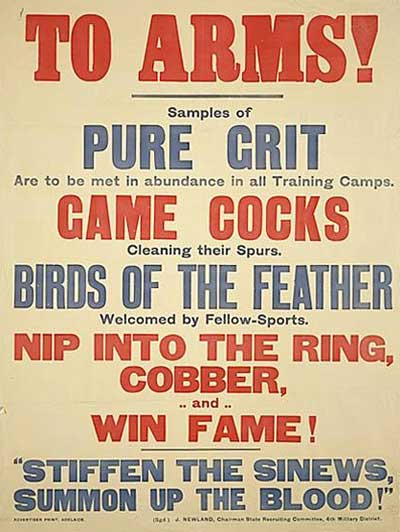
This Australian war recruitment poster, handily doubles as a Soho cinema listing

After the usual “we do. we don’t.” hokey cokey from Labour on whether to support the bill, the leadership of the unions swung decisively behind the measure.

And so the bill passed with fulsome Labour backing.

Conscription had been (and continued to be) a difficult issue for Labour,  and the party may have changed their minds more frequently than they changed socks, but in one sense it was just a symptom of a more deep seated problem: the position in the war.

Bloody stalemate on the continent was devouring Britain’s resources. It had made conscription necessary and the resulting manpower shortages were fomenting rebellion within the Labour movement against the leadership.

In March 1916, shop stewards at Beardmores engineering works on “red Clydeside” in Glasgow went on strike in objection to the “dilution” of labour. This involved semi-skilled labour and unskilled labour, and often, god forbid, women being used to fill roles normally occupied by skilled labour. It enabled the skilled labour to be freed for more important activities, such as getting blown up at the front. Read the rest of this entry »

Facebook Twitter Digg Delicious StumbleUpon

UNCUT: The far left has gained entry at the top of the Labour party

06/02/2013, 01:24:28 PM

by Rob Marchant

While the latest controversy surrounding the Socialist Workers Party shows that we all still have an odd, vicarious interest in the goings-on of a fringe, far-left party – or as blogger Laurie Penny put it in an unintentional comedy moment, a party which contains “many of the UK’s most important thinkers and writers” –  we might just miss something less obviously scandalous but closer to home.

Three weeks ago, Ken Livingstone’s former chief of staff, Simon Fletcher, was appointed as trade union liaison manager to the leader’s office. A backroom role, it is there to manage the relationship between trade unions and the party and has the ear of the party’s leader and deputy.

While the Mail and the Standard, not really newspapers which understand the running of the Labour party, ran their predictable “Red Ed” headlines and tried to use the appointment, laughably, to attack Miliband for being a Trot in disguise, in the process they made one legitimate point which should concern us on the mainstream left. It relates to the so-called Socialist Action group.

Although most Labourites believe they know Livingstone, it is surprising how many of his supporters are still unaware of Socialist Action. For those requiring a brief refresher, the Trotskyite clique that spawned most of Livingstone’s advisers during his mayoral tenure is documented in an extract from his biography:

“[it is] so discreet and secretive that it does not even admit its own existence and its members will not confirm they have ever belonged to the group.”

The only member of Ken’s coterie listed on the group’s website appears to be Redmond O’Neill – who died in 2009 – although Fletcher’s and others’ associations with it have been documented by other sources, including said biography and former members. With Socialist Action, the emphasis, as the above quote indicates, is on plausible deniability, an old tactic of the far left frequently wielded by the former mayor himself (although, in his case, the word “plausible” may have often been stretched to breaking point).

Read the rest of this entry »

Facebook Twitter Digg Delicious StumbleUpon

UNCUT: The conventional wisdom is wrong, David Cameron has been strengthened by the Tory rebellion on gay marriage

06/02/2013, 07:00:42 AM

by Atul Hatwal

Tory splits, MPs in open revolt and a beleaguered Conservative prime minister; it all seems rather 1990s. Labour tacticians are rubbing their hands in barely concealed glee. The political fall-out will be devastating, or so the conventional wisdom goes.

Weak leadership, political incompetence and an out of touch party do indeed dominate today’s news stories. And Labour does seem to be receiving a poll boost from this latest bout of Tory fratricide.

But David Cameron is not John Major, and in the medium term he will be strengthened by the rebellion.

Three points differentiate what happens next for the current prime minister from the fate of his Conservative predecessor.

First, the vote was won. Even with the Tory rebellion, this bill which David Cameron has staked so much upon, will become law. Yes, it was only won with Labour and Lib Dem votes, but to the general public this is a nuance: the prime minister emerged triumphant.

In the 1990s, the truly memorable occasions were when John Major was defeated.  Think Maastricht or VAT on fuel, few remember the countless near defeats where Major somehow squeaked through. A win is a win and Cameron will now have a genuine legacy achievement to point to.

Second, by taking on his party, Cameron has defined very clearly that he is a different type of Conservative to most of the rest of his colleagues. While many of his MPs do their level best to live up to the billing “same old Tories”, Cameron is vividly showing how he isn’t.

One of the mistakes the Tories made under both William Hague and Michael Howard was failing to understand how their stance on individual issues impacted the public’s overall view of the party.

Their obsession with Europe and immigration might have made for good day to day headlines, and been popular with sections of the electorate, but at election time, mainstream voters looked at the Tories and concluded that if they were this right-wing on Europe and immigration, then they would probably also privatise the NHS and laugh as pensioners starved in their freezing homes.

By taking a liberal stand on gay marriage, David Cameron has helped buy himself the benefit of the doubt from voters on all the other issues where they might suspect a traditional Tory.

Read the rest of this entry »

Facebook Twitter Digg Delicious StumbleUpon

UNCUT: Don’t judge my family

05/02/2013, 01:49:34 PM

by Julianne Marriott

It is a truth universally acknowledged by troublesome elements of the Conservative party that men and women should get married, especially if children are involved, and that same sex couples should not.

In an attempt to appease those resisting (and in some cases resigning from) the party’s direction of travel, the Tory leadership has pulled a marriage tax allowance out of the hat. They are, they say, sending a signal that they understand the value of commitment by recognising marriage (and civil partnershps) in the tax system.

However, Cameron and Osborne, while finding the image of a land of fantasy fifties families alluring, are not actually as out of touch with the public as many on the left like to think. They have no ideological commitment to a marriage tax allowance. They know that it is not the job of the government to judge commitment. They also know that this policy will not help those families that most need it. But they need to be seen to go through the motions to keep their party together to fight the next election.

So the rhetoric begins. Read the rest of this entry »

Facebook Twitter Digg Delicious StumbleUpon

UNCUT: Conservative MPs will be more, not less, reliant on David Cameron after the gay marriage vote

05/02/2013, 12:24:15 PM

by Mark Stockwell

Tonight’s vote on same-sex marriage will deepen the divide between Cameron and his party but ultimately it will make Conservative MPs more, rather than less, dependent on their leader.

The “rebels” (inverted commas, as it is technically a free vote) believe Cameron’s failure to win an overall majority marks him out as a loser and that they would do better without him. They were wrong to start with, and their actions over Europe and now same-sex marriage will make them even more wrong.  Cameron may be a “posh boy who doesn’t know the price of milk” but on both these issues he’s more in tune with the electorate than those who seek to displace him.

If there is damage to the Conservative party, it will be a result of the right refusing to acknowledge that they are a busted flush electorally and grieving publicly for the lost causes they continue to espouse. The impression of disunity is far more damaging than the exaggerated fears of a small and dwindling section of the population around the validity of institutions, social or political, that they seem to think they have exclusive rights to define as they see fit.

That said, it is astonishing that so many of the supporters of same-sex marriage, both in the upper echelons of the Conservative party and their supporters in the media, have such a tin ear for the sensibilities of the Conservative party in parliament and at large, that they have chosen to frame their appeals to the traditionalists in terms of how their vote may be perceived in 10, 20, 50 years’ time.

This is straight out of the Whig version of history – a view which is just not shared by this section of the Conservative party. In fact, the traditionalists, almost by definition, see themselves as a bulwark against precisely this sort of progressive view of the world. The past (stuff that’s already happened) and the present (stuff that’s happening here and now and might get them re-elected) matter much more than the future (stuff that may or may not happen some time after the next election if these lefty johnnies get their way).

Telling them they are ‘on the wrong side of history’ is the equivalent of pointing out to Luis Suarez that taking a tumble in the box may get him a penalty, but it will look bad in the TV replay.

Read the rest of this entry »

Facebook Twitter Digg Delicious StumbleUpon

UNCUT: Beastly Eastleigh

05/02/2013, 07:00:39 AM

by John Braggins

The voters of Eastleigh – an old railway town just outside Southampton – lost their MP, Stephen Milligan in unfortunate circumstances on February 7th 1994. A Tory with promise ahead of him came to a tragic end, and was found wrapped in a bin bag after accidentally suffocating himself in an apparently solitary sexual episode.

Fast forward 20 years and an another MP, Chris Huhne, this time a LibDem, was on a fast-track to high political office only to find he was travelling too fast, eventually ending his career in an equally bizarre manner, only far less tragic this time.

So the voters of Eastleigh will yet again face battalions of LibDem Focus leafleters, legions of Tory In Touch deliverers and car loads of Labour Rose activists spreading out across the wastelands of Chandlers Ford, Eastleigh Town and Hedge End.

In 1994, along with my colleague Alan Barnard, I was asked by Labour’s elections supremo, Jack Cunningham, to take charge of Labour’s campaign for the forthcoming by-election. Our remit was to avoid the traditional by-election squeeze on our vote and avoid losing our deposit. We were tasked with finding a way to take the fight to the Lib Dems and to encourage Labour voters to stay with us.

The Eastleigh by-election of 1994 was a turning point for Labour, coming as it did after two by-elections in ‘the south’ – Christchurch and Newbury where Labour’s vote was squeezed almost out of existence. Labour was unlikely to win Eastleigh but increasing its share of the vote and coming ahead of the Tory was seen by Labour’s shadow cabinet as one of the most important by-election objectives in the run-up to the 1997 general election, showing, as it did, Labour could increase its vote in the vital southern key seats.

Straight after the by-election result, when Labour had come second in what at the time was one of only six by-elections since the Second World War to have a swing from Tory to Labour, the recently elected leader Tony Blair was able to say “There are no no-go areas for new Labour.”

In his analysis column for the Daily Telegraph on the Saturday after polling day, Professor Anthony King wrote under the headline “The real winners came second at Eastleigh”. He said “The big news from the by-election …… is that Labour is now back, constituting a real electoral threat to the Tories for the first time since 1979″ and “Such an outcome in a general election would sweep Labour to power.”

Read the rest of this entry »

Facebook Twitter Digg Delicious StumbleUpon

UNCUT: Chris Huhne’s political demise is a tragedy all round

04/02/2013, 04:55:14 PM

by Kevin Meagher

No-one should take any pleasure in witnessing Chris Huhne’s public defenestration. A sequence of events that clearly spun out of control has cost a cabinet minister and plausible contender to succeed Nick Clegg his career, his seat and just possibly his liberty.

His resignation from parliament as he awaits sentencing for perverting the course of justice is not just a humiliating end to his political life but a personal tragedy. All the more so for his children and family, doubly victims given the disputatious end of his marriage to Vicky Pryce. But British politics has two abiding characteristics which are up in neon lighting for all to see today: there is little sympathy for the fallen and attention immediately focuses on who benefits from another’s misfortune.

So talk turns to the pending Eastleigh by-election, the prospects of UKIP’s Nigel Farage if he chooses to stand and the implications for the coalition if the Conservatives mount a full throttle campaign to snatch the seat. But there are other consequences our rubber-necking politicians and hacks should pause and reflect on.

The career path of a growing number of our parliamentarians now ends in the most brutal ignominy; a public shaming in court and a custodial sentence. On a human level, this is awful for anyone. Collectively, it scuttles public trust in our governing class.

Read the rest of this entry »

Facebook Twitter Digg Delicious StumbleUpon

UNCUT: We are witnessing the march of the zombie jobs

04/02/2013, 03:11:56 PM

by Dan McCurry

We now have an explanation for why unemployment hasn’t soared in the worst recession since the first World War.

It seems that the banks are keeping failing companies afloat rather than calling in their loans, for fear of damaging their capital base and failing to comply with regulations. It is this priority of the regulators that has had the perverse effect of bunging up the unemployment market and creating a million zombie jobs.

Before you think this is a good thing, recognise that productivity is supposed to improve during a recession, instead it has slumped, causing long term damage. Meanwhile the unemployment has only been delayed. Sooner or later the banks will be forced to call in their loans. At that point, the zombie companies fold, and the workers become unemployed.

When I was working for a retail chain called Wilding Office Machines in the early ‘90s recession, the board decided to start, and then lose, a price war with Dixons. A man called Charles Wigador had built a fleet of salesmen selling mobile phones to businesses. Phones were changing from being bricks to pocket sized devices that consumers could buy, but there were no retail shops to supply them. When we were about to go bust Charles bought us out, all 120 shops, staff and head office, for a mere £100k.

For us, overnight the recession ended and we were on the cutting edge of a new business, and Britain was at the cutting edge of mobile phones. Within a couple of years, Charles sold out to a small company called Vodafone for £17 million.

If George Osborne was in charge at the time, Wildings would have been kept alive as a zombie company and Vodafone would not today exist as the largest phone company in the world. George Osborne promised the “march of the makers”, but the British economy today can best be described as the march of the zombies.

Read the rest of this entry »

Facebook Twitter Digg Delicious StumbleUpon

GRASSROOTS: In defence of Student Unions

04/02/2013, 07:00:54 AM

by Sam Fowles

Reading Jack Rivlin’s recent blog for the Telegraph I thought, from the vitriol spewed upon his unfortunate subjects, he must be writing about something truly repulsive. An international trollers collective perhaps, or at least the Liberal Democrats. But he wasn’t. He was writing about student unions or, as the charming Mr Rivlin describes them, “sandal wearing prigs” (why is footwear so offensive to him?) who “while away a 35 hour week reading the Leveson report and ordering personalised fleeces”. As a former sabbatical officer at St Andrews students’ union I feel somewhat obliged to stick up for my former colleagues.

Mr Rivlin claims that students unions are unrepresentative because their officers are elected by only a tiny proportion of the student body. This is a common criticism and one I found often used against me. However, this was almost always by  those busy closing down academic departments or pricing the poor out of higher education. The fact is: it’s just not true. While Mr Rivlin makes hay of the 8% turnout at UEA, he neglects to mention any other examples. At Imperial the turnout in 2012 was 32%, at Huddersfield it regularly hits over 20% and at my own St Andrews our most recent turnout was 51%.

To put this in context, the turnout for the London Mayoral election was 37.8% and Police and Crime Commissioners only managed to pull out 15% (The X-factor final reached 28%). I agree we have a problem with apathy but its neither confined to nor most prevalent in student elections.

But the main point of Mr Rivlin’s article is that students’ unions do joyless and pointless things such as (his chosen example) UEA banning the six nations from their bar because it’s sponsored by RBS. You know it’s his main point because he works up to it with apoplexy worthy of the Daily Mail. Now let’s be honest, it’s a ludicrous decision and, as the sort of student who was eating all three meals a day in the union bar during the 2007 rugby world cup (not during my term as a sabbatical officer), I would have been one of the first to protest.

Read the rest of this entry »

Facebook Twitter Digg Delicious StumbleUpon

UNCUT: The Sunday review: Lincoln

03/02/2013, 08:00:25 AM

by Anthony Painter

As a director, how can you possibly cope with a figure such as Abraham Lincoln on screen? The most logical projection is to mesh civil war grotesqueness with the oratorical adeptness. Perhaps one could place him in a battle of wills and minds with his confederacy adversary, Jefferson Davis: a man of history doing battle with a man of corrupted vested interests. Some none too subtle allusions to the later pioneers of racial equality could be sprinkled in along the way – maybe the distant voices of a Luther King or even a Barack Obama could be dropped in. The gruesome life of a slave could be depicted and reminders that America’s third president – Thomas Jefferson – took a slave concubine (his late wife’s half sister) could be referenced.

To be perfectly honest, all of this is exactly what was to be expected once Steven Spielberg took on the challenge of re-introducing us to America’s most brilliant yet enigmatic president – post founding fathers that is. And somehow, despite himself, Spielberg mostly avoids the obvious pitfalls. Spielberg is a director who does schmaltzy and effect-heavy kids films with a certain panache and treats adults as if they are kids- with honourable exceptions such as Schlinder’s List. Not this time.

Instead, Spielberg focuses our gaze on the character of the man himself. For that to work would require a method actor of sublime capacity. You’d need someone like Daniel Day-Lewis. That is precisely who Spielberg persuaded to do the role. The brilliance of this biopic is that from the outset the director draws us simultaneously into the world of wartime political intrigue and the character of the man who found it his responsibility to navigate the republic through civil war with its union intact and slavery abolished. Everything I have ever read about the character of Lincoln was there in this on-screen play- for that is what it is.

Read the rest of this entry »

Facebook Twitter Digg Delicious StumbleUpon