




UNBOUND: Tuesday News Review

26/04/2011, 06:55:03 AM

Mandelson and Johnson urge Labour to vote Yes

Two Labour grandees have accused the coalition of hijacking the AV debate to air its “petty tensions” and cynically turn it into a bitter row between the Conservatives and Liberal Democrats, after a series of high-profile clashes between ministers over next week’s referendum. Alan Johnson, the former home secretary, told the Guardian that the debate was “bigger than the Liberal Democrats” and appealed to Labour voters to back the alternative vote, claiming that a vote against reform was in effect a vote for the Conservatives. Lord Mandelson, the former cabinet minister, claimed the prime minister had adopted a high profile role in the no campaign to divert attention away from a debate about AV. The cabinet will meet for the first time after the Easter recess on Tuesday, with coalition relations at a new low. – the Guardian

David Cameron is today accused of cynically turning the referendum campaign on the voting system into a bitter row between the Conservatives and Liberal Democrats to head off a Yes vote. In his first intervention in the AV referendum, Lord Mandelson, the former Labour cabinet minister, claimed that the Prime Minister had adopted a high-profile role in the No campaign in order to divert media and public attention away from a debate about the alternative vote (AV). In an interview with The Independent, Lord Mandelson warned Labour figures who are backing the No camp that their actions could condemn the party to years in the electoral wilderness. He appealed to Labour supporters to vote Yes in next week’s referendum to damage the Tories and undermine Mr Cameron’s position. – the Independent

After AV, will the Lord’s be the next Coalition issue?

Like all of God’s earthly creation, the House of Lords is imperfect.  Its powers, its composition and its legitimacy have all come in for severe criticism over the years, from different parts of the political spectrum.  There have been several major reports, a Joint Committee and numerous votes in Parliament in recent years.  The result has been a lot of disagreement, and no change. It has now been reported that — as prefigured in the Coalition Agreement — the Government will publish a Bill at the end of May to bring in an 80% elected Upper Chamber of 500 or so using Proportional Representation.  “Senators” would apparently be elected in thirds every five years. People will differ over the merits of this and other possible models.  The question is, should an elected House of Lords be a priority right now?  To answer it, what we need are non-partisan arguments, arguments that ignore party politics and just look at the merits of the issue in the current context. From this viewpoint the answer is pretty clearly No.  – Conservative Home

Conservative whips under fire from newbies

For years they have been feared and loathed in equal measure, rumoured to have the ability to reduce errant MPs to tears and submission with a flick through their “little black book”. But now the fabled Conservative whips – who provided the inspiration for the murderous Francis Urquhart in The House of Cards – are facing a rebellion they are finding hard to control: the modern world. They are under attack from their new MPs who make up almost half the parliamentary party and cannot understand for need for the cast-iron discipline and subservience to the whips’ office that their predecessors took for granted. Most have had jobs in the “real world” as bankers, doctors and accountants and believe the whips should be keener on “career development” than career control. But what has caused the most ire among the new backbenchers is the whips’ policy of using “overwhelming force” to ensure they never lose a parliamentary vote. – the Independent

Facebook Twitter Digg Delicious StumbleUpon

GRASSROOTS: The No to AV campaign is too unpleasant to support, even if you wanted to

25/04/2011, 07:30:52 PM

by Conrad Landin

In the forthcoming referendum, voters will consider contrasting factors when deciding where to place their crosses.

Some will vote on the merits of the alternative vote system, others on the basis of a long-term quest for proportional representation, for a third group, perhaps “basest of the three”, outlook on the current government will doubtless play a role.

Though there remains the under-discussed likelihood that Nick Clegg would use any Yes outcome to serenade a vindication of the coalition deal between his party and the Conservatives. And vindication it would be – this was, after all, the deal which saw every promise bar electoral reform sacrificed.

But despite my strong feelings on the issue, I can’t bring myself to join the campaign against the reform.

Figures in the Yes camp have suggested that their opponents come from a political spectrum narrower even than the Conservative party. With Labour heavyweights such as Ronnie Campbell and John Prescott weighing in with their endorsements of the campaign, we can see that this is far from the case. Yet there is something about the campaign’s tactics which makes one question whether the critics have it right. Read the rest of this entry »

Facebook Twitter Digg Delicious StumbleUpon

UNCUT: What America really thinks of William and Kate

25/04/2011, 03:30:54 PM

by Jonathan Todd

Baltimore

“I know America to be a forward thinking country because otherwise why would you have let that retard and cowboy fella be president for eight years? We were very impressed. We thought it was nice of you to let him have a go, because, in England, he wouldn’t be trusted with a pair of scissors”.

With such jokes, Russell Brand, as host of the MTV awards, initiated what is becoming an Anglo-American tradition: the cheeky Brit at a major American award ceremony. Ricky Gervais followed up at the Golden Globes this year. These comedians aren’t short of lines ripping George W Bush, but what assurance can we have that the British head of state can be trusted with a pair of scissors? Or even know what scissors are?

We can, of course, have no such guarantee. Birth right determines our head of state, irrespective of their abilities with scissors or other qualities. In contrast, the commander-in-chief is subject to the most gruelling of recruitment procedures. This fundamental difference between our monarchy and their republic convinces me that no matter what wise cracks Brand may make and how many William and Kate themed souvenirs American tourists may buy, ultimately, Americans are laughing at us. The idea of Donald Trump being president is preposterous, but selecting our head of state by birth is infinitely more so. Read the rest of this entry »

Facebook Twitter Digg Delicious StumbleUpon

UNCUT: Three kinds of leader in the age of the insurgent

25/04/2011, 12:00:58 PM

by Kevin Meagher

Like bad luck, musketeers and Neopolitan ice cream, our political leaders come in threes. Consolidators, new brooms and insurgents; a trio of broad headings that sums up the different approaches to party leadership -Tory, Labour and Liberal alike.

First, we have consolidators. They are elected to lead divided parties, offering a familiar, reassuring presence, often at a moment of peril and self-doubt. They provide a small “c” conservative choice for parties turning in from the world. Michael Foot, Iain Duncan-Smith and Ming Campbell fall into this category. Their election is often a mark of intellectual defensiveness for their party, sometimes at the fag end of a period in office. Douglas-Home, Callaghan, and Gordon Brown also fit this bill.

Consolidators are kept on a short leash by their party; sometimes only too willingly. Their guiding belief is “hold what we have”, which really means that the party believes it is right, regardless of what the electorate has decided. Although never leader, this is Tony Benn quipping that Labour’s disastrous 1983 election result was “eight and a half million votes for socialism”. Read the rest of this entry »

Facebook Twitter Digg Delicious StumbleUpon

GRASSROOTS: Come and help Leicester South deliver Britain’s verdict on Cameron and Clegg

25/04/2011, 07:51:20 AM

By Jon Ashworth

With the working-class council estates of Eyres Monsell and Saffron Lane, diverse communities closer to the city centre, traditionally Tory wards on the outskirts and liberal-leaning voters in the areas around the university, Leicester South really is a microcosm of Britain.

Its politics have mirrored the country’s, too. The seat has changed hands no fewer than five times since the seventies. It’s been represented by MPs from all three major parties over the last twenty years with the Lib Dems winning the 2004 by-election.

And when it goes to the polls in the by-election on 5 May it will have the opportunity to speak for Britain again.

The decision by Sir Peter Soulsby, the area’s respected and hard-working MP for the last six years, to stand down to contest the election for the city’s first directly elected Mayor has given local voters the chance to cast the nation’s verdict on a raft of the Conservative-led government’s unpopular policies.

Over the last two weeks, both Ed Miliband and Ed Balls have traveled to Leicester and stood on the very spot outside De Montfort University at which Nick Clegg chose to pledge his opposition to tuition fees.

“It was here a year ago that he made his promise he would be the voice of young people,” the Labour leader told a crowd of young people inside. “The full gravity of the betrayal has today become clearer. Today we learn that 70% of universities are going to charge £9,000 tuition fees”.

Read the rest of this entry »

Facebook Twitter Digg Delicious StumbleUpon

UNBOUND: Monday News Review

25/04/2011, 06:49:56 AM

Another day, another dose of staged AV campaigning anger

A Liberal Democrat cabinet minister has widened an increasingly damaging rift inside the coalition by warning that the prime minister and other senior Conservatives could face legal action over the manner in which they have campaigned for a no vote in next week’s referendum on a change to the voting system. Chris Huhne, the Lib Dem energy secretary, admitted for the first time that the campaign against the alternative vote by senior Conservatives will make the coalition government “more difficult” to manage in the aftermath of the 5 May referendum. Huhne said the claims made by David Cameron, George Osborne and other Tories undermined their credibility. He is concerned about two claims made by the Conservatives – that a move to AV will need new counting machines, and so cost as much as £250m, and that it will favour extremist parties. He said: “If they don’t come clean on this, I am sure the law courts will.” – the Guardian

To say senior Liberal Democrats are desperate to secure a Yes vote for AV would be an understatement. With less than two weeks to go to the referendum on electoral reform, they have cranked up their rhetoric to fever pitch. Paddy Ashdown has condemned the campaign of those opposed to the Alternative Vote as ‘stinking’. Energy Secretary Chris Huhne launched a tirade of abuse against Chancellor George Osborne for pointing out that AV would be costly and complicated to implement. And Business Secretary Vince Cable has melodramatically portrayed the referendum battle as a fight between the ‘progressive majority’ and the atavistic forces of Conservatism. Yesterday it was Nick Clegg’s turn to whip up the hysteria, with a rambling diatribe against our traditional first-past-the-post voting system, and anyone with the temerity to believe it works. – the Daily Mail

Read the rest of this entry »

Facebook Twitter Digg Delicious StumbleUpon

UNCUT: The Sunday Review: the interim report of the independent commission on banking

24/04/2011, 01:00:13 PM

by Anthony Painter

There is nothing more British than an establishment fudge. And as establishment fudges go, the interim report of the independent commission on banking (ICB) is an absolute belter. It lays out the case for a fundamental reassessment of the UK’s financial sector, but proposes nothing like that. It is like a flood risk report saying that only a twenty foot high concrete wall will protect a town from flooding but then actually only recommends the installation of sandbags. And given that George Osborne is in compromising mood, it will be watered down further. Get ready for the flood.

Don’t worry, the UK might get lucky. Maybe there won’t be a flood at all. We didn’t think floods happened – or we forgot. Then one did. But still, they are rare right? Well, The ICB doesn’t seem to think so:

“There is an inherent uncertainty about the nature of the next financial crisis”.

So we are not dealing with “ifs” here; we are dealing with “when”. This staggering statement, buried in section 4.173 comes after a long section on the need to protect the competitiveness of the UK financial sector. It provides jobs and £50 billion of tax revenues, after all (though £10 billion or so are from the retail operation, which presumably isn’t going to be off-shored any time soon). That is not insignificant. As we have discovered, that is not a cost and risk free income. In fact, it is highly risky and costly.

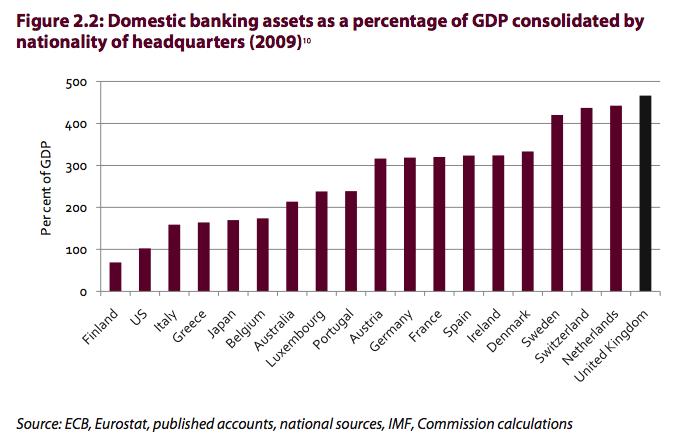
This graph helpfully provided on p.22 of the report tells us why:

In financial terms, the UK is more flood-exposed than any other nation. It may not feel this way given the massive output loss, fiscal disaster, and unemployment, but the UK was “lucky” this time. For Ireland, it was far worse:

“Had the asset quality of UK banks turned out to be as bad as that in Ireland, the hit to the UK’s fiscal position would have been significantly worse than it was”.

Oh, those Irish with their junk investments. How silly of them. Only it’s not quite like that. Financial crises don’t generally occur because people are buying junk. They occur because people are buying high quality assets that turn out to be junk. If people are buying junk then investors notice. If it’s AAA grade prime then they are relaxed. The global financial crisis occurred in no small part because AAA assets turned out to be useful only for composting.

At enormous cost, it’s all been quarantined, sanitised and disposed of now right? Perhaps. But there’s still lots of other risks that may be underpriced. An obvious example is the sovereign debt that banks hold. What happens if governments start to default on their debt just as owners of subprime mortgages started to default on their repayments?

Calamity is what happens. If Greece, Portugal, Spain, or Ireland were to default then suddenly the bonds held by German, Dutch, British banks et al are turned from prime to subprime in an instant. Mark Blyth on Crooked Timber has war gamed the shock that would be sent through the European economy. Fantasy? No actually, it’s a completely plausible scenario. The eurozone crumbles but, worse than that, the fiscal hit will be tremendous. What on earth will the Royal Bank of Scotland’s balance sheet look like if that happens and how will we keep a flow of credit to the real economy?

According to the ICB report, there are four functions of a banking system:

• providing payments systems;

• providing deposit-taking facilities and a store-of-value system;

• lending to households, businesses and governments; and

• helping households and businesses to manage their risks and financial needs

over time.

Its measures only aim to safeguard two of them: keeping the payments system going and providing deposit-taking facilities. In the event of another flood, it means that lives will be saved which is clearly a good thing. However, the damage and economic cost to the unprotected town will be enormous. If the flood is a eurozone flood, then governments will need to fiscally intervene once again if credit and lending are to be maintained (and we do have a £141billion deficit to finance as well a businesses and mortgages to finance). The question is – again one posed by the ICB – at what point does “too big to fail” become “too big to save”?

The harsh reality is that we have a financial system that would be too big to save if the flood were big enough. It is a bigger weight on our shoulders than that any on other country’s. We have broad shoulders, but they can’t take unlimited pressure.

And this is the real issue with the ICB interim report. It lays out the evidence that UK may face a financial catastrophe even greater than was experienced in 2008. And then it defaults to the traditional defence of the UK financial sector’s competitive position as an unarguable good. It has been criticised for not doing enough to promote further competition (and our banking sector is monocultured and uncompetitive), or to separate casino from utility banking. In a sense, these criticisms – though fair – miss the point also.

The UK economy and UK taxpayers may not be able to sustain the risk of a financial sector this large at all – even with better regulation. Actually, “competitiveness” may be economically calamitous. So the ICB should have been more honest with us. It should have said:

“We are recommending a 20-foot high concrete wall. This is expensive and it will cause much pain but that is our honest assessment of what it will take to protect us from the flood. It is not unreasonable if we do want to protect ourselves from what could be an adverse event that we see in the not too distant future. This needs a bigger debate than the one we are having. It is about the whole way we run our economy and requires real long-term vision, explanation, and courage. This is a choice but we don’t feel it is a choice that should be brushed under the carpet because of vocal interests or political compromise. We have experienced a calamity but it may only have been a warning. Next time we may not be able to cope at all”.

It didn’t say that. It said, it’s bad but let’s not overact. For that reason, the report is a failure. Meanwhile, Bank of England figures show lending to small and medium sized businesses falling again and the cost of finance increasing. And consumers are starting to borrow to consume more once more.

Here we go again. And did I mention the flood risk?

Anthony Painter is an author and economist.

Facebook Twitter Digg Delicious StumbleUpon

UNBOUND: Sunday News Review

24/04/2011, 09:00:55 AM

Clegg and Cameron’s choreographed war

Nick Clegg is spoiling for a fight with just about everyone – David Cameron, Andrew Lansley, all Tories, Ed Miliband, John Reid, universities, the Daily Mail, Germany, even his own MPs. Rivals will dismiss this as mere pre-election posturing: creating false dividing lines in a desperate attempt to avert a bloodbath in town halls the length of the country. But it seems to go deeper than that. After he has attacked in all but name by every Tory from the PM down, the rules of engagement have changed. Aides say Clegg has woken up to pleas from his party to make clear the Liberal Democrat influence in government, even if that means rocking the coalition boat. As a final effort to save his own skin, it could be too late. But he is going down fighting. The main battleground is over his attempt to ditch first past the post for the alternative vote in 5 May’s referendum. The stakes are high, which explains the escalation of tensions at the heart of government. The Prime Minister, in particular, gets both barrels: accused of telling “lies”, using big Tory money to fund “the very nastiest reactionary politics”. – the Independent

The criticism is seen by some in Westminster as an attempt by the Liberal Democrats to create clear dividing lines between the Lib Dems and the Tories in the run-up to the local elections. It follows yesterday’s public spat between Cameron and Clegg over internships which centred on comments made in an interview in which the prime minister admitted to recently giving work experience to a neighbour’s son. Cameron said he was “very relaxed” about the situation and that he would continue to help friends by offering their children internships. The remarks appeared to contradict a policy unveiled by Clegg earlier this month that seeks to reduce the number of unpaid internships, described by the deputy prime minister as a bar on social mobility. Yesterday, Clegg admitted he disagreed with Cameron. “I’m not relaxed about this at all,” he said. “It just can’t be right that plum internships are decided by who you know, not what you know.” – the Observer

Cameron’s new lords cost tax payer £18.25million a year

DAVID Cameron has broken his pledge to slash the cost of politics by packing the House of Lords with his cronies. The PM vowed the Coalition would bring in a plan to save £12million a year by cutting the number of MPs from 650 to 600 at the next election. But Mr Cameron’s move to appoint 117 new peers since the last General Election a year ago will cost taxpayers a staggering £18.25million a year – £6.25million a year more than his promised savings. Each new peer will cost an average of £156,000 a year, according to figures ­released by the House of Lords. The total cost of the 117 new peers will land ­taxpayers with an extra bill of at least £91million over a five-year ­Parliament. Labour MP Thomas Docherty said: “David Cameron said he wanted to cut the cost of politics. But, by creating a record number of new peers, he’s the one making the cost of politics go up.” – the Sunday Mirror

David Cameron has broken his manifesto promise to cut the cost of politics by creating an unprecedented number of peerages, Labour claimed last night. New figures show that the taxpayer will have to foot the £6m-plus balance from the creation of 117 new peers by the Prime Minister since the election. In the Conservative manifesto last year, Mr Cameron promised to slash the number of MPs from 650 to 600, saving £12m a year. But the cost of swelling ranks in the House of Lords – at £156,000 per member – was £18.25m, more than £6m more. A report last week claimed that Mr Cameron’s decision to elevate 117 people to the Lords, more than any other PM in his first year, had led to a cramped upper chamber, with 792 peers. No 10 indicated he will continue to create peerages to redress the balance in the Lords, where Labour is the main party. – the Independent

Mandelson says ‘Yes’

The ruthless and increasingly shrill determination they have shown in protecting their party interest in the AV campaign is part of a wider ambition to rebuild the same foundations for electoral success in this century that saw them dominate the last. I do not criticise them for it. Long-term majority Conservative government is their project and it will be greatly emboldened by a no vote on 5 May.  Equally, a yes vote would greatly undermine Cameron and spark a rupture in his party. The strains are already starting to show and we need to understand what’s going on. Cameron is fighting to retain the long-term advantage of a split between the progressive parties. But at the same time he is fighting to retain the unity of his party and his job. That’s why we have seen his more rightwing crowd-pleasing interventions of late. If he lost the referendum, a sin the Tory right would not forgive, it could fatally weaken and shatter his leadership. So progressives must wake up, including Liberal Democrats who need to reassert their own interests and self-confidence, just as their coalition partners are doing. Labour needs to recover the hunger we had in the 1990s, born from years in the wilderness. That means, above all, doing the hard work to regain trust in our capacity to manage the economy and public finances responsibly. – the Observer

Facebook Twitter Digg Delicious StumbleUpon

GRASSROOTS: Clegg’s phoney war on social immobility

23/04/2011, 12:30:27 PM

by Susanna Bellino

David Cameron’s comments a few weeks ago about Oxford university’s lack of black students might have annoyed its dons and PR team but he made a valid point. Granted he skewed the statistics but the truth remains that only 27 black undergraduates – approximately 1% – made its undergraduate intake that year.

The results of a freedom of information request by David Lammy MP revealed, among other startling facts, that Merton College, Oxford, had not admitted a single black student for five years. And although it pains me to say it, my own alma mater doesn’t fair much better – despite its more liberal reputation, white students were more likely to be successful than black applicants at every Cambridge college except one.

These figures are in stark contrast to Oxbridge’s American counterpart, Harvard, where 11% of students were black. Affirmative action no doubt plays a large part in this but Oxbridge does run its own access programmes although – if rumours are to be believed – aiming these schemes at a comprehensive school in Hackney might better achieve social mobility than running them at Marlborough College.

For once, we can’t blame the coalition for something. Oxbridge’s unrepresentative undergraduate intake and the general trend of the lack of upward social mobility in the UK has long been an issue. When I went up to Cambridge in 2007, 57% of the student body were state school educated – a decent enough figure perhaps but we need to consider that in 1997, 55% of the student body were state school educated – hardly an improvement. Read the rest of this entry »

Facebook Twitter Digg Delicious StumbleUpon

HOME: The week Uncut

23/04/2011, 10:30:13 AM

In case you missed them, these were the best read pieces on Uncut in the last seven days:

Dan Hodges wants the Guardianistas to get dirty

Kevin Meagher thinks it is time Prezza put the gloves back on

Tom Watson told Douglas Alexander off and then said sorry

Sunder Katwala reports on the “purple bookers”

Jim Murphy wants a ‘No’ vote, but not because of Clegg

Alex Hilton is sick of the “we work hard defence” of fptp

Atul Hatwal reveals the real Labour untruth on immigration

Facebook Twitter Digg Delicious StumbleUpon