




UNCUT: Helen Hayes: A star is born in Dulwich and West Norwood

31/03/2014, 09:48:14 AM

by Jonathan Todd

It wasn’t quite a warm summer day spent indoors writing frightening verse, as the Smiths song goes but it was a warm day, spent indoors, in a school hall with large windows. We could see the sunshine but we weren’t in it. We were inside, stewing.

When we re-emerged, Helen Hayes had been selected to fight Dulwich and West Norwood (DaWN) for Labour at the general election. Tessa Jowell has represented the seat since its creation in 1997, having won the previous Dulwich seat from the Conservatives with a slender majority 5 years earlier. Favourable boundary changes and Jowell’s assiduous cultivation of support across a constituency with pockets of affluence and poverty mean that she bequeaths a much more substantial majority of over 9000 to Hayes.

The seat may have transitioned from being perceived as marginal to safe under Jowell but some parts of it conform to the characteristics of seats that Lewis Baston deems ‘gentrifying inner London’. He sees changes in them that may benefit the Conservatives – “old working class traditional Labour households in terraced areas have been replaced by upwardly mobile and high paid couples and families”. The East Dulwich ward in DaWN, for example, is much less blue-collar than when Jowell worked in it as a social worker in the 1970s. Foxtons, Caffè Nero and various gastro pubs have arrived in the 8 years that I’ve lived in the ward.

Hayes will need Jowell’s capacity to build a big tent of support across different groups to keep the seat as safe as it has become. Douglas Alexander, Rachel Reeves and Chuka Umunna saw sufficient evidence of Hayes’ talent to endorse her candidacy. In addition, Frank Dobson, Patrick Diamond and – declaring an interest – myself did so. While it’s unusual for someone seeking to become a Labour PPC to secure the support of three members of the shadow cabinet, Hayes was not alone among the candidates in getting top level backing.

Read the rest of this entry »

Facebook Twitter Digg Delicious StumbleUpon

UNCUT: Letter from Wales: Labour’s record in Wales is harming the party’s national prospects

29/03/2014, 11:06:50 PM

by Julian Ruck

At long last national media appears to be waking up to the situation in Wales. Newspaper reports of Ed’s address to the Welsh Labour conference are peppered with serious questions about what is going on over here. It is a great pity that most Welsh Labour MP’s are not following the same path.

Indifference and Welsh political secession are the orders of the day where Westminster is concerned. Welsh MP’s represent their constituents and yet feel obliged to wail the same insipid refrains of “That’s a devolved matter and nothing to do with me!,” every time they are confronted with pointed questions about the Welsh administration and its more than obvious failure to bring Wales out of the dark ages.

Welsh schoolchildren enduring schools not fit for purpose, a Welsh NHS where waiting times for hip replacements are months longer than England and an economy that national growth is leaving behind, are matters beyond their remit and whatever you do don’t be seen to exercise the democratic prerogative of outspoken criticism.

Cowering resistance to accusations of “traitor!” and “quisling!” by the Crachach aristocracy must be avoided at all costs.

Hywel Francis MP, Geraint Davies MP and former secretary of state for Wales no less, Paul Murphy, have all been contacted for a comment on the devastation that is the Welsh education comic opera.

Responses?

None.

Read the rest of this entry »

Facebook Twitter Digg Delicious StumbleUpon

UNCUT: Shadow cabinet league: Khan remains the boss

28/03/2014, 05:15:01 PM

by Alan Smithee

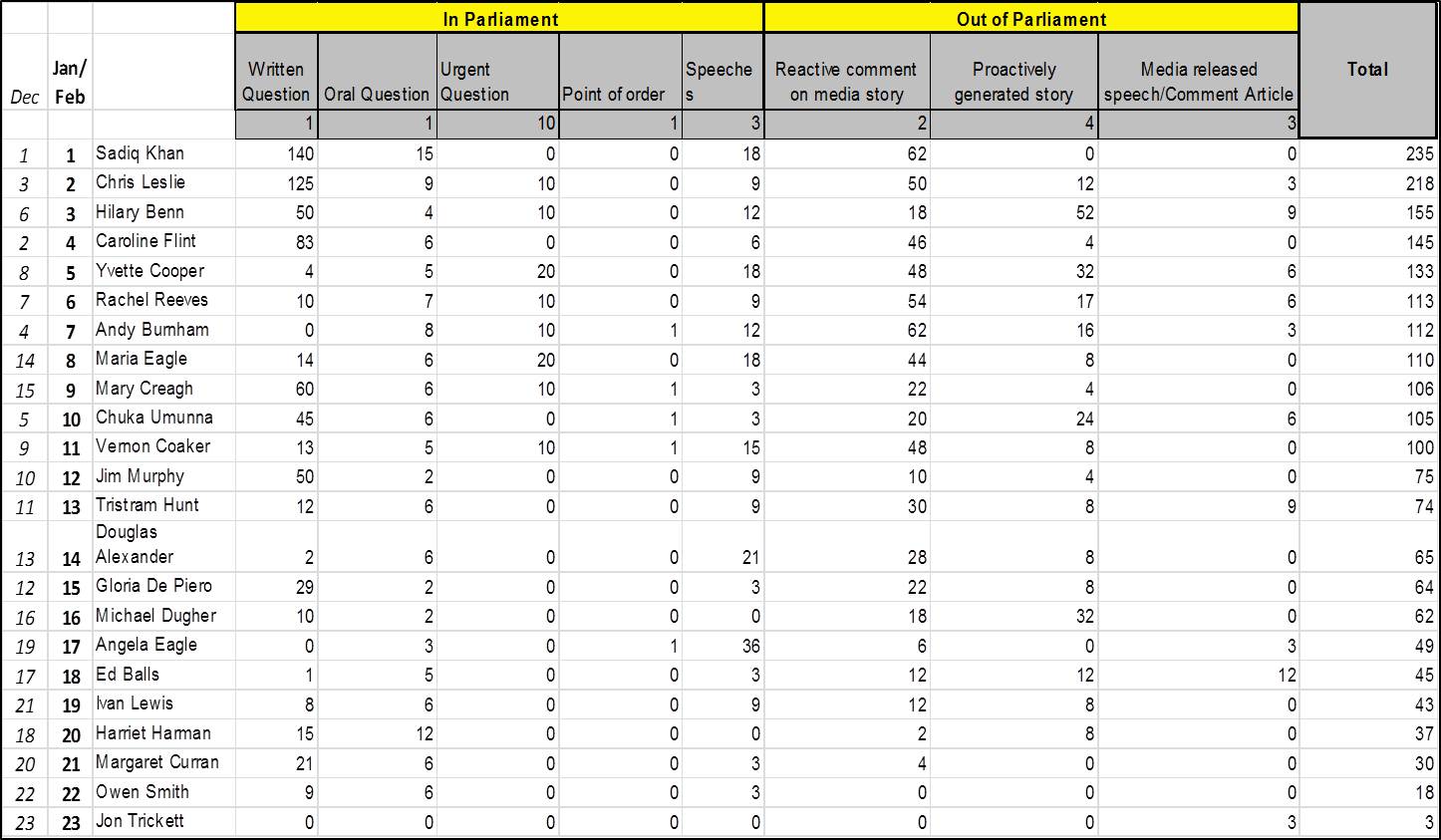
This column returns, bronzed with liver aching, from a brief absence. Thankfully, the shadow cabinet has not taken a similar sojourn. As we enter the New Politics™ era, the shadow cabinet remains important to delivering a Labour victory in 2015 and harrying the coalition in the meantime.

Two MPs have established a commanding lead at the top of the table. Sadiq Khan and Chris Leslie have consistently performed well. Khan has excellent in consistent reactive media work and producing a gargantuan amount of written question. His continued focus on Oakwood Prison and the disturbance in January shows a commitment to scrutiny rather than questions based on cynical opportunism.

Leslie, who does the donkey work in the Treasury team, has produced similar levels of questions and has been able to generate a number of attacks on the Government.  His speech on the zero-base review helped flesh out Labour’s pledge, key for offering fiscal credibility.

Shad Cab table 2013-02-28

Read the rest of this entry »

Facebook Twitter Digg Delicious StumbleUpon

UNCUT: Labour’s right is rumbling. Not before time.

27/03/2014, 10:23:02 PM

by Atul Hatwal

Since 2010, one of the most successful operations mounted by Ed Miliband’s team has been to convince journalists that the party is at peace. That Labour has avoided the type of bitter in-fighting that characterised past ejections from government and is united around the leader.

This point is so core to the Miliband narrative that he repeats it in his stump speech to Labour audiences.

However, while it is true the 1980s haven’t been re-run, the absence of conflict is not the same as the presence of unity.

The reason Labour’s divisions have not been visible has been  a temporarily effective but ultimately unsustainable party management strategy; one that has combined Ed Miliband avoiding taking definite positions on the most contentious political questions with a concerted marginalisation of Labour’s right-wing.

When Gordon Brown was defeated in 2010, his electoral demise bequeathed two questions to Labour.

In a world of limited spending, what would Labour prioritise and what would it cut?

And how could more, be achieved from less, in the areas where money was to be spent?

From day one, Ed Miliband has run from these questions, in part for good reason.

Hamstrung by a lack of support in the parliamentary party and reliant on the unions’ succour to bolster his position, he has had to tack left to retain his union support while not straying so far from the more centrist concerns of the electorate that Labour’s poll rating collapses.

For Ed Miliband, to answer has been to lose – either the electorate or his political life support system on the left.

Read the rest of this entry »

Facebook Twitter Digg Delicious StumbleUpon

UNCUT: Labour needs evidence as well as emotion to make its case effectively

25/03/2014, 03:13:02 PM

by Alan Donnelly

Being in opposition is difficult. You can’t change anything, for starters. And if things appear to be going the government’s way, the chance of getting the message through seems to evaporate. However, I do believe Labour will be more effective if we develop a mantra that is entirely fact-based.

The response to last Wednesday’s Budget has allowed a bounce for the government such that they are neck-and-neck in national polls. It is true that employment and growth are improving, and we should welcome that. With the massive resource of the civil service available for the government, the chancellor is able to rattle off the numbers that make the situation sound good. Intuitively members, MPs and councillors know their communities are not feeling the recovery. And many fundamentals are actually in our favour. How to translate this into political victory is the big question.

Labour’s response to the autumn statement was slow and inadequate. Wednesday’s response was better as theatre, but equally lacked a lot. Of course it’s important to have go to lines and simple communicative devices. But it’s a mismatch to face off a stat-heavy barrage with politicking rhetoric. There were numbers, but these were tied to the banker-based “out of touch” line. Fine, but does it actually do any damage? Or when we say Osborne wants a race to the bottom, what do we have to back that up?

Yesterday’s letter to the Guardian underlined the problem of effectiveness. In warning of waiting for the Tories to lose the election, rather than going out to win it, the signatories are of course correct. But while it might be bolder, it’s hard to see how a strategy of taking on board the devolution agenda wholesale would make labour more likely active winners.

Read the rest of this entry »

Facebook Twitter Digg Delicious StumbleUpon

UNCUT: Big and bold? How about hard-headed and realistic?

25/03/2014, 08:50:13 AM

by Kevin Meagher

The most surprising thing about yesterday’s letter to the Guardian from a wide collection of august Labour thinkocrats is that there was nothing surprising in it at all.

Unfortunately, in setting out what Labour needs to do to address the “unprecedented challenges” of dealing with austerity, tacking inequality, sorting out climate change and fixing our clapped-out political system, the authors avoided making the hard choices that Ed Miliband and Labour’s frontbench are confronted with.

Granted, it was just a 250-word letter, but we’re now at the stage where anything less than hard, practical suggestions are pretty worthless. In urging Miliband to be less cautious they in turn were taciturn about what, specifically, he should do that he’s not already doing to rebalance our economy away from over-mighty finance, lift up those who are ground down by poverty and refloat our scuttled public services.

But the next Labour government has to make good on issues like these with little money to do it. The New Labour model of avoiding tough spending challenges – the ‘spend, don’t offend’ approach – has had it. This means Labour has now to be much clearer on prioritisation, which in turn means squeezing more out of existing public spending, which in turn means making very hard choices that some people – many in the party’s own ranks – will not like.

Yet in arguing for Labour to embark on “a transformative change in direction” and to earn “a mandate for such change” the signatories still frame their argument in the abstract.

Talk of “accountability of all powerful institutions, whether the state or market, to all stakeholders” could mean for want of a better phrase, regulatory capitalism, making markets work better with stronger disincentives and penalties for abusing market position. In seeking to make capitalism work more efficiently in the interests of consumers, will the same ambition be set for the public sector too?

Read the rest of this entry »

Facebook Twitter Digg Delicious StumbleUpon

UNCUT: Class-based jibes are not an effective attack on Osborne’s feel-good budget pitch

24/03/2014, 03:52:00 PM

by Jonathan Todd

“Tories neck and neck with Labour,” reported The Sunday Times. Revisiting the questions that Uncut posed for George Osborne prior to the Autumn Statement allows us to assess how the landscape is evolving.

1.) Has the relationship between economic and Tory recovery broken?

Last October Uncut ran a regression to analyse the relationship between economic sentiment and Labour’s poll lead. This indicated that for every 1% increase in the proportion of the electorate reporting the economy as doing well, the Tories would close on Labour by 0.6% – ‘the Todd thesis’, as Lewis Baston christened it. The table below, which uses figures from YouGov, shows how these variables have evolved since then.

Picture5

The upward trend in economic sentiment is clear. Labour’s lead over the Tories, though, remains much the same now (5.6%) as last October (5.7%). This is the stuff of the ‘voteless recovery‘ that Tories fear.

Digging deeper into these numbers, however, raises some challenges for Labour. The table shows that Labour’s lead was largest during November and December. This might be explained by the popularity of Labour’s price freeze commitment made at party conference. As this commitment has featured less prominently in political debate, Labour’s lead has withered.

Read the rest of this entry »

Facebook Twitter Digg Delicious StumbleUpon

UNCUT: 3 early warning signs that Labour’s poll-lead drama is about to become a full blown crisis

24/03/2014, 10:36:14 AM

by Atul Hatwal

It’s been a bracing week for Labour. A widely panned budget response from Ed Miliband, followed by weekend polls placing the poll lead at just one point, have brought Labour’s private jitters out into the open.

First, last week an MP briefed Uncut on the disconsolate mood in the PLP following Ed Miliband’s budget response, then, yesterday John Mann broke cover, publicly airing some of the concerns discussed daily in the PLP.

And now, even the world of Labour think tanks has got involved, with a coalition ranging from the Unite backed Class to the Blairite Policy Network calling on Ed Miliband to be “bold,” and “radical,” (though the bold and radical vision that could unify such an ideologically disparate group of signatories is singularly unclear.)

Polls go up and down, but the overall direction of travel is unmistakeable. As the Tories draw level, or even nose in front, in the coming months, Labour’s cracks are going to become ever more evident.

Here are 3 early warning signs to watch for from the PLP and Labour leadership that the party’s poll lead drama is turning into a full scale crisis.

1. Off-topic interventions from the shadow cabinet

When a party is riding high in the polls, the leader’s authority is absolute and members of the shadow cabinet stick obediently to their briefs. When the situation is less favourable, the temptation to answer interviewers’ questions on how the position can be improved, becomes much stronger.

In summer 2013, as the last crisis of confidence in Ed Miliband gathered momentum, Andy Burnham gave an extraordinary Guardian interview. In it, he talked of how Labour had “lost the art of thinking bigger,” and ranged widely, tackling political strategy, economic policy, as well as the importance of the two Eds’ green lighting his plans for integrating health and social care (which they pointedly haven’t.)

Read the rest of this entry »

Facebook Twitter Digg Delicious StumbleUpon

UNCUT: Letter from Wales: How much taxpayers’ money is the Welsh Language Commission spending on its legal battles?

21/03/2014, 02:20:35 PM

by Julian Ruck

I must draw readers’ attention to the Welsh Language Commission quango which was set up in 2012 to enforce the Welsh Language Act 1993.

Its Crachach supremo is one Meri Huws (for you English readers that’s Mary Hughes, everything in Wales has to be translated into Welsh so I don’t see why I can’t translate Welsh into English, what’s sauce for the goose…) and before one goes any further it needs to be pointed out that the lady Commissioner is yet another Welsh schooled, Welsh university madrassa alumnus.

Now readers may well be thinking here we go again, but Meri is a Commissioner with a difference.

She was chair of the Welsh Language Society in the 1980’s, an organisation whose purpose is the imposition of the Welsh language on the Wales, regardless of what the Welsh might want.

Meri’s recently been on a high court crusade to overturn a decision by NS&I in its attempt to dump its Welsh language service (because no-one used it). You can imagine my interest and the prospect of an interview became somewhat irresistible – such an act of unbridled coercion legal or otherwise, will have cost the taxpayer a great deal of money.

There were also the other tantalising issues of Welsh medium schools (teaching a nationalist agenda, corrupting history eg changing the names of historical figures, Guy Fawkes to Gito Fawkes), and recent wholesale English GCSE failure, not to mention the more general question of how the Welsh language is affecting the Welsh economy.

Read the rest of this entry »

Facebook Twitter Digg Delicious StumbleUpon

INSIDE: “Much more of this and we are going to need a Devon Loch scenario to win”

19/03/2014, 05:07:33 PM

News reaches Uncut that Ed Miliband’s budget response has depressed spirits on the already gloomy Labour benches in the Commons.

After weeks of narrowing polls and increasing jitters in the tea room, today’s budget set-piece was widely viewed as an opportunity for Miliband to rally his troops.

The benign economic circumstances enjoyed by George Osborne had already been priced into PLP expectations, as had the difficulties faced by the leader of the opposition in delivering an instant budget response without having had the time to study its small print.

Few expected the Labour leader to fillet the detail of what was announced, but MPs were looking for a fighting performance from their leader. Something to settle the nerves and show some command at the despatch box.

But as the MPs filtered out of the chamber following the main speeches, the mood on the Labour side was sombre. One MP who spoke to Uncut shortly after leaving the debate was scathing, describing the performance as “embarrassing,” and that morale among their colleagues was now “really quite low.” 

Looking forward to the election next year, their assessment of Labour’s prospects was bleak, “Much more of this and we are going to need a Devon Loch scenario to win.”

For readers too young to either directly recall the Devon Loch Grand National in 1956, or to have seen countless repeats of the incident on Grand National specials through the years, the clip below should help.

For this MP, and many of their colleagues, unless Ed Miliband improves, Labour will require a slip from David Cameron equivalent to that of Devon Loch’s, to triumph in 2015 . 

Facebook Twitter Digg Delicious StumbleUpon