




In reality, the Lansley “reforms” have not been paused

09/05/2011, 05:00:40 PM

by Jonathan Todd

Pause, listen, reflect and improve”. That’s what David Cameron and Nick Clegg said they were going to do on the NHS bill. Most people know what these words mean. Cameron and Clegg don’t seem to, though.

The only thing that Clegg now reflects upon is how he can shore up his position as Liberal Democrat leader. With Chris Huhne and Tim Farron, two would-be assassins, both playing to his party’s gallery, he has reason to be worried. He sees the NHS as he now sees everything else: through the prism of his anxiety. For the NHS to relieve this, he needs to come to be seen as the man who saved it. The restorer of sanity subsequent to the Andrew Lansley-induced madness.

He wants “substantial, significant changes” to Lansley’s proposals. But the extraction of compromises is the least of the barriers standing in the way of him being re-born as Mr. NHS. He needs to explain away no Liberal Democrat MP voting against the bill at either first or second reading. Perhaps his MPs followed their whip because they thought the whole thing a Liberal Democrat idea. After all, that’s what Clegg argued not so long ago and, as John Redwood reminded Today listeners, the proposals are consistent with the Liberal Democrat manifesto.

Having broken promises on tuition fees and the depth and speed of cuts, Clegg’s attempt to reposition himself on the NHS bill is supremely opportunistic. Labour needs to expose this manoeuvre for the shallow gesture that it is. Only we have consistently opposed this bill and advocated workable reform in the NHS. The Liberal Democrats must not be allowed to steal our clothes.

(more…)

Facebook Twitter Digg Delicious StumbleUpon

It’s Lib Dem MPs, not Labour ones, that Cameron is really trying to cull

09/05/2011, 02:00:45 PM

by John Underwood

So there we have it. Vince Cable is surprised to discover that the Conservatives are “ruthless, calculating and thoroughly tribal”. That’s a bit like being surprised that the Pope is a Catholic, that fish swim and that this year Christmas Day will fall on the 25 December. The word “naïve” doesn’t come close.

A man who is surprised that the Conservatives are ruthless would probably be surprised that a couple of young, female “constituents” asking sharp questions at a constituency surgery turned out to be a pair of reporters from the Daily Telegraph.

For years, of course, the Liberal Democrats have been the very embodiment of ruthless calculation, by pretending to be different things to different people in different parts of the country – the “only” alternative to Labour in the north of England and the “only” alternative to the Conservatives in the south.

Last week, they reaped a whirlwind of rewards for years of political duplicity. In the north, they lost votes to Labour because they were seen to be part of a Conservative-led government that is cutting public services; and in the staunch Tory heartlands they lost votes to the Conservatives because die-hard Conservative voters rather like the idea of cutting public services.

Labour supporters can be forgiven a few days of schadenfreude as they reflect on the mire the Liberal Democrats find themselves in. But before long they will need to turn their attention to the Conservatives.

As for the Lib Dems, the question is whether they will learn their lesson and wise up to the need to get tough with their coalition partners.

It won’t be enough to posture and strut over Andrew Lansley’s health service changes and to threaten a “veto”. The current proposals have, in effect, already been vetoed by Conservative back benchers like Charles Walker MP, who is currently leading a particularly vociferous campaign to save an urgent care centre in his Broxbourne constituency. There will be changes to the health and social care bill, but it’s no thanks to the likes of Nick Clegg.

Having been stitched up by the Conservatives on the AV referendum, the question is whether the Liberal Democrats will get tough with their coalition partners in other areas.

Reducing the number of MPs from 650 to 600 has largely been reported as a barely disguised ruse for reducing the number of Labour MPs. In fact, it could be more accurately described as a ruse for maximising David Cameron’s chances of achieving what he failed to achieve at the last election – an overall majority. Reducing the number of MPs is as much about getting rid of his Liberal Democrat “partners” as it is about hurting Labour.

If, in the aftermath of the AV referendum, the Liberal Democrats really want to prove to their supporters that haven’t been taken for patsies, they could do worse than consider a serious “go slow” on this part of the coalition agreement.

John Underwood is a former director of communications of the Labour party.

Facebook Twitter Digg Delicious StumbleUpon

The Labour and Unionist party

09/05/2011, 11:15:36 AM

by Michael Dugher

On Friday afternoon I was sat in traffic on the M1, driving down from Barnsley to the elections count in Leicester. The news broke at about three o’clock that Labour had picked up five seats in Ipswich – including three from the Tories – to take control of the council. It was in Ipswich that Labour’s Chris Mole had been defeated in the general election last year, giving the Conservatives the seat for the first time in nearly 20 years. Despite some very good results for Labour across the country, particularly in the big northern cities and towns, as well as in battleground contests in the midlands and in the south of England, the news on the car radio was bad. We had been heavily defeated in the Scottish parliament elections. Labour had even lost Kirkcaldy, in Gordon Brown’s own backyard, a result that meant Alex Salmond was on course to a majority at Holyrood. The “story” on Friday afternoon was already moving on to include interviews with talking heads about what the SNP win meant, what the constitutional ramifications were, and when the referendum on Scottish independence might be held.

(more…)

Facebook Twitter Digg Delicious StumbleUpon

The Sunday Review: Triumph of the City, by Ed Glaeser.

08/05/2011, 03:00:30 PM

by Anthony Painter

The royal family is bad for growth. It was nice of them to have a wedding to showcase London and the UK. It undid some of the bad that they may have done. It is not the institution of the monarchy that is the problem. It’s the personage. In fact, it’s one individual – Prince Charles.

It is the heir to throne’s misguided interventions in protecting sight-lines and the like that have contributed to London’s failure to sufficiently grow upwards to facilitate growth, argues Ed Glaeser in Triumph of the City. The worst thing an economy can do is make successful cities unaffordable and constrained. That is the impact of the types of argument that the Prince of Wales deploys. Instead, we should celebrate, promote, invest in, enjoy, and believe in the city. Glaeser loves cities; he sees them as fundamental to the future of civilisation. Their story has barely even begun.

Triumph of the City achieves something exceedingly radical. It not only develops a powerful case for the city per se, it asks us to challenge our entire notion of what a city is. In Glaeser’s world, the city is not the physical structures of the built environment, but rather the human networks that create culture, value, love, ideas and opportunity. In this, he echoes the social urbanist, Jane Jacobs, though sees her as ultimately too small-scale and conservative.

(more…)

Facebook Twitter Digg Delicious StumbleUpon

George Lansbury: the unsung father of blue Labour

08/05/2011, 09:57:43 AM

Below we reproduce Jon Cruddas’ speech at George Lansbury’s recent plaque unveiling, with Angela Lansbury, in Bow.

by Jon Cruddas

Thank you very much. It is great to be with you all this afternoon. We are here to celebrate the life of one of the true heroes of the Labour party: George Lansbury. A man who was – to quote the great historian AJP Taylor – “the most lovable figure in British politics”.

We as a party are really only beginning to understand the true significance of the man and of his leadership of the party; a process of rehabilitation is underway yet is far from complete.

I think of Lansbury as arguably the greatest ever Labour leader. Not in an empirical sense in terms of elections won – he never faced the electorate in a general election as our leader.

Raymond Postgate wrote after George had resigned – and two weeks later an election was called – that “now they had lost their only popular leader, it was enough to wreck the labour men’s hopes of a victory”.

Irrespective of this, to have a third Labour government in 1945, or Wilson’s and Callaghan’s governments of the 60s and 70s – or Blair and Brown’s of more recent years – you had to have a party for them  to inherit and subsequently lead; indeed from which to govern.

This is part of Lansbury’s legacy – to quote George Thomas

“He not only saved the soul of the party, he saved the party. We could have sunk into oblivion and the Liberals could have been reborn”.

(more…)

Facebook Twitter Digg Delicious StumbleUpon

David Miliband looks to Labour’s future in DC

07/05/2011, 10:25:03 AM

by Jonathan Todd

On the day before his brother’s attendance at the royal wedding, David Miliband was in Washington DC. This followed his tentative steps back towards the philosophical front line with a speech at the LSE on the decline of the left in Europe. Then, at the centre for American progress, he addressed the politics of identity and fear. On both occasions, therefore, he tackled in an international context issues of profound domestic significance.

This approach, obviously, has the advantage of minimising any sense in which David is stepping on Ed’s toes. But such internationalism is also instructive. The challenges facing Labour are similar to those facing social democratic parties elsewhere. The rise of the English Defence League is not the only instance of the search for identity turning ugly. In different ways everything from the birther movement to the success of the True Finns and Thilo Sarrazins can be seen through the same prism.

Miliband identifies “a backlash against globalisation. In the context of a big shift in power from west to east, there are no votes in being an internationalist and there are votes in being nativist”. The west-east shift is involved with a deepening of the global economy, but political impulses form a counter-reaction to this. They may be less pronounced where economies are strong. Canada’s economy is relatively healthy and Bloc Québécois, who might be considered a nativist element in Canadian politics, suffered in recent elections.

(more…)

Facebook Twitter Digg Delicious StumbleUpon

The clouds in last night’s silver lining

06/05/2011, 10:01:59 AM

by Atul Hatwal

As Ed Miliband surveys the results after his first major test as leader he will have mixed emotions.  Great in England, good in Wales, bad in Scotland and rapidly forgotten on AV.

A curate’s egg, whatever one of those might be.

While the dynamics of devolved government mean the results in Scotland and Wales are driven by regional factors, and AV is done for a generation at least, it’s the English local elections where the tea leaves for the next general election can be best read.

England is where Labour needs to win the key seats, and its England where Labour has proportionately lost most voters since 1997. Ostensibly, the results give a sound basis for hope.

Not quite street party territory, but at least a couple of glasses of sherry.

On this happy path, the numbers of new Labour councillors elected take Labour back to respectable mid-2000s levels of representation in local government. Gains in a single election on this scale have not been seen since the mid-1990s.

This is not to be lightly dismissed. Revival in local government is an essential pre-requisite for national success.

Then there’s the overall vote share. While not spectacular, it was much improved over the election last year and progress at this rate would lead to a solid Labour majority at the next general election.

But still, there’s doubt.

Can a national result be extrapolated from local elections? Is this really a foundation for victory built by winning back Labour sceptics? Or a house of cards made from passing protest votes?

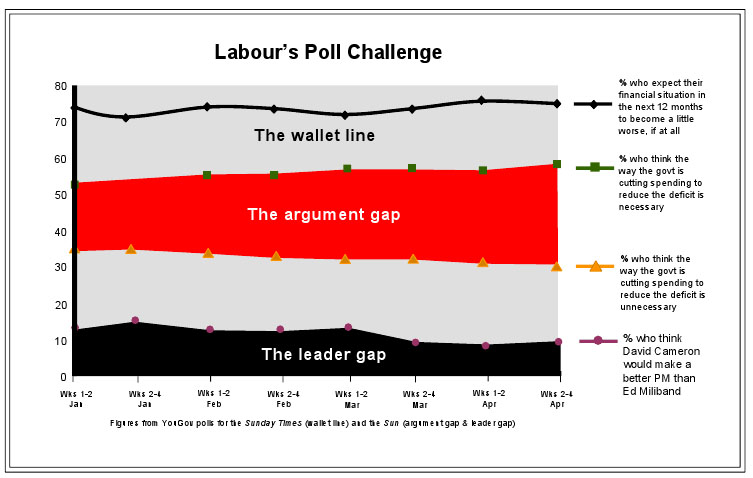
A few months ago in this column, I highlighted Labour’s poll challenge by looking at three specific questions asked intermittently by YouGov in their daily and weekly polls, and tracked their responses over the previous three months. These questions examined voters’ attitudes to the defining issues for the next general election.

The updated results to Labour’s poll challenge hold the key to interpreting last nights mixed election results.

The three YouGov questions look below topline voting intentions to reveal how voters feel the government is hitting them in the wallet, their view of how the government is cutting the deficit and who they prefer as a leader – David Cameron or Ed Miliband.

The public’s answers over this year have involved responses from tens of thousands of people and give a clear view of the scale of the problem.

(more…)

Facebook Twitter Digg Delicious StumbleUpon

Some people still believe in democracy

05/05/2011, 07:00:35 AM

by Peter Watt

When you are involved in politics in an active way it can be quite easy to forget what really matters.  The fight becomes more important than the victory. Scoring points and getting one over on your opponents become what really matters. Of course losing is tough – but it is all too often actually losing, rather than the consequences of losing, that hurts the most. It is easy to see why this happens; politics can be an emotionally bruising affair. Getting on involves hours of leafleting, meetings and door knocking. You take to the stump armed only with your credibility and after all those hours spent on a single endeavour – winning – the outcome is obviously going to be felt pretty personally. All in all, politics can be a pretty nasty addiction if you get seriously hooked.

The AV referendum campaign has been a particularly classic case of a campaign fought between addicts. It has felt exclusive, otherworldly and somehow just not important. The key campaign messages seemed to be more point scoring between people in an elite club. There was a certainly a lot of shouting and calculation of the most tribally beneficial outcome. Yah-boo politics of the worst kind. As a result, the campaign has passed most non-politicos by. In fact, it has passed many politicos by as well.

It certainly hasn’t been the celebration of democratic renewal that I suspect the Yes campaign hoped for – whatever the result.

(more…)

Facebook Twitter Digg Delicious StumbleUpon

No to PR, Yes to AV

04/05/2011, 08:07:14 PM

by Tom Watson

When Roy Jenkins recommended a change in the electoral system twelve years ago I helped lead the campaign to defeat it and preserve the first past the post system. I was dead against any form of proportional representation then and I still am now. But whilst I remain as firmly opposed to proportional representation as ever, I have become convinced that our current first past the post system is in need of reform and upgrading. That is why I am supporting the campaign to introduce the alternative vote and will be voting Yes in tomorrow’s referendum.

The main objections I have to proportional representation do not apply to the alternative vote system. One of my main concerns has always been that PR would give the BNP a greater chance of gaining representation at Westminster. But that is even less likely with AV than FPTP. That is why the BNP have come out to say they will be supporting a No vote in the referendum. AV is the anti-extremist system. With AV, no-one can get elected unless most people back them. Therefore the risk of extremist parties being elected by the back door is eliminated.

Another of my traditional objections to PR was that it will lead to unstable government. But hung parliaments are no more likely with AV than with first past the post. As the recent election showed, first past the post has not given Britain any special immunity to hung parliaments. The result at the last election was not an exception. It is the result of long-term changes in our voting patterns here in the UK which means the current voting system can no longer be relied upon to deliver a clear-cut result with a strong and stable single-party system previously the strongest argument for preserving first past the post.

The last of my major objections to PR, and to the hybrid system Roy Jenkins put forward, was that it was too complicated and alien to the way we have always voted. But AV, in contrast, couldn’t be more straightforward. It simply allows you to choose your candidates in order of your preference. It is literally as easy as 1,2,3. For voters, it simply means swapping an X on your ballot paper for a 1,2,3. And if you still want to vote for only one candidate you can.

So the alternative vote doesn’t have the disadvantages I have always associated with PR. But it does offer advantages that I believe will help change the way we do our politics for the better. (more…)

Facebook Twitter Digg Delicious StumbleUpon

Half a minute Harris

04/05/2011, 04:20:34 PM

Episode 8: Fingers crossed tomorrow’s AV result keeps it out of the next manifesto

You can catch up with previous episodes here:

Episode 1: Welcome, Uncut readers, to the mind of Tom Harris

Episode 2: Should we abstain on the welfare reform bill?

Episode 3: How’s that working out for you Polly?

Episode 4: Student visas… I’m with Theresa May on this one

Episode 5: A distraction from the main event

Episode 6: Ollie Letwin and the common people

Episode 7: Why I’m backing an in/out referendum on the EU

Facebook Twitter Digg Delicious StumbleUpon